
Live streaming today isn’t just about delivering video — it’s about delivering it securely, reliably, and with ultra-low latency for professional broadcasting environments.
That’s why broadcasters, OTT platforms, and production teams rely on SRT streaming (Secure Reliable Transport) for first-mile and contribution workflows.
With 5centsCDN, teams can deploy:
- SRT ingest with AES-128 / AES-256 encryption
- Low-latency SRT contribution over public internet
- Optional ad-marker forwarding (if required)
- Transcoding for multi-device delivery
- HLS output for global distribution
This guide explains how SRT streaming works and how 5centsCDN supports secure, broadcast-grade contribution workflows.
What is SRT (Secure Reliable Transport)?
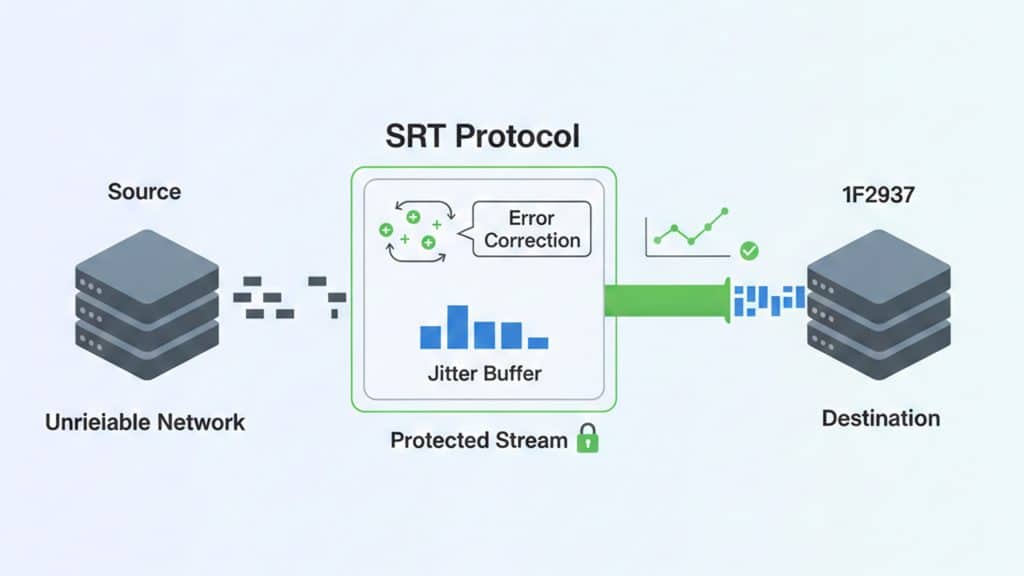
SRT (Secure Reliable Transport) is a live video transport protocol designed for low-latency, secure, and reliable video delivery over unpredictable networks.
Unlike traditional streaming protocols, SRT is built specifically for professional contribution feeds and remote production workflows.
SRT is widely used for:
- Sports broadcasting
- News contribution feeds
- Remote production
- Live events
- OTT and IPTV ingestion
SRT technology is designed to handle real-world network challenges such as:
- Packet loss
- Jitter
- Variable bandwidth
- Long-distance streaming
- Internet congestion
This makes SRT streaming ideal for transporting high-quality live video over the public internet without compromising stability.
Why Broadcasters Choose SRT Streaming
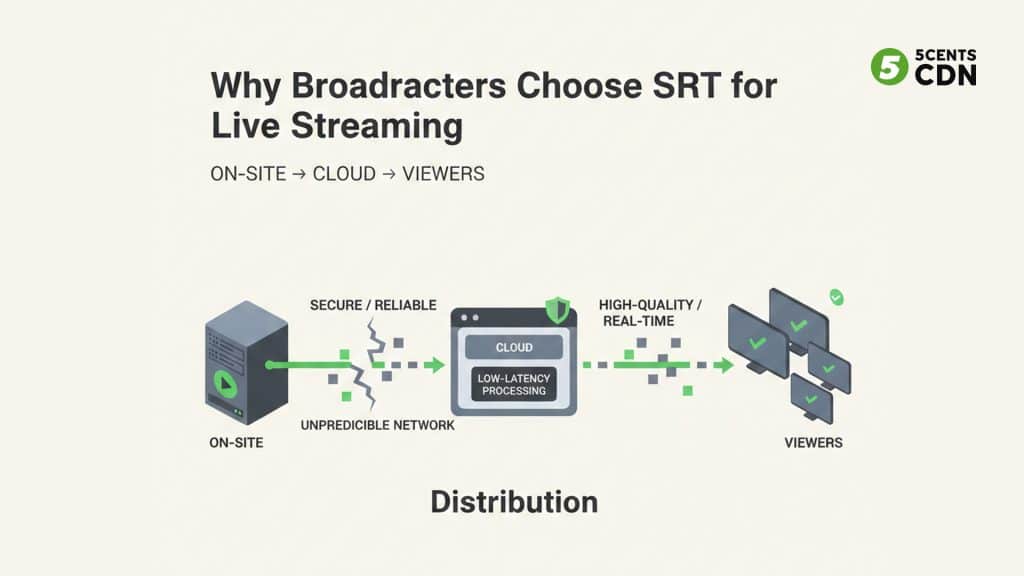
Professional streaming teams choose SRT because it offers:
- Low-latency live contribution
- Built-in encryption
- Adaptive error recovery
- Firewall-friendly deployment
- High reliability over unstable networks
For contribution workflows (venue → cloud → CDN), SRT streaming provides a secure and stable transport layer before distribution begins.
SRT with AES-128 / AES-256 Encryption
Security is critical for premium live content.
SRT supports built-in encryption using:
- AES-128
- AES-256
This ensures live video streams remain protected during transport from encoder to cloud ingest.
With encrypted SRT streaming, broadcasters can:
- Prevent unauthorized interception
- Protect licensed sports and event feeds
- Secure enterprise streaming workflows
- Maintain compliance with security requirements
5centsCDN supports SRT streaming with AES encryption for secure contribution across global networks.
SRT Contribution with Transcoding & HLS Output
After ingesting via SRT, most broadcasters require transcoding to support multiple devices and bandwidth conditions.
With 5centsCDN, SRT streams can be:
- Transcoded into adaptive bitrate (ABR) renditions
- Packaged for HLS output
- Delivered globally via CDN
This allows teams to combine:
- Secure SRT contribution
- Multi-device playback
- Scalable global delivery
SRT handles the secure ingest layer, while HLS ensures broad device compatibility.
Optional Monetization Workflows
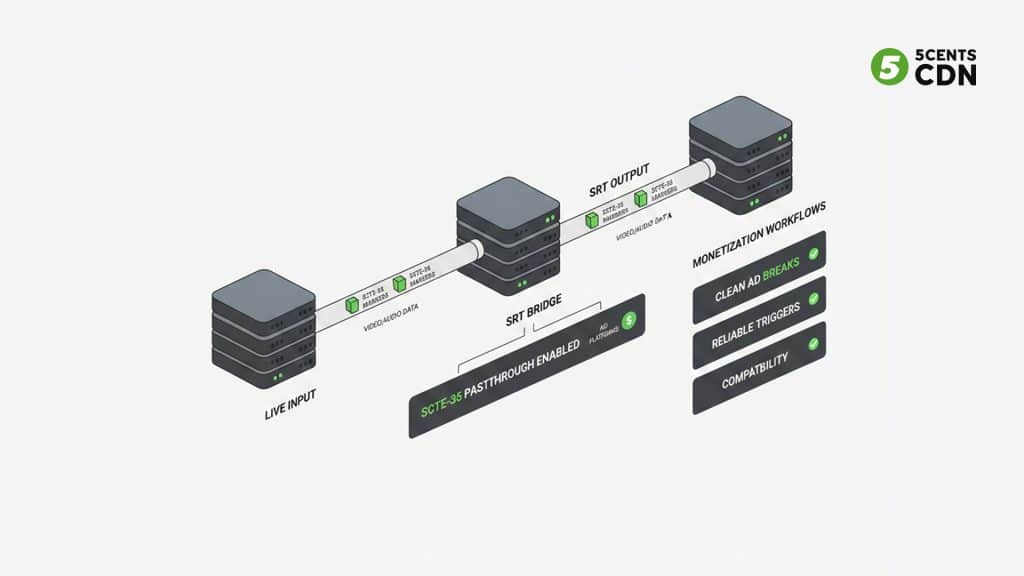
For teams that require monetization features such as ad marker forwarding or SSAI integration, SRT workflows can support marker preservation during ingest and transcoding.
(For a deeper breakdown of SCTE-35 and SSAI workflows, refer to our dedicated guide on SCTE-35 support.)
This keeps the focus on SRT while allowing monetization when needed.
Supported Output Protocol: HLS
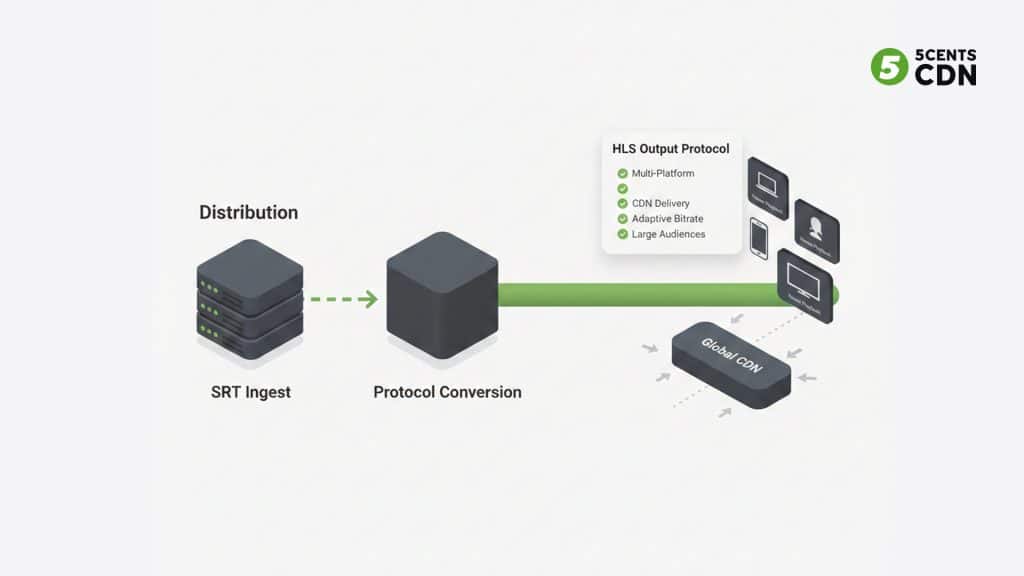
Once contribution is complete, the stream is delivered using HLS (HTTP Live Streaming).
HLS provides:
- Wide browser compatibility
- Smart TV and mobile support
- Adaptive bitrate streaming
- Reliable CDN scaling
By combining SRT ingest with HLS delivery, broadcasters get the best of both worlds — secure transport and scalable playback.
Get Started with SRT Streaming
If you’re looking for secure, reliable, and low-latency SRT streaming for professional broadcasting, our Custom Plan is built for you.
Contact 5centsCDN to enable secure SRT ingest, encrypted contribution, transcoding, and global HLS delivery.