
Satellite communication plays a critical role in global broadcasting, live event coverage, remote connectivity, and media distribution. One of the most important components of satellite communication is the satellite downlink — the process of transmitting signals from space back to Earth.
From television broadcasting to live sports contribution feeds, satellite downlink enables real-time data and video delivery across continents.
In this guide, we’ll explain what satellite downlink is, how it works, common use cases, and how it integrates with modern IP and CDN-based streaming workflows.
What Is Satellite Downlink?
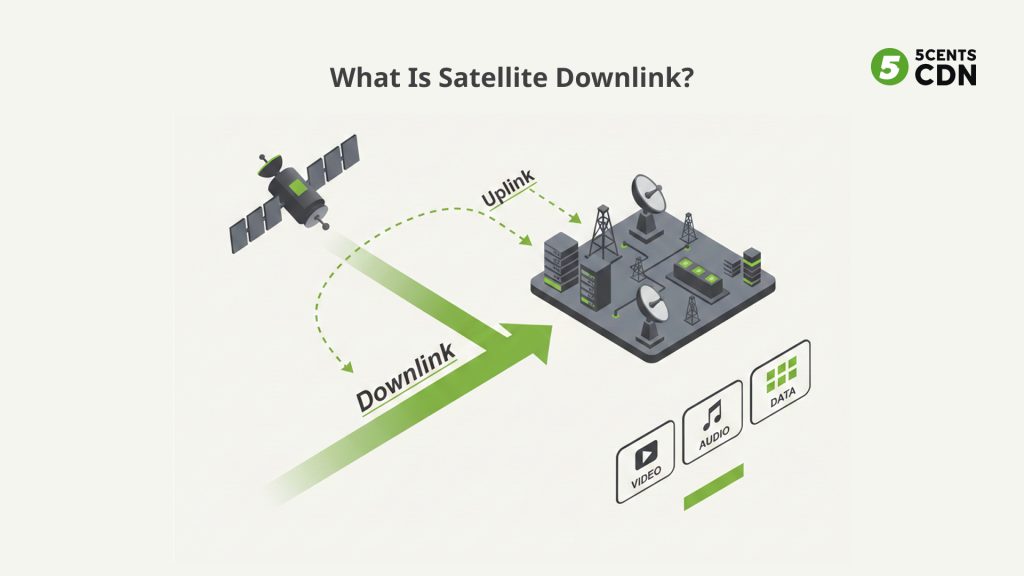
A satellite downlink refers to the transmission of signals from an orbiting satellite to ground-based receiving equipment.
In satellite communication systems, there are two directions of signal flow:
- Uplink → Ground station to satellite
- Downlink → Satellite to ground station
The downlink is responsible for delivering video, audio, and data signals back to Earth. For a deeper technical definition of the term, you can refer to the Wikipedia explanation of Satellite Downlink
How Satellite Downlink Works
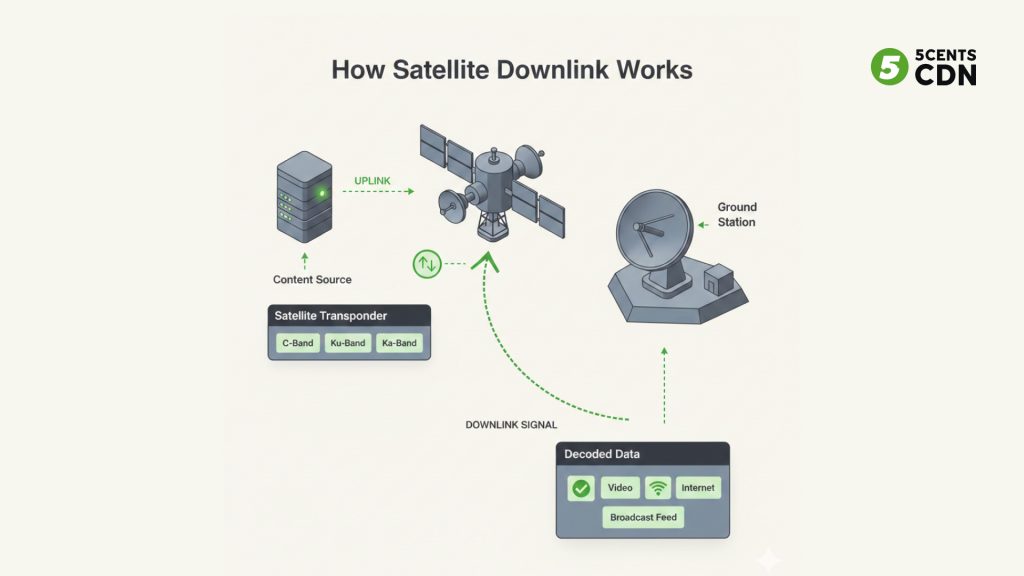
Satellite downlink works by transmitting radio frequency (RF) signals from a satellite transponder to a ground-based receiving station.
The typical process includes:
- A content source sends data via uplink to a satellite.
- The satellite receives and amplifies the signal.
- The satellite retransmits the signal back to Earth.
- A ground station or antenna dish receives the downlink signal.
- The signal is decoded and converted into usable data (video, internet, broadcast feed).
Downlink frequencies commonly operate in:
- C-band
- Ku-band
- Ka-band
Each frequency band serves different coverage and weather-resilience purposes.
Common Use Cases of Satellite Downlink
Satellite downlink remains essential in industries where global reach and reliability are critical.
1. Television Broadcasting
Traditional satellite TV relies on downlink signals delivered to households and cable headends worldwide.
2. Live Sports & Events
Major sporting events and concerts use satellite downlink to deliver live feeds to broadcasters across regions.
3. News Contribution
Breaking news from remote or disaster-prone areas often depends on satellite connectivity for immediate transmission.
4. Government & Defense Communication
Secure satellite downlink systems support critical communication networks.
5. Remote Internet Connectivity
Rural and maritime connectivity solutions depend on satellite-based downlink infrastructure.
Satellite Downlink vs IP-Based Delivery
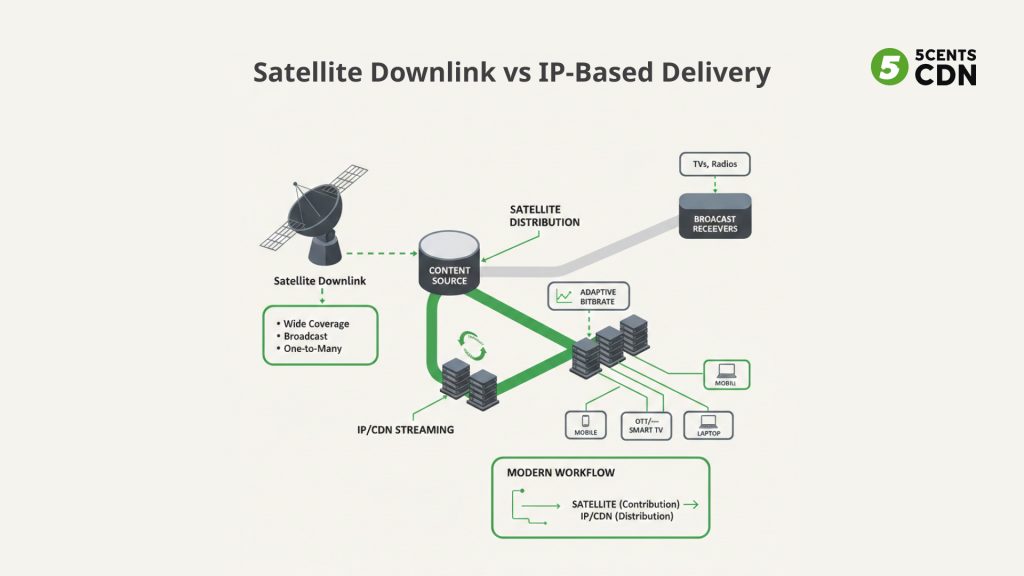
While satellite downlink remains highly reliable, modern content distribution increasingly combines satellite with IP-based streaming.
Satellite Downlink Strengths:
- Wide geographic coverage
- Reliable broadcast distribution
- Strong for one-to-many transmission
IP/CDN-Based Delivery Strengths:
- Scalable global streaming
- Adaptive bitrate support
- Lower latency over optimized routes
- Device compatibility (mobile, OTT, smart TVs)
Today, many workflows use satellite for contribution and IP/CDN for final distribution.
How Satellite Downlink Integrates with Modern Streaming
In modern broadcast infrastructure, satellite downlink often acts as the first stage of content acquisition.
After the downlink signal is received:
- Content is decoded and digitized
- Transcoded into adaptive bitrate formats
- Packaged into streaming formats like HLS
- Delivered globally via CDN
This hybrid approach enables:
- Traditional broadcast reliability
- Modern OTT scalability
- Monetization through ad insertion
- Multi-device compatibility
Challenges in Satellite Downlink
Despite its reliability, satellite downlink comes with certain limitations:
- Higher latency compared to fiber/IP
- Weather-related interference (especially in Ku/Ka bands)
- Infrastructure and equipment costs
- Limited interactivity compared to IP streaming
This is why many organizations now combine satellite downlink with cloud-based streaming workflows.
The Future of Satellite Downlink in Streaming
Satellite downlink is not disappearing — it’s evolving.
Modern broadcasters are integrating:
- Cloud playout systems
- IP-based transport protocols
- CDN acceleration
- Real-time analytics and monitoring
By combining satellite acquisition with IP distribution, organizations can maximize reliability and scalability.
How 5centsCDN Supports Hybrid Satellite-to-IP Workflows
For broadcasters and media companies receiving content via satellite downlink, the next step is often digital distribution.
5centsCDN supports workflows that bridge traditional satellite acquisition with modern streaming infrastructure by enabling:
- CDN-based global delivery
- HLS packaging
- Adaptive bitrate streaming
- Monetization-ready pipelines
- Performance optimization and monitoring
This allows content acquired via satellite to be efficiently distributed to OTT platforms, websites, and connected TV ecosystems.
Final Thoughts
Satellite downlink remains a foundational component of global communication infrastructure.
While IP streaming and CDN-based delivery continue to grow, hybrid satellite-to-cloud workflows are shaping the future of broadcasting and digital media distribution.
If you’re modernizing your broadcast infrastructure and need to bridge satellite acquisition with scalable digital delivery, our team can help design the right workflow for your needs.