
Website performance is no longer just a technical metric — it directly impacts SEO rankings, user experience, conversions, and revenue.
But how do you truly understand how visitors experience your website in the real world?
That’s where Real User Monitoring (RUM) becomes essential.
Unlike synthetic testing tools that simulate traffic in controlled environments, RUM captures performance data from actual users across real devices, networks, and locations. This makes it one of the most accurate ways to measure true digital experience.
In this complete guide, we’ll explain what Real User Monitoring is, why it matters, how it works, and how it supports SEO and performance optimization.
What Is Real User Monitoring (RUM)?
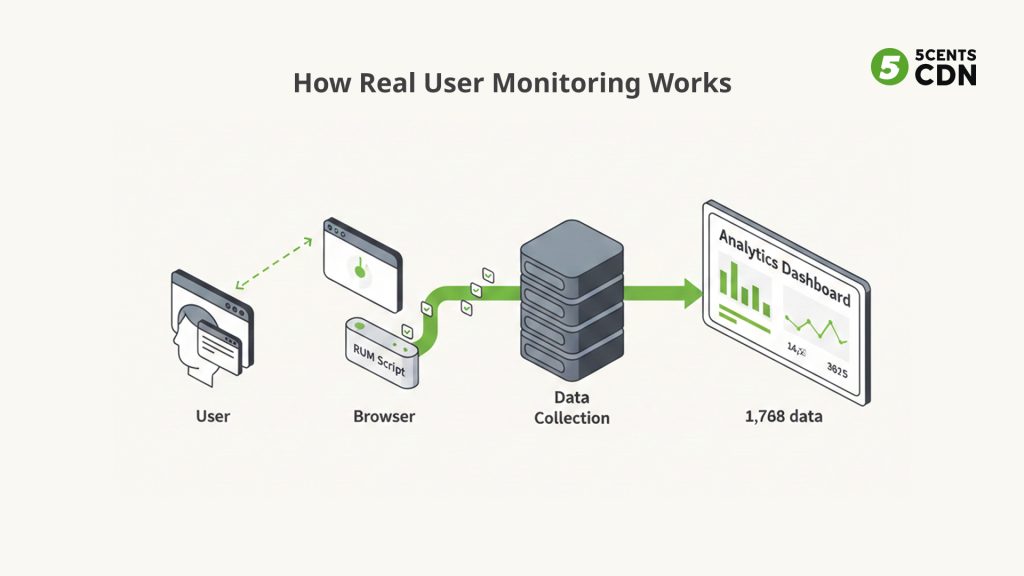
Real User Monitoring (RUM) is a performance monitoring method that collects data directly from real visitors as they interact with your website or web application.
A lightweight JavaScript snippet is embedded into your website, which records key performance metrics during real user sessions.
RUM tracks how your website behaves across:
– Different devices (mobile, desktop, tablet)
– Multiple browsers
– Various geographic regions
– Real network conditions
– Different connection speeds
Because the data comes from actual users, it reflects real-world performance — not lab simulations.
Why Real User Monitoring Matters in 2026
Digital competition is increasing, and users expect instant loading, smooth navigation, and zero friction.
Even small delays can result in:
– Higher bounce rates
– Lower conversions
– Reduced engagement
– Negative brand perception
RUM helps identify performance bottlenecks that directly impact business outcomes.
1. RUM Supports SEO and Core Web Vitals
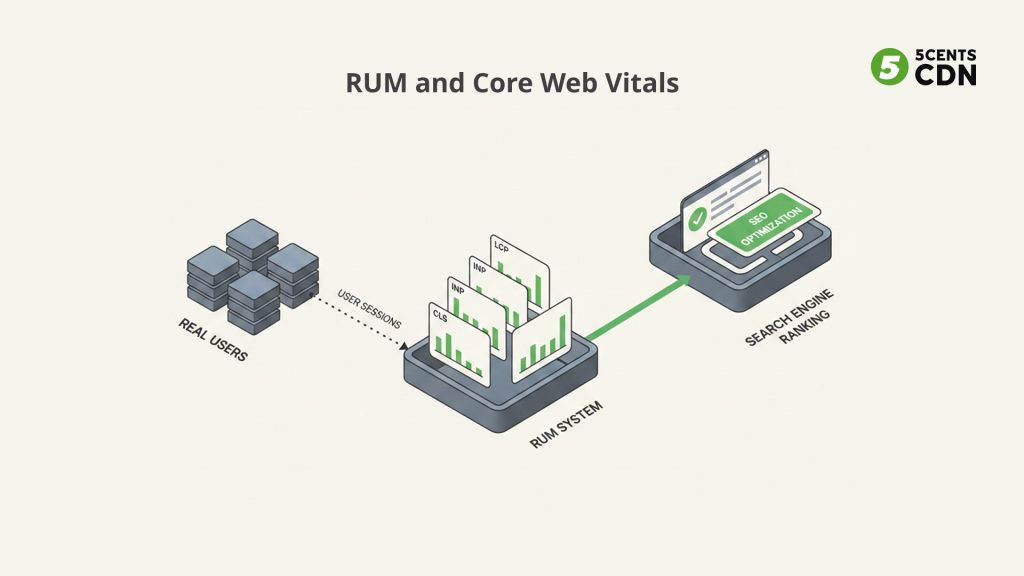
Search engines like Google use real user field data when evaluating **Core Web Vitals**, including:
– Largest Contentful Paint (LCP)
– Interaction to Next Paint (INP)
– Cumulative Layout Shift (CLS)
Since RUM measures real user sessions, it provides visibility into the same metrics search engines use for ranking.
This makes RUM a critical tool for SEO optimization and improving organic search performance.
2. RUM Reveals Geographic Performance Issues
Performance often varies by region.
Users in one country may experience fast loading, while users elsewhere may see delays due to:
– CDN configuration
– Network routing
– Asset delivery inefficiencies
– Server latency
RUM exposes these differences so teams can optimize delivery based on real-world behavior.
3. RUM Improves Conversion Rates
Slow checkout pages, delayed form submissions, and laggy product images can silently reduce conversions.
By analyzing real user sessions, teams can:
– Identify slow pages
– Track user frustration signals
– Reduce drop-offs
– Improve customer journey performance
RUM vs Synthetic Monitoring: What’s the Difference?
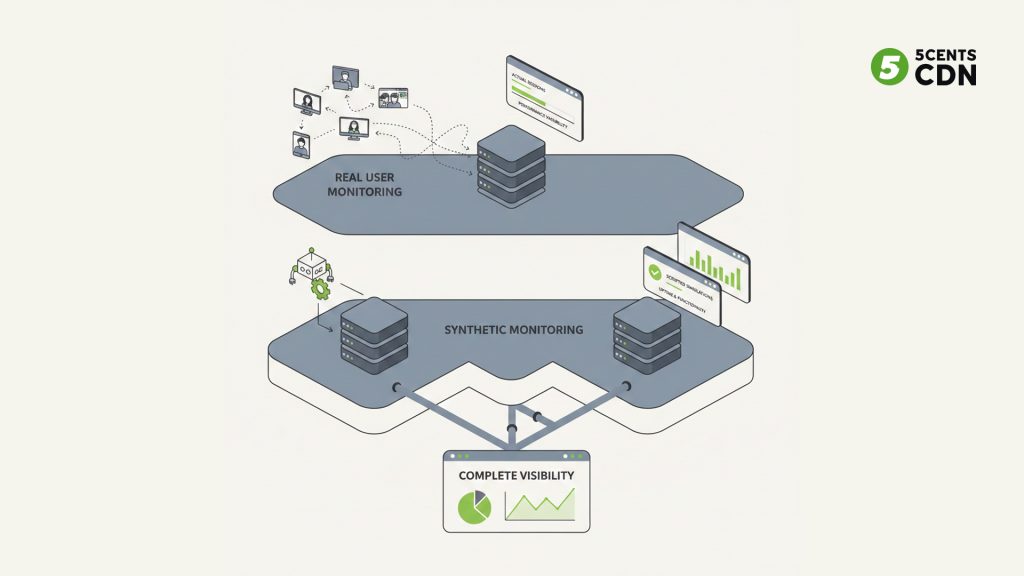
Both monitoring methods serve important roles — but they work differently. For a deeper technical breakdown of how real user monitoring compares to synthetic testing, Mozilla’s guide on RUM vs Synthetic Monitoring explains the differences in detail.
Real User Monitoring (RUM)
– Measures actual visitor sessions
– Captures real-world device and network diversity
– Reflects authentic user experience
– Best for long-term optimization insights
Synthetic Monitoring
– Uses scripted test scenarios
– Runs from controlled environments
– Detects uptime and functionality issues
– Useful for pre-deployment testing
In most performance strategies, RUM and synthetic monitoring complement each other rather than compete.
Key Metrics Captured by Real User Monitoring
A strong RUM setup tracks performance metrics that directly influence UX and business impact.
Common metrics include:
– Page load time
– Time to First Byte (TTFB)
– Core Web Vitals
– JavaScript execution errors
– API response times
– Device-level performance
– Regional performance differences
– Session duration and engagement data
These metrics provide a comprehensive view of how your digital platform performs in real conditions.
How Real User Monitoring Works
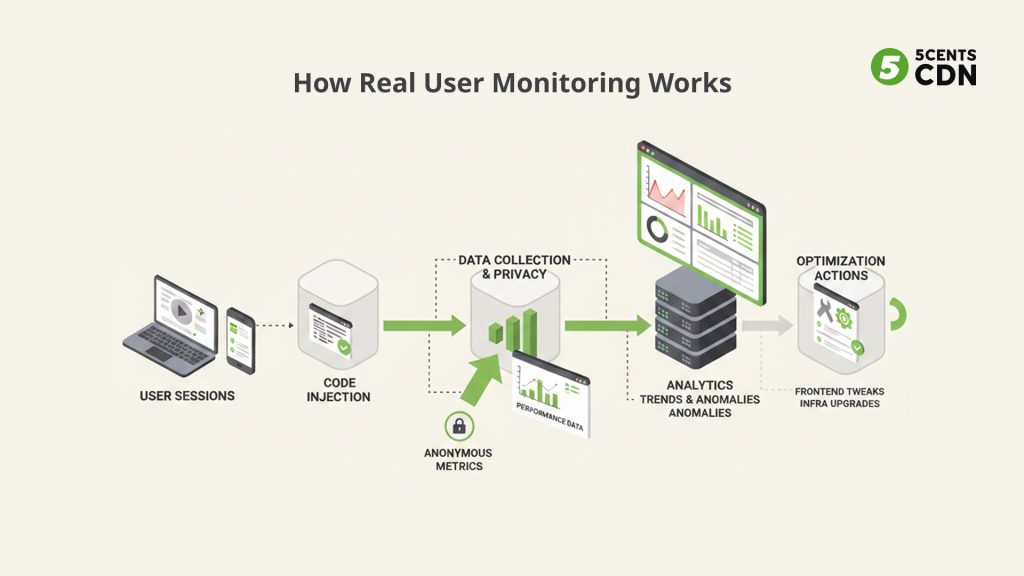
RUM works through a simple process:
1. A lightweight monitoring script is added to your website.
2. The script collects performance data during user sessions.
3. Data is sent to a centralized analytics dashboard.
4. Performance patterns and anomalies are analyzed.
5. Optimization actions are implemented based on real data.
Modern RUM systems ensure data privacy by collecting only performance-related metrics, not personal user information.
Why CDN-Integrated RUM Is Powerful
When Real User Monitoring is combined with CDN-level delivery insights, optimization becomes more effective.
Instead of just observing slow performance, teams can immediately adjust:
– Caching rules
– Content delivery paths
– Asset compression
– Image optimization
– Regional routing strategies
This creates a feedback loop where real user data directly improves content delivery performance.
Platforms that integrate RUM with CDN infrastructure allow performance monitoring and delivery optimization to work together seamlessly.
Business Benefits of Real User Monitoring
Implementing RUM is not just a technical upgrade — it’s a strategic advantage.
Better Decision-Making
Teams prioritize real issues instead of hypothetical lab results.
Faster Issue Detection
Performance anomalies can be identified before they impact large user segments.
Increased Revenue
Optimized performance improves user retention and conversion rates.
Competitive Edge
Organizations that understand real user experience outperform those relying solely on simulated tests.
When Should You Use Real User Monitoring?
RUM is especially important if:
– Your website receives high traffic
– You operate an e-commerce platform
– You manage media or streaming platforms
– SEO performance is critical
– You serve users globally
– Performance varies by region
If user experience directly affects revenue or growth, RUM should be part of your monitoring stack.
How 5centsCDN Integrates Real User Monitoring
While Real User Monitoring is valuable on its own, integrating it directly with CDN performance tools unlocks even greater optimization potential.
5centsCDN provides a Real User Monitoring module that connects real user performance insights with content delivery optimization tools.
This allows teams to:
– Monitor real user experience across regions
– Identify performance bottlenecks
– Optimize CDN delivery strategies
– Improve Core Web Vitals
– Detect anomalies and traffic irregularities
By combining monitoring and delivery infrastructure, performance improvements can be implemented quickly and efficiently.
Get Started with Real Performance Insights
Understanding how real users experience your website is essential in today’s competitive digital landscape.
If you’re looking to combine Real User Monitoring with advanced CDN performance optimization, 5centsCDN provides integrated tools designed to improve speed, stability, and user experience at scale.
Contact our team to learn how you can implement Real User Monitoring as part of your performance strategy.