
Cache Hit Ratio (CHR) is one of the most critical metrics for measuring CDN performance. It tells you exactly how often requested content is served directly from a CDN edge server — rather than being retrieved from your origin.
A good cache hit ratio typically falls between 95–99%, meaning fewer than 5% of requests ever need to reach your origin server. For platforms distributing large volumes of content — streaming services, software distribution platforms, e-commerce sites, or high-traffic web applications — even a 1–2% improvement in cache hit ratio can have a measurable impact on delivery speed, infrastructure costs, and scalability.
In this guide, we cover what cache hit ratio is, what causes it to drop, and 6 proven strategies to improve it.
What Is Cache Hit Ratio?
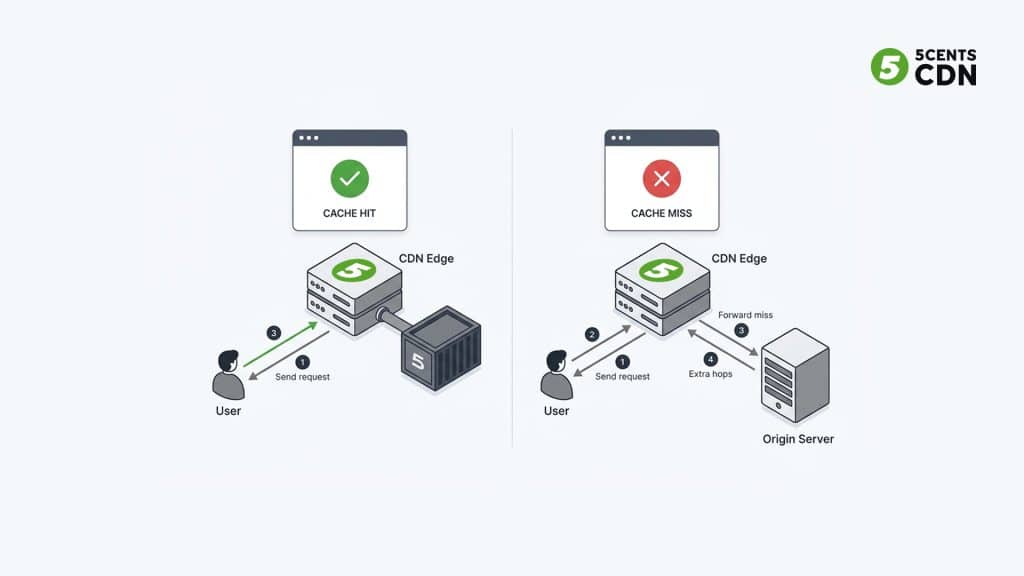
Cache Hit Ratio represents the percentage of requests served from a CDN cache versus the total number of requests received.
| Cache Hit Ratio = (Cache Hits ÷ Total Requests) × 100 |
A cache hit occurs when a requested file is already stored at a CDN edge node and delivered immediately. A cache miss occurs when the file is not in cache and must be fetched from the origin server.
Example: If 95 out of 100 requests are served from cache, your Cache Hit Ratio is 95%.
Cache hit ratio is an important benchmark for CDNs. Most CDN dashboards expose this metric natively — if yours does not, it is worth investigating before moving forward with optimization.
Why Cache Hit Ratio Matters for CDN Performance
Improving your CHR has direct, measurable effects on performance and infrastructure costs:
Faster Content Delivery
When requests are fulfilled at the edge, users receive content faster regardless of where they are located relative to your origin server.
Reduced Origin Load
Fewer cache misses means fewer round trips to your backend infrastructure, lowering the risk of origin bottlenecks during traffic spikes.
Lower Bandwidth Costs
Serving content from CDN cache reduces data egress from your origin. For large-scale platforms, the savings compound quickly — every percentage point gained in CHR translates directly to reduced origin transfer costs.
Better Scalability
High cache efficiency allows platforms to absorb large traffic spikes without overloading backend systems. This is especially important for live events, product launches, and viral content spikes. If you are evaluating your current infrastructure, our CDN cost calculator can help you estimate potential savings.
What Causes a Low Cache Hit Ratio?
Before optimizing, it helps to understand what is pulling your ratio down. Common causes include:
- Short TTL values: If cache TTL is configured too short, edge nodes frequently pull fresh content from origin instead of serving from cache.
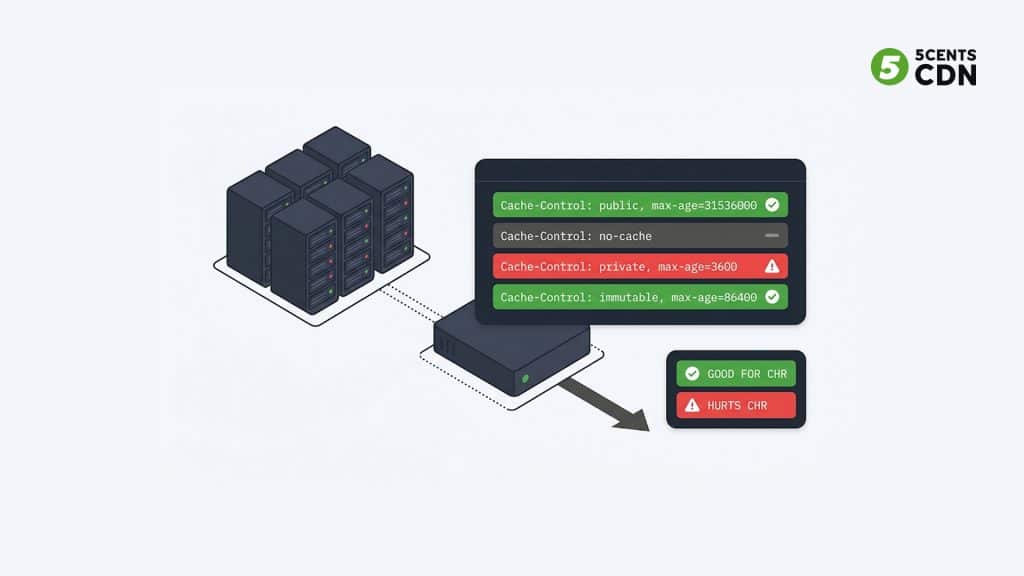
- Improper Cache-Control headers: Headers set to no-cache, no-store, max-age=0, or private prevent the CDN from caching resources at all.
- Unmanaged query strings: Each unique query string creates a separate cache entry — causing fragmentation for identical content.
- Dynamic or personalized content: Content that changes per-user or per-session is inherently harder to cache and lowers overall ratio.
- Frequent cache purging: Aggressive invalidation prevents content from accumulating meaningful cache residency time.
6 Strategies to Improve Cache Hit Ratio
Strategy 1: Configure Proper Cache-Control Headers
HTTP cache headers are the foundation of any caching strategy. They instruct CDN edge nodes how long to retain content before fetching a fresh copy from origin.
For static assets — images, JavaScript, CSS files, fonts, and video segments — set long TTL values. Assigning TTLs of up to 365 days for fingerprinted or versioned static files maximizes cache residency. For more frequently updated assets, use shorter but non-zero TTLs to balance freshness with efficiency. For a full reference on directives, see the HTTP caching headers guide on MDN.
Strategy 2: Use Tiered Caching (Origin Shield)
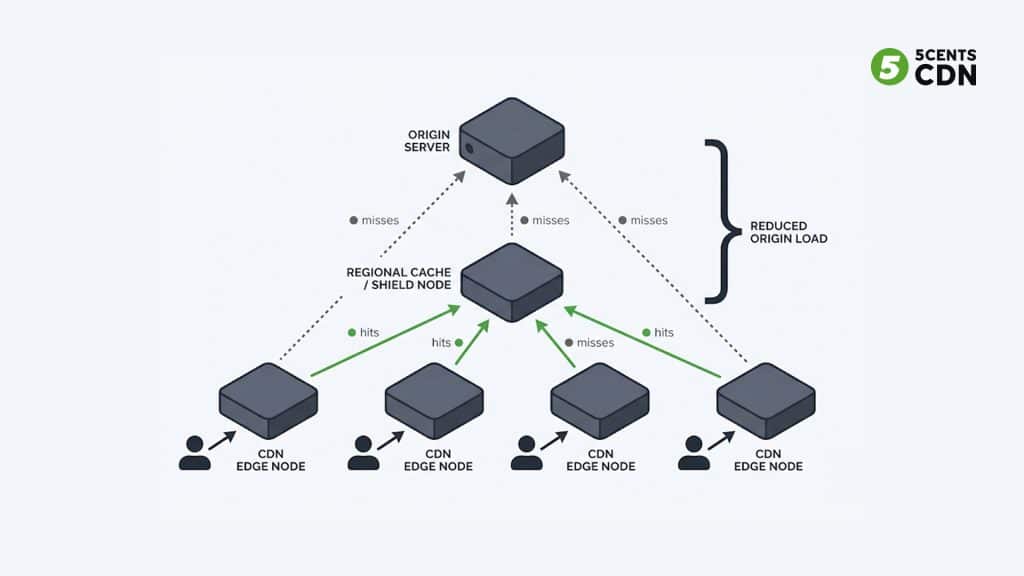
Tiered caching introduces an intermediate cache layer — a regional shield node — between your CDN edge servers and your origin server. When an edge node experiences a cache miss, it queries the regional cache instead of going directly to origin.
This significantly reduces the number of origin requests, especially on platforms with many PoPs across regions. 5centsCDN’s origin shield implements this tiered approach, and you can pair it with our broader delivery acceleration features for maximum cache efficiency.
Strategy 3: Normalize URLs and Query Parameters
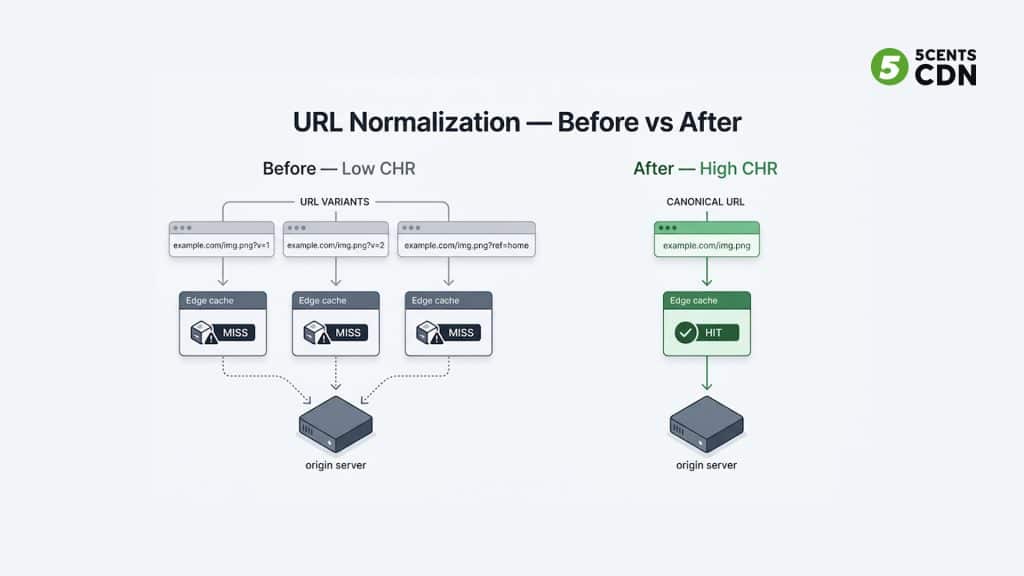
Multiple URL variations pointing to the same resource are a silent CHR killer. Without normalization, URLs like example.com/image.png?ref=homepage and example.com/image.png?ref=sidebar are treated as two separate cache entries.
Strip or whitelist query parameters — cache only on parameters that affect content, not tracking parameters like utm_source. Use edge rules to enforce URL normalization at the CDN layer and automate redirects to canonical paths.
Strategy 4: Separate Static and Dynamic Content
Not all content should follow the same caching rules. Mixing dynamic and static content under a single policy leads to under-caching of static assets and over-caching of dynamic ones.
CDNs primarily accelerate static content: CSS, JavaScript, images, fonts, and video files. Dynamic content — API responses, personalized pages, and server-side rendered output — is typically pulled from the origin.
Structure your delivery to clearly separate the two. Apply aggressive long-TTL caching to static assets using tools like the asset optimizer and image optimizer. For dynamic content, explore edge-side rendering or fragment caching where appropriate.
Strategy 5: Optimize Video Streaming Segment Caching
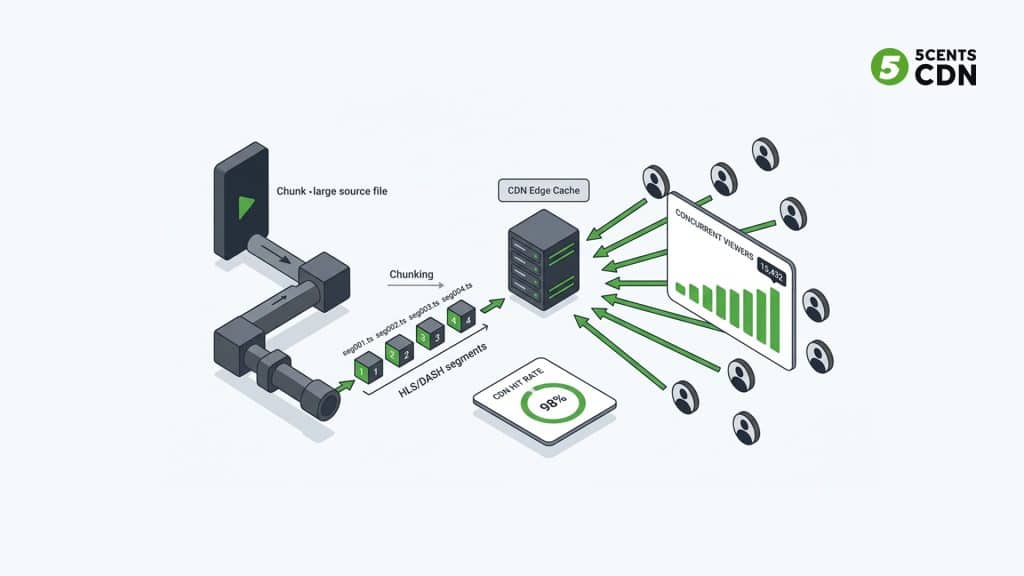
For video platforms, segment caching deserves dedicated attention. Each video is broken into small chunks — typically 2–10 seconds in HLS or DASH format — which are requested repeatedly by thousands of concurrent viewers.
Using consistent hashing to map specific segments to fixed regional cache nodes ensures those segments stay cached even under high load. This is particularly important for live event streaming where thousands of users request the same segments simultaneously. A strong CHR here directly reduces buffering, accelerates playback startup, and lowers origin bandwidth usage. Explore 5centsCDN’s video streaming platform and live streaming infrastructure for purpose-built caching configurations.
Strategy 6: Monitor Cache Performance Continuously
Caching is not a configure-and-forget operation. Content patterns evolve, traffic spikes change, and TTL values that worked six months ago may be suboptimal today.
Key metrics to track regularly:
- Cache hit percentage — overall and broken down by content type
- Cache miss frequency — and which URLs are missing most often
- Origin request volume over time — look for unexpected spikes
- Edge bandwidth vs. origin bandwidth ratio
A cache hit ratio consistently below 80% is a sign that something is misconfigured. Use CDN analytics tools and the video analytics SDK to identify which content types and URLs are responsible for the most misses, then adjust TTL and cache-key policies accordingly.
What Is a Good Cache Hit Ratio?
A typical website composed mostly of static content can achieve a cache hit ratio in the 95–99% range. For video streaming platforms and software distribution networks, ratios at or above 95% are considered standard.
If you are well below this range, the strategies above — particularly fixing Cache-Control headers, normalizing URLs, and enabling tiered caching — will have the most immediate impact.
Summary: 6 Strategies at a Glance
| # | Strategy | Primary Benefit | Difficulty |
| 1 | Cache-Control headers with long TTLs | Extends cache residency for static assets | Low — header config change |
| 2 | Tiered caching / origin shield | Reduces origin requests from edge misses | Low-Medium — CDN feature enable |
| 3 | URL & query string normalization | Eliminates duplicate cache entries | Medium — requires edge rule setup |
| 4 | Static / dynamic content separation | Maximizes cacheable surface area | Medium — architecture change |
| 5 | Video segment caching strategy | Reduces origin load for streaming | Medium — per-format tuning |
| 6 | Continuous monitoring | Catches regressions, guides tuning | Low — analytics setup |
Frequently Asked Questions
What is a cache hit ratio in a CDN?
Cache hit ratio is the percentage of content requests fulfilled directly from a CDN edge cache, without contacting the origin server. A higher ratio means better CDN performance and lower origin costs.
What is a good cache hit ratio?
For static-heavy websites, a good cache hit ratio is 95–99%. For video streaming platforms, anything above 95% is standard. Ratios below 80% typically indicate a misconfiguration in Cache-Control headers or TTL settings.
How do I calculate cache hit ratio?
Use this formula: Cache Hit Ratio = (Cache Hits ÷ Total Requests) × 100. For example, if you had 950 cache hits and 50 cache misses, your ratio is 950 ÷ 1000 × 100 = 95%.
Why is my CDN cache hit ratio low?
The most common causes are: short TTL values, Cache-Control headers set to no-cache or no-store, excessive query string variants creating duplicate cache entries, and not separating static from dynamic content.
Does tiered caching improve cache hit ratio?
Yes. Tiered caching adds a regional shield layer between CDN edges and your origin. When an edge node misses, it checks the regional cache first. This dramatically reduces origin requests and improves overall hit ratio. Learn how 5centsCDN’s origin shield implements this.
Start Improving Your Cache Hit Ratio Today
Improving cache hit ratio is one of the highest-leverage CDN optimizations available. The strategies covered in this guide — proper Cache-Control configuration, tiered caching, URL normalization, content separation, video segment optimization, and continuous monitoring — work together to reduce origin dependency and improve delivery speed at scale.
If you are evaluating your current CDN setup or looking to switch to a provider built for high-traffic delivery, compare CDN providers to see how 5centsCDN stacks up, review our CDN pricing plans, or use the CDN bandwidth calculator to estimate your delivery requirements.
| Ready to Maximize Your Cache Hit Ratio? 5centsCDN offers built-in origin shield, edge rules, asset optimization, and real-time analytics — everything you need to push your CHR to 95%+. → View CDN Plans & Pricing |