

Every OTT platform eventually faces the same infrastructure question: what happens when your concurrent viewer count explodes? A season finale, a live sports event, a viral moment — any of these can send traffic from baseline to hundreds of thousands of simultaneous streams in minutes. Without the right CDN for OTT platforms, that traffic spike hits your origin server directly. The result: buffering, degraded quality, playback failures, and subscriber churn. With a properly configured CDN, the same spike is absorbed at the edge — transparent to the viewer. This guide explains how CDN infrastructure works for OTT platforms, what architecture decisions affect scale, and what metrics you should be tracking to know your CDN is actually working.
What Is an OTT CDN and Why Does It Matter?
Over-the-top (OTT) refers to video content delivered directly over the internet — bypassing traditional broadcast and cable infrastructure. See: Over-the-top media service — Wikipedia. OTT platforms include subscription streaming services, live sports broadcasters, religious broadcasters, corporate video platforms, and educational streaming services.
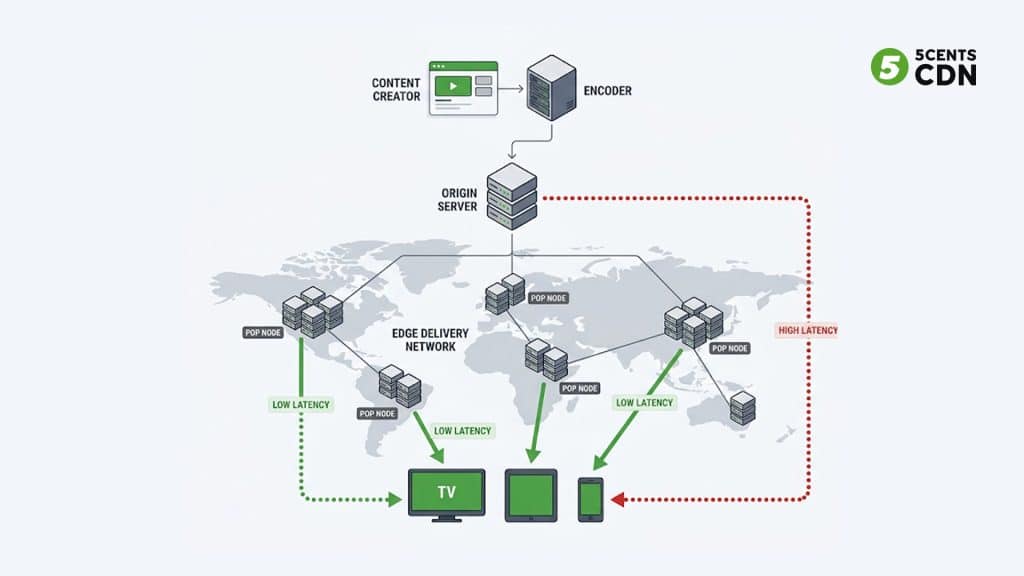
A content delivery network for OTT works by distributing your video content across a global network of edge servers. When a viewer presses play, they receive their stream from the nearest edge node — not from your origin server thousands of miles away. This reduces latency, increases reliability, and critically, distributes load across the network instead of concentrating it at a single point.
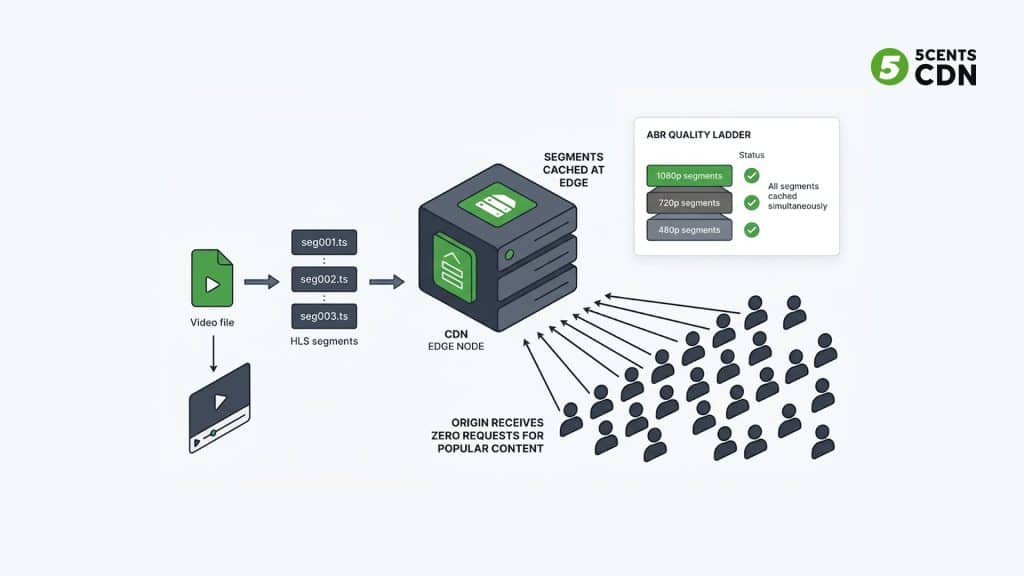
Without a CDN, serving 100,000 concurrent viewers means 100,000 requests hitting your origin simultaneously. With an edge CDN, your origin might handle fewer than 1,000 of those — the rest are served directly from cached content at edge nodes close to the viewers. That’s the core value of CDN for OTT platforms. Start with our live streaming infrastructure and video streaming platform to see how 5centsCDN supports this at scale.
How Many Concurrent Viewers Can a CDN Handle?
There is no hard ceiling — CDN capacity scales with the number of edge PoPs and available throughput. The practical question is: how much bandwidth does your viewer count actually require?
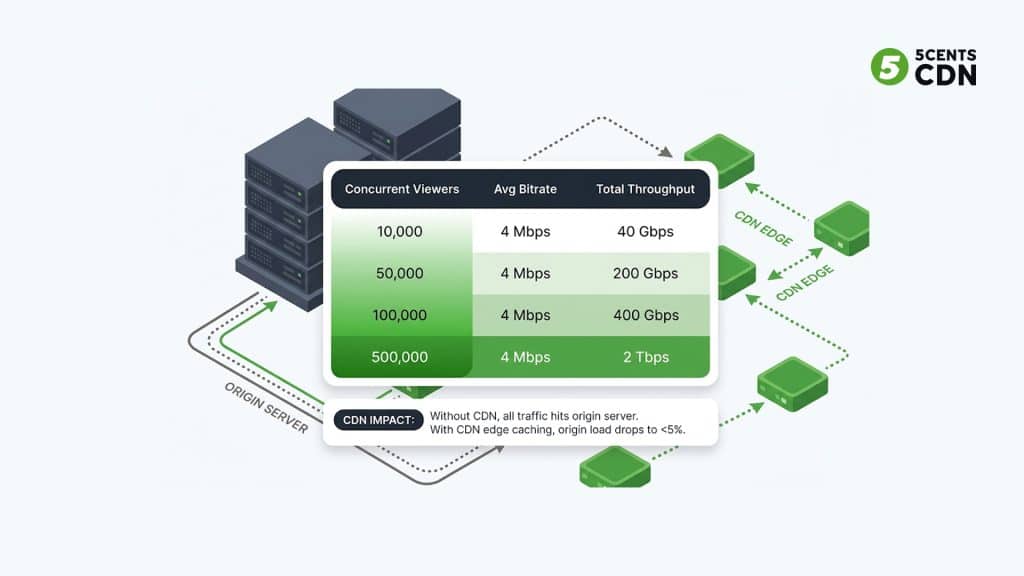
The math is straightforward: multiply your concurrent viewer count by the average per-viewer bitrate. A platform serving 100,000 concurrent viewers at an average of 4 Mbps per stream requires 400 Gbps of total throughput. At 500,000 viewers, that becomes 2 Tbps.
What this means practically:
- A mid-size OTT platform at 50,000 concurrent viewers at 1080p needs ~200 Gbps of edge throughput — far beyond what any single origin server can serve
- Without CDN edge caching, origin infrastructure costs scale linearly with viewers — unsustainable above ~10,000 concurrent
- With CDN tiered caching, origin load drops to under 5% of total requests for well-cached VOD content
- For live streaming, cache hit ratios of 85–95%+ are achievable when segments are properly configured for edge storage
Use our CDN bandwidth calculator to model your specific viewer count and bitrate combination, or the live transcoding calculator to estimate costs for multi-rendition ABR output.
Origin Shield and Tiered Caching for OTT
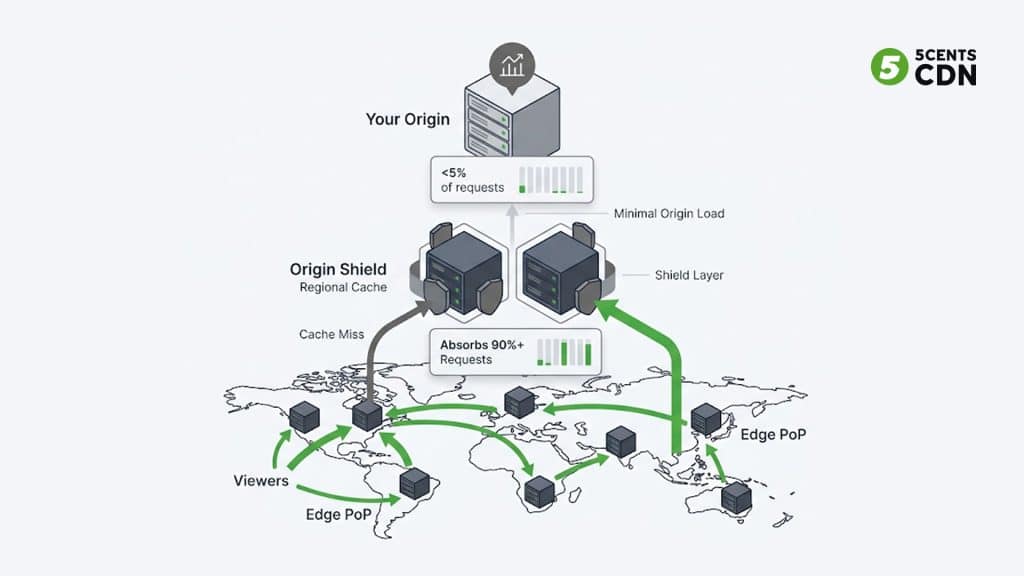
As viewer counts grow, a flat CDN architecture — where every edge node pulls from the origin on a cache miss — creates an origin fan-out problem. Hundreds of edge nodes all requesting the same segment simultaneously can overwhelm even a well-provisioned origin server.
The solution is tiered caching with an origin shield: a regional intermediate cache layer that sits between edge nodes and the origin. When an edge node misses, it requests from the shield. Only the shield talks to the origin — and it only does so once per segment, regardless of how many edge nodes need it.
For live streaming events especially, this architecture is essential. A viral live stream can trigger thousands of simultaneous cache miss requests from edge nodes across a region. Without a shield layer, each of those hits your origin. With a shield, the origin receives one request per region per segment — a reduction of several orders of magnitude.
ABR and HLS/DASH Segment Caching at the CDN Edge
Modern OTT delivery relies on adaptive bitrate streaming: encoding the same video into multiple quality renditions (e.g. 480p, 720p, 1080p) and letting the player switch automatically based on available bandwidth.
Both HLS and DASH deliver video as sequences of short segments — typically 2–6 seconds each. Once a segment is cached at the CDN edge, every viewer in that region requesting that quality tier receives it directly from cache. For popular live streams or high-demand VOD content, this means your origin is only contacted during the first request for each new segment — all subsequent requests are served from edge cache.
For this to work correctly, your CDN must be configured to cache segments efficiently:
- Set appropriate TTL for live segments (short — 30–60 seconds) vs VOD segments (long — hours to days)
- Ensure Cache-Control headers from your packager are not set to no-cache or no-store
- Use consistent segment URLs — query string variance breaks caching and forces unnecessary origin requests
- Cache all ABR renditions, not just the most popular quality tier
5centsCDN’s live transcoding produces multi-rendition HLS/DASH output optimized for edge caching, and our HLS/DASH video player handles ABR switching automatically on the client side.
Content Security: DRM, Token Auth, and Geo-Blocking
For paid OTT platforms, content protection is as important as delivery performance. Digital rights management (DRM) prevents unauthorized copying and redistribution of premium content — but DRM alone is not sufficient. CDN-level security layers add a second line of defence.
Key CDN security mechanisms for OTT platforms:
- Token authentication: Signed URLs or signed cookies ensure only authenticated subscribers can access stream URLs. Tokens expire after a short window, preventing URL sharing.
- Geo-blocking: Restrict stream access to specific countries or regions based on content licensing agreements — enforced at the CDN edge rather than at the origin.
- Hotlink protection: Prevent unauthorized embedding of your streams on third-party sites.
- DDoS protection: CDN edge nodes absorb volumetric attacks before they reach your origin infrastructure.
Configure these using 5centsCDN’s edge rules and delivery acceleration features.
QoE Metrics OTT Operators Should Monitor
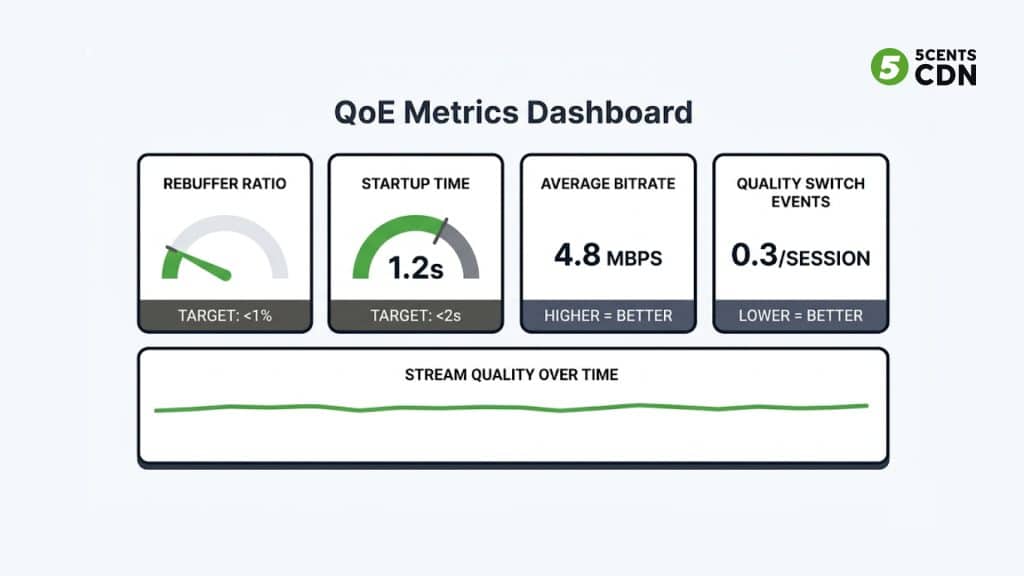
Configuring your CDN correctly is only half the work. The other half is knowing whether it is actually performing as expected. Quality of Experience (QoE) metrics tell you what viewers are actually experiencing — not just whether your servers are running.
The four most important QoE metrics for OTT platforms:
| Metric | What It Measures | Good Target | Warning Threshold |
| Rebuffer Ratio | % of playback time spent buffering | < 0.5% | > 1% — investigate CDN config |
| Startup Time | Seconds from play press to first frame | < 2 seconds | > 3s — check edge PoP proximity |
| Average Bitrate Served | Mean quality tier delivered to viewers | As high as possible | Dropping trend = bandwidth issues |
| Quality Switch Events | ABR tier changes per session | < 0.5 per session | > 2/session = unstable connection or CDN |
Use the video analytics SDK to track these metrics in real time across your viewer base.
Multi-CDN Strategy for Large-Scale Live Events
For platforms that regularly host high-concurrency events — major sports, global premieres, esports finals — a single CDN is a single point of failure. Multi-CDN architecture routes traffic across two or more CDN providers simultaneously, with automatic failover if one experiences degradation.
Benefits of multi-CDN for OTT:
- Redundancy — a regional CDN outage does not affect viewers in other regions or on alternate CDNs
- Load distribution — peak event traffic is spread across multiple networks, preventing saturation of any single provider
- Performance optimization — route each viewer to whichever CDN performs best in their region at that moment
- Cost control — use a primary CDN for most traffic and a secondary for overflow or specific regions
For platforms evaluating CDN architecture options, our compare CDN providers page and CDN pricing plans outline the configurations available for different scale requirements.
When You Might Not Need a CDN Yet
CDN infrastructure is essential at scale — but not every OTT platform needs it from day one. You can likely operate without a CDN if:
- Your platform serves fewer than 500–1,000 concurrent viewers and your audience is in a single geographic region
- All your content is highly dynamic or personalized per-user with no cacheable segments
- You are in early beta and validating content before investing in distribution infrastructure
Once you cross ~1,000 concurrent viewers, start distributing to multiple countries, or plan any live events, CDN infrastructure becomes necessary rather than optional. The cost of a CDN outage or buffering event at that scale — in subscriber churn and brand damage — almost always exceeds the CDN cost.
Summary: CDN Architecture Decisions for OTT Platforms
| Challenge | CDN Solution | Key Feature |
| 100K+ concurrent viewers | Edge caching — serve from PoPs, not origin | High cache hit ratio (85–95%+) |
| Origin overload at peak | Origin shield / tiered caching | Single origin request per segment per region |
| Variable viewer bandwidth | Adaptive bitrate streaming (ABR) | Multi-rendition HLS/DASH at edge |
| Content piracy / unauthorized access | Token auth + DRM + geo-blocking | Signed URLs, edge rules enforcement |
| Measuring CDN effectiveness | QoE monitoring | Rebuffer ratio, startup time, avg bitrate |
| Single CDN failure risk | Multi-CDN with automatic failover | Traffic distribution + redundancy |
Frequently Asked Questions
How does a CDN help OTT platforms handle concurrent viewers?
A CDN distributes video content across edge servers located close to viewers. When many viewers request the same stream simultaneously, they are served from local edge nodes rather than a central origin server. This means 100,000 concurrent viewers do not produce 100,000 requests to your origin — the vast majority are served from cached segments at the edge.
What is a good cache hit ratio for OTT live streaming?
For VOD content, a cache hit ratio of 90–99% is achievable and expected. For live streaming, where segments are continuously generated, 80–95% is a realistic target with well-configured segment TTL and consistent URLs. Ratios below 70% for live streaming suggest a caching misconfiguration that is creating unnecessary origin load.
What CDN features are most important for OTT platforms?
The five most critical CDN features for OTT are: origin shield (tiered caching), multi-format support (HLS and DASH), token authentication for content protection, real-time QoE analytics, and geographic PoP coverage matching your audience distribution.
Do I need a multi-CDN setup for my OTT platform?
Multi-CDN is recommended for platforms that regularly host high-concurrency live events (100K+ concurrent viewers), operate globally across multiple regions, or cannot tolerate any CDN-level downtime. For smaller platforms, a single well-configured CDN with origin shield is sufficient.
How does adaptive bitrate streaming interact with CDN caching?
Adaptive bitrate streaming (ABR) produces multiple quality renditions of the same content. Each rendition’s segments are independently cached at the CDN edge. This means all quality tiers — 480p, 720p, 1080p — must be configured for caching. The ABR player on the viewer’s device then selects the appropriate cached tier based on available bandwidth. See: Adaptive bitrate streaming — Wikipedia.
What is the difference between QoS and QoE for OTT streaming?
Quality of Service (QoS) measures CDN-side metrics: uptime, throughput, cache hit ratio. Quality of Experience (QoE) measures what the viewer actually experiences: rebuffer ratio, startup time, average bitrate served. OTT operators should monitor both — QoS tells you if your CDN is running, QoE tells you if your viewers are happy.
Build Your OTT CDN Infrastructure with 5centsCDN
Whether you are launching a new OTT platform or scaling an existing one past its current infrastructure limits, CDN architecture is the foundation everything else builds on. Edge delivery, origin shielding, ABR caching, and content protection — all of these need to be configured together to deliver a reliable viewer experience at scale.
5centsCDN provides purpose-built infrastructure for OTT streaming: from live transcoding and edge delivery to video analytics and origin shield — designed specifically for platforms that can’t afford buffering.
| Ready to Scale Your OTT Platform? Get edge delivery, origin shield, live transcoding, and real-time analytics — all built for OTT at scale. → View CDN Pricing Plans | → Explore OTT Solutions |