


Live sports streaming infrastructure is the end-to-end system — capture, contribution, encoding, packaging, delivery, and playback — engineered to deliver a live event to millions of simultaneous viewers with the lowest possible delay. Unlike on-demand video, it must absorb sudden concurrency spikes, hold latency to a few seconds, and protect premium rights, all without a single buffering moment at the worst possible time.
A live sports broadcast is the hardest test any streaming stack will ever face. A drama series releases to an audience that trickles in over days; a championship final pulls millions of viewers to the exact same second of footage, and a single goal can trigger a surge of people hitting play within seconds of each other. On top of that, fans will not tolerate delay — if the stream is fifteen seconds behind, a neighbour’s cheer or a phone notification spoils the moment before it reaches the screen. This guide breaks down the infrastructure that makes real-time sports delivery possible, stage by stage, and the engineering decisions that separate a flawless final from a crash. If you are still deciding whether to build this in-house or with a partner, our live event streaming overview is a useful companion to this technical deep-dive.
Why live sports is uniquely demanding
Three characteristics make sports the pinnacle of streaming difficulty, and every infrastructure decision flows from them.
Synchronised, spiky concurrency. Scripted content spreads its audience over time. Sports compresses it. A World Cup semi-final can push hundreds of thousands — sometimes millions — of concurrent streams through delivery infrastructure within minutes of kickoff, and a goal, penalty, or VAR decision can spike traffic 10x to 100x its baseline in under sixty seconds. Infrastructure built for average load fails at peak load, and peak is the only moment that matters.
Latency intolerance. In sports, delay is not a minor annoyance — it breaks the experience. Standard streaming runs 20–45 seconds behind real time, which is fine for a drama but disastrous when social media, betting markets, and the person in the next room are all ahead of your stream. Sports infrastructure is designed around a latency budget measured end to end, from camera to screen.
High-value, protected rights. Premium sports rights cost fortunes, and piracy operates at industrial scale across football, F1, boxing, and MMA. The infrastructure must enforce who can watch, where, and on what device — without adding latency. These three pressures, working at once, are why a sports stack looks so different from general video delivery.
The end-to-end pipeline
At a high level, every live sports stream travels through the same six stages. Understanding each — and the protocol that dominates it — is the foundation of the whole architecture.
- Capture. Cameras at the venue produce high-bitrate feeds, often multiple angles plus graphics and commentary.
- Contribution. Those feeds are sent from the stadium to the cloud or broadcast centre. This first-mile hop must survive unreliable venue networks.
- Encoding & transcoding. The source is compressed and converted into an adaptive bitrate ladder — multiple resolutions and bitrates for every device and connection.
- Packaging. The renditions are segmented and wrapped into streaming formats, with DRM and encryption applied.
- Delivery. A CDN — usually more than one — distributes segments from edge servers close to viewers.
- Playback. The player on each device requests segments, adapts quality to the network, and renders the stream.
The art of sports infrastructure is choosing the right technology at each hop and making the handoffs between them resilient. Let’s walk the pipeline.
Contribution: getting the feed out of the stadium
The first mile is where many live streams quietly fail. Stadium connectivity is unpredictable, and a dropped packet on the contribution link becomes a visible glitch for every viewer downstream. This is why Secure Reliable Transport (SRT) has become a contribution standard for sports: it delivers low-latency, encrypted transport that recovers from packet loss over the public internet, so a feed can travel from a venue to a cloud ingest point without a dedicated satellite truck. RTMP is still used for simpler ingest, but it is older and less resilient on lossy networks. For teams using 5centsCDN, SRT streaming support means the contribution feed arrives intact even when venue connectivity is marginal — the difference between a clean broadcast and a stuttering one. Our SRT streaming guide covers the protocol in more depth.
Encoding and transcoding: building the ABR ladder
Once the feed reaches the cloud, it must be turned into something every device can play. A single high-bitrate source is useless to a viewer on a congested mobile connection, so the stream is transcoded into an adaptive bitrate ladder — a set of renditions from, say, 4K at 15–20 Mbps down to a low-resolution profile that keeps playing on a weak network. The player then switches between them in real time as conditions change. For live sports, this transcoding has to happen continuously and instantly, with auto-scaling encoder capacity that can spin up for an event and spin down after. Live transcoding that produces a well-designed ABR ladder is what lets a platform serve a stadium-quality picture to a fibre viewer and an uninterrupted stream to someone on the move — from the same source.
Codec choice matters here too. Newer codecs reduce the bitrate needed for a given quality, which directly cuts delivery cost and bandwidth strain at scale. Shorter encoding segments — needed for low latency — slightly reduce compression efficiency, but modern encoders with lookahead largely compensate, and the trade is worth it for sports. Picking the segment length is effectively choosing a point on the latency-versus-efficiency curve.
Packaging: segments, formats, and low latency
Packaging segments the encoded renditions and wraps them into delivery formats. The dominant choice today is CMAF (Common Media Application Format), which lets a single set of segments serve both HLS and DASH players, reducing storage and cache duplication. Crucially, packaging is also where the latency tier is decided. Standard HLS with six-second segments sits 20–45 seconds behind live. Low-latency HLS and low-latency DASH cut that dramatically by using partial segments, blocking playlist reloads, and preload hints (defined in the HLS specification), bringing glass-to-glass delay into the low single-digit seconds while preserving adaptive bitrate. The trade-off is operational: smaller, more frequent segments mean many more requests hitting the CDN, so the delivery layer must be tuned for that request pattern.
Latency tiers: matching delay to the use case
Not every sports stream needs the same latency, and chasing the lowest number always costs money or quality. The practical approach is to match the tier to what the content actually requires.
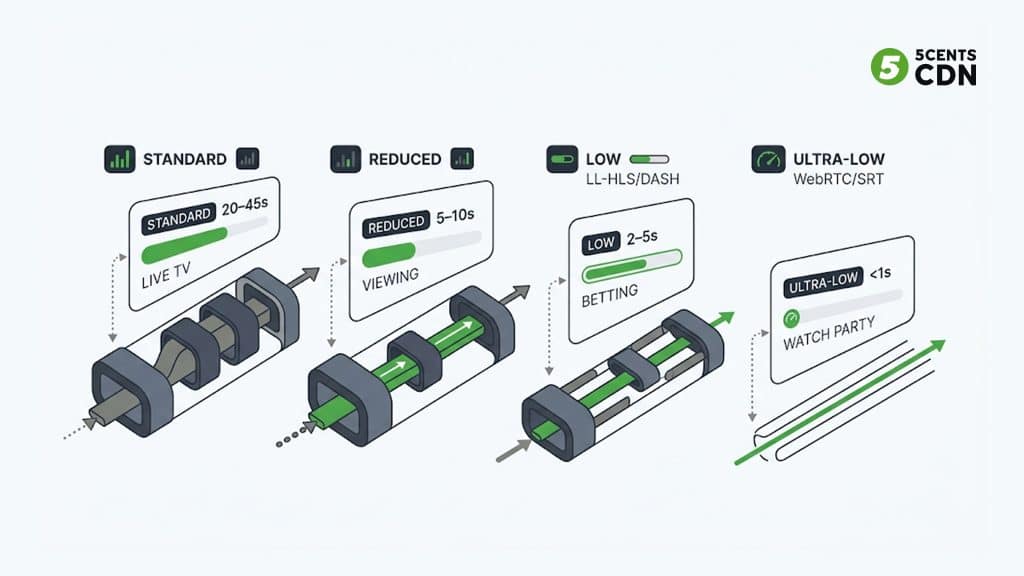
| Latency tier | Typical delay | Protocols | Sports use case |
|---|---|---|---|
| Standard | 20–45 s | Default HLS/DASH (6s segments) | Replays, catch-up, non-time-critical |
| Reduced | 5–10 s | Shorter segments, tuned playlists | General live viewing |
| Low | 2–5 s | LL-HLS / LL-DASH (partial segments) | Live betting, interactive, near-broadcast |
| Ultra-low | <1 s | WebRTC / SRT | Watch parties, live commentary, auctions |
For most premium sports, low-latency HLS/DASH in the 2–5 second range is the sweet spot — fast enough to stay ahead of spoilers, scalable to millions. WebRTC delivers sub-second latency for genuinely interactive scenarios, but scaling it to mass audiences is hard and usually means a hybrid design — WebRTC for the interactive tier, LL-HLS for the masses. For more on the protocol mechanics, our low latency streaming guide goes deeper, and reducing buffering in live streaming covers the playback side.
Delivery at scale: surviving the goal-moment spike
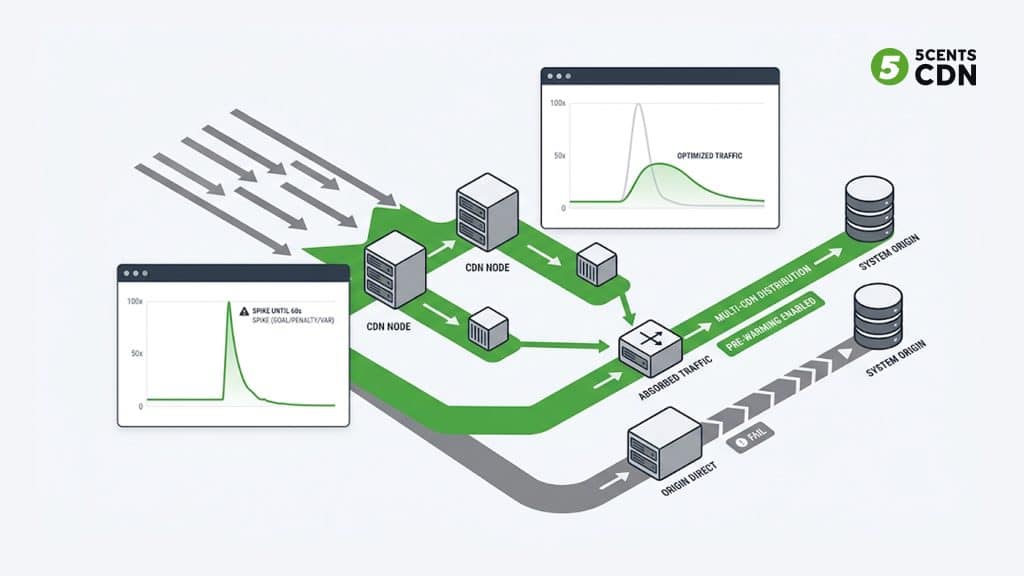
This is where sports infrastructure earns its keep. A live event stream is, from a caching perspective, a single non-cacheable-for-long object being requested by a vast synchronised audience — the opposite of a static file served from cache for weeks. When a goal goes in and traffic jumps 10x to 100x in under a minute, the delivery layer either absorbs it or collapses. Several techniques work together to handle this.
A single CDN is a single point of failure. For a marquee event, relying on one network is a risk — if it degrades in a region, a chunk of the audience is lost at the worst moment. Multi-CDN delivery distributes load across networks and routes viewers to the best-performing one in real time, adding both capacity and redundancy.
Pre-warming and cache priming. Before a scheduled event, manifests and opening segments can be pushed to edge caches in advance so the first wave of viewers doesn’t all hit origin at once. For anticipated high-demand events, capacity is reserved ahead of time rather than scrambled for on the day.
Tiered caching and origin shield. A regional shield layer absorbs cache misses so they don’t stampede the origin. With origin shield in place, the origin sees a fraction of total requests even under extreme concurrency, and modern sports delivery routinely targets 95–98% cache hit ratios. A few percentage points of cache efficiency can mean six-figure cost differences across a single tournament.
Edge processing. Increasingly, work that was once server-side — just-in-time packaging, DRM insertion, token and geo enforcement — happens at the CDN edge, closer to viewers, cutting round-trips and latency.
Security and rights enforcement
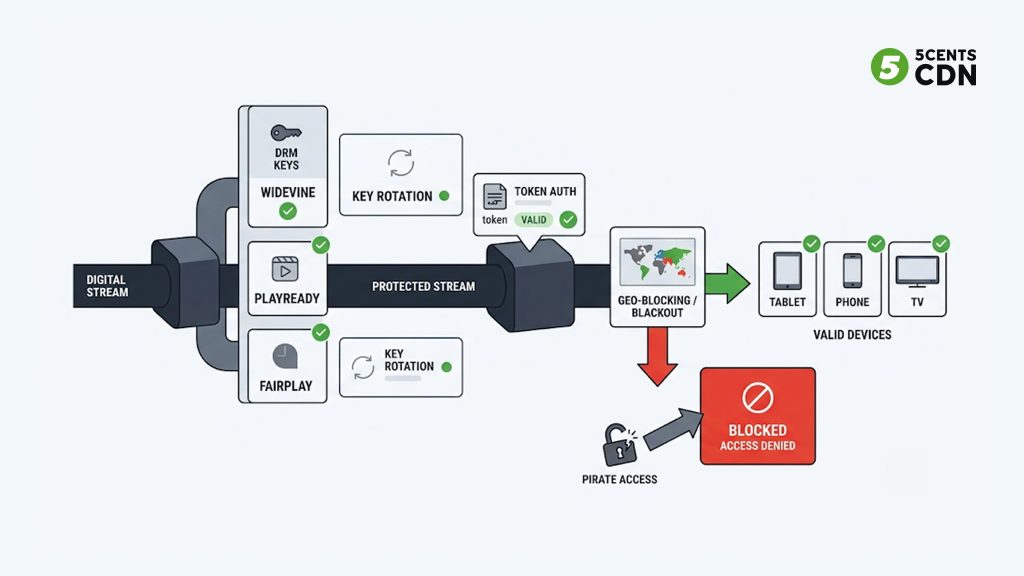
Premium sports rights are only worth what you can protect. The infrastructure has to ensure that only authorised, paying viewers in permitted regions can watch — and it has to do so without adding delay to a real-time stream. Several layers combine. Multi-DRM (typically Widevine, PlayReady, and FairPlay to cover all devices) encrypts the content and controls playback. For live, the encryption key is rotated periodically during the event — key rotation — so a compromised license only exposes a short window. The license server must be sized for peak, not average: during a big event, thousands of viewers initiate playback in the same few seconds, and the license system has to answer all of them at once. Our guide to DRM goes deep on live key rotation and license-server capacity planning.
On top of DRM sit token authentication (time-limited, signed URLs that stop link sharing), geo-blocking and blackout enforcement (regional rights often forbid certain viewers from seeing a feed, which demands precise edge logic), and DDoS protection to keep the stream online when a high-profile event inevitably attracts attacks. Enforcing these at the edge, rather than the origin, is what keeps them from becoming a latency tax.
The cost reality at scale
Sports streaming is bandwidth-intensive in a way few other workloads are. Delivering 4K at 15–20 Mbps to millions of concurrent viewers means petabytes of traffic for a single match, and without optimisation the delivery bill becomes the dominant line item. Three levers control it: codec efficiency (fewer bits for the same quality), cache hit ratio (every request served from edge instead of origin is a request you don’t pay origin egress for), and right-sizing the ABR ladder so you’re not shipping more renditions than devices actually use. Because traffic is so spiky, elastic infrastructure that scales with demand — rather than provisioning permanently for peak — is what keeps margins intact. Model your own event with the CDN cost calculator before committing to a design.
Putting it together: an event-day architecture
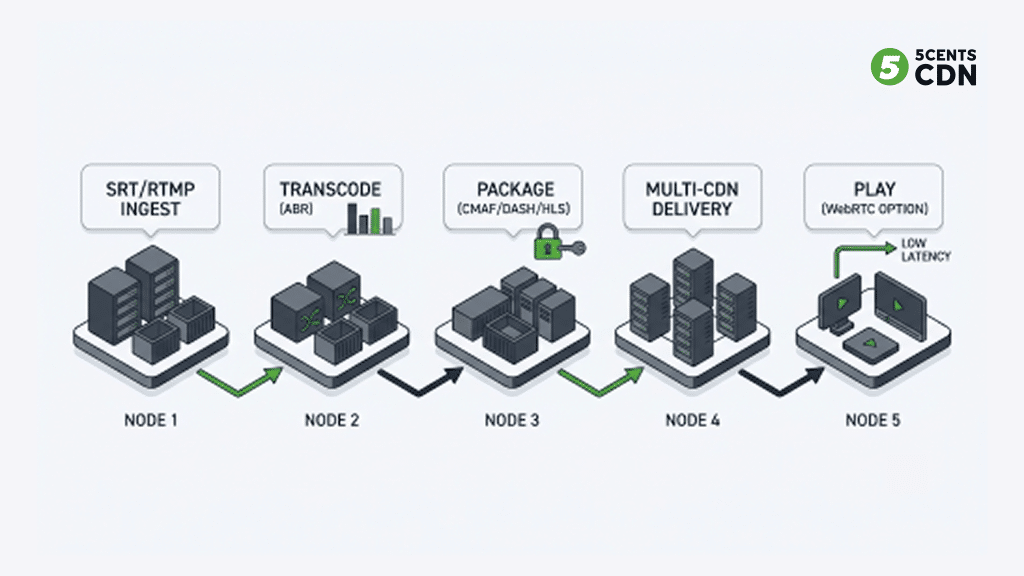
A resilient live sports setup, end to end, looks like this:
- Redundant contribution feeds from the venue over SRT, with backup paths.
- Auto-scaling cloud transcoding producing a device-appropriate ABR ladder.
- CMAF packaging with LL-HLS/LL-DASH for a 2–5 second latency target, plus a WebRTC tier if interactivity is needed.
- Multi-CDN delivery with pre-warmed caches, origin shield, and real-time performance-based routing.
- Multi-DRM with live key rotation, token auth, and edge-enforced geo-blocking/blackouts.
- Real-time QoE monitoring (startup time, rebuffer ratio, concurrency) so problems are caught during the event, not after.
Built this way, the system treats the goal-moment spike as a normal Tuesday rather than a crisis. If you’re assembling this for an OTT or media service, our live streaming platform and OTT & media solutions bring these pieces together. For the wider set of pitfalls, see live sport streaming challenges, and for how live differs from on-demand, live streaming vs VOD.
Frequently asked questions
What is glass-to-glass latency in live sports streaming?
Glass-to-glass latency is the total delay from the camera lens at the event to the viewer’s screen. It covers capture, contribution, encoding, packaging, delivery, and playback. For premium sports, infrastructure typically targets 2–5 seconds using low-latency HLS or DASH, versus 20–45 seconds for standard streaming.
How many concurrent viewers can a live sports stream support?
With properly designed multi-CDN delivery, modern infrastructure supports millions of concurrent viewers for a single event. The limiting factor is rarely raw capacity — it’s how well the system absorbs sudden spikes (a goal can trigger a 10–100x surge in under a minute) through pre-warming, tiered caching, and high cache hit ratios.
What is the best protocol for live sports streaming?
It depends on the latency target. For mass-audience delivery at 2–5 seconds, low-latency HLS or low-latency DASH (often via CMAF) is the standard. For sub-second interactive use cases like watch parties or auctions, WebRTC is used, frequently in a hybrid design alongside LL-HLS. SRT is the common choice for getting the feed out of the venue.
Do I need a single CDN or multi-CDN for live sports?
For high-stakes events, multi-CDN is strongly recommended. A single CDN is a single point of failure, and a regional degradation can cost a large slice of the audience at the worst moment. Multi-CDN adds both capacity and redundancy, with real-time routing to the best-performing network per viewer.
How is live sports content protected from piracy?
Through layers: multi-DRM (Widevine, PlayReady, FairPlay) with live key rotation, token authentication with signed URLs, edge-enforced geo-blocking and blackout rules, and DDoS protection. These are applied at the packaging and edge stages so they protect the stream without adding meaningful latency.