

Every paid OTT platform distributes content it does not own outright. Sports rights, studio deals, licensed series — all of it comes with contractual content protection requirements. Digital Rights Management (DRM) is how those requirements are met technically. Without it, a platform cannot sign a content licensing agreement with a major rights holder, cannot offer HD or 4K playback of premium content, and cannot prevent paying subscribers from redistributing streams to non-subscribers.
DRM for OTT streaming is not a single technology — it is a layered system combining encryption, license management, device authentication, and playback policy enforcement. This guide explains how it works, the three dominant DRM systems (Widevine, FairPlay, and PlayReady), how multi-DRM architecture is implemented using CENC, and the specific decisions OTT platform operators face when building or selecting a DRM solution.
What Is DRM?
Digital Rights Management (DRM) is a technology framework that protects digital content from unauthorized access, copying, and redistribution. In OTT streaming, DRM encrypts video streams and controls who can access them, on which devices, under what conditions, and for how long.
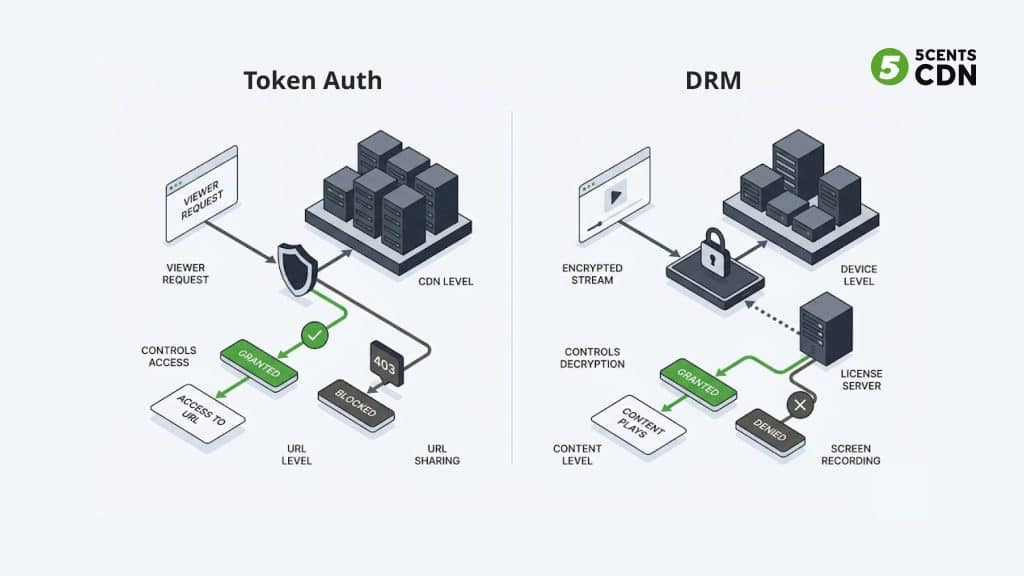
DRM operates at the content level — it governs what happens to the video data itself. A viewer with a valid DRM license can watch a stream. A viewer who obtains the stream URL but lacks a valid license cannot decrypt the content and sees nothing. This is the fundamental protection DRM provides that URL-level access controls alone cannot.
For OTT operators, DRM is not optional for premium content. Major studios and sports rights holders require DRM certification as a precondition for content licensing. Without it, access to premium licensed content is closed off entirely.
Why OTT Platforms Need DRM
There are three distinct reasons OTT platforms implement DRM — and all three matter:
Content Licensing Requirements
Studios, sports leagues, and premium rights holders require platforms to demonstrate certified DRM implementation before granting distribution licenses. Without Widevine, FairPlay, or PlayReady certification, a platform cannot legally distribute major studio content, premium sports, or first-run series. DRM is a business requirement before it is a technical one.
Piracy Prevention
Piracy websites recorded an estimated 141 billion visits globally in 2023 alone — a 12% increase since 2019. Without DRM, a live stream or VOD file can be downloaded, redistributed, and rebroadcast on piracy platforms with minimal technical effort. DRM encryption makes raw stream files useless without a valid license — directly reducing the value of pirated copies.
Revenue and Subscription Protection
Account sharing and credential redistribution directly erode subscription revenue. DRM enables concurrency limits (maximum simultaneous streams per account), device binding (content locked to specific registered devices), and session-level licensing that expires on logout or subscription cancellation. Combined with video analytics, DRM enforcement creates an auditable record of playback activity.
How DRM Works: The End-to-End Pipeline
A DRM-protected OTT delivery system involves six sequential stages:
- Transcoding and packaging: The source video is transcoded into multiple ABR renditions (480p, 720p, 1080p, 4K) and packaged into HLS or DASH segments.
- CENC encryption: During or after packaging, the video segments are encrypted using AES-128 or AES-CTR encryption under the Common Encryption standard. The content encryption key (CEK) is generated and stored securely in the license server — not in the stream.
- CDN delivery of encrypted content: Encrypted segments are distributed to CDN edge nodes. The CDN caches and delivers the encrypted content normally — it does not need the decryption key and cannot read the content.
- Player initiates playback: When a viewer presses play, the player reads the DRM signaling in the stream manifest and identifies which DRM system is required (Widevine, FairPlay, or PlayReady).
- License request: The player sends a license request to the license server, including the viewer’s authentication token (from the platform’s subscriber backend) and the content ID.
- License issuance and decryption: The license server validates the subscriber’s entitlement, generates a license containing the decryption key and playback rules (expiry time, resolution limits, concurrency restrictions), and returns it to the player. The player decrypts the content inside a secure environment and begins playback.
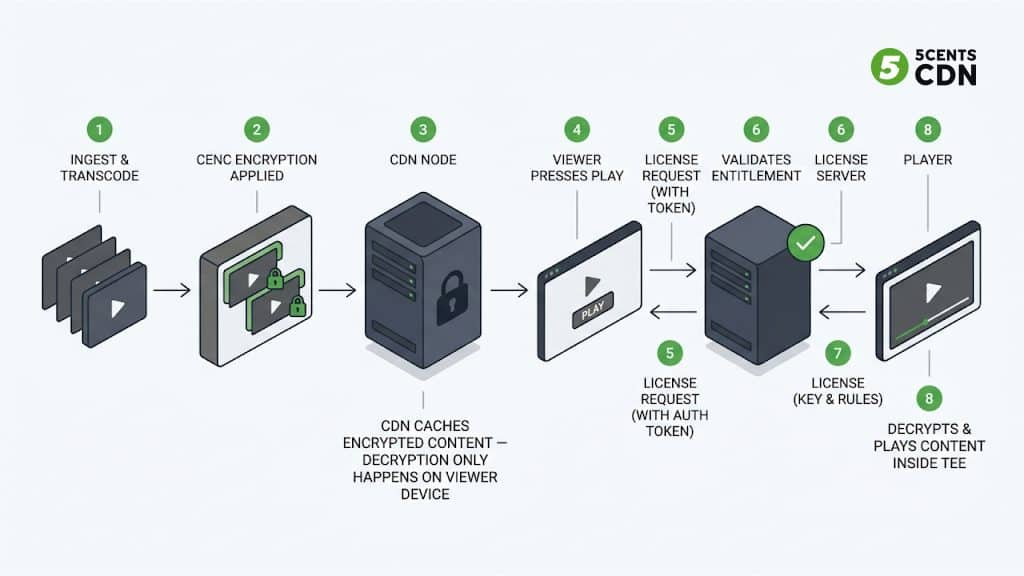
| Key architecture point: The CDN never holds or processes decryption keys. It caches and delivers encrypted segments. Decryption happens entirely on the viewer’s device inside a secure execution environment. This means DRM protection is maintained regardless of CDN configuration or edge node security. |
The Three Major DRM Systems: Widevine, FairPlay, and PlayReady
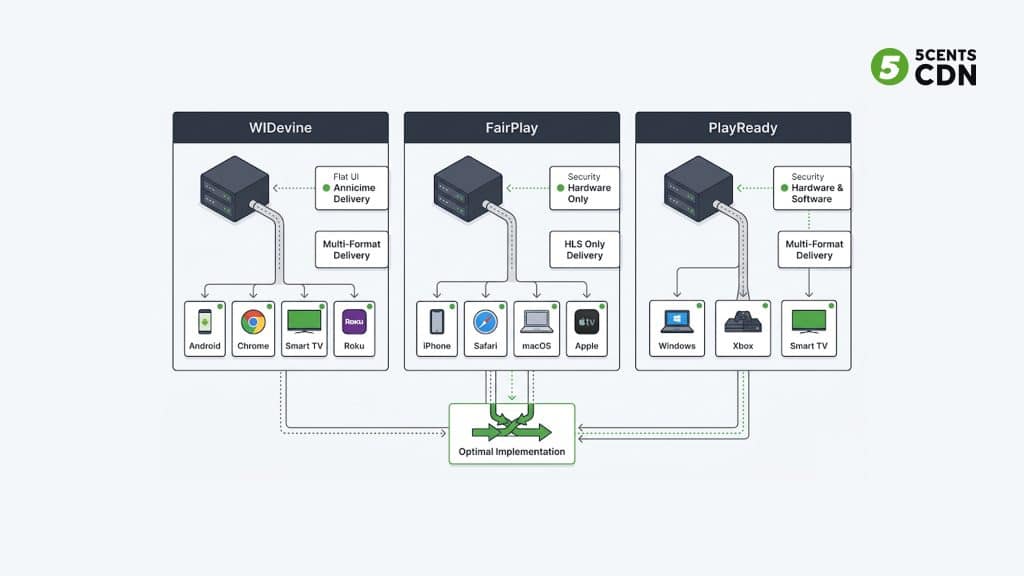
No single DRM system covers all devices. The OTT device landscape is split across three ecosystems, each controlled by a different technology company with its own DRM implementation:
Widevine (Google)
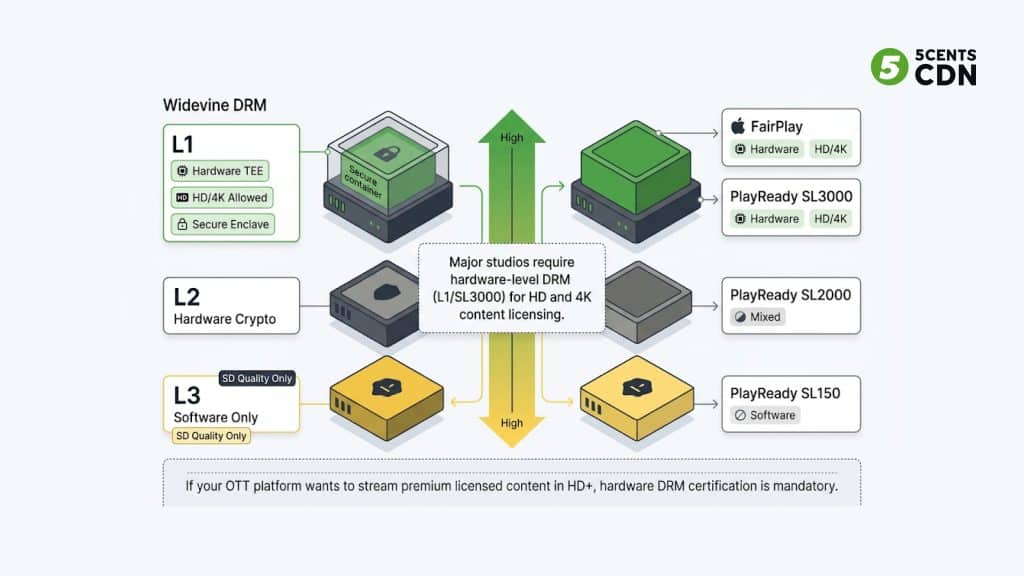
Widevine is Google’s DRM system, used on Android devices, Chrome browser, Chromecast, and most Smart TV platforms (Samsung Tizen, LG webOS, Roku). It supports three security levels:
- L1 (hardware): decryption and video processing occur in a hardware Trusted Execution Environment (TEE). Required for HD and 4K playback of premium studio content.
- L2 (hardware crypto): hardware-assisted cryptography but video processing in software. Less common in modern devices.
- L3 (software): decryption in software. Supported everywhere but typically restricted to SD quality by studios. Most browsers without hardware TEE run Widevine L3.
FairPlay (Apple)
FairPlay is Apple’s DRM system, used exclusively on Apple platforms: iOS, iPadOS, macOS (Safari), tvOS, and Apple TV. FairPlay only supports hardware-level security — there is no software fallback. All FairPlay playback runs in Apple’s Secure Enclave. FairPlay delivers content exclusively over HLS.
PlayReady (Microsoft)
PlayReady is Microsoft’s DRM system, used on Windows, Xbox, Edge browser, and a range of third-party Smart TV platforms. Like Widevine, PlayReady has multiple security levels:
- SL3000 (hardware): hardware TEE required. Required for HD and 4K on Windows and Xbox.
- SL2000: hardware-assisted. Intermediate security level.
- SL150 (software): software-only. Used where hardware TEE is not available.
For any OTT platform targeting a broad device audience, implementing all three DRM systems is required. A platform with only Widevine cannot protect content on iOS and Safari. A platform with only FairPlay cannot serve Android viewers. This is the problem that CENC multi-DRM architecture solves.
CENC: The Multi-DRM Efficiency Standard
Common Encryption (CENC) is the ISO standard that allows a single encrypted copy of the content to be licensed by multiple DRM systems simultaneously. Before CENC, platforms needed to encrypt content separately for each DRM system — three separate encrypted copies of every video file, with three separate storage and delivery pipelines.
CENC solves this by defining a standard encryption format (AES-128 in CBC or CTR mode) that all three DRM systems can work with. The content is encrypted once using CENC. Then:
- Widevine license server provides a Widevine license for Android/Chrome viewers
- FairPlay license server provides a FairPlay license for Apple device viewers
- PlayReady license server provides a PlayReady license for Windows/Xbox viewers
All three receive licenses for the same encrypted content. One encrypted copy in the CDN serves all device types — dramatically reducing storage costs, CDN overhead, and operational complexity.
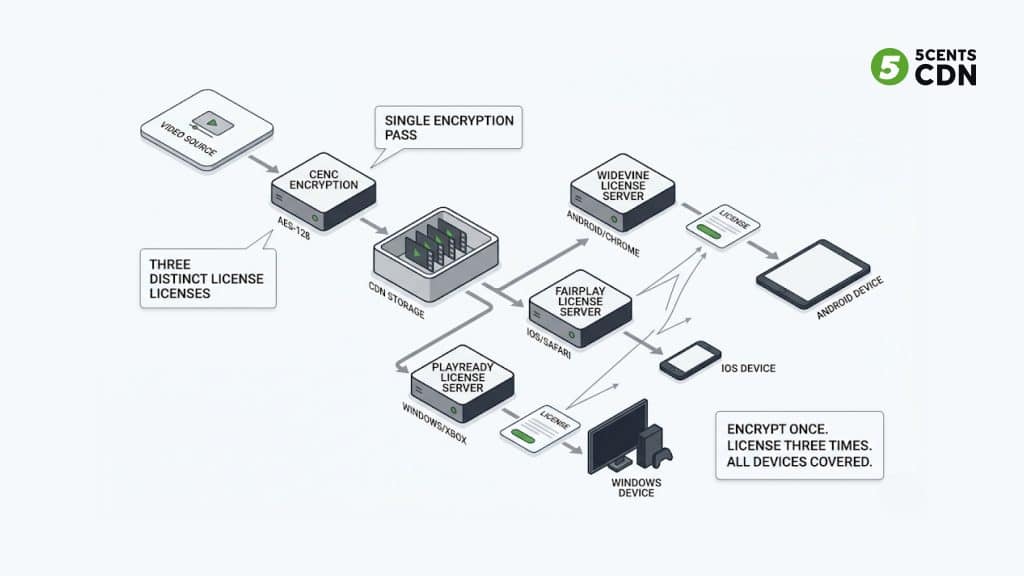
CENC is implemented during the packaging stage of the transcoding pipeline. The encrypted segments are then delivered via CDN like any other HLS or DASH content. 5centsCDN’s delivery acceleration infrastructure handles delivery of CENC-encrypted DASH and HLS content without any special configuration — the CDN delivers encrypted bytes, the license server handles key management.
DRM vs Token Authentication: Two Different Protection Layers
DRM and token authentication are frequently conflated, but they operate at completely different layers and serve different purposes. Both are necessary — neither replaces the other.
| Dimension | Token Authentication | DRM Encryption |
| What it protects | Access to the stream URL | The video content itself |
| Where it operates | CDN edge — blocks unauthorized URL access | Player device — controls decryption and playback |
| What it prevents | URL sharing, hotlinking, unauthorized embedding | Downloading, screen recording, redistribution |
| License required? | No — validated at CDN edge via signed token | Yes — player requests license from license server |
| Bypassed by? | Capturing the raw decryption key from an unprotected stream | Cannot be bypassed without compromising TEE |
| Required for studio content? | No (but strongly recommended) | Yes — mandatory for premium content licensing |
| Speed impact | Negligible — token check at edge | Negligible — license request is fast (<100ms) |
The correct architecture uses both: token authentication (via edge rules) controls who can access the CDN URL, while DRM controls who can decrypt and watch the content even if they obtain the URL.
Hardware DRM vs Software DRM
DRM security is not binary — it exists on a spectrum from software-only implementation to hardware-enforced decryption inside a Trusted Execution Environment (TEE).
Software DRM
Software DRM (Widevine L3, PlayReady SL150) handles decryption in the device’s general-purpose CPU. It is universally supported and requires no special hardware. However, it is more vulnerable to key extraction attacks — skilled attackers can theoretically recover decryption keys from software implementations.
Studios typically restrict software DRM to SD quality. A streaming platform cannot deliver 1080p or 4K content under a studio license using software DRM only.
Hardware DRM (TEE)
Hardware DRM (Widevine L1, FairPlay, PlayReady SL3000) performs decryption inside a dedicated Trusted Execution Environment — a secure processor partition isolated from the main OS. The Advanced Encryption Standard decryption key never leaves the TEE in plaintext, making key extraction attacks practically infeasible.
For OTT platforms distributing premium licensed content in HD or 4K, hardware DRM on viewer devices is mandatory — not optional. This is enforced by the license server: when the platform issues a license, it can specify the minimum security level required for playback at each resolution.
DRM for Live Streaming
DRM for live streaming uses the same encryption and license framework as VOD — but with specific operational requirements driven by the real-time nature of the pipeline.
For live content, the content encryption key (CEK) is typically rotated periodically during the stream — a process called key rotation. Key rotation limits the exposure window if a license is compromised: an attacker who captures one license can only decrypt a limited window of content before the key changes.
Live DRM also requires the license server to handle concurrent license requests from thousands of viewers simultaneously — especially during live events where all viewers initiate playback within a short window. License server capacity planning is a critical operational consideration for large-scale live OTT events.
When combined with 5centsCDN’s live transcoding and live event streaming infrastructure, DRM can be applied to the packaging stage of the live pipeline with minimal latency impact — typically under 50ms added to the end-to-end glass-to-glass latency.
Offline Playback and Download-to-Watch DRM
Download-to-watch functionality — offered by Netflix, Amazon Prime, and similar platforms — requires DRM support for offline playback. The mechanism differs from streaming:
- The viewer downloads an encrypted video file to their device.
- A time-limited offline license is issued at download time, specifying how long the content can be played without internet access (e.g., 48 hours after first play, 30 days from download).
- On playback, the DRM client checks the offline license expiry against the device’s secure clock. If expired, the content cannot be played.
- When the viewer reconnects to the internet, the license server can revoke or renew the offline license based on subscription status.
Offline DRM is supported by Widevine (L1 required for HD offline on Android) and FairPlay (all offline playback on Apple devices). PlayReady also supports offline licensing. All three use the same CENC-encrypted content file — only the license handling differs.
Common DRM Implementation Mistakes
- Implementing only one DRM system: Widevine-only excludes all Apple device viewers. FairPlay-only excludes Android, Windows, and Smart TV viewers. For any OTT platform targeting broad device coverage, all three systems are required via CENC.
- Confusing token auth with DRM: Token authentication controls URL access. DRM controls content decryption. A platform with token auth but no DRM has access control without content encryption — the stream is still freely copyable by anyone who captures it.
- No key rotation for live streams: Using a static encryption key for the duration of a live event means a compromised license exposes the entire broadcast. Implement periodic key rotation — typically every 10–30 minutes.
- Underprovisioning the license server: During a live event, license requests spike sharply as thousands of viewers start playback simultaneously. License server capacity must be scaled to handle concurrent request peaks, not average load.
- Using software DRM for premium content: Distributing HD or 4K premium licensed content without hardware DRM (Widevine L1 / PlayReady SL3000) violates most studio licensing agreements and may result in license termination.
Summary: DRM for OTT Streaming at a Glance
| Topic | Key Point | OTT Operator Action |
| What DRM does | Encrypts content; controls who can decrypt and watch | Implement before signing any premium content license |
| Widevine | Google DRM — Android, Chrome, Smart TVs, Roku | L1 required for HD/4K on Android |
| FairPlay | Apple DRM — iOS, Safari, tvOS, Apple TV | Hardware-only; all FairPlay delivers via HLS |
| PlayReady | Microsoft DRM — Windows, Xbox, some Smart TVs | SL3000 required for HD/4K on Windows |
| CENC | Single encryption pass — all three DRM systems read same encrypted content | Implement at packaging stage; reduces storage and CDN complexity |
| Token auth vs DRM | Token auth = URL access control; DRM = content encryption | Use both — they protect at different layers |
| Hardware DRM | TEE-enforced decryption; required for premium HD/4K licensing | Plan device support matrix for required security levels |
| Live DRM | Same pipeline as VOD; add key rotation and license server scaling | Rotate keys every 10–30 mins; scale license server for event peaks |
| Offline DRM | Time-limited offline license; syncs on reconnect | Implement if your platform offers download-to-watch |
Frequently Asked Questions
What is DRM in streaming?
DRM (Digital Rights Management) is a technology framework that encrypts video content and controls playback through a license system. In streaming, DRM ensures that only authorized subscribers with a valid license can decrypt and watch the content — on approved devices, under specified conditions (resolution limits, concurrency restrictions, expiry time). It prevents downloading, redistribution, and unauthorized copying of protected content.
Do I need DRM for my OTT platform?
If your platform distributes premium licensed content — studio films, sports rights, first-run series — DRM is a contractual requirement, not a choice. Rights holders require certified DRM implementation before granting distribution licenses. If your platform distributes only original or freely licensed content, DRM is optional but still recommended for any subscription or pay-per-view model to prevent unauthorized redistribution.
What is the difference between Widevine, FairPlay, and PlayReady?
All three are DRM systems, but each serves a different device ecosystem. Widevine (Google) protects content on Android, Chrome, and most Smart TVs. FairPlay (Apple) protects content on iOS, Safari, macOS, and Apple TV. PlayReady (Microsoft) protects content on Windows, Xbox, and some Smart TVs. For universal device coverage, OTT platforms implement all three via CENC multi-DRM architecture.
What is CENC and why does it matter for OTT?
CENC (Common Encryption) is an ISO standard that allows a single encrypted copy of video content to work with all three major DRM systems — Widevine, FairPlay, and PlayReady. Without CENC, platforms would need to encrypt and store separate copies of every video for each DRM system. With CENC, content is encrypted once and each DRM system’s license server provides the appropriate decryption key to each device type. See: MPEG Common Encryption — Wikipedia.
What is the difference between DRM and token authentication?
Token authentication controls access to the stream URL at the CDN edge — it determines who can request the URL. DRM controls who can decrypt the content itself — even if someone obtains the URL. Token authentication without DRM means access control but no content encryption. DRM without token authentication means the content is encrypted, but the URL is unprotected. Both layers are needed for comprehensive OTT content protection.
Can a CDN deliver DRM-protected?
Yes — CDNs deliver DRM-protected content exactly as they deliver unprotected content. The CDN caches and delivers encrypted video segments without decrypting them. Decryption happens entirely on the viewer’s device after a license is obtained from the license server. The CDN never holds or processes decryption keys. This means DRM protection is maintained regardless of how many CDN edge nodes handle the content delivery.
DRM and Content Protection Infrastructure at 5centsCDN
Implementing DRM for an OTT platform involves decisions across transcoding pipeline integration, CENC packaging, license server selection, CDN delivery configuration, and token authentication — all of which interact. The right setup depends on your content type, device target audience, licensing requirements, and whether you are delivering live content, VOD, or both.
5centsCDN provides custom solutions for OTT platforms building secure streaming infrastructure — covering CDN delivery of encrypted content, edge rules for token authentication, origin shield, and live transcoding infrastructure. DRM license server selection and integration is scoped per project based on your platform requirements.
| Building Secure OTT Streaming Infrastructure? 5centsCDN provides CDN delivery, token authentication, and live streaming infrastructure for OTT platforms with DRM requirements. Get in touch to discuss your setup. → Contact us |