

SSAI (server-side ad insertion) is a streaming technology that stitches ads directly into a video stream on the server before it reaches the viewer, so content and ads arrive as one seamless, buffer-free stream that ad blockers cannot easily separate.
If you run an OTT service, a FAST channel, or any ad-supported stream, SSAI is the technology that decides whether your ads play smoothly — and whether they actually generate revenue. It is also frequently called dynamic ad insertion (DAI). This guide explains what SSAI is, how it works, how it differs from client-side insertion, and the part most articles skip: how much publishers realistically earn with it.
Because ads are stitched in before delivery, the global CDN carrying the stream plays a central role in how reliably those ads reach viewers — which is exactly where SSAI lives in the pipeline.
What does SSAI stand for?
SSAI stands for Server-Side Ad Insertion. The “server-side” part is the whole point: the work of inserting the ad happens on a server in the cloud, not on the viewer’s phone, browser, or smart TV. The viewer’s device simply plays one continuous stream and never knows where the content ended and the ad began.
How SSAI works
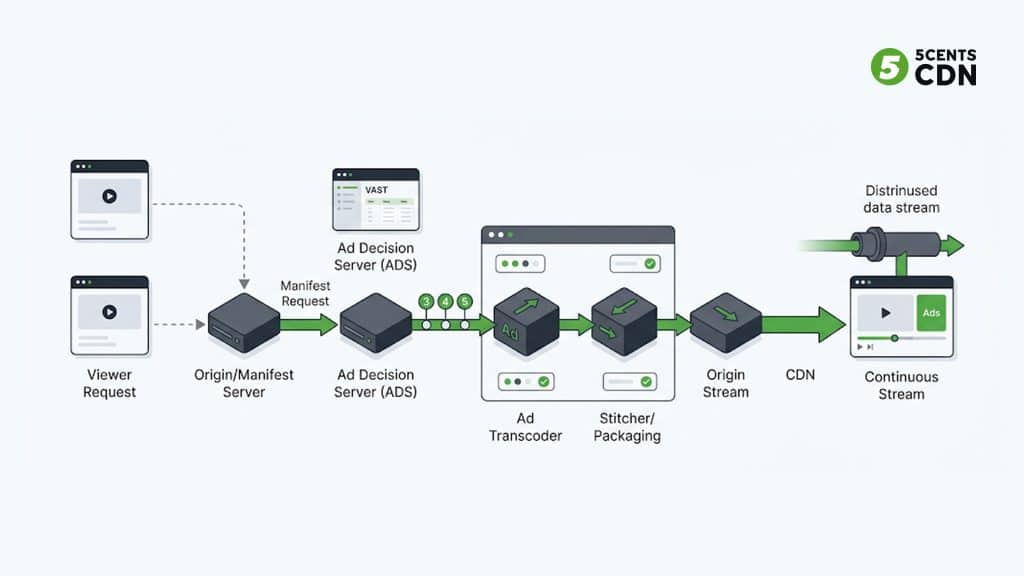
Here is the end-to-end flow, simplified into five steps:
- A viewer presses play. The player requests the stream and its manifest — the playlist that tells the player what segments to load and in what order.
- The SSAI service spots an upcoming ad break, usually flagged by an SCTE-35 marker embedded in the stream.
- It queries an ad decision server (ADS) using a VAST or VMAP request, passing context like device, geography, and content metadata so the right ad is chosen.
- The chosen ad is transcoded to match the stream’s bitrate, resolution, and codec, then stitched into the manifest at the break point.
- The CDN delivers the unified stream — content and ad as one — to the viewer with no visible transition.
The technical signaling behind step 2 (SCTE-35 cue markers, marker pass-through vs. CDN-side insertion, VAST tag setup) is a topic on its own. If you are ready to implement, our SCTE-35 support & SSAI workflow guide walks through the hands-on configuration.
Under the hood, SSAI works by manipulating the HLS manifest — the playlist defined in RFC 8216 — swapping in ad segments while preserving the bitrate ladder so adaptive streaming keeps working.
SSAI vs CSAI: what’s the difference?
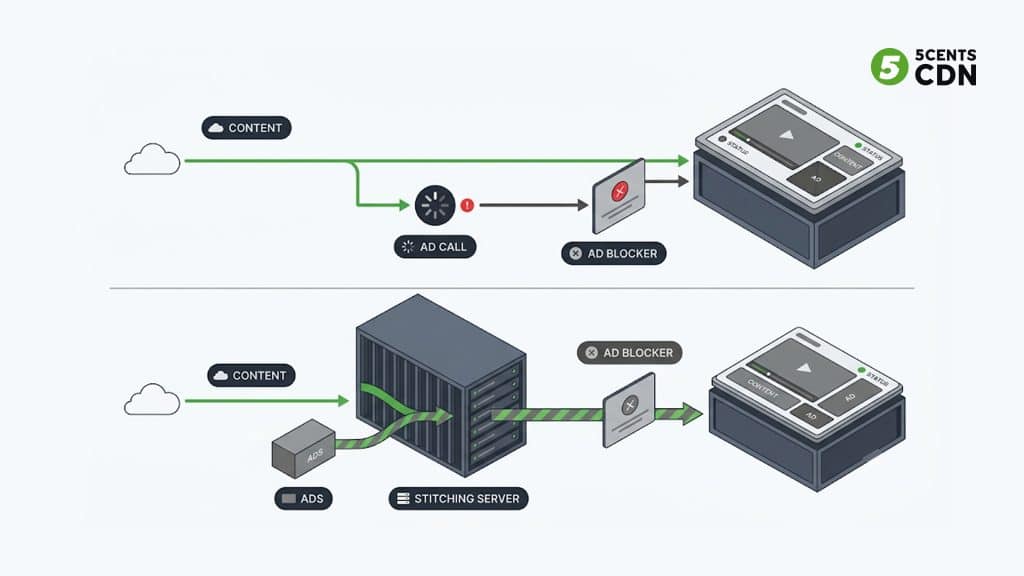
The alternative to SSAI is CSAI (client-side ad insertion), where the viewer’s player requests and loads each ad separately at the break. The transactional and measurement steps look similar; the difference is where the insertion happens — on a server, or on the device.
| Factor | SSAI (server-side) | CSAI (client-side) |
|---|---|---|
| Where ads are inserted | On the server, before delivery | On the viewer’s device/player |
| Viewer experience | Seamless, no buffering at transitions | Possible spinning wheel / lag |
| Ad-blocker resistance | High — ads are part of the stream | Low — separate ad calls can be blocked |
| Scale (live, high concurrency) | Excellent — centralized | Heavier load per device |
| Interactivity | More limited | Richer (SDK-driven formats) |
| Best for | CTV, FAST, live, VOD at scale | Mobile apps, browser, interactive units |
Why SSAI matters for monetization
- Ad-blocker bypass: because ads ride inside the content stream, standard blockers can’t cleanly separate and drop them — protecting impressions and revenue.
- Higher completion rates: CTV/SSAI inventory routinely posts 90%+ video completion, which advertisers pay a premium for.
- Broadcast-grade experience: no black screens or ad-load stutter means lower abandonment and stronger retention.
- Targeting without cookies: SSAI can personalize using IP, device, and content context — useful in a cookieless world.
How much do publishers actually earn with SSAI?
This is the question most explainers dodge. SSAI itself doesn’t set your earnings — it protects and scales them by making sure ads are delivered and counted. What you earn comes down to three levers: your CPM (revenue per thousand ad impressions), your fill rate (share of breaks actually filled with paid ads), and your ad load (ad minutes per viewing hour).
The simple earnings formula:
Revenue = (Ad impressions ÷ 1,000) × CPM × Fill rate
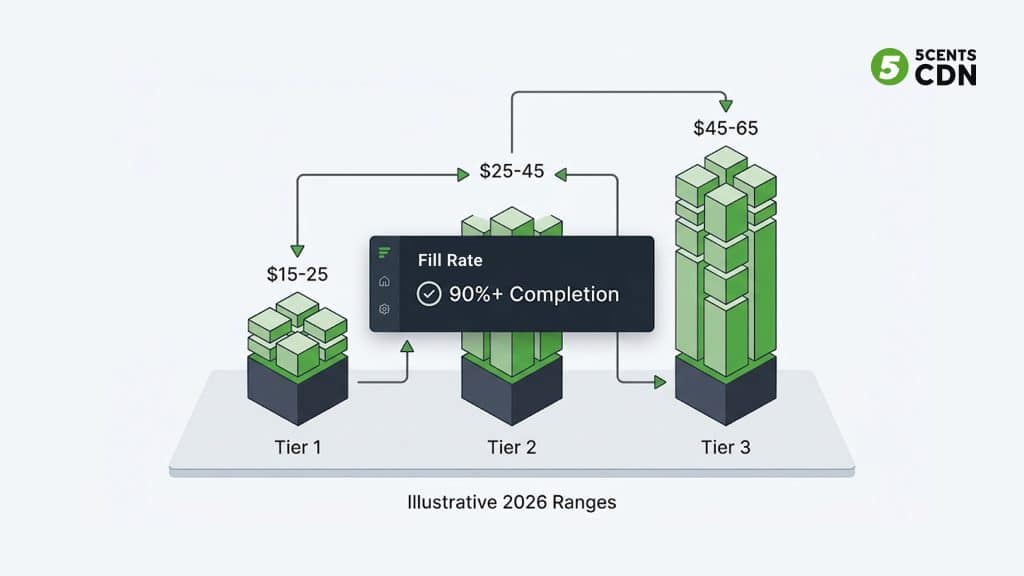
CPMs vary widely by inventory tier. Based on public 2026 CTV benchmarks (and remembering CPM means cost per thousand), the market sits in three broad tiers:
| Inventory tier | Typical 2026 CPM range | Notes |
|---|---|---|
| FAST / broad AVOD | $15 – $25 | Where most performance dollars land; high volume, broad targeting |
| Premium AVOD | $25 – $45 | Logged-in premium streaming; standard programmatic |
| Premium / live sports | $45 – $65+ | Direct-sold pods, live adjacency, scarce inventory |
Illustrative industry ranges compiled from public 2026 CTV/programmatic benchmark reporting. Actual rates vary by region, demand, targeting, and deal type. CTV CPMs typically run several times higher than open-web display, offset by 90%+ completion.
Three worked examples
To make the value concrete, here are three placeholder publishers. The numbers are modeled from the public ranges above — not pulled from any specific company’s reported results.
Publisher A — a niche FAST channel
Assume 1,000,000 monthly viewing hours, an ad load of ~8 minutes/hour at 4 ads/break-equivalent (roughly 16 ad impressions/hour), a $20 FAST-tier CPM, and an 80% fill rate.
- Ad impressions ≈ 16M/month → (16,000,000 ÷ 1,000) × $20 × 0.80 ≈ $256,000/month gross ad revenue.
Pair this with FAST channel delivery built for 24/7 linear output.
Publisher B — a mid-size premium AVOD library
Assume 500,000 monthly viewing hours, ~12 ad impressions/hour, a $35 premium-AVOD CPM, and an 85% fill rate.
- Ad impressions ≈ 6M/month → (6,000,000 ÷ 1,000) × $35 × 0.85 ≈ $178,500/month gross ad revenue.
Fewer hours than Publisher A, but a richer CPM and fill rate narrow the gap — showing why tier and fill matter as much as raw volume.
Publisher C — a live sports event operator
Assume a marquee event drawing 2,000,000 viewing hours in a month, ~10 ad impressions/hour, a $55 live-sports CPM, and a 90% fill rate.
- Ad impressions ≈ 20M → (20,000,000 ÷ 1,000) × $55 × 0.90 ≈ $990,000 gross for the event window.
Live, high-concurrency monetization like this is exactly where SSAI’s centralized stitching shines — see live event streaming.
Takeaway: the same audience can be worth 3–4× more depending on tier, fill, and ad load. SSAI is what makes those impressions reliably deliverable and countable — it turns potential revenue into collected revenue.
Does SSAI work for live streaming?
Yes. SSAI is widely used for live, but live insertion demands low-latency ad decisioning, precise SCTE-35 cue signaling, and real-time manifest manipulation. For live sports and events, that real-time stitching at scale is the core advantage. A reliable live streaming platform with SSAI support keeps ad breaks clean even under spiky, high-concurrency load.
Getting started with SSAI
If you’re monetizing OTT, FAST, or live content, SSAI is effectively table stakes for protecting and scaling ad revenue. The build involves accurate SCTE-35 markers, an ad decision server, and a CDN tuned for ad-stitched delivery. 5centsCDN’s server-side ad insertion solution and OTT & media stack are built for exactly this. For the technical setup, start with our SCTE-35 & SSAI workflow guide, and for the bigger monetization picture see the complete FAST channels guide.
Frequently asked questions
Is SSAI the same as DAI?
Mostly, yes. Dynamic ad insertion (DAI) is the broad technique of inserting ads dynamically per viewer; SSAI is the server-side method of doing it. The terms are often used interchangeably.
Does SSAI stop ad blockers?
It strongly resists them. Because the ad is stitched into the same stream as the content, standard ad blockers can’t easily tell the ad apart to block it — protecting impressions and revenue.
Does SSAI work for live streaming?
Yes. It’s common for live, though it requires low-latency ad decisioning, accurate SCTE-35 signaling, and real-time manifest manipulation.
What’s the difference between SSAI and CSAI?
SSAI inserts ads on the server before delivery for a seamless, ad-blocker-resistant stream; CSAI inserts them on the viewer’s device, which allows richer interactivity but is more prone to buffering and blocking.
How much can I earn with SSAI?
It depends on your CPM tier, fill rate, and ad load. FAST/broad AVOD CPMs run roughly $15–25, premium AVOD $25–45, and premium or live sports $45–65+ in 2026. SSAI doesn’t set the CPM — it ensures those impressions are delivered and counted.