

Live streaming vs VOD (video on demand) are the two fundamental content delivery models in online video. On the surface, the difference is straightforward: live streaming delivers content in real time as it happens, while VOD delivers pre-recorded content that viewers watch on their own schedule.
But for OTT platform operators and streaming engineers, the differences run much deeper than timing. Live streaming and VOD operate on different transcoding pipelines, different CDN caching mechanics, different cost structures, and different infrastructure constraints — even when they share the same underlying technologies of HLS, adaptive bitrate streaming, and CDN edge delivery.
This guide covers the infrastructure-level differences between live streaming and VOD delivery, the use cases that determine which model to choose, the cost models behind each, and how modern OTT platforms run both on a single infrastructure.
What Is Live Streaming?
Live streaming delivers video content in real time over the internet as it is being captured or generated. The viewer watches the event as it unfolds — with a glass-to-glass latency that can range from under one second (WebRTC) to 30 seconds (standard HLS), depending on the delivery protocol and configuration.
Live streaming requires the encoder to generate segments continuously, the CDN to distribute those segments within seconds of creation, and the viewer’s player to maintain playback from a continuously updated stream rather than a static file. Every component of the pipeline — from encoder to edge — must operate in real time.
What Is VOD (Video on Demand)?
Video on demand (VOD) delivers pre-recorded content that viewers access on their own schedule. The video is encoded, processed, and distributed to CDN edge nodes before any viewer requests it. When a viewer presses play, the content is already available at the nearest edge node — served from cache rather than generated in real time.
VOD covers a wide range of content models: subscription libraries (SVOD), transactional rentals and purchases (TVOD), ad-supported free content (AVOD), and institutional or educational video archives. What all VOD models share is the elimination of the real-time delivery constraint that governs live streaming.
How the Two Delivery Models Work
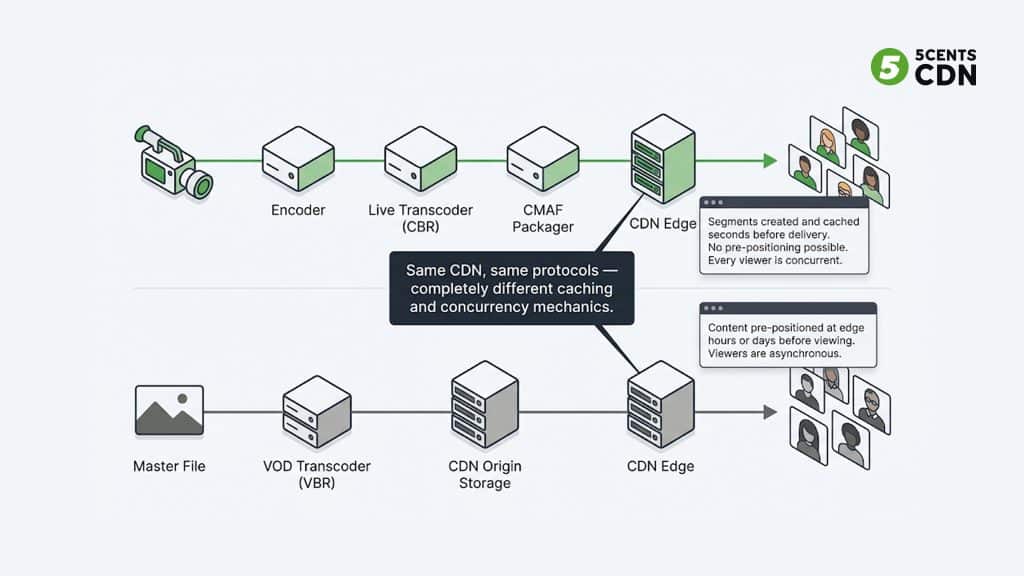
Despite using many of the same underlying technologies — HLS, adaptive bitrate streaming, CDN delivery — live and VOD operate on fundamentally different pipelines:
| Pipeline Stage | Live Streaming | VOD |
| Content source | Real-time camera or encoder feed | Uploaded master file (ProRes, H.264, etc.) |
| Transcoding timing | Real-time — must process faster than playback rate | Asynchronous — can take minutes to hours |
| Transcoding priority | Stability, speed, consistent output | Maximum quality per bit |
| Encoding mode | CBR (Constant Bitrate) | VBR, CRF, or multi-pass |
| Segment generation | Continuous, seconds ahead of playback | Pre-generated, complete before any viewer |
| CDN pre-positioning | Not possible — content doesn’t exist yet | Possible — edge nodes cache before viewers arrive |
| Viewer timing | All concurrent — watching simultaneously | Asynchronous — spread across time |
| Error recovery | Skip forward — can’t retry past segments | Full retry — can re-encode, re-process |
CDN Caching: How Live and VOD Differ
Both live and VOD use a content delivery network for distribution, but the caching mechanics are fundamentally different — and those differences have significant implications for performance and infrastructure design.
VOD CDN Caching
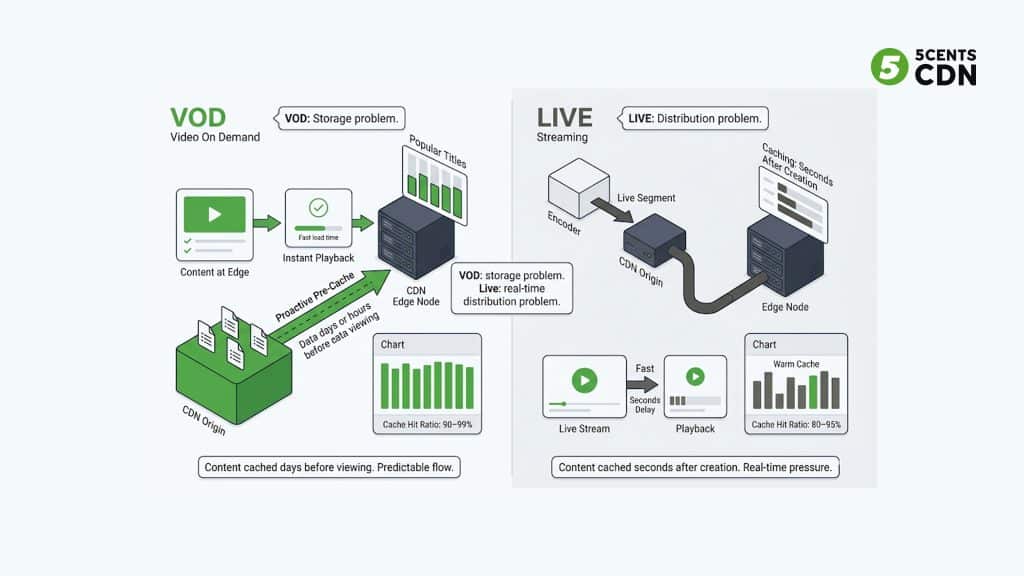
VOD content can be pre-positioned at CDN edge nodes hours or days before viewers arrive. Popular titles are proactively pushed to edge nodes in all target regions. When a viewer presses play, the content is already at the nearest edge node — the request is served directly from cache with no origin involvement. VOD platforms routinely achieve cache hit ratios of 90–99%.
Live Streaming CDN Caching
Live content does not exist before it is generated. Each segment is created seconds before delivery — there is no opportunity for pre-positioning. The first viewer request for each new segment is always a cache miss at the edge. The CDN must fetch that segment from the packager or origin within milliseconds, cache it, and then serve all subsequent requests for the same segment from cache.
This is why origin shield is particularly important for live streaming: when thousands of edge nodes simultaneously request the latest segment, a shield layer ensures origin receives only one request per region — not thousands. Without it, origin overload is a live event risk that has no VOD equivalent.
Transcoding: Different Pipelines, Different Priorities
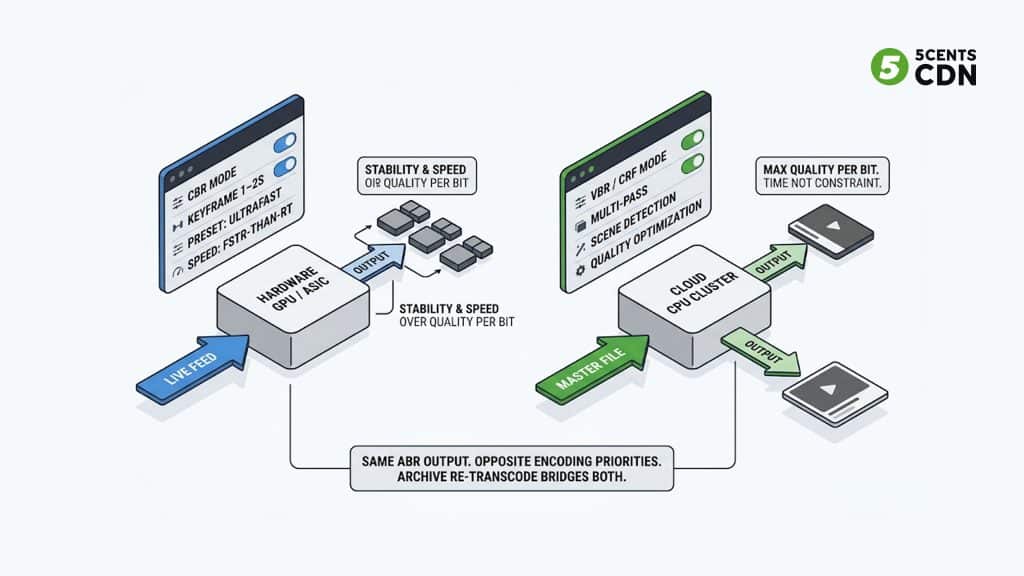
Both live and VOD require transcoding into multiple ABR renditions for delivery. But the transcoding pipeline and its optimization goals are opposite:
Live Transcoding
Live transcoding must process video faster than real-time — a 30fps stream generates 30 frames per second, and the transcoder must keep pace. This requires hardware GPU acceleration, CBR output for predictable CDN delivery, and short keyframe intervals (1–2 seconds) for low-latency delivery. 5centsCDN’s live transcoding service handles this real-time pipeline — quality optimization is secondary to speed and stability.
VOD Transcoding
VOD transcoding has no real-time constraint. The same content can take 10 minutes, an hour, or longer to process — the viewer is not waiting. This enables multi-pass VBR encoding, scene-detection-based keyframe placement, and CRF (Constant Rate Factor) modes that maximize quality per bit. Use the video encoding calculator to estimate output file sizes and delivery costs for your VOD library.
A common production workflow: transcode live for real-time broadcast using CBR hardware encoding, then re-transcode the recorded archive using multi-pass VBR for the VOD version in the content library. The VOD version is higher quality at the same bitrate — worth the additional processing time for permanent catalog assets.
Latency Requirements: Why They Diverge
Latency tolerance is the clearest operational dividing line between live and VOD:
- Live streaming: latency directly affects the viewer experience. A 30-second delay on a live sports event means viewers see goals after social media spoilers. A 5-second delay on a live auction means bids are placed on outdated information. Low-latency delivery (2–5 seconds for LL-HLS, sub-second for WebRTC) is a product requirement, not a nice-to-have.
- VOD: latency is irrelevant. A viewer watching a film on demand does not care whether the segment was cached 2 seconds or 2 hours before their request. VOD startup time (how quickly the first frame appears) matters, but the delivery latency of individual segments does not.
This means live streaming platforms must invest in low-latency delivery infrastructure — LL-HLS packaging, short segment TTLs, origin shield, and CDN PoP proximity — that VOD platforms do not need to prioritize. See the full breakdown in our low latency streaming protocols guide.
Infrastructure Cost: Two Very Different Models
The cost structures of live and VOD delivery diverge significantly — and planning for the wrong model is one of the most common infrastructure mistakes OTT operators make.
Live Streaming Cost Model
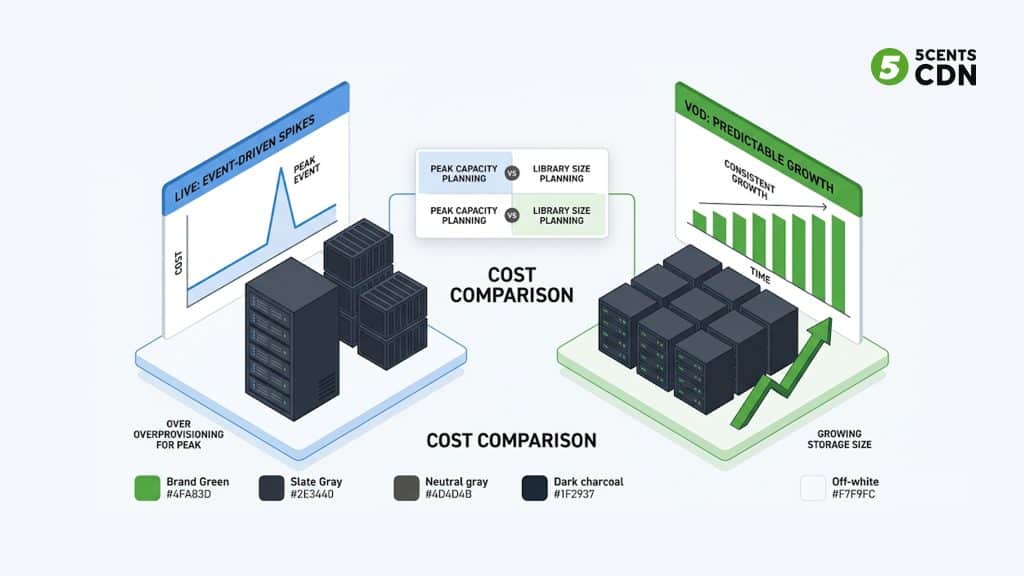
Live streaming cost is event-driven and concurrent-viewer-dependent. A platform serving 100,000 concurrent viewers at 4 Mbps generates 400 Gbps of simultaneous throughput. That spike happens during the event window and then drops to near-zero. Infrastructure must be provisioned for the peak — not the average. Use the CDN bandwidth calculator to model event-specific throughput requirements before provisioning.
VOD Cost Model
VOD cost is predictable and library-scale-dependent. Cost components are: storage (GB of encoded content), CDN delivery (GB transferred per month based on average daily views), and transcoding (one-time per asset). Viewership is asynchronous — 100,000 daily VOD views are spread across 24 hours, not concentrated in a 2-hour window. Infrastructure scales with library growth and average consumption, not with peak concurrency.
| Cost Factor | Live Streaming | VOD |
| Cost driver | Concurrent viewers × bitrate × event duration | Storage + avg daily GB delivered |
| Cost pattern | Spike at event time, near-zero baseline | Consistent monthly, grows with library |
| Infrastructure planning | Plan for peak concurrency | Plan for library growth + avg consumption |
| Transcoding cost | Ongoing per-minute of live content | One-time per asset upload |
| Storage cost | Minimal (live segments expire) | Ongoing (library grows over time) |
| Bandwidth cost | Very high during events | Predictable, spreadable |
Use Cases: When Live Streaming Is the Right Choice
Live streaming is the correct delivery model when the moment matters more than the replay — when the value of the content is tied to its real-time nature:
- Live sports and esports: the result must be unknown; the crowd energy is part of the experience; concurrent viewing creates social momentum
- Concerts and live events: the shared simultaneous experience is the product — a recording of a concert has fundamentally different value than the live broadcast
- News and breaking information: immediacy is the core value proposition
- Interactive formats: live Q&A, auctions, betting, co-watching — any format where viewer participation requires real-time awareness of events
- Time-sensitive commerce: live shopping events where purchase urgency is created by the real-time experience
Use Cases: When VOD Is the Right Choice
VOD is the correct delivery model when viewer control, content longevity, and on-demand access are more important than real-time delivery:
- Subscription content libraries: films, series, documentaries — content consumed on the viewer’s schedule across weeks or months
- E-learning and training: courses accessed across time zones and at individual pace — completion tracking and rewind are essential
- Corporate video and internal communications: all-hands recordings, product demos, onboarding content — accessible across geographies on demand
- Long-form content archives: catch-up TV, sports highlights, event recordings — the live event drives viewership; the VOD version serves the long tail
- Premium transactional content: pay-per-view film rentals, digital purchases — content with a defined shelf life per transaction
Monetization Models
The delivery model shapes the monetization strategy:
| Model | Full Name | Best Fit | Why |
| SVOD | Subscription VOD | VOD library | Viewers pay for ongoing access to a deep library — content depth drives retention |
| TVOD | Transactional VOD | VOD or live PPV | Per-title purchase or rental — premium content, one-time access |
| AVOD | Ad-supported VOD | VOD free tier | Ad revenue from large asynchronous audiences — CPM model requires volume |
| PPV | Pay-per-view live | Live events | Time-limited urgency drives purchase — the event won’t happen again |
| FAST | Free Ad-Supported TV | Live linear / VOD | Scheduled linear programming or VOD playlists with ad breaks |
Live urgency creates PPV purchase motivation that VOD cannot replicate. VOD library depth creates SVOD subscriber retention that live cannot sustain alone. Most successful OTT platforms use live events to drive subscriber acquisition and VOD libraries to drive retention — the two models are complementary, not competing.
Hybrid Architecture: Running Both on One Platform
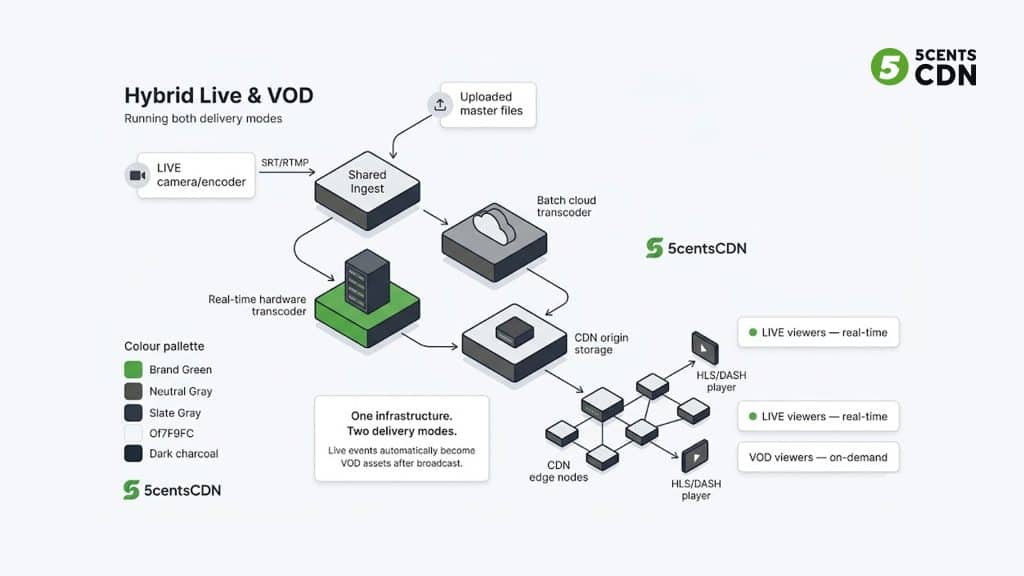
Modern OTT platforms almost universally run both live and VOD on the same infrastructure. Separating them into independent platforms wastes resources and fragments the content library. A unified hybrid architecture is both operationally simpler and more cost-effective.
A practical hybrid architecture on a single CDN and transcoding pipeline:
- Shared CDN origin and edge delivery: both live segments and VOD assets are stored at CDN origin and distributed to the same edge nodes — no separate delivery infrastructure needed
- Parallel transcoding paths: live feed goes through real-time hardware transcoder; VOD uploads go through asynchronous cloud transcoder — same output formats (HLS/DASH), different processing pipelines
- Automatic live-to-VOD recording: the live stream is recorded simultaneously and automatically converted to a VOD asset after broadcast — the live event generates permanent catalog content
- Unified video analytics SDK across both modes: consistent QoE tracking, viewer behavior analytics, and content performance data regardless of delivery model
Live Streaming vs VOD: Full Comparison Table
| Dimension | Live Streaming | VOD |
| Content timing | Real-time — as events happen | Pre-recorded — viewer chooses when |
| Latency requirement | Critical — 2–30s depending on protocol | Irrelevant — startup time matters, not stream latency |
| CDN caching | Reactive — segments cached seconds after generation | Proactive — content pre-positioned before viewing |
| Transcoding mode | CBR, real-time, hardware-accelerated | VBR/CRF, multi-pass, quality-optimized |
| Concurrency pattern | Spike — all viewers simultaneous | Spread — viewers asynchronous across time |
| Error handling | Skip forward — no retry possible | Full retry — re-encode, re-process |
| Infrastructure cost | Event-driven spikes, hard to predict | Predictable, scales with library size |
| Monetization | PPV, FAST, subscription events | SVOD, TVOD, AVOD |
| Primary use case | Sports, events, news, interactive | Films, series, education, archives |
| DRM requirement | Key rotation required for live feeds | Standard license expiry for VOD assets |
| Viewer control | None — watches at broadcast pace | Full — pause, rewind, fast-forward |
| Content longevity | Ephemeral — value tied to real-time | Permanent — grows more valuable over time |
Decision Framework: Which Should You Use?
| Your Situation | Choose | Reason |
| Content has time-sensitive value (sports, news, events) | Live streaming | Viewer experience tied to real-time — VOD loses value |
| Viewer interaction is part of the product | Live streaming | Q&A, auctions, co-watching require real-time delivery |
| Content is produced in advance and evergreen | VOD | No real-time constraint — maximize quality and accessibility |
| You have a large content library to monetize | VOD (SVOD/AVOD) | Depth drives subscriber retention — catalog is the product |
| You need both acquisition events and retention content | Hybrid | Live drives sign-ups; VOD library drives renewals |
| Budget is constrained and audience is small | VOD first | Lower infrastructure complexity and more predictable costs |
| You want to re-use live content long-term | Hybrid with live-to-VOD recording | Single ingest generates both live viewers and permanent catalog |
Frequently Asked Questions
What is the main difference between live streaming and VOD?
The core difference is timing: live streaming delivers content in real time as it is generated, while VOD delivers pre-recorded content that viewers access on their own schedule. But the infrastructure differences run deeper — live streaming uses CBR real-time transcoding, reactive CDN caching, concurrent viewer delivery, and low-latency delivery protocols. VOD uses quality-optimized transcoding, proactive CDN pre-positioning, asynchronous viewer delivery, and storage-optimized infrastructure.
Can you use the same CDN for both live streaming and VOD?
Yes — and most OTT platforms do. The same CDN infrastructure handles both delivery modes. The key differences are in configuration: live streaming requires shorter segment TTLs, origin shield for cache miss management, and edge PoP proximity for low-latency delivery. VOD benefits from proactive content pre-positioning and higher cache TTLs. A well-configured CDN handles both simultaneously from the same edge infrastructure.
Which is more expensive — live streaming or VOD?
Live streaming is generally more expensive per unit of delivery because of the concurrent viewer spike model. All viewers consume bandwidth simultaneously during an event, requiring infrastructure provisioned for the peak. VOD viewers are spread across time, smoothing the bandwidth load. However, VOD has ongoing storage costs and transcoding costs per uploaded asset. The total cost comparison depends heavily on your event frequency, concurrent viewer count, and VOD library size.
What is a hybrid live and VOD platform?
A hybrid platform runs both live streaming and VOD delivery on a single shared infrastructure — the same CDN origin, same edge delivery network, same player, and unified analytics. Most production OTT platforms are hybrid: live events drive subscriber acquisition and are automatically converted to VOD assets after broadcast, building the permanent content library that drives subscription retention.
Is VOD or live streaming better for OTT?
Neither is universally better — they serve different audience intents and content types. Live streaming is better when the value of content is tied to its real-time nature: sports, news, events, interactive formats. VOD is better when viewers need on-demand access, pause/rewind control, and time-shifted viewing. Most successful OTT platforms use both: live events for audience acquisition and cultural moment creation, VOD libraries for subscriber retention and long-tail monetization.
How does latency differ between live streaming and VOD?
Live streaming latency — the delay from capture to viewer display — ranges from under 1 second (WebRTC) to 15–30 seconds (standard HLS). This latency matters for live content because viewers watching sports or news need near-real-time delivery to avoid spoilers and maintain engagement. VOD has no meaningful latency requirement — once the first frame appears (startup time target: <2 seconds), the delivery latency of individual segments is irrelevant to the viewer experience. See our low latency streaming protocols guide for a full protocol comparison.
Live Streaming and VOD Infrastructure at 5centsCDN
Building a platform that handles both live and VOD delivery requires infrastructure designed for both concurrency models — real-time edge distribution for live events and scalable on-demand delivery for VOD libraries.
5centsCDN provides custom OTT infrastructure covering live streaming, video on demand delivery, live transcoding, origin shield, and delivery acceleration — for platforms that need both delivery models on a single infrastructure.
| Building a Live + VOD OTT Platform?5centsCDN provides infrastructure for OTT platforms running both live streaming and VOD — from CDN delivery and transcoding to origin shield and analytics. Get in touch to discuss your requirements. → Contact us |