

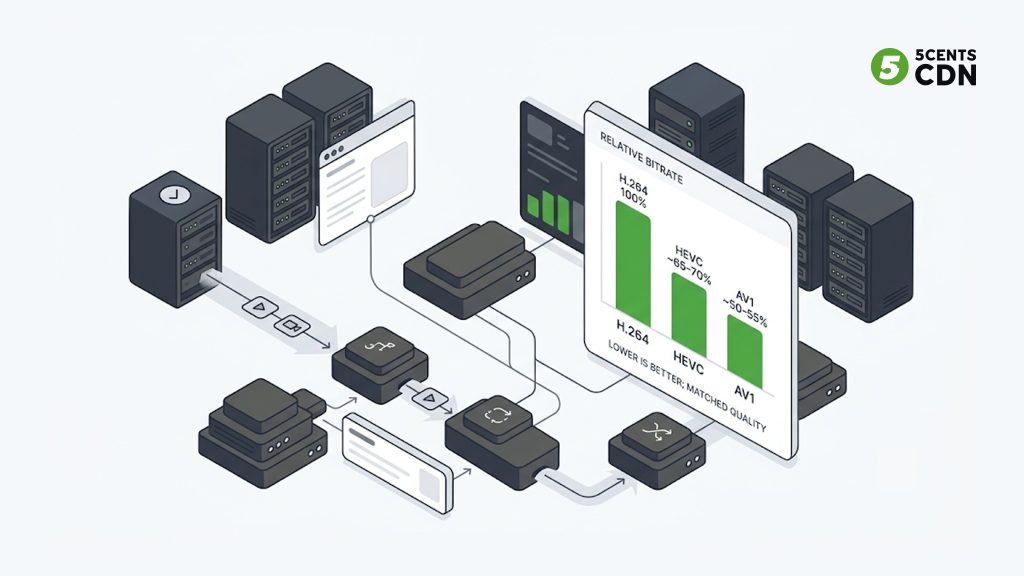
AV1 is an open, royalty-free video codec built by the Alliance for Open Media. It delivers roughly 30% better compression than HEVC and around 50% better than H.264 at matched quality — meaning smaller files, lower bandwidth, and reduced CDN delivery costs — with no licensing fees, which is why it has become the default modern codec for large-scale OTT streaming.
For any OTT platform, the codec you encode in quietly controls one of your biggest line items: delivery bandwidth. AV1 has moved from ‘promising but impractical’ to the codec powering a large share of the world’s streaming — by 2026 it serves roughly 30% of one major platform’s streams and over 75% of another’s playback. This guide explains what AV1 is, how it compares to HEVC and H.264, the 2026 device reality, and — the part that matters most — when and how to adopt it without leaving viewers behind. If you’re running the delivery side, our OTT & media solutions pair with the strategy below.
What is the AV1 codec?
AV1 (AOMedia Video 1) is a video compression format developed by the Alliance for Open Media — a consortium that includes the largest technology, streaming, and chip companies. It was published in 2018 as a successor to VP9, designed from the start for internet video. Its defining characteristics are two: exceptional compression efficiency, and a royalty-free licensing model. Both matter enormously at OTT scale, and together they are why AV1 adoption accelerated so fast once hardware caught up.
How much bandwidth does AV1 actually save?
Compression efficiency is AV1’s headline. At matched perceptual quality — measured with metrics like VMAF — AV1 streaming sessions are reported to use roughly one-third less bandwidth than both H.264 (AVC) and HEVC (H.265), while scoring slightly higher on quality. The practical, viewer-facing result reported by large platforms is a substantial drop in buffering — around 45% fewer rebuffering interruptions — because smaller segments arrive faster and adapt more gracefully on weak connections.
| Codec | Relative bitrate (same quality) | Licensing | Notes |
|---|---|---|---|
| H.264 (AVC) | ~100% (baseline) | Near royalty-free, universal | Oldest, most compatible, least efficient |
| HEVC (H.265) | ~65–70% | Complex, multi-pool royalties | Strong 4K/HDR; licensing slows OTT adoption |
| AV1 | ~50–55% | Royalty-free | Best efficiency; higher encode cost |
Figures are industry-reported approximations at matched quality and vary by content, encoder, and settings. Treat as directional.
The royalty-free advantage
The technical story gets most of the attention, but for OTT operators the economic story is just as important. HEVC delivers excellent compression, yet its licensing environment is fragmented across multiple patent pools, creating cost and legal uncertainty that scales with your audience. AV1 is royalty-free by design — you can encode, decode, and distribute it without per-stream licensing fees. At small scale that’s a footnote; at millions of streams it is a structural advantage, and it’s a major reason the largest platforms standardized on AV1. (It’s worth noting some patent-pool operators have made AV1 royalty claims, which AV1’s backers have publicly rejected; the codec’s governance is explicitly built to keep it royalty-free.)
AV1 device support in 2026
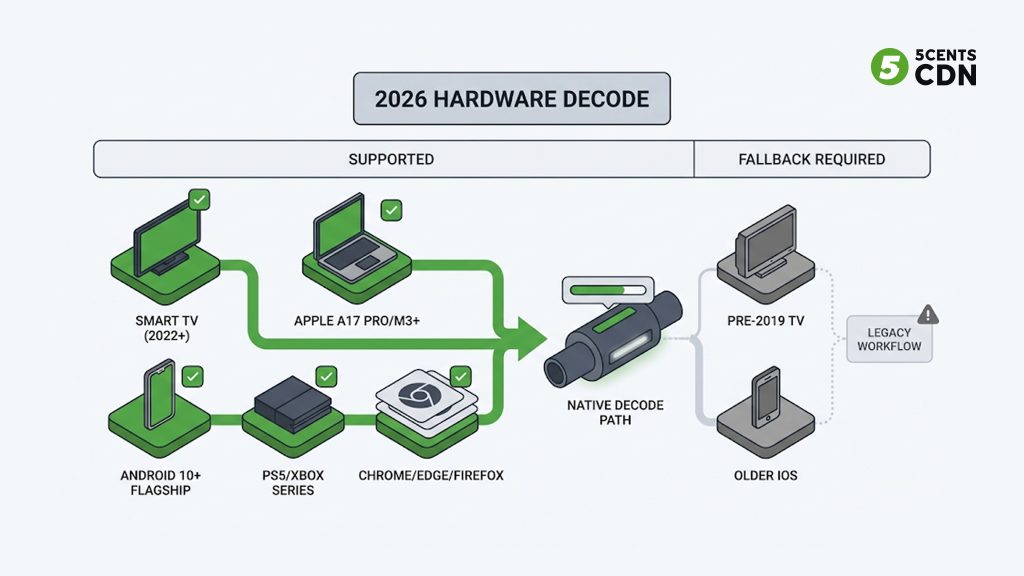
AV1’s biggest historical blocker was playback support — a codec is only useful if the viewer’s device can decode it efficiently. That blocker has largely fallen. In 2026, AV1 hardware decode covers the large majority of active consumer devices. Practically every smart TV manufactured since 2022 ships AV1 decode (across the major TV brands), modern streaming sticks and the current game consoles support it, Android flagships from 2020 onward decode it, and the major desktop browsers play it. Apple — historically the last holdout — added AV1 hardware decode starting with its A17 Pro and M3-class chips in 2023, and has expanded it across newer models since.
The gap that remains is the older-device tail: pre-2019 smart TVs, first-generation streaming sticks, and older iOS hardware. This tail is exactly why AV1 is almost never deployed alone — a fallback codec is required for full coverage. Auditing your own device mix is the first real step in any AV1 decision: if 90%+ of your delivered minutes hit AV1-capable devices, the case is strong; if you serve a large legacy CTV tail, you’ll lean more on fallback.
The encoding trade-off
AV1’s one genuine cost is encoding. Producing AV1 is far more computationally intensive than H.264 — high-quality software AV1 encoding can run many times slower than equivalent H.264 — which raises transcoding cost and, for live, latency. Hardware AV1 encoders (modern GPUs and dedicated ASICs) close much of the speed gap, with software still edging ahead on quality at a given bitrate. The encoder landscape has matured: SVT-AV1 has become the production workhorse, with mid presets hitting practical speeds for VOD. The point for operators is that encoding is usually a small slice of total video cost — often 10–20% — while CDN bandwidth and storage dominate. That ratio is what makes the AV1 business case work: you pay more once to encode, then save on every stream delivered. A robust video encoding pipeline is what turns that trade into a net win.
Does AV1 pay off? The cost math
The decision comes down to a simple ratio: extra encode cost versus delivery savings. Because AV1 segments are roughly a third smaller than H.264 at the same quality, every delivered stream costs less in CDN egress. For a high-volume VOD library, the saved bandwidth across millions of views dwarfs the one-time encode premium on the most-watched titles. A common, pragmatic pattern is to re-encode only the top slice of a catalog — the most-watched assets often account for the large majority of delivery — capturing most of the savings without re-encoding everything. Model your own break-even with the video encoding calculator and the CDN cost calculator before committing.
VOD vs live: where AV1 fits today
VOD is the easy win. You encode once and deliver many times, so the encode cost amortizes across every view and the bandwidth savings compound. For an on-demand video on demand library, AV1 is close to a no-brainer where device coverage allows.
Live is harder — but viable. Real-time AV1 encoding is tighter on latency than H.264 or HEVC. Hardware AV1 encoders and the faster SVT-AV1 presets make low-latency live AV1 practical in 2026, though many operators still run HEVC or H.264 for the lowest-latency live tiers and reserve AV1 for VOD and less latency-critical live. A capable live transcoding pipeline with hardware acceleration is what makes live AV1 feasible.
How to adopt AV1: the multi-codec ladder
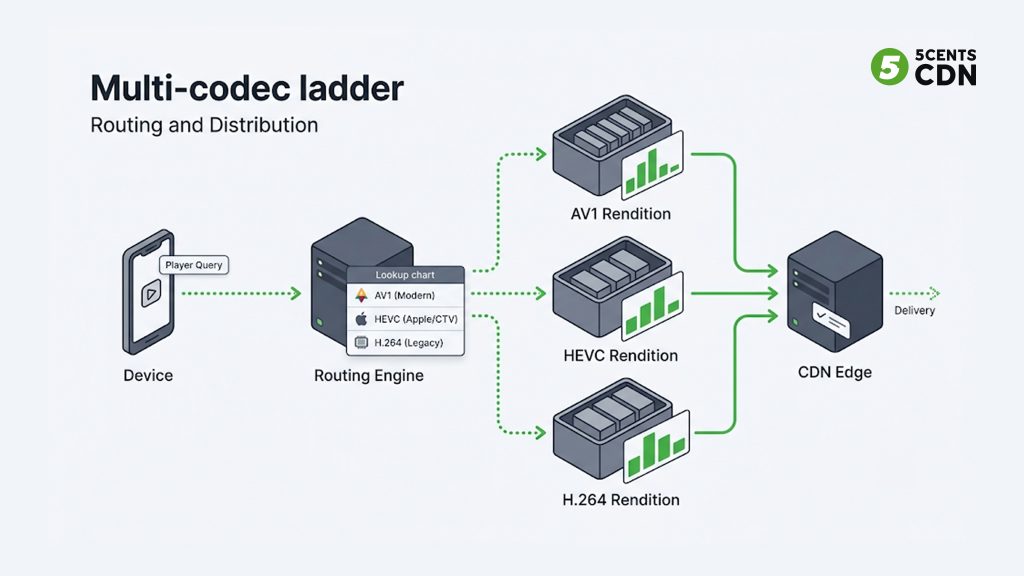
The production answer to the device-tail problem is the multi-codec ladder: encode content in more than one codec and let the player pick the best one each device supports. It works alongside adaptive bitrate — each codec gets its own bitrate ladder of renditions.
- Encode renditions in AV1, plus HEVC and/or H.264 as fallback, across your ABR ladder.
- Generate HLS or DASH manifests that list every codec/bitrate combination available.
- At playback, the player queries the device for AV1 hardware decode support.
- AV1 renditions are served to capable devices; HEVC or H.264 is served to the rest.
- The CDN serves the matched rendition from edge cache — and AV1’s smaller segments cut egress per stream.
Which combination to run depends on your audience. If your viewers are overwhelmingly on post-2023 hardware, AV1 with a light fallback is enough. Most production stacks straddle a few hardware generations and run AV1 + HEVC, with H.264 added as a universal safety net when a meaningful legacy tail exists. This same pattern future-proofs you: when the royalty-free successor AV2 arrives on devices, it simply becomes another rung — a config change, not a re-architecture. For the HEVC side of the ladder, see our H.265 streaming guide, and for the underlying mechanics, what is video transcoding and transcoding for streaming.
Should you adopt AV1?
| Your situation | Recommendation |
|---|---|
| Audience 90%+ on post-2023 devices | AV1 with light fallback — strong case |
| Audience straddling 2020–2025 hardware | AV1 + HEVC dual ladder (most platforms) |
| Significant legacy CTV / older Android / older iOS | AV1 + HEVC + H.264 triple ladder |
| High-volume VOD library, rising CDN bill | Adopt AV1 on top-watched assets first |
| Lowest-latency live as the priority | Keep HEVC/H.264 for live; AV1 for VOD |
If you’re weighing AV1 for your platform, 5centsCDN supports AV1 as part of our video encoding pipeline — alongside HEVC and H.264 for full multi-codec device coverage — so you can capture the bandwidth savings without leaving viewers behind. If that’s something you’re exploring, get in touch and we’ll help you scope the right codec strategy for your audience and catalog.
Frequently asked questions
Is AV1 better than HEVC?
In compression, yes — AV1 delivers roughly 30% better efficiency than HEVC at matched quality, and it’s royalty-free, which removes HEVC’s licensing complexity. HEVC still has broader support on some older devices, so most platforms run both: AV1 where supported, HEVC as a fallback.
Is AV1 royalty-free?
Yes. AV1 was designed to be royalty-free and is governed by the Alliance for Open Media specifically to keep it that way. Some patent-pool operators have made royalty claims, but AV1’s backers have publicly rejected them, and there has been no successful challenge to its royalty-free status.
Does my device support AV1?
Most modern devices do. Smart TVs made since 2022, current game consoles, Android flagships from 2020 on, Apple devices with A17 Pro/M3 chips or later, and the major desktop browsers all support AV1. Pre-2019 TVs and older iOS devices generally need an HEVC or H.264 fallback.
How much bandwidth does AV1 save?
At matched quality, AV1 uses roughly one-third less bandwidth than H.264 and HEVC. For OTT platforms that translates into lower CDN egress per stream and fewer buffering interruptions for viewers — the saving compounds across high-volume delivery.
Should I use AV1 for live streaming?
You can, but it’s tighter than VOD. Real-time AV1 encoding is more demanding on latency, so it needs hardware acceleration or fast SVT-AV1 presets. Many operators adopt AV1 for VOD first and keep HEVC or H.264 for the lowest-latency live tiers.