

A content delivery network spreads your content across many edge locations so viewers are served from somewhere nearby. But those edges all share one weakness: when they don’t have a requested file cached, they go back to your origin server to get it — and with dozens or hundreds of edge locations, your origin can end up fielding the same request many times over. Origin shield is the CDN feature that fixes this. It inserts a single intermediate caching layer between the edges and your origin, so that no matter how many edges need a file, your origin serves it approximately once. This guide explains how origin shield works, the problem it solves, where to place it, and when it’s worth enabling.
What Origin Shield Is
Origin shield — also called a shield tier, mid-tier cache, or shield PoP — is an additional caching layer that sits logically between a CDN’s global edge servers and the origin. Instead of every edge location pulling from the origin independently on a cache miss, edges pull from the shield, and only the shield talks to the origin.
The effect is to turn a many-to-one relationship into a funnel. Without a shield, all your edge PoPs are clients of your origin. With a shield, the edges become clients of the shield, and the shield is the origin’s single well-behaved client. Your origin’s view of the world shrinks from “hundreds of caches asking me for things” to “one cache asking me for things,” which is far easier and cheaper to serve.
A useful way to picture it: without a shield, every checkout lane in a supermarket sends a runner to the warehouse whenever a shelf is empty, and the warehouse is mobbed. With a shield, there’s one stockroom between the lanes and the warehouse — the lanes ask the stockroom, and the stockroom makes a single trip to the warehouse for anything it’s missing.
How Origin Shield Works
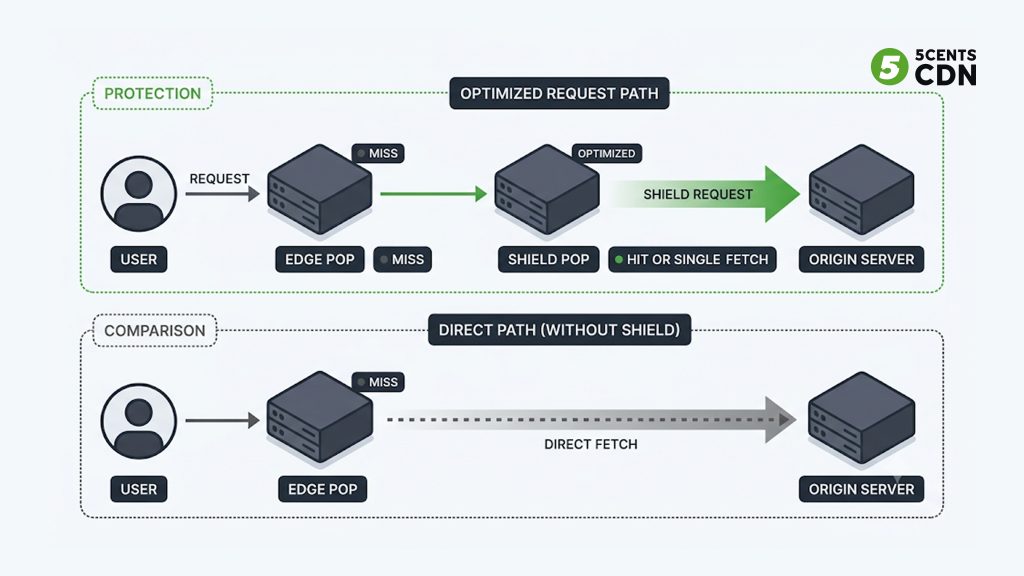
Follow a single request through a shielded CDN and the mechanism is clear:
- The user’s request reaches the nearest edge PoP. If the edge has the file cached, it serves it immediately — the shield isn’t involved at all. Most requests end here.
- On an edge cache miss, the edge does not go to the origin. It forwards the request to the shield PoP.
- If the shield has the file, it returns it to the edge, which caches and serves it. The origin is never touched.
- Only if the shield also misses does it make a single request to the origin, cache the response, and pass it back to the edge.
The consequence is that popular content is fetched from the origin roughly once and then served to every edge from the shield. The first edge to want a file pays the cost of the origin fetch (via the shield); every other edge gets it from the shield’s cache. Your origin does a fraction of the work it would otherwise.
Some CDNs signal shield involvement with a response header so you can confirm it’s active and observe hit behaviour in your CDN logs, which is worth checking when you first enable it.
The Problem It Solves: The Thundering Herd
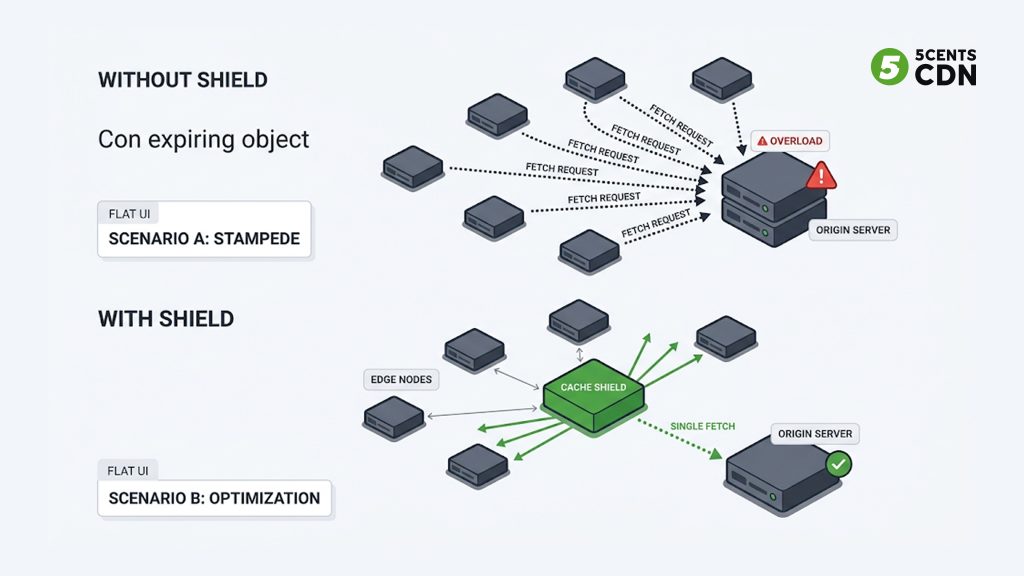
The clearest way to understand origin shield’s value is the scenario it prevents. Imagine a popular file — a product image, a software update, a video segment — expires from cache, or is freshly published, across a CDN with 100 edge PoPs. The next request at each of those PoPs is a miss. Without a shield, all 100 edges turn to the origin at nearly the same instant for the same object. Your origin, which was idle a moment ago, is suddenly hit with 100 identical requests.
This is a version of the thundering herd problem (in caching contexts often called a cache stampede): many clients simultaneously miss the same cache entry and all stampede the backend at once. It’s sudden, coordinated, and self-amplifying — precisely the kind of load that topples an origin that was coping fine seconds earlier.
Origin shield defuses it with request collapsing (also called request coalescing). Because all 100 edges now route through the shield, the shield sees the flood of identical requests and forwards just one of them to the origin, holding the rest until that single response arrives — then fans the cached object back out to all 100 edges. A hundred-request stampede becomes a single origin fetch. The arithmetic is stark: 100 edges, 1 origin request. For an origin on modest infrastructure, or during a cache-warming event after a purge or deploy, that difference is the difference between staying up and falling over.
The Benefits
Origin offload and cost
The headline benefit is dramatically reduced origin load. Fewer origin requests means less compute, less origin bandwidth, and lower egress cost from your origin — which is often billed per gigabyte. For teams whose origin is a cloud bucket or a single server, cutting origin fetches by a large factor is both a stability win and a direct cost saving.
Higher cache hit ratio
A shield raises your effective cache hit ratio because it acts as a consolidated second-chance cache. Content that has been evicted from a busy edge, or that a cold edge has never seen, can still be served from the shield rather than the origin. It also smooths cold starts: after a cache purge or a new deployment, content is pulled to the shield once and then distributed to edges from there, instead of every edge independently re-fetching from the origin.
Origin protection
By ensuring the origin only ever talks to the shield, you shrink its exposure. Far fewer direct connections reach the origin, which reduces its attack surface and helps it ride out traffic spikes it couldn’t otherwise absorb. Origin shield isn’t a security product — it doesn’t filter or block malicious requests the way a web application firewall does — but by consolidating traffic it provides a genuine layer of resilience in front of your infrastructure.
Where to Place the Shield
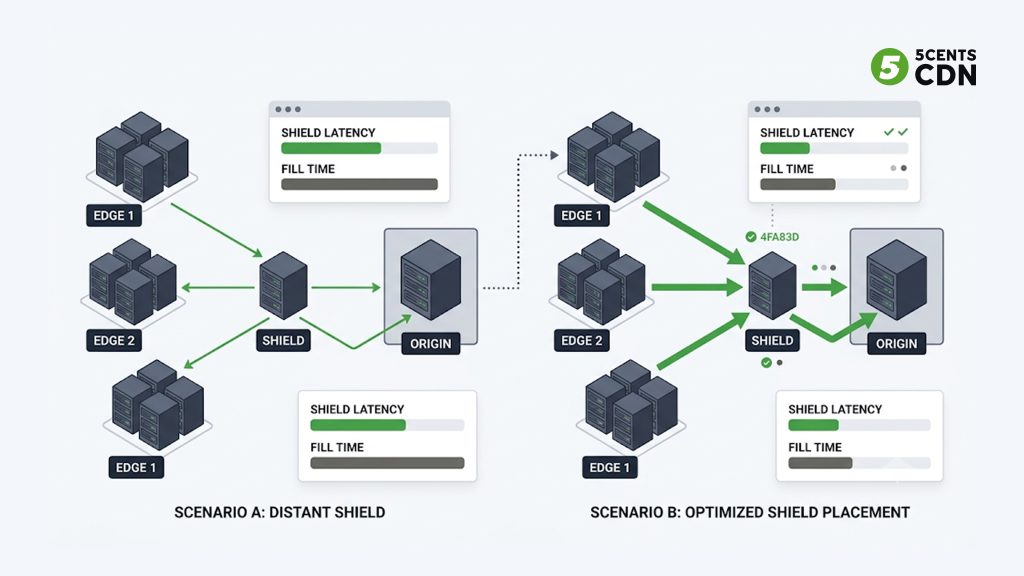
Shield placement is the main tuning decision, and the usual guidance is to place the shield close to your origin. The reasoning is about which network hop you want to make short. Once a shield is in the path, a cache miss travels edge → shield → origin. The edge-to-shield hop happens on the CDN’s own fast backbone, but the shield-to-origin hop crosses to your infrastructure. Putting the shield near the origin keeps that final, off-network hop as short as possible, so cache-fill latency stays low.
If your origin sits in a specific region, choose a shield location in or near that region. Some CDNs let you pick the shield PoP explicitly; others select and manage it automatically. Where you’re given the choice and your origin’s location isn’t the deciding factor, the region with your highest cache-hit rate is a reasonable alternative anchor.
The Trade-Offs
Origin shield is not free of cost in every sense, and a balanced view matters. The main trade-off is latency on cache misses. Adding a shield inserts an extra hop into the miss path: instead of edge → origin, a miss now travels edge → shield → origin. For content already cached at the edge — the overwhelming majority of requests on a well-tuned CDN — there is no added latency at all, because the shield is never consulted. But for the subset of requests that miss at the edge and also miss at the shield, there is a small additional delay from the extra hop. Sensible shield placement keeps this minimal, and the origin-offload benefit almost always outweighs it, but it’s a real effect worth understanding.
There’s also a conceptual point: a shield concentrates traffic through a single logical layer. Reputable CDN implementations make that layer resilient rather than a single point of failure, but it’s a reason to rely on the CDN’s managed shield behaviour rather than improvising your own.
When Origin Shield Helps — and When It Doesn’t
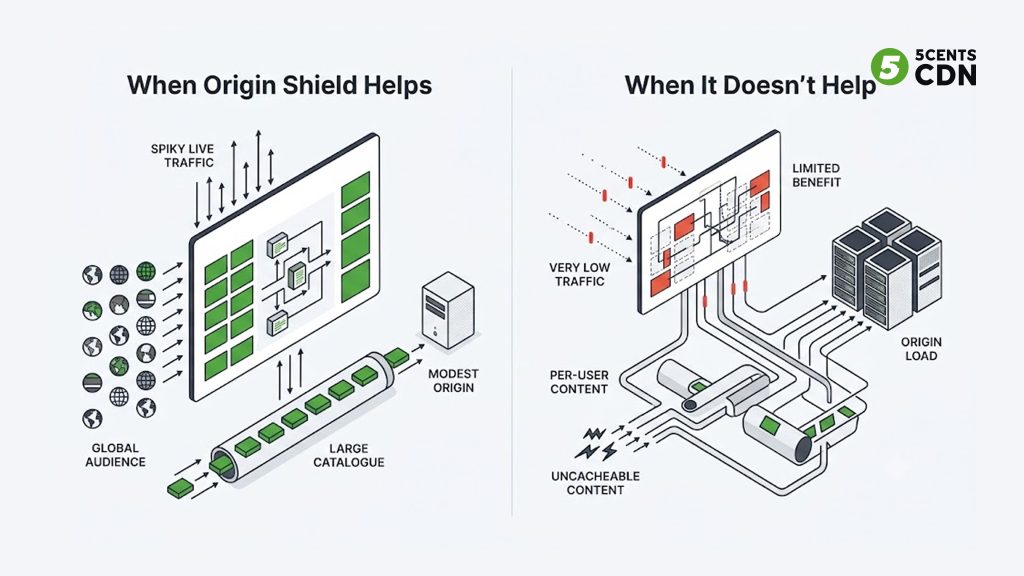
Origin shield delivers the most value in specific conditions, and relatively little in others. It’s a strong fit when:
- You have a global audience across many edge locations. The more edges you have, the more origin fetches a shield consolidates.
- You serve a large content catalogue. Big libraries — a VOD platform, a large media site — have long-tail content that benefits from a consolidated second-chance cache.
- Your traffic is spiky. Live events, product launches, and viral moments create exactly the synchronized cache-miss storms request collapsing was built for.
- Your origin is on modest infrastructure. A single server or a cost-sensitive cloud bucket benefits enormously from being shielded.
It delivers little when:
- Traffic is very low. If few requests overlap, there’s not much duplication to collapse, and the extra hop may not pay for itself.
- Content is highly personalised or uncacheable. If almost every response is unique per user, a shared cache layer has little to cache, so the benefit shrinks.
Origin Shield for Video Streaming
Origin shield is especially relevant to streaming, where the load patterns are exactly the ones it’s built for. A live event produces a continuous stream of fresh segments, each of which is briefly requested by every edge serving that event at almost the same moment — a rolling thundering herd, segment after segment. A shield collapses each of those bursts into a single origin fetch, protecting the packaging origin from load that scales with your edge count rather than your actual content.
For on-demand libraries, the long tail is the issue: a large catalogue means many titles that aren’t hot enough to stay cached at every edge but still get requested from around the world. A shield keeps that mid-popularity content one hop from the edges instead of forcing repeated origin fetches. And because adaptive streaming multiplies every title into many segment files across several renditions, the sheer object count makes origin offload more valuable, not less. If your delivery involves a video encoding pipeline feeding a packaging origin, shielding that origin is one of the highest-leverage reliability improvements available.
Origin Shield with 5centsCDN
5centsCDN provides origin shield as part of its CDN platform, giving you a consolidated mid-tier cache in front of your origin to cut origin load, absorb traffic spikes, and lift cache efficiency across the edge network. It works alongside features like edge rules for fine-grained cache control, and pairs naturally with our live and video delivery stack for streaming workloads. If you’re weighing whether origin shield fits your architecture — and where the shield should sit relative to your origin — talk to our team and we’ll help you work it through.
Frequently Asked Questions
What is origin shield in a CDN?
Origin shield is an additional caching layer that sits between a CDN’s edge servers and your origin server. Instead of every edge location fetching from the origin on a cache miss, edges fetch from the shield, and only the shield contacts the origin. This consolidates requests so the origin serves each file roughly once regardless of how many edges need it.
How does origin shield reduce origin load?
It consolidates cache-miss traffic. When many edge locations miss the same file at the same time, they all route through the shield, which forwards a single request to the origin and then serves the cached copy to every edge. This request collapsing turns what could be hundreds of identical origin fetches into one.
Does origin shield add latency?
Only on cache misses that also miss at the shield, because those requests take an extra hop (edge to shield to origin) instead of going straight to the origin. Content already cached at the edge — the large majority of requests — is unaffected. Placing the shield close to your origin keeps the added latency small, and the origin-offload benefit usually outweighs it.
Where should I place my origin shield?
Generally as close to your origin server as possible. A cache miss travels from edge to shield to origin, and the shield-to-origin hop leaves the CDN’s fast backbone, so keeping it short minimises cache-fill latency. If your origin is in a particular region, choose a shield location in or near that region.
Is origin shield the same as a WAF?
No. A web application firewall inspects and filters requests to block malicious traffic. Origin shield is purely a caching and traffic-consolidation layer — it reduces how much traffic reaches your origin but does not filter or block requests. They solve different problems and are often used together.