

VOD delivery architecture is the layered system that turns a raw video file into on-demand playback for any viewer: content is ingested, transcoded into an adaptive bitrate ladder, packaged into streaming formats, stored in tiers, distributed through a CDN, and protected by DRM and access controls — all prepared before a single viewer presses play.
Every video on demand platform — from a niche course library to a global streaming service — runs on the same architectural pattern. The scale differs, but the layers don’t. Understanding those layers is what lets you design a platform that plays smoothly, scales without breaking, and doesn’t bleed money on delivery. This guide walks the full VOD architecture layer by layer, explains how the pieces fit together, and closes with the practical questions that matter most: how to scale it, and whether to build or buy. If you’re running the delivery side, our video on demand stack maps directly onto the architecture below.
What makes VOD architecture different from live
The defining trait of VOD is that everything happens before the viewer arrives. A live stream is generated and delivered in real time, with no second chances; VOD content is ingested, processed, and pre-positioned at the edge ahead of demand. That single difference cascades through the whole architecture: VOD can use slower, higher-quality multi-pass encoding because nothing is waiting on it; its segments are highly cacheable and can sit at edge nodes for hours or days; and its origin load stays low because popular titles are served almost entirely from cache. The trade-off is storage — a large library has to live somewhere, organized and retrievable. For a full side-by-side of the two models, see our live streaming vs VOD guide; here we focus on the on-demand pipeline itself.
The five layers of VOD architecture
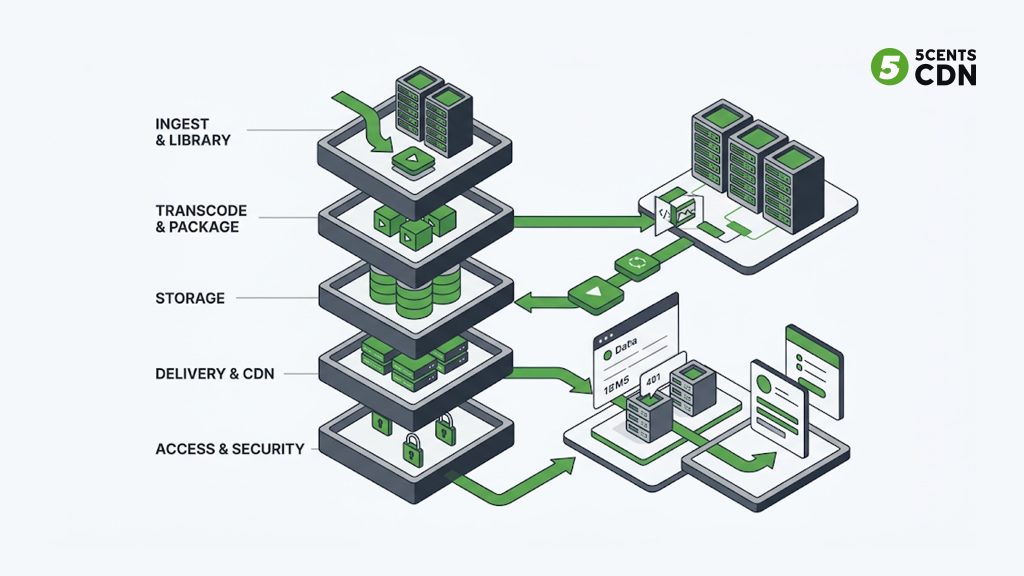
A VOD platform is cleanest to reason about as five layers, each handing off to the next, with security wrapping the whole flow:
- Ingest & library — getting source content in and organized.
- Transcoding & packaging — converting it into adaptive renditions and streaming formats.
- Storage — holding processed assets in cost-appropriate tiers.
- Delivery & CDN — moving segments from origin to edge to viewer.
- Access & security — controlling who can watch and protecting the content.
Let’s walk each one.
Layer 1: Ingest and content library
Ingest is the front door. Source files — often large, high-bitrate masters — are uploaded into the system, validated, and registered with metadata: title, description, language, thumbnails, categories, and rights information. This metadata layer is what later powers search, recommendations, and the content catalog viewers browse. A video manager handles this organization — uploading, cataloging, and managing a library at scale. Get ingest and metadata right and everything downstream (discovery, playback, analytics) has a clean foundation; get it wrong and you inherit a disorganized library that’s painful to scale.
Layer 2: Transcoding and packaging
Raw masters can’t be streamed directly to every device and network, so the next layer converts them. Transcoding produces an adaptive bitrate ladder — multiple resolution/bitrate renditions of each title — so the player can switch quality to match the viewer’s connection. Because VOD has no real-time constraint, this stage can use slower, higher-quality encoding (multi-pass, per-title optimization) that squeezes the best quality from every bit. Codec choice lives here too: H.264 for universal compatibility, HEVC for efficiency on capable devices, and increasingly AV1 for the best compression — see our AV1 codec for OTT guide for that decision, and VOD video transcoding — how it works for the mechanics.
Packaging is the second half of this layer. Each rendition is segmented into small chunks and wrapped into streaming formats — HLS and MPEG-DASH — with CMAF increasingly used so a single set of segments serves both, cutting storage and cache duplication. For more on how the ABR ladder is designed, our streaming bitrate guide covers the rendition math.
Layer 3: Storage architecture
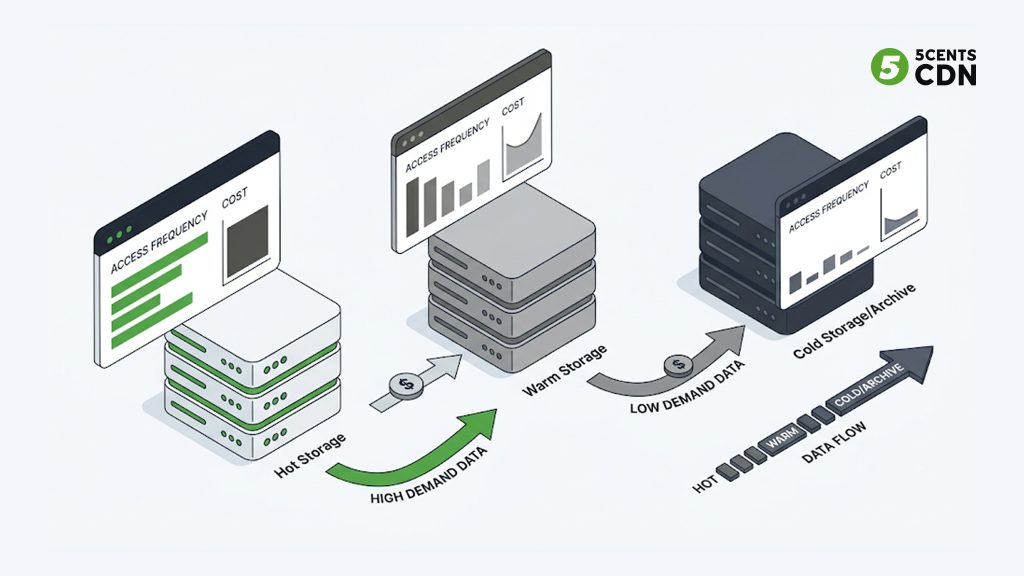
Once processed, assets need a home — and at library scale, storage strategy is a real cost and performance decision, not an afterthought. Most VOD platforms use object storage for its scalability and durability, then organize content into tiers by how often it’s accessed.
| Tier | Holds | Trade-off |
|---|---|---|
| Hot | New releases, trending, most-watched | Fastest access, highest cost |
| Warm | Mid-popularity, recent catalog | Balanced cost/speed |
| Cold / archive | Long-tail, rarely watched, compliance | Cheapest, slower retrieval |
The pattern matters because a small fraction of a catalog usually drives the majority of views. Keeping that hot set on fast storage while letting the long tail fall to cheaper archive tiers controls cost without hurting the viewer experience. Scalable cloud storage with tiering is what makes a large, growing library economical to hold.
Layer 4: Delivery and the CDN
Delivery is where architecture meets the viewer. Processed segments live at an origin, but serving every viewer directly from origin doesn’t scale — it concentrates load and latency at one point. A global CDN solves this by caching segments at edge nodes close to viewers: when someone presses play, the content is already at a nearby edge, served from cache rather than fetched across the world. Because VOD segments are static and highly cacheable, cache hit ratios of 90% and above are normal — meaning the origin handles only a small fraction of total requests.
Two techniques sharpen this further. An origin shield adds a tiered cache layer so even cache misses are absorbed regionally before reaching origin, and consistent segment URLs plus correct cache TTLs keep the hit ratio high. Getting this right is the single biggest lever on delivery cost — our how to improve cache hit ratio guide goes deep, and CDN for OTT platforms covers scaling to large concurrent audiences.
Layer 5: Access, identity, and security
Wrapping the whole pipeline is the layer that decides who watches what, and protects the content in transit and at rest. The common building blocks are DRM (encrypting content and controlling playback on authorized devices), token authentication (time-limited signed URLs that prevent link sharing), and geo-blocking (enforcing licensing and regional rights at the edge). For premium or paid libraries, these aren’t optional — they’re what protects the business. Enforcing them at the edge, through edge rules and secure tokens, keeps protection from becoming a performance drag. Analytics and logging also live here: every viewing event is recorded for QoE monitoring, billing, and audit.
How the layers fit together: the request lifecycle
Put the layers in motion and a single play request looks like this:
- A viewer browses the catalog (ingest/metadata layer) and presses play on a title.
- The player requests the manifest, which lists the available ABR renditions (transcode/package layer).
- Access is verified — token checked, DRM license issued, geo-rules applied (security layer).
- The player requests segments; the CDN serves them from the nearest edge cache (delivery layer), fetching from origin/storage only on a cache miss.
- The player adapts quality up or down as the network changes, pulling the right rendition each time.
Because the heavy work — transcoding, packaging, pre-positioning — happened before playback, the live path is fast and cheap: mostly cache hits served from the edge.
Scaling VOD architecture
Scaling VOD is less about raw horsepower and more about caching and storage discipline. The dominant cost at scale is delivery egress, and the dominant lever is cache hit ratio — every percentage point served from edge instead of origin is bandwidth you don’t pay for twice. Three principles carry most of the weight: keep segment URLs consistent and TTLs correct so the edge caches effectively; tier storage so the long tail doesn’t sit on premium disk; and right-size the ABR ladder so you’re not transcoding or storing renditions devices never request. Codec efficiency compounds all of this — smaller segments mean cheaper delivery and storage at once. Model your own numbers with the video encoding calculator before committing to a ladder or storage plan.
Build vs buy: assembling your VOD architecture
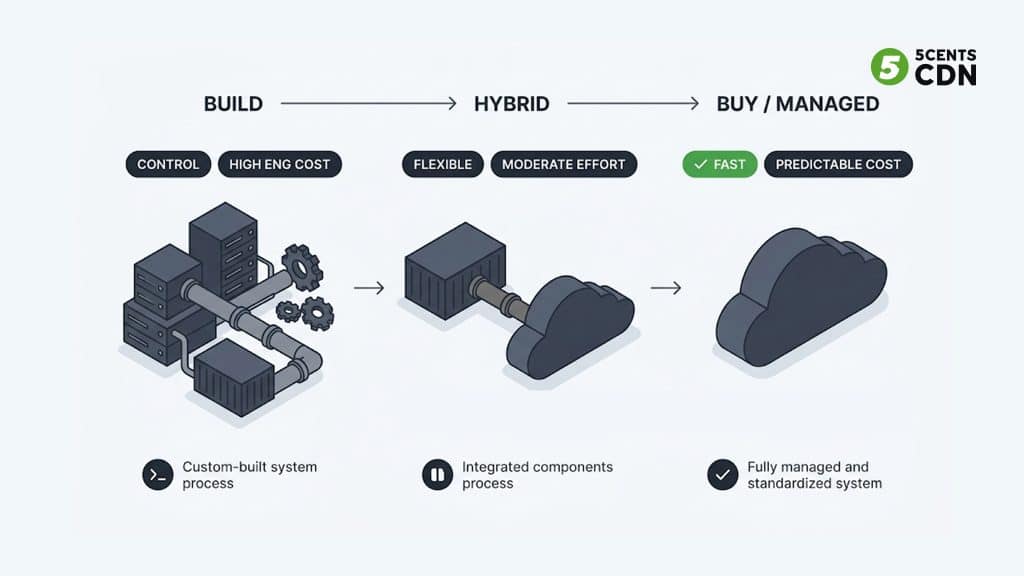
You don’t have to build every layer from scratch. The realistic options sit on a spectrum:
| Approach | Best when | Trade-off |
|---|---|---|
| Build in-house | You have engineering depth + unique needs | Maximum control; high cost + time to ship |
| Managed platform | You want to launch fast and predictably | Speed + simplicity; less low-level control |
| Hybrid (managed delivery, own player/UX) | Most platforms | Control where it matters, offload the rest |
The hybrid path is where most platforms land: own your catalog, player, and viewer experience, and lean on a provider for the transcoding, storage, and CDN delivery layers that are expensive to build and operate well. That keeps you in control of the product while the heavy infrastructure is handled by people who run it at scale. Our OTT & media solutions cover those layers end to end.
Building or scaling a VOD platform?
If you’re designing a VOD architecture — or your delivery costs are climbing as your library grows — 5centsCDN provides the transcoding, scalable storage, and global CDN delivery layers that sit behind a production VOD platform, with edge security and analytics built in. If you’d like help scoping the right setup for your catalog size and audience, get in touch and we’ll walk through the architecture with you.
Frequently asked questions
How does VOD streaming work?
A source video is ingested and tagged with metadata, transcoded into an adaptive bitrate ladder, and packaged into formats like HLS or DASH. The processed segments are stored and distributed to CDN edge nodes ahead of demand. When a viewer presses play, the player streams cached segments from the nearest edge, adapting quality to the network — all secured by DRM and access tokens.
What is a VOD origin server?
The origin is where your processed, packaged video assets live as the source of truth. The CDN pulls from the origin to populate its edge caches; once cached, most viewer requests are served from the edge and the origin handles only a small fraction of traffic. An origin shield adds a regional cache layer to protect the origin further.
Should I use HLS or DASH for VOD?
Both are widely used adaptive formats. HLS has the broadest device support (especially Apple); DASH is an open standard common elsewhere. Many platforms package once with CMAF so a single set of segments serves both HLS and DASH, reducing storage and cache duplication.
How is VOD architecture different from live streaming?
In VOD, transcoding, packaging, and edge pre-positioning all happen before the viewer arrives, so content is highly cacheable and origin load stays low — but you need storage for the library. Live generates and delivers segments in real time with strict latency limits and lower cacheability. They share technologies (HLS, ABR, CDN) but differ in pipeline and cost structure.
Should I build my own VOD platform or use a managed service?
Build in-house only if you have the engineering depth and genuinely unique requirements. Most platforms do better with a hybrid approach — owning the catalog, player, and viewer experience while using a provider for the transcoding, storage, and CDN delivery layers that are costly to build and operate at scale.