

Every adaptive stream reaches a moment, several times a minute, where the player has to make a bet. It has just finished downloading a segment and must decide which quality to request next — reach for a higher rendition and risk a stall, or play it safe and leave quality on the table. The logic that makes that bet, over and over, is the ABR adaptation algorithms, and it is the single biggest factor in whether a stream feels crisp and stable or blurry and stuttering.
This is a deep dive into that decision logic specifically — not what adaptive bitrate streaming is, and not how to design the bitrate ladder the algorithm chooses from. If you need those foundations first, our guides on streaming bitrate and the encoding ladder cover them. Here we assume you know that a player switches between renditions based on conditions, and we open up the part that actually does the switching: how throughput-based, buffer-based, and hybrid algorithms each decide, where each one fails, and why nearly every production player today blends them.
The Decision the Algorithm Has to Make
Before comparing algorithm families, it helps to state the problem precisely, because every ABR algorithm is solving the same constrained optimization. The player is trying to maximize two things that are in direct tension: the highest possible video quality, and the lowest possible rebuffering. Streaming at the top rendition constantly maximizes quality but risks the buffer draining to zero and the video freezing. Streaming at the bottom rendition constantly eliminates stalls but wastes available bandwidth on a soft picture. Every algorithm is a strategy for walking that line.
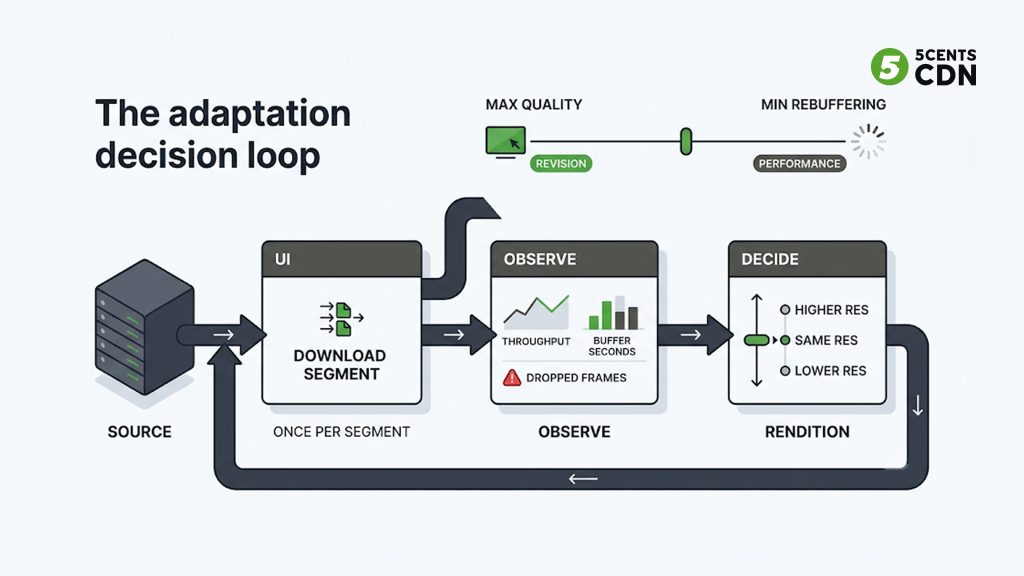
The algorithm runs on the client, segment by segment. After each segment downloads, it has a small set of observations to work with — how fast recent segments arrived, how many seconds of video are sitting in the buffer ahead of the playhead, and sometimes device signals like dropped frames — and it must map those observations to one decision: which rendition to request for the next segment. The differences between algorithm families come down to which observation they trust most when they make that call.
Two structural facts shape everything that follows. First, the player almost always starts at a low rendition and climbs, because at startup it has no download history to estimate from and an empty buffer to protect. Second, the frequency of decisions is set by segment duration: with two-second segments the player re-decides every two seconds; with six-second segments it is locked into each choice three times as long. Segment duration is therefore not just a packaging detail — it directly bounds how fast any algorithm can react, a point we return to at the end.
Throughput-Based Adaptation
The oldest and most intuitive family is throughput-based (also called rate-based) adaptation. Its logic is simple: measure how fast recent segments downloaded, estimate the available bandwidth from that, and pick the highest rendition whose bitrate fits comfortably under the estimate.
Concretely, a throughput-based algorithm records the download time of the last segment or a short window of recent segments, computes an effective throughput, applies a safety margin, and selects the richest rendition below that adjusted number. If recent segments arrived fast, it climbs; if they arrived slowly, it drops. The appeal is responsiveness — it reacts directly to what the network just did, so when bandwidth genuinely improves it can climb quickly to take advantage.
The weakness is that throughput estimates are noisy and, worse, systematically misleading in two common situations. The first is mobile networks, where bandwidth swings wildly second to second; a single fast or slow segment can whipsaw the estimate and send the algorithm chasing a number that no longer reflects reality. The second is more subtle and specific to live and low-latency streaming: when segments are delivered at close to the encoder’s bitrate rather than as fast as the network allows, the measured “throughput” reflects the pace of production, not the true capacity of the link. The algorithm then underestimates available bandwidth and parks the viewer on a lower rendition than the network could actually sustain. This is a well-known failure mode of naive throughput estimation on live streams, and it is one reason pure throughput logic has largely given way to blended approaches.
Throughput-based adaptation also tends toward oscillation. Because it reacts to short-term measurements, it can climb on a fast segment, immediately find the higher rendition too heavy, drop back down, and repeat — producing visible quality flapping that viewers find more annoying than a stable, slightly-lower quality. Damping this requires smoothing the estimate over a window, which trades away some of the responsiveness that was the algorithm’s whole advantage.
Buffer-Based Adaptation
The buffer-based family, popularized by research that showed how far you can get using buffer occupancy alone, flips the primary signal. Instead of asking “how fast is the network?” it asks “how much video do I have in reserve?” and makes the rendition decision primarily from the buffer level.
The reasoning is elegant. The buffer is a direct, noise-free measurement of whether the player is keeping up: if the buffer is growing, the current rendition is sustainable and the player can consider climbing; if the buffer is draining, the current rendition is too heavy regardless of what any bandwidth estimate claims, and the player should drop. The buffer occupancy already integrates the effect of network conditions over time, so it sidesteps the noise and estimation errors that plague throughput measurement.
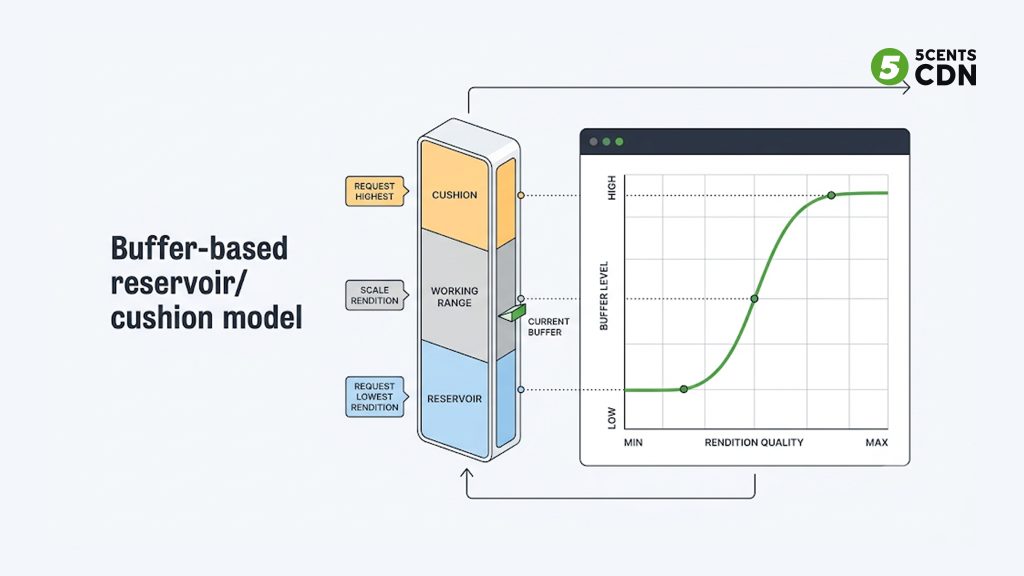
A buffer-based algorithm defines a mapping from buffer level to rendition. Below a low threshold — often called the reservoir — it requests the lowest rendition to refill as fast as possible and protect against a stall. Above an upper threshold — the cushion — it requests the highest rendition, confident there is enough reserve to absorb a download that runs slow. Between the two, it scales the chosen rendition smoothly with buffer level. The reservoir protects against rebuffering; the cushion enables high quality; the region between is the working range.
Buffer-based logic is markedly better at avoiding rebuffering because it acts on the one signal that directly measures the risk. Its weaknesses are at the edges. At startup the buffer is empty, so a pure buffer-based algorithm has nothing to go on and must fall back to conservative behavior or a throughput hint until the buffer fills — which is exactly why startup is the phase where buffer-based logic needs the most help. And on rapidly rising bandwidth, a buffer-based algorithm can be slow to climb: it waits for the buffer to build past its thresholds before reaching for higher quality, leaving bandwidth unused for longer than a throughput-based algorithm would. It is safe, but it can be sluggish to reward a genuinely improved connection.
Hybrid Adaptation: What Production Players Actually Do
| Family | Primary signal | Strength | Weakness |
|---|---|---|---|
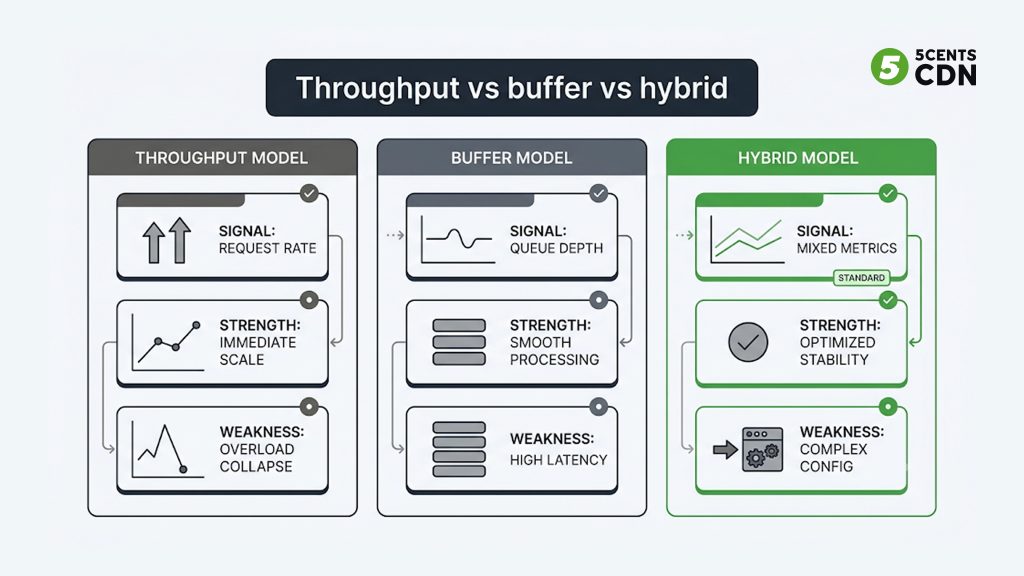
| Throughput-based | Recent segment download speed | Reacts fast to real bandwidth change; good at startup | Noisy; oscillates; misreads live encoder-paced streams |
| Buffer-based | Buffer occupancy (seconds queued) | Stable; strongest at avoiding stalls | Slow to climb; blind at startup (empty buffer) |
| Hybrid | Bandwidth + buffer + dropped frames | Covers both failure modes; production standard | More complex to tune |
| ML-driven | Learned model over the same signals | Can predict change before it shows in metrics | Heavier; less predictable; still emerging |
In practice, almost no serious player uses throughput or buffer logic in isolation, because their strengths and weaknesses are complementary. Throughput estimation is good at reacting to change and at the startup phase where the buffer is uninformative; buffer occupancy is good at steady-state stability and at avoiding stalls. Hybrid algorithms combine both signals, and this is what the major players run today.
A hybrid algorithm weighs several inputs together: the estimated available bandwidth from recent download speeds, the buffer health in seconds ahead of the playhead, and often device-level signals such as dropped frames, which indicate the current rendition is too heavy for the decoder even if the network can deliver it. It uses throughput heavily during startup and rapid changes, and leans on buffer occupancy for steady-state decisions, blending the two so neither signal’s failure mode dominates. The result is a player that climbs promptly when bandwidth truly improves but does not oscillate on noise, and that protects the buffer without being sluggish.
One of the most influential formal approaches in this space, BOLA, framed rendition selection as an optimization problem driven principally by buffer level, and demonstrated that near-optimal decisions can be made from buffer occupancy with throughput used to sharpen behavior. Many production players use a BOLA-derived or BOLA-plus-throughput scheme as their default. The academic literature more broadly classifies these blended designs as control-theoretic — treating adaptation as a feedback control problem that balances quality against buffer risk each step — and this framing is why hybrid approaches have become the default rather than an exception.
The newest direction extends the hybrid idea with machine learning: instead of hand-tuned rules weighing throughput and buffer, an ML model is trained to predict the best rendition from the same observations, and in some designs to anticipate network changes before they show up in measurements rather than reacting after conditions degrade. These approaches are gaining traction in advanced players, though hand-tuned hybrid heuristics remain the workhorse of most production deployments because they are predictable and cheap to run on the client.
The Signals an Algorithm Weighs
Whatever family a player belongs to, the modern ones draw on a common set of inputs, and understanding each clarifies why decisions sometimes look surprising.
Estimated bandwidth comes from the download time of recent segments. It is the most direct read on network capacity but the noisiest, and — as noted — it can be actively misleading on live streams delivered at encoder pace. Its value is in reacting to change and in bootstrapping the startup decision.
Buffer health, measured in seconds of video queued ahead of the playhead, is the stability anchor. It is noise-free and directly measures stall risk, which is why it dominates steady-state decisions in modern players. Its limitation is that it says nothing useful when it is empty, at startup.
Dropped frames are a device signal rather than a network one. If the player is receiving segments fine but the decoder cannot keep up — common when a low-power device is handed a high-resolution, high-bitrate rendition — frames are dropped, and a good algorithm treats that as a cue to step down even though the network is healthy. This is the signal that distinguishes a network problem from a device problem, and algorithms that ignore it can strand a weak device on a rendition it cannot actually render.
Startup state deserves its own mention because the first few decisions are made blind — no download history, empty buffer — and they disproportionately shape perceived quality. Reach too high too fast and the first thing the viewer experiences is a stall; start too low and stay there and the opening looks soft. Startup logic is where much of a player’s tuning effort goes.
Why Segment Duration Bounds Every Algorithm
No adaptation algorithm can react faster than it gets to make decisions, and it gets to decide once per segment. This makes segment duration a hard ceiling on responsiveness that no clever logic can overcome. With long segments, the player commits to each rendition choice for the full segment length, so a sudden bandwidth drop mid-segment cannot be corrected until the next boundary — by which point the buffer may have taken a serious hit. With short segments, the player re-decides far more often and can track volatile networks much more closely.
The trade-off is that shorter segments carry more overhead — more requests, more manifest entries, and, for some codecs, slightly reduced compression efficiency because of more frequent keyframes. This is why segment duration is a joint decision between adaptation responsiveness and delivery efficiency, and why low-latency streaming approaches, which need fast adaptation, lean toward shorter segments or chunked delivery. Packaging in a common format like CMAF with well-chosen chunk sizes lets the same segments serve fast adaptation without multiplying storage. The algorithm and the packaging are two halves of one system: the best adaptation logic in the world is still capped by how often the segment structure lets it act.
Where Delivery Meets Adaptation
A subtle but important point ties this back to infrastructure: every algorithm’s bandwidth estimate is a measurement of the path between the player and wherever the segment came from. If renditions are served from a distant origin, download times are longer and more variable, so throughput estimates are noisier and every algorithm makes worse decisions — not because the logic is bad, but because it is reasoning from degraded data. When renditions are served from a nearby edge cache, download times are short and consistent, throughput estimates are cleaner, and the algorithm can climb confidently and hold quality steady. Good adaptation depends on good delivery. Keeping every rendition warm at an edge close to the viewer is what lets the player’s algorithm see the network clearly enough to make the right bet — which is where the adaptation logic meets the CDN carrying the stream.
Frequently Asked Questions
What is the difference between throughput-based and buffer-based ABR?
Throughput-based adaptation chooses the next rendition by estimating available bandwidth from how fast recent segments downloaded, then picking the highest rendition that fits under the estimate. Buffer-based adaptation instead makes the decision primarily from buffer occupancy — how many seconds of video are queued ahead of the playhead — climbing when the buffer is healthy and dropping when it drains. Throughput logic reacts faster to genuine bandwidth changes but is noisy and can be misled on live streams; buffer logic is more stable and better at avoiding stalls but slower to climb and unhelpful at startup when the buffer is empty. Modern players combine both.
Which ABR algorithm is best?
There is no single best algorithm in isolation, which is why nearly all production players use a hybrid. Pure throughput-based logic reacts quickly but oscillates and misjudges live streams; pure buffer-based logic is stable but sluggish to climb and blind at startup. Hybrid algorithms weigh estimated bandwidth, buffer health, and device signals together, using throughput to handle startup and rapid change and buffer occupancy for steady-state stability, so neither signal’s weakness dominates. The practical answer is a well-tuned hybrid matched to your content, segment duration, and audience.
What is BOLA?
BOLA is an influential ABR algorithm that frames rendition selection as a formal optimization driven principally by buffer occupancy, showing that near-optimal quality-versus-rebuffering decisions can be made largely from buffer level, with throughput used to refine behavior. It is widely implemented as a default or near-default in production players, often combined with a throughput signal. Its significance is demonstrating that a rigorous, buffer-centered approach could match or beat throughput-heavy heuristics on real streams.
Why does my stream keep switching quality up and down?
Visible quality flapping — climbing to a higher rendition, immediately dropping, and repeating — is a classic symptom of throughput-based logic reacting to short-term network noise, especially on mobile connections where bandwidth swings second to second. The algorithm climbs on one fast segment, finds the higher rendition unsustainable, drops, and loops. Fixes include smoothing the bandwidth estimate over a longer window, leaning more on buffer occupancy for steady-state decisions (a hybrid approach), and ensuring adjacent renditions on the ladder are spaced far enough apart that the player is not tempted to hop between near-identical rungs.
Does segment duration affect ABR performance?
Yes, directly. An adaptation algorithm can only make a new decision once per segment, so segment duration sets a hard ceiling on how fast it can react. Long segments lock the player into each choice for longer, so a mid-segment bandwidth drop cannot be corrected until the next boundary; short segments let the player re-decide more often and track volatile networks more closely. The trade-off is that shorter segments add request and packaging overhead, so segment duration is chosen to balance adaptation responsiveness against delivery efficiency.
Can a CDN improve ABR decisions?
Indirectly but meaningfully. Every algorithm’s bandwidth estimate is a measurement of the path to wherever the segment is served from. Serving renditions from a distant origin makes download times longer and more variable, which makes throughput estimates noisier and every algorithm’s decisions worse. Serving from a nearby edge cache produces short, consistent download times and cleaner estimates, letting the player climb confidently and hold quality steady. The adaptation logic lives in the player, but the quality of the data it reasons from depends on how close and consistent your delivery is.
Getting Adaptation and Delivery Working Together
ABR adaptation is a continuous bet between quality and stability, made once per segment from a handful of noisy signals. Throughput-based logic reacts fast but flaps and misreads live streams; buffer-based logic is stable but slow to climb and blind at startup; hybrid algorithms — the production standard — blend estimated bandwidth, buffer health, and device signals so each covers the others’ failure modes, with newer ML-driven designs pushing toward prediction over reaction. And no matter how good the logic, segment duration caps how fast it can act, and delivery quality determines how clearly it can see the network.
| Getting adaptation and delivery working together 5centsCDN provides the delivery side that lets a player’s adaptation algorithm perform at its best — live transcoding and video encoding that produce clean multi-rendition output, an HLS/DASH player that runs ABR across devices, and a global edge network that keeps every rendition warm so throughput estimates stay clean and switching stays fast. If you are building an adaptive streaming pipeline and want the encoding, player, and delivery tuned together, contact our team to talk through your setup. |