

Every ad you see inside a streaming video passed through a chain of systems before it reached your screen, and most explanations of that chain stop at the surface. The short version of DSP vs SSP vs ad exchange goes like this: a DSP helps advertisers buy, an SSP helps publishers sell, and an ad exchange connects the two. That is accurate, but it is not enough to actually understand what is happening — and for anyone monetizing a live stream or a video-on-demand catalog, the surface version is exactly where expensive misunderstandings begin. This guide explains what each platform does, how money and ad requests flow between them, and — the part almost no other guide covers — how that programmatic chain connects to the video delivery path that puts the ad inside your stream.
If you run a streaming service, a FAST channel, or a live event and you have ever been confused about whether you are supposed to be buying ads or selling ad space, this is the article that clears it up.
The one rule that makes everything else make sense
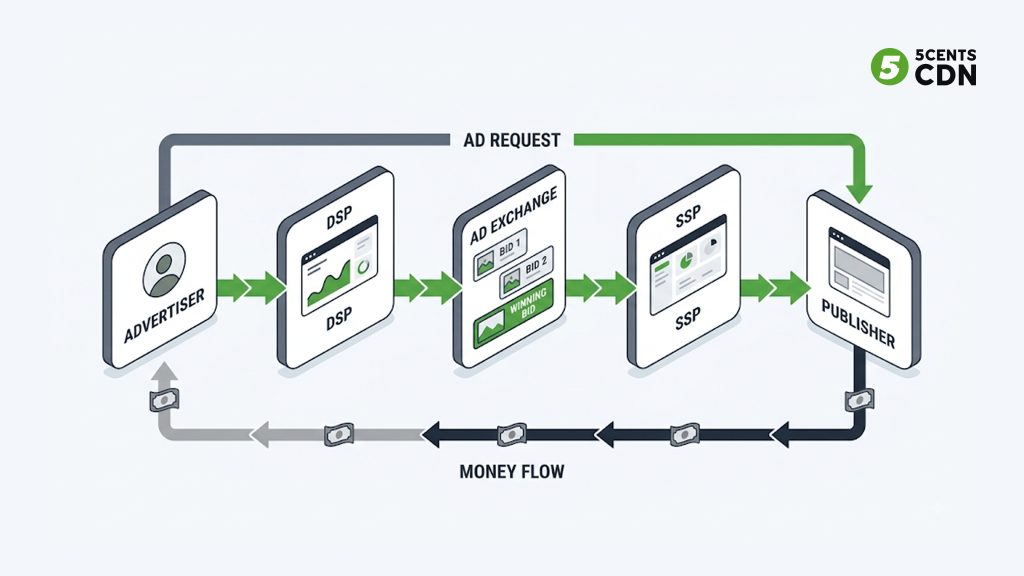
Before any acronym, learn this: in advertising, money flows from the advertiser to the publisher. The advertiser pays. The publisher gets paid. Everyone in the middle takes a cut as the money passes through. That single direction of flow is the compass for the entire ecosystem.
The confusing part is the vocabulary. In ad tech, “buy” and “sell” refer to buying and selling ad space — impressions — not the ads themselves. A publisher sells impressions and receives money. An advertiser buys impressions and pays money. So when someone in this industry says they are “selling,” they mean they are getting paid. Hold onto that, because it is the exact point where most newcomers — and plenty of experienced streaming operators — get turned around.
With that compass set, the two sides of the market become simple. There is a demand side, which represents advertisers who want to spend money to reach an audience. And there is a supply side, which represents publishers who own an audience and want to earn money from it. Every platform in programmatic advertising sits on one of those two sides, or in the marketplace between them.
What is a Demand-Side Platform (DSP)?
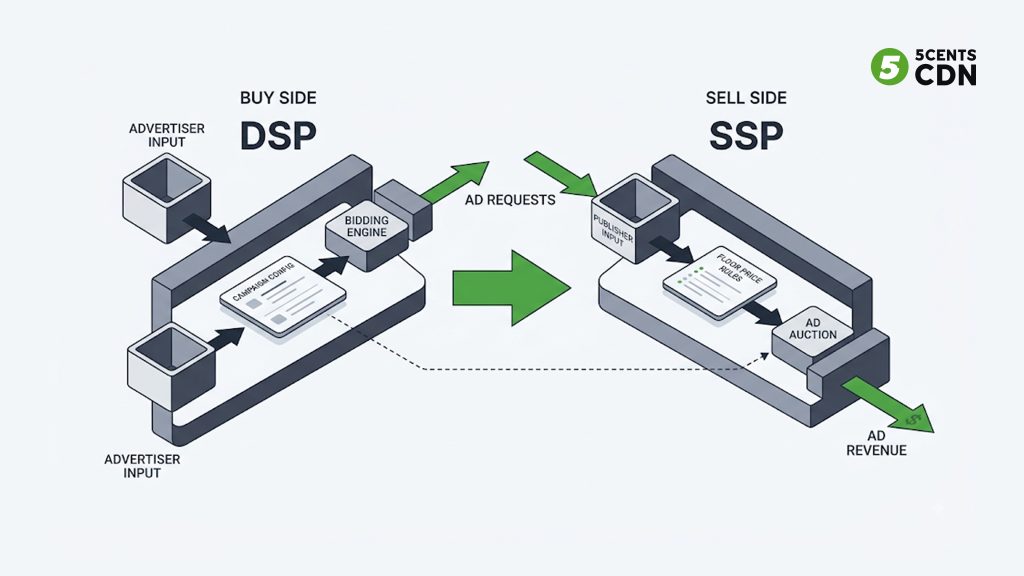
A Demand-Side Platform is software that advertisers, brands, and agencies use to buy ad inventory automatically across many publishers at once. It represents the demand side — the money coming in. An advertiser sets a budget, defines the audience they want, and the DSP spends that budget on their behalf by bidding on individual ad opportunities in real time.
The key word is buy. A DSP is a spending tool. When a car brand wants to reach sports viewers in Canada, or a game studio wants Android users in a certain age band, they express that intent inside a DSP, and the platform goes out and purchases matching impressions wherever they appear. Real examples of DSPs include Google Display & Video 360, The Trade Desk, and Amazon DSP. Each gives advertisers automated, data-driven buying across display, video, connected TV, and mobile.
A DSP decides which impressions are worth bidding on and how much to pay, using audience data and campaign goals, then submits bids in milliseconds as opportunities appear. Its whole reason to exist is to make advertiser money go further: better targeting, smarter bidding, less waste.
What is a Supply-Side Platform (SSP)?
A Supply-Side Platform is the mirror image. It is software that publishers, media owners, and app developers use to sell their ad inventory automatically and earn as much as possible from it. It represents the supply side — the money coming out, toward the publisher.
The key word here is sell. An SSP is an earning tool. A publisher connects their available ad slots to an SSP, and the SSP exposes those slots to many buyers at once, running automated auctions so the highest bid wins. Real examples of SSPs include Magnite, PubMatic, and Google Ad Manager on its sell-side. Their job is yield optimization — squeezing the most revenue out of each impression through competition, price floors, and quality controls.
This is the exact distinction that trips up streaming operators. If you own the audience — you run the channel, the app, the live event — you belong on the supply side. You are a publisher, trying to sell impressions and get paid. You are not, in this role, an advertiser buying ad space. Signing up for the wrong side of a platform is one of the most common and costly mistakes in streaming monetization, and it usually happens because a single company offers both a buy-side and a sell-side product in one login, and the operator picks the wrong door.
A quick note on Google, because it causes real confusion: Google Ad Manager is a publisher tool — it helps you show ads and get paid per impression, which is the supply side. Google’s separate product, Display & Video 360 (DV360), is the DSP — the advertiser’s buying tool on the demand side. Same company, opposite jobs. If your mental model of “the Google ads thing” is “it shows my ads and pays me,” that model describes Ad Manager, not a DSP.
What is an Ad Exchange?
If the DSP is the buyer and the SSP is the seller, the ad exchange is the marketplace where they meet. It is a digital auction house that connects demand and supply and runs the transaction, usually through real-time bidding.
Here is the sequence. A viewer opens a stream or a page, creating an ad opportunity. The SSP packages that opportunity — with context like device, location, and content — and offers it to the exchange. The exchange broadcasts it to connected DSPs. Each DSP evaluates the opportunity against its advertisers’ targeting and budgets and submits a bid. The exchange picks the winner, and the winning ad is returned to be shown. All of this happens in the time it takes a video to reach its first ad frame — typically well under a second.
An ad exchange is not choosing sides. It is neutral infrastructure that makes the auction possible and efficient, the same way a stock exchange matches buyers and sellers without owning the shares.
It is worth noting that the lines between these platforms have blurred in recent years. Some large SSPs now let advertisers buy more directly, and some DSPs build direct relationships with publishers. That is why “same company, two products” situations are so common — a single vendor may run both a demand-side and a supply-side business. For a streaming operator, the practical lesson is not to trust the company name to tell you which side you are on; confirm which product you are actually using and whether it buys inventory or sells it.
Real-Time Bidding: the auction underneath it all
Real-time bidding (RTB) is the auction mechanism that ties DSPs, SSPs, and exchanges together. Rather than negotiating ad placements in advance, RTB auctions each individual impression the instant it becomes available. The moment a viewer triggers an ad slot, a bid request goes out, DSPs respond with bids, the highest bid wins, and the ad is served — per impression, in milliseconds.
RTB is why programmatic advertising scales. A publisher does not need to strike a deal with each advertiser; they simply expose inventory and let the auction find the best price for each view. It is also why targeting matters so much: because each impression is priced individually, an impression in front of the right viewer is worth far more than a generic one.
Streaming video adds a wrinkle that display advertising does not have. In a webpage, an impression is a small box that can load an ad almost instantly. In connected TV and live streaming, an ad break is a fixed window of time — say, ninety seconds — that must be filled with real video, at the right resolution and bitrate, before the viewer notices a gap. That changes the economics: the auction has to resolve fast enough to serve the break, the winning ad has to match the stream’s quality, and if no bid comes in, the publisher needs a fallback rather than dead air. This is why video monetization depends not just on winning bids but on fill rate — the share of ad opportunities actually filled with a paying ad — and why the delivery side of the chain carries weight in streaming that it barely registers in display.
Two supporting acronyms you will meet
Two other platforms show up constantly in these discussions. A Data Management Platform (DMP) collects and organizes audience data and feeds it to DSPs and SSPs so targeting is sharper on both sides — it does not buy or sell, it informs the buying and selling. And an ad server stores the ad creative and delivers it, tracking impressions and clicks. The ad server is the delivery clerk; the DSP and SSP are the traders.
How the players fit together
Put the pieces in order and the flow reads cleanly. An advertiser uses a DSP to buy. A publisher uses an SSP to sell. The ad exchange runs the auction between them. RTB is the bidding that decides each winner. The DMP sharpens targeting on both sides, and the ad server delivers the winning creative. Money flows from the advertiser, through the DSP, exchange, and SSP, to the publisher — with each platform taking a margin along the way.
For a website or a mobile app, that is essentially the end of the story: the winning ad loads into a slot on the page. But for streaming video, there is a second half that the generic guides never cover — and it is the half that determines whether the ad actually appears cleanly inside your stream or breaks the viewing experience.
Where video changes everything: from ad decision to ad insertion
In display advertising, once the auction picks a winner, the ad simply renders in a box. In video, winning the auction is only the decision. The ad still has to be physically placed inside a moving stream that is already being delivered to thousands of viewers at different quality levels — and that is a delivery-infrastructure problem, not an advertising problem.
This is the distinction that matters most for a streaming business, and it is precisely the one that gets lost. The DSP, SSP, and exchange decide which ad to show and what it is worth. None of them put the ad into your video. That job belongs to a different layer entirely: the ad insertion and delivery layer, which sits inside the video path.
Here is how the two halves connect for a live stream. The stream carries ad-break signals — commonly SCTE-35 markers — that announce when a commercial break is starting. When a break opens, the streaming platform generates an ad request and sends it toward the demand side. The response comes back in a standard format called VAST (Video Ad Serving Template), which describes the ad: which video file to play, how long it runs, and how to track it. The streaming platform then has to take that ad and stitch it into the stream so the viewer sees it as a seamless part of the broadcast.
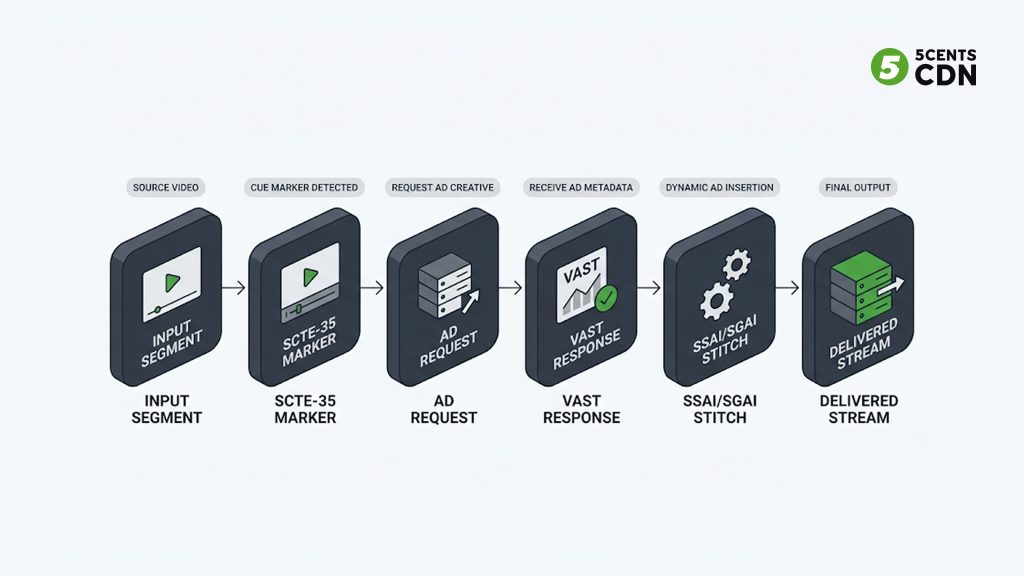
That stitching is done through server-side ad insertion (SSAI) or server-guided ad insertion (SGAI) — techniques that live in the video infrastructure, not in the ad marketplace. This is why publishers who already have a demand source still need a separate streaming and insertion partner: the demand side answers “which ad,” and the delivery side answers “how it gets into the video.” They are two different industries connected by one standard, VAST.
Understanding this split resolves the most common streaming-monetization mix-up of all. A demand partner can hand you a VAST endpoint that returns ads, but it will not stitch those ads into your stream — that is not what a demand platform does. Conversely, an insertion platform places whatever ad the VAST response returns, but it does not decide which advertiser wins or set the price. You generally need both, and knowing which is which is what stops you from signing up for the wrong service.
Where 5centsCDN fits
5centsCDN sits in the video delivery and insertion layer — the second half of the chain. Because we already operate the streaming path, we can detect the ad break, send the ad request, read the VAST response, and stitch the selected ad into your live or on-demand stream using SSAI or SGAI, then deliver it worldwide over the CDN. In practice that means you bring the demand — your own advertising source or a demand partner’s VAST endpoint — and we handle the technology that places those ads cleanly inside your stream. Our ad insertion product covers the stitching, and our ad manager adds a decisioning and demand-routing layer for publishers who want to manage multiple demand sources, fallback rules, and reporting in one place. If you are still deciding how to monetize at all, our OTT monetization models guide walks through AVOD, FAST, and the rest.
The takeaway is simple: the DSP, SSP, and ad exchange are the marketplace that decides which ad wins and what it costs. The insertion and delivery layer is what actually puts that ad into your video and gets it to the viewer. Both matter, they are different jobs, and confusing them is the single most expensive misunderstanding in streaming advertising. If you want to talk through where your setup sits in this chain, get in touch with our team.
Frequently asked questions
What is the main difference between a DSP and an SSP?
A DSP (demand-side platform) is used by advertisers to buy ad inventory and spend budget; an SSP (supply-side platform) is used by publishers to sell ad inventory and earn revenue. They sit on opposite sides of the same transaction — one represents the money coming in, the other the money going out to the publisher.
Is a publisher on the demand side or the supply side?
The supply side. If you own the audience — a channel, an app, a live event — you are a publisher, and your role is to sell impressions and get paid. You would only be on the demand side if you were acting as an advertiser buying someone else’s ad space.
Does a DSP or SSP insert ads into my video stream?
No. DSPs, SSPs, and ad exchanges decide which ad wins and what it costs. Physically placing the ad inside a video stream is done by an ad insertion layer using server-side (SSAI) or server-guided (SGAI) ad insertion, which lives in the streaming infrastructure, not in the ad marketplace.
What is the difference between an ad exchange and an SSP?
An SSP represents the publisher and works to sell that publisher’s inventory for the highest price. An ad exchange is neutral marketplace infrastructure where SSP-supplied inventory is auctioned to bidding DSPs. The SSP takes a side; the exchange runs the auction between sides.
Do I need both a demand source and a streaming platform to run ads?
Usually yes. A demand source (via a VAST endpoint) supplies the ads and decides which advertiser wins; a streaming and insertion platform detects the ad break, reads the VAST response, and stitches the ad into your stream. The two are separate functions connected by the VAST standard.