


When evaluating video CDN vs standard web CDN, a video CDN is a content delivery network built specifically for streaming—it caches and delivers adaptive bitrate video segments at scale, with low startup time and live-origin support, while a standard web CDN is optimized for static files like HTML, CSS, images, and scripts.
Once you’ve decided you need a content delivery network (and if you haven’t, start with our guide on CDN vs no CDN for video streaming), the next question is which type of CDN you actually need. Most general-purpose CDNs can technically move video — but a video-optimized CDN is built for the demands streaming puts on delivery. This guide explains the difference and how to choose.
What is a standard web CDN?
A standard web CDN — a global CDN in the everyday sense — caches and delivers the static assets that make up a website: HTML pages, CSS, JavaScript, images, fonts, and downloadable files. It places copies of those files on edge servers worldwide so a visitor loads them from a nearby location instead of a distant origin. For most websites and web apps, that’s exactly what’s needed: small files, cached once, served many times.
What is a video CDN?
A video CDN does the same edge-caching job, but it’s engineered for the specific shape of streaming traffic. Instead of one static file, video on demand delivery and live streams are broken into many small time-based segments, encoded at multiple quality levels using adaptive bitrate streaming. A video CDN caches and serves those segments while the player switches bitrates on the fly, keeps startup time low, and — for live — pulls fresh segments from origin in real time.
Why video breaks a general-purpose web CDN
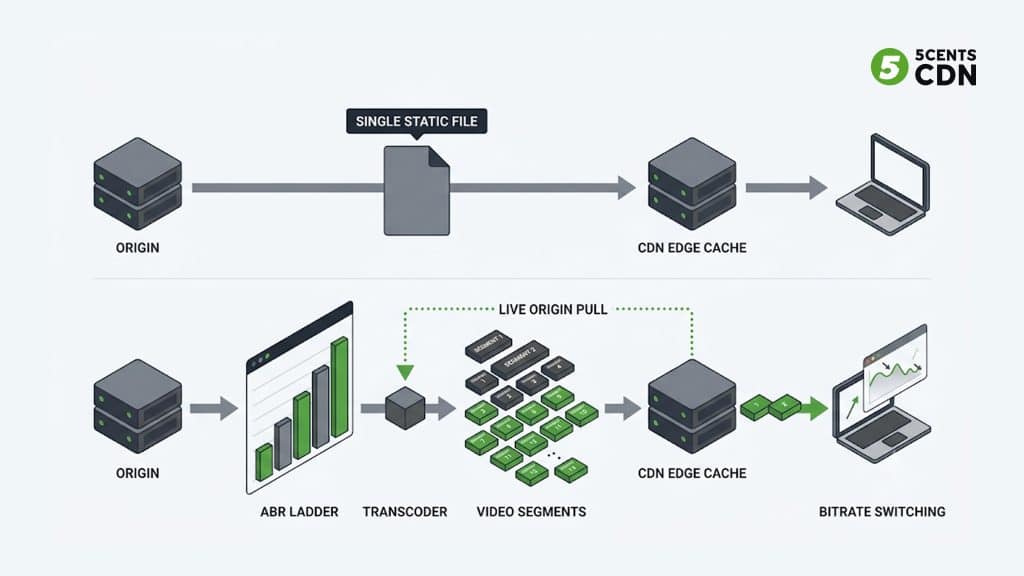
Video isn’t just ‘bigger’ web content — it behaves differently in ways that stress a standard web CDN:
- Huge, continuous volume: a single 4K title can be several gigabytes; a live event multiplies that across thousands of concurrent viewers.
Segmented, multi-rendition delivery: with HLS or DASH (see the HLS spec, RFC 8216), one stream becomes hundreds of segments across an ABR ladder — all of which need consistent edge caching.
- Strict startup-time and rebuffer expectations: viewers abandon slow streams in seconds, so a video CDN is tuned for fast first-frame and minimal rebuffering.
Live origin pull: live streams can’t be pre-cached, so the CDN must fetch and distribute segments continuously — often paired with live transcoding to produce the ABR renditions.
- Streaming-specific security and control: token authentication, geo-blocking, and signed URLs for content licensing — beyond what a basic web CDN typically exposes.
Video CDN vs standard web CDN: side-by-side
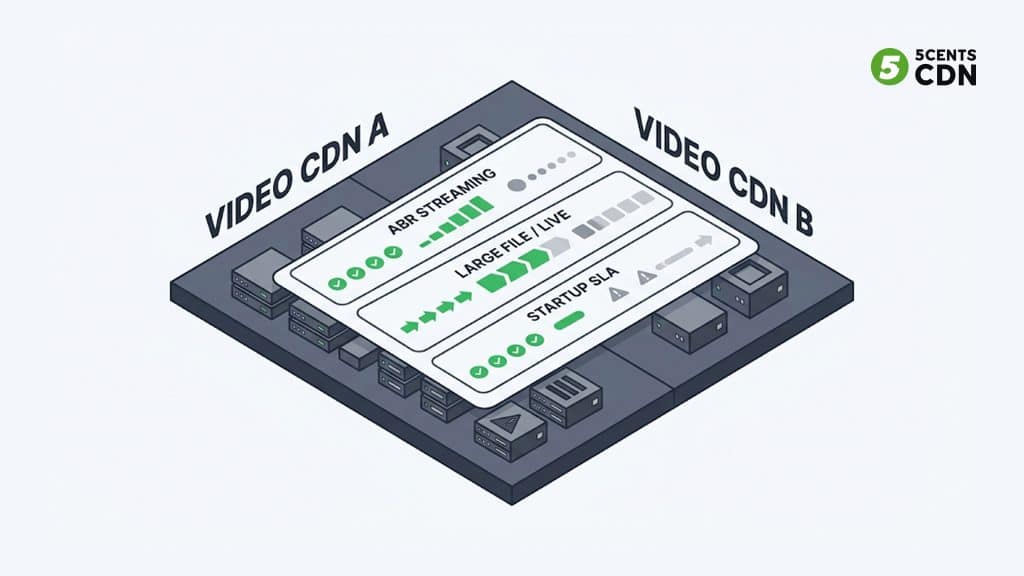
| Dimension | Standard Web CDN | Video CDN |
|---|---|---|
| Primary content | HTML, CSS, JS, images, files | ABR video segments (VOD + live) |
| File pattern | Small, static, cached once | Many segments, multiple renditions |
| Adaptive bitrate | Not a focus | Core capability |
| Live delivery | Limited / not optimized | Real-time origin pull + low latency |
| Transcoding | Not included | Often integrated (ABR ladder) |
| Startup-time tuning | Page-load focused | First-frame / rebuffer focused |
| Security controls | Basic edge security | Token auth, geo-block, signed URLs |
| Analytics | Web traffic metrics | Viewer QoE: startup, rebuffer, concurrency |
| Best for | Websites, web apps, asset delivery | OTT, live events, VOD platforms, 4K/8K |
Do you always need a separate video CDN?
Not necessarily. A capable platform can do both — deliver your web assets and your video from one network. The key is that the video path is genuinely optimized for streaming, not just ‘allowed.’ 5centsCDN, for example, pairs streaming-grade video delivery with delivery acceleration for static web assets, plus origin shield to keep origins from being overwhelmed at scale.
When to choose which
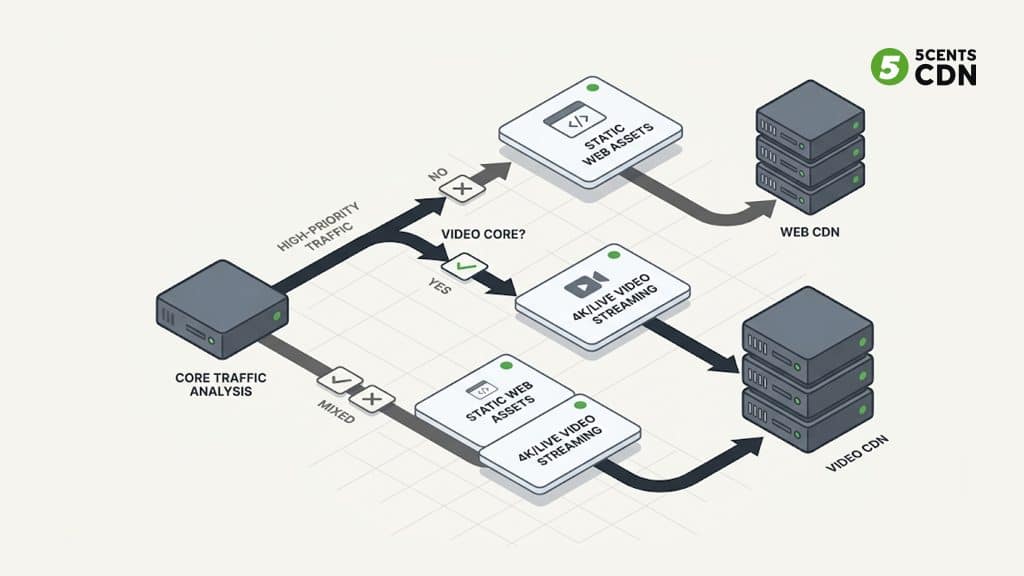
| Your situation | Recommended | Why |
|---|---|---|
| Mostly static site, little/no video | Standard web CDN | Static caching is all you need |
| Occasional embedded marketing video | Web CDN may suffice | Low volume, not latency-critical |
| VOD platform / course library | Video CDN | ABR + segment caching + QoE matter |
| Live events / sports / 24/7 channels | Video CDN | Live origin pull + low latency required |
| 4K/8K or global streaming audience | Video CDN | Bandwidth + edge proximity critical |
| Mixed: heavy site + serious video | Video CDN that also serves web assets | One network, both paths optimized |
The cost angle (briefly)
Cost is where the two diverge most. A web CDN’s bill tracks page assets. A video CDN’s bill is driven by streaming-specific factors: high egress volume (video is bandwidth-heavy), transcoding compute for ABR renditions, and storage for multiple quality levels. The upside is that edge caching offloads the vast majority of traffic from your origin, which is where the real savings appear at scale. For a deeper cost breakdown, see CDN vs no CDN for video streaming, and model your own numbers with the CDN cost calculator. When you’re comparing tiers, the CDN pricing page maps plans to viewer scale.
Getting started
If video is a meaningful part of your traffic — especially live, VOD at scale, or high-resolution — a video-optimized CDN is the right call. If you’re running an OTT or media service, our OTT & media solutions and live streaming stack are built for streaming-grade delivery. For background, the what is a CDN and CDN for OTT platforms guides give the wider picture.
Frequently asked questions
What is the difference between a video CDN and a web CDN?
A web CDN is optimized for static files (HTML, CSS, images), caching small files once and serving them many times. A video CDN is optimized for streaming — it caches adaptive bitrate video segments, supports live origin pull, tunes for low startup time, and adds streaming-specific security.
Can a regular web CDN stream video?
It can move video files, but it isn’t tuned for segmented adaptive streaming, live delivery, or the startup-time and rebuffer expectations viewers have. For occasional, low-volume video it may be fine; for VOD platforms, live events, or large audiences, a video CDN performs far better.
Is Cloudflare a video CDN?
General-purpose CDNs can deliver video and some offer dedicated video products, but ‘web CDN’ and ‘video CDN’ describe how the delivery path is optimized, not a single brand. Evaluate any provider on its streaming-specific capabilities: ABR support, live latency, transcoding, and QoE analytics.
Do I need a special CDN for video streaming?
If video is core to your product — live, VOD at scale, or high resolution — yes. A video-optimized path delivers lower buffering, faster startup, and better cost efficiency than a general web CDN. For small, occasional video, a standard CDN may be enough.
Can one CDN handle both my website and my video?
Yes — a capable platform can serve static web assets and stream video from the same network, as long as the video path is genuinely optimized for streaming rather than just permitted.