

When you start streaming video online, the infrastructure question comes up quickly: do you actually need a CDN, or can your origin server handle it? The honest answer depends on your viewer count, your audience geography, and whether you can afford buffering — financially and reputationally.This guide gives you a direct CDN vs no CDN comparison for video streaming across cost, quality, performance, and scalability — with real bandwidth math so you can make an informed decision. We also cover exactly when video streaming platforms can operate without a CDN, and what triggers the point where origin-only delivery breaks down.
What Is Origin-Only Video Delivery?
Origin-only delivery means your video content is served directly from a single server — your origin. Every viewer’s device connects to that server directly to request video segments. There is no intermediate caching layer, no geographic distribution, and no load sharing.
This works fine at very small scale. If you have 50 viewers all located near your server, origin-only delivery is entirely adequate. The problems begin when viewer count grows, when your audience spans multiple countries, or when you run a live event that generates a sudden traffic spike.
Understanding why requires understanding how a content delivery network actually changes the delivery architecture — not just the performance numbers.
What Changes When You Add a CDN?
A CDN replaces the direct viewer-to-origin connection with a viewer-to-edge-node connection. Instead of every viewer’s device pulling video segments from your origin server, they pull from a CDN edge server located in their geographic region. That edge server has already cached the content — or fetches it from origin once and serves all subsequent requests from cache.
The practical consequences of this architectural shift are significant across every dimension that matters for streaming: cost, quality, scale, and security.
With an origin shield layer added, even CDN cache misses don’t reach your origin directly — a regional cache handles them first. This means your origin can serve thousands of concurrent viewers while receiving only a fraction of the total request volume.
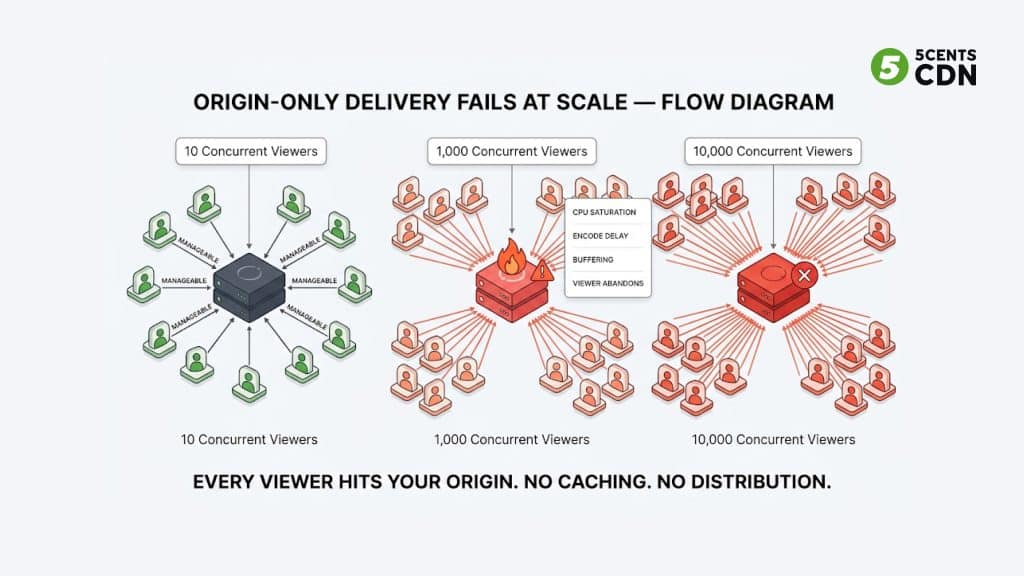
What Happens Without a CDN at Scale
Without a CDN, every viewer creates a direct load on your origin server. The impact compounds quickly as viewer count rises.
The Waterfall Effect
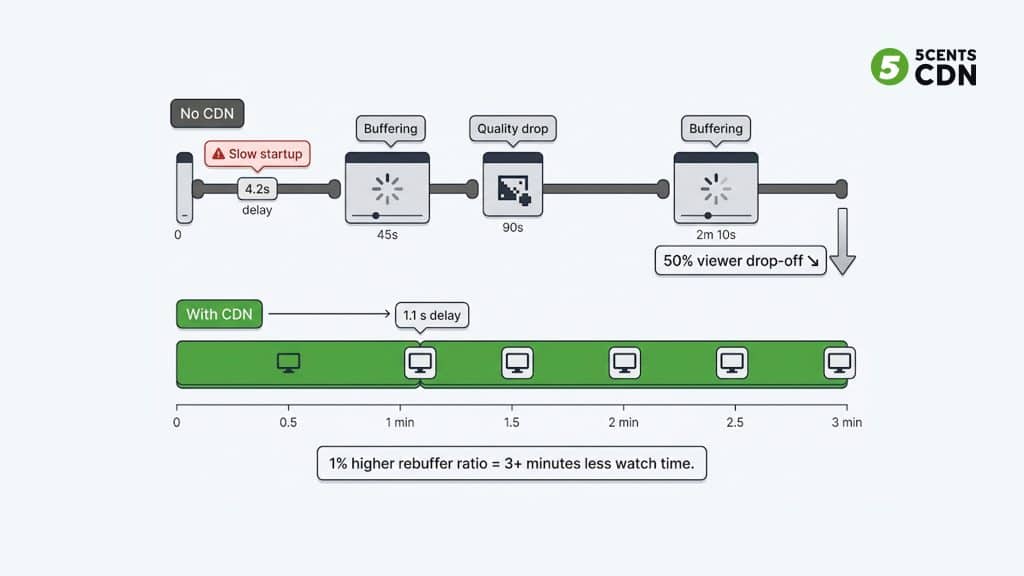
When origin CPU becomes saturated — typically from concurrent request overload — latency increases. Higher latency means the video player cannot buffer segments fast enough to stay ahead of playback. The result is buffering — the spinner viewers see while the player waits for the next segment. Research published in 2025 found that each 1% increase in rebuffer ratio reduces average viewing time by more than 3 minutes per session.
The Cost Spiral
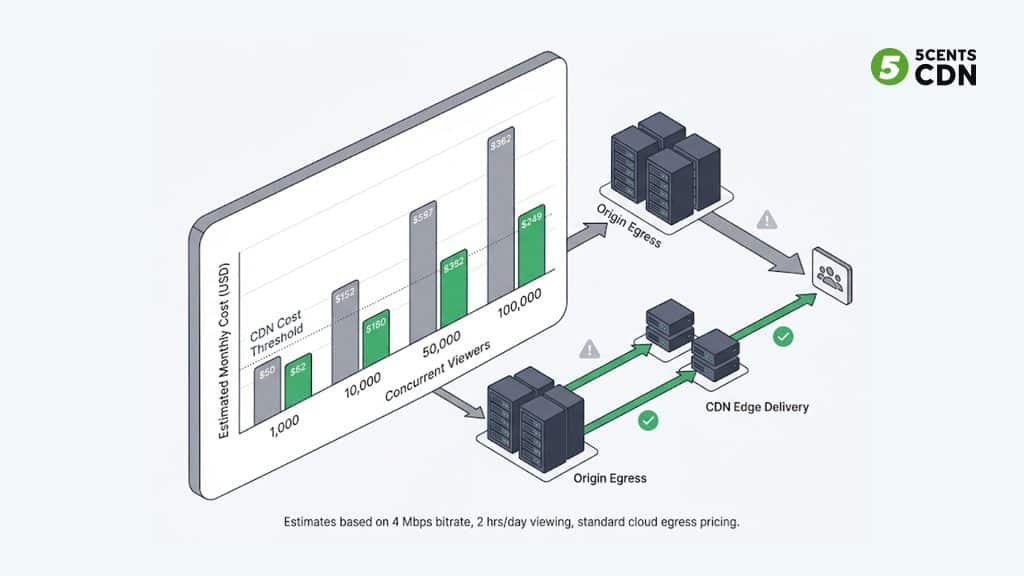
Origin server egress costs — the fees charged by cloud providers for outbound data transfer — rise directly with viewer count and bitrate. At cloud provider rates of $0.08–0.09 per GB of outbound data, a platform serving 50,000 concurrent viewers at 4 Mbps for 2 hours per day generates roughly 180,000 GB of monthly data transfer. At $0.08/GB, that is $14,400 per month in egress alone — from a single origin, with no redundancy.
The Abandonment Problem
More than 50% of viewers abandon a live stream within 90 seconds if quality is poor. A 2-second delay in startup time increases viewer drop-off rates by over 6% per additional second. Every buffer event at scale translates directly to lost viewers, reduced watch time, and lower subscriber retention.
CDN vs No CDN: Side-by-Side Comparison
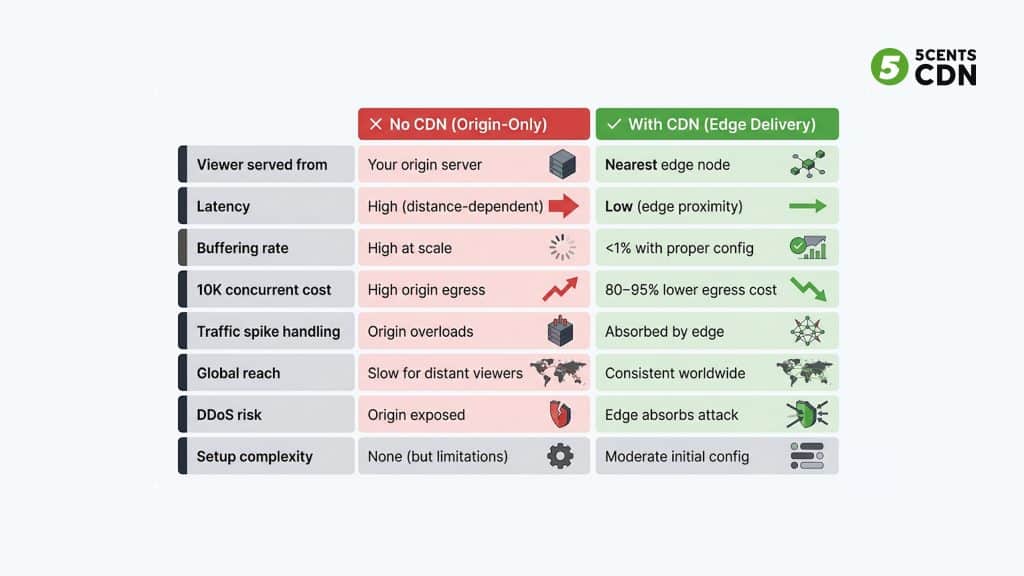
| Dimension | ❌ No CDN (Origin-Only) | ✅ With CDN (Edge Delivery) |
| Content served from | Your origin server (one location) | Nearest CDN edge node (global) |
| Latency | High — increases with viewer distance | Low — edge proximity reduces RTT |
| Buffering at scale | High — origin saturates under load | <1% with properly configured edge caching |
| 10K concurrent viewers | Origin likely overwhelmed | Handled — load distributed across PoPs |
| 100K concurrent viewers | Origin fails or costs skyrocket | Manageable with tiered caching setup |
| Traffic spike handling | Manual scale-up required (slow, costly) | Absorbed automatically at the edge |
| Global audience quality | Degrades with distance | Consistent worldwide via distributed PoPs |
| Bandwidth egress cost | Full origin egress per viewer | 80–95% lower — most traffic served from cache |
| DDoS exposure | Origin server exposed directly | Edge absorbs volumetric attacks |
| Content security | Limited — no token auth at edge | Token auth, geo-blocking, signed URLs |
| ABR / adaptive quality | Possible but strains origin | Fully supported — multiple renditions cached at edge |
| Setup complexity | Zero (but hard ceiling on scale) | Moderate initial config — ongoing low maintenance |
The Real Cost Difference
The cost comparison between CDN and origin-only delivery is counterintuitive to many platform operators. Origin delivery feels free — you are already paying for your server. But egress — outbound data transfer — is one of the largest variable costs in cloud infrastructure, and it scales directly with viewer count and bitrate.
A practical scenario: a platform with 50,000 concurrent viewers streaming at 4 Mbps average, 2 hours per day:
- Total daily data transfer: 50,000 × 4 Mbps × 7,200 seconds = 1,440,000 GB per day — roughly 43 million GB per month
- At $0.08/GB cloud egress: approximately $3.4 million per month from origin
- With a CDN serving 90% from cache: origin sees ~4.3 million GB per month — approximately $344,000 in origin egress, with CDN delivery costs on top but at negotiated per-GB CDN rates
- Net result: CDN delivery is substantially cheaper at scale, even after CDN fees
Use the CDN bandwidth calculator or CDN cost calculator to model your specific viewer count, bitrate, and geography.
Quality and Viewer Experience
Quality is where the CDN vs no CDN difference is most immediately felt by viewers. Two metrics determine most of the perceived quality gap: startup time and rebuffer ratio.
Startup Time
Without a CDN, startup time — the delay between pressing play and the first frame appearing — scales with the distance between the viewer and your origin server. A viewer 5,000 km from your origin server may wait 4–6 seconds before playback begins. With edge delivery, the nearest PoP reduces that same startup time to 1–2 seconds regardless of origin location.
Rebuffer Ratio
Rebuffer ratio measures the percentage of playback time spent buffering rather than playing. Research consistently shows that adaptive bitrate streaming via CDN reduces initial buffering duration by 40–60% compared to origin-only delivery, with the most significant gains occurring during peak usage. A 1% increase in rebuffer ratio correlates with a 3+ minute reduction in average session length — a measurable impact on watch time and subscriber retention.
With a CDN, live transcoding produces multiple ABR renditions. Each rendition is cached at the edge, allowing viewers to receive the highest quality their connection supports — served from a local edge node rather than a distant origin.
Performance and Scalability
Performance at baseline viewer counts is similar between CDN and no CDN — the gap widens as concurrent viewers increase. Origin-only delivery has a hard scalability ceiling determined by your server’s CPU and bandwidth capacity. CDN delivery scales horizontally — adding more viewers adds more edge load, distributed across the network rather than concentrated at origin.
For live events specifically, this distinction is critical. A live premiere or sports broadcast can see concurrent viewers jump 10–50x in minutes. Origin servers require manual pre-scaling for these events, and over-provisioning between events wastes money. CDN infrastructure absorbs these spikes automatically.
For platforms on 5centsCDN, delivery acceleration and the asset optimizer further compress and optimize static assets at the edge — reducing per-viewer bandwidth consumption in addition to origin offload.
Security Differences
Without a CDN, your origin server is directly reachable by all viewer traffic — including attack traffic. A DDoS attack targeting your stream URL hits your origin directly. A credential-stuffing attack on your API hits your origin directly.
With a CDN, the origin is shielded behind the edge network. DDoS attacks are absorbed at the edge — distributed across hundreds of PoPs rather than concentrated on your origin. Edge-level security features add additional layers:
- Token authentication: Time-limited, signed stream URLs prevent unauthorized sharing and ensure only paying subscribers access content
- Geo-blocking: Enforce content licensing restrictions at the edge — viewers in unauthorized regions are blocked before reaching origin
- Hotlink protection: Prevent unauthorized embedding of your streams on third-party sites
Configure these through 5centsCDN’s edge rules without any changes to your origin infrastructure.
When You Don’t Need a CDN for Video Streaming
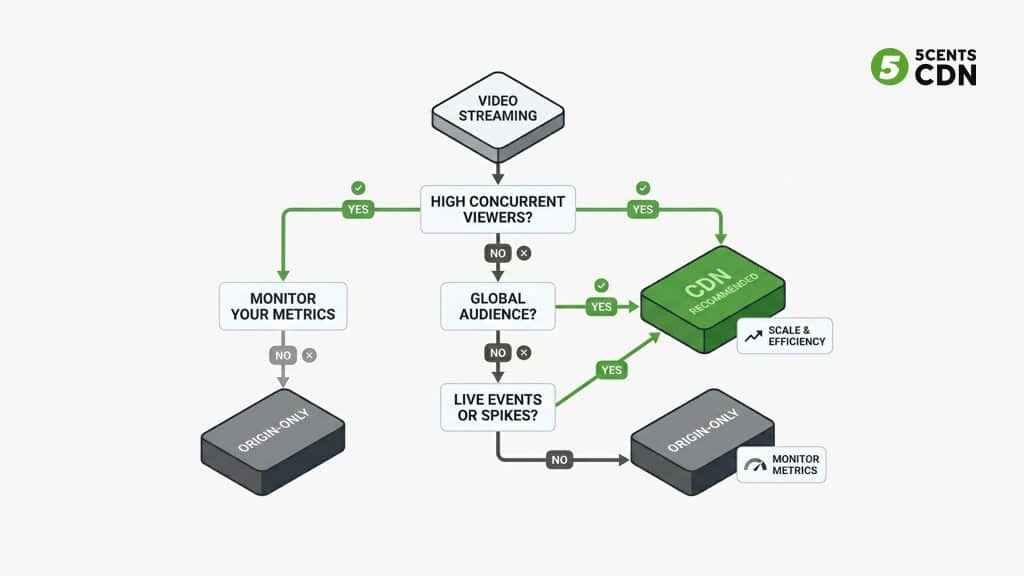
A CDN is not universally required from day one. Origin-only delivery is a reasonable starting point if:
- Your platform has fewer than 500–1,000 concurrent viewers and all are located in the same country or region
- Your content is highly personalized per-user (e.g. private video calls or one-to-one streams) with no shared cacheable segments
- You are in a closed-beta or internal testing phase and not yet distributing publicly
- Your budget is extremely constrained and your current viewer count is manageable on origin
Once any of the following conditions are true, origin-only delivery becomes a liability rather than a cost saving:
- Concurrent viewers exceed 1,000 regularly
- Your audience spans more than one country
- You plan or host any live events with unpredictable traffic
- Subscriber churn from poor playback quality is measurable in your analytics
Decision Framework: Which Is Right for You?
Use this framework to decide whether to add CDN infrastructure to your video streaming stack:
| Your Situation | Recommendation | Next Step |
| <500 concurrent, single country, VOD only | Origin-only is fine for now | Monitor rebuffer ratio and startup time monthly |
| 500–2,000 concurrent, growing audience | CDN recommended — start now before you need it | Start with a basic CDN pull zone and edge caching config |
| 2,000+ concurrent OR global audience | CDN required | Enable origin shield + ABR transcoding immediately |
| Live events with unpredictable traffic | CDN required with auto-scaling | Pre-warm CDN cache before event; test concurrent load |
| Paid subscription / DRM content | CDN required for security | Enable token auth + geo-blocking at CDN edge |
| Existing CDN but poor QoE metrics | CDN misconfiguration likely | Audit cache hit ratio, TTL settings, and URL normalisation |
Use the compare CDN providers page to evaluate your options, or the CDN pricing plans page to find a tier that fits your current viewer count.
Summary: CDN vs No CDN at a Glance
| Factor | No CDN | With CDN |
| Best for | <500 viewers, single region, testing | Any growing platform, global audience, live events |
| Cost at scale | Rises steeply — full origin egress per viewer | 80–95% lower egress via edge caching |
| Viewer experience | Degrades with distance and viewer count | Consistent quality globally |
| Buffering risk | High at scale | Low with proper edge configuration |
| Security | Origin exposed directly | Edge-level DDoS, token auth, geo-blocking |
| Scalability | Hard ceiling — origin bottleneck | Horizontal — scales with edge network |
| Setup required | Zero — but no growth path | Moderate initial config, low ongoing effort |
Frequently Asked Questions
Do I need a CDN for video streaming?
It depends on your scale and audience. If you have fewer than 500 concurrent viewers in a single country, origin-only delivery may be sufficient. Once you exceed ~1,000 concurrent viewers, serve a global audience, or run any live events, a CDN becomes necessary for reliable quality and manageable costs.
Is a CDN cheaper than serving video from my own server?
At small scale, origin-only is cheaper because you have no CDN fees. At medium-to-large scale, a CDN is significantly cheaper — because cloud egress fees from origin scale with every viewer, while CDN caching reduces the number of origin requests by 80–95%. The break-even point is typically around 500–1,000 concurrent viewers.
What happens to video quality without a CDN?
Without a CDN, video quality degrades as viewer count and geographic spread increase. Viewers far from your origin server experience higher latency, longer startup times, and more frequent buffering. Research shows that each 1% increase in rebuffer ratio reduces average session length by more than 3 minutes.
Can I start without a CDN and add one later?
Yes, and this is a reasonable approach for early-stage platforms. Most CDN configurations are additive — you point your player at a CDN pull zone and your origin continues serving as the source. The transition is typically low-risk. However, waiting too long means your viewers experience a poor-quality period that can accelerate churn before you switch.
How much does CDN delivery cost compared to origin egress?
CDN per-GB costs vary by provider and volume. For a rough comparison: cloud provider origin egress typically runs $0.08–0.09/GB. CDN delivery at volume is often $0.01–0.04/GB, and with 85–95% of traffic served from cache, total data from origin drops dramatically. Use our CDN cost calculator to model your specific scenario.
What is the difference between a CDN and an origin server for video streaming?
Your origin server stores and generates your video content. A CDN caches and distributes that content globally. The origin is the source of truth; the CDN is the distribution network. Without a CDN, every viewer talks to your origin. With a CDN, viewers talk to the nearest edge node and your origin only handles the initial segment request per region.
Ready to Move Beyond Origin-Only Delivery?
The CDN vs no CDN decision is straightforward once you know your viewer count and audience geography. For any platform scaling beyond a few hundred concurrent viewers — or planning live events — CDN infrastructure is the most cost-effective and performance-reliable path.
5centsCDN provides edge delivery, origin shield, live transcoding, token authentication, and real-time analytics — all built for video streaming platforms that cannot afford buffering. Explore our OTT and media CDN solutions or review CDN pricing plans to get started.
| Compare CDN Options for Your Video Platform Edge delivery · Origin shield · ABR transcoding · Token auth · Real-time analytics → View CDN Pricing | → Try the Bandwidth Calculator | → Compare CDN Providers |