

Understanding unicast vs multicast vs broadcast starts with how video reaches a screen. When a video reaches a screen, it has traveled across a network in one of three fundamental ways: sent to exactly one recipient, to a selected group, or to everyone at once. Those three models—unicast vs multicast vs broadcast—form the foundation of how all streaming works, and the choice between them shapes cost, scale, and quality more than almost any other delivery decision.
The quickest way to hold the three in your head is one-to-one, one-to-many, and one-to-all. This guide explains each precisely, shows how they differ in protocol and efficiency, and then answers the question the definitions alone leave hanging: if multicast is so efficient, why does virtually all internet streaming run on unicast? The answer is where the CDN comes in.
The Three Delivery Models at a Glance
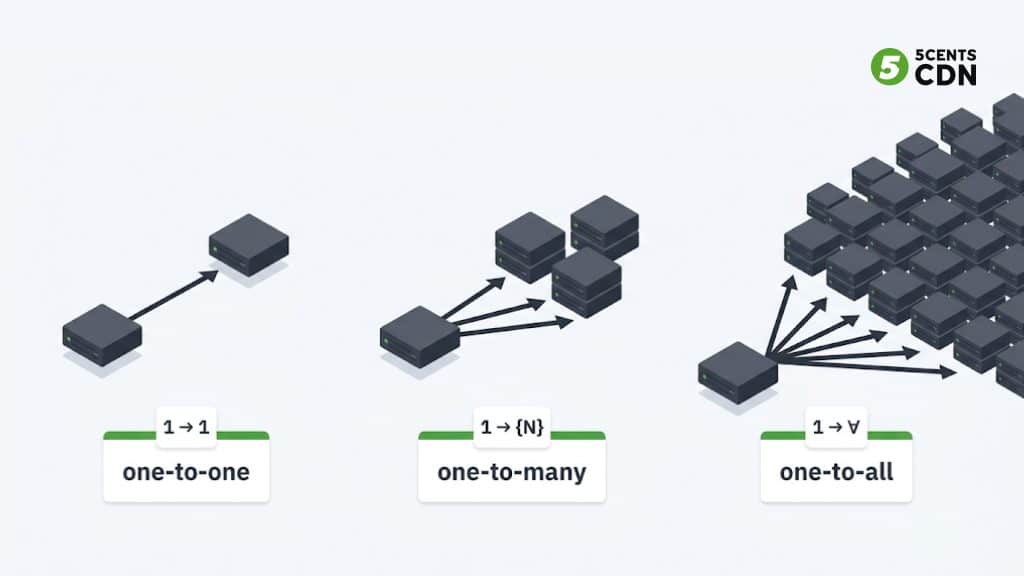
Before the detail, here is the whole idea in one line each. Unicast is one-to-one: a private conversation between one sender and one receiver. Multicast is one-to-many: a single stream sent once and delivered only to the devices that asked for it. Broadcast is one-to-all: a single stream pushed to every device on the network whether it wants it or not. Everything else is a consequence of those three shapes.
What Is Unicast?
Unicast is a one-to-one connection between a single sender and a single receiver. Each viewer gets their own dedicated stream over their own connection, typically using TCP (Transmission Control Protocol) for reliable, in-order delivery over the public internet. Think of it like a phone call: one line, two people, a private conversation that nobody else shares.
Because every viewer has a separate stream, unicast can tailor delivery to each person — their device type, their available bandwidth, their chosen quality — which is exactly what makes adaptive bitrate streaming and personalized, on-demand playback possible. The trade-off is load: if a thousand people watch, the source sends a thousand streams; if a million watch, a million. On its own, a single origin server cannot sustain that, which becomes the central problem we return to below.
It is worth being concrete about why that load is so punishing. Each unicast stream consumes its own slice of the origin’s bandwidth and connection capacity, so demand scales linearly with the audience: double the viewers, double the load, with no economies of scale at the source. A live event that suddenly draws a large simultaneous audience — a match kickoff, a product launch — can overwhelm a single origin in seconds. This is not a flaw to be engineered away in the protocol; it is inherent to one-to-one delivery. The fix is architectural, not protocol-level, which is why the CDN exists.
What Is Multicast?
Multicast is a one-to-many method: the source sends a single stream, and the network itself replicates that stream only to the devices that have joined the multicast group requesting it. It uses UDP (User Datagram Protocol) and depends on multicast-capable routers and switches along the path. The classic analogy is a relay race — the source hands off one baton, and the network copies and passes it along only down the branches where viewers are actually waiting, rather than every viewer running back to the source individually.
This is remarkably efficient: no matter whether ten or ten thousand people watch, the source transmits the stream only once, and duplication happens inside the network exactly where needed. The catch is that it requires a network you control end to end — every router in the path must support and be configured for multicast. That is achievable on a managed network like a telecom operator’s own infrastructure or a corporate LAN, but not across the open public internet, where you do not control the intervening routers.
Mechanically, devices opt in and out of a stream by joining and leaving a multicast group, signaled through the Internet Group Management Protocol (IGMP). When you change the channel on an IPTV set-top box, for example, the box leaves the old channel’s group and joins the new one, and the network starts forwarding the new stream to your branch and stops the old. Routers use this membership information to build an efficient distribution tree, forwarding each stream only along paths that lead to an actual subscriber. That is what lets a single source feed a very large audience without the traffic multiplying at the origin — the network does the fan-out, not the server.
What Is Broadcast?
Broadcast is one-to-all: a single stream is sent to every device on a network segment, regardless of whether each device wants it. The nearest everyday analogy is a public address announcement in a building — everyone in earshot hears it whether it concerns them or not. In IP networking, broadcast is confined to a local network segment and is not used to deliver video across the internet.
Traditional over-the-air television, cable, and satellite are broadcast in the general sense — one signal radiated to all receivers in range. But in the context of IP streaming delivery, pure network broadcast is inefficient (it consumes bandwidth on every device even for those not watching) and does not scale beyond a local segment, so it is not how modern streaming platforms deliver content. It is included here mainly to complete the picture and to contrast with the targeted efficiency of multicast.
The distinction between broadcast-the-concept and broadcast-the-IP-mechanism is worth holding onto, because it explains the industry’s whole direction of travel. Classic broadcasting is extraordinarily efficient for reaching a mass audience with identical content — one transmitter, unlimited receivers, no per-viewer cost — but it offers no personalization, no on-demand, no return path, and no way to serve each viewer something different. The move to IP delivery traded that raw efficiency for interactivity and choice: multicast preserved broadcast’s efficiency on controlled networks, while unicast plus a CDN gave the internet the flexibility that on-demand, personalized streaming demands. Understanding the three models is really understanding that trade between efficiency and flexibility.
Unicast vs Multicast vs Broadcast: Side by Side
| Unicast | Multicast | Broadcast | |
|---|---|---|---|
| Pattern | One-to-one | One-to-many | One-to-all |
| Typical protocol | TCP (also UDP) | UDP | UDP |
| Streams from source | One per viewer | One total | One total |
| Network needed | Any (public internet) | Managed, multicast-enabled | Local segment only |
| Scales on internet | Yes, with a CDN | Not across public internet | No |
| Personalization / ABR | Yes | No (same stream to all) | No |
| Typical use | OTT, VOD, internet live | IPTV, LAN, broadcast facility | Legacy / local only |
Why Internet Streaming Uses Unicast (and How the CDN Makes It Work)
Here is the apparent paradox: multicast is dramatically more bandwidth-efficient, yet nearly all internet streaming — every OTT service you use — runs on unicast. Why choose the “inefficient” model?
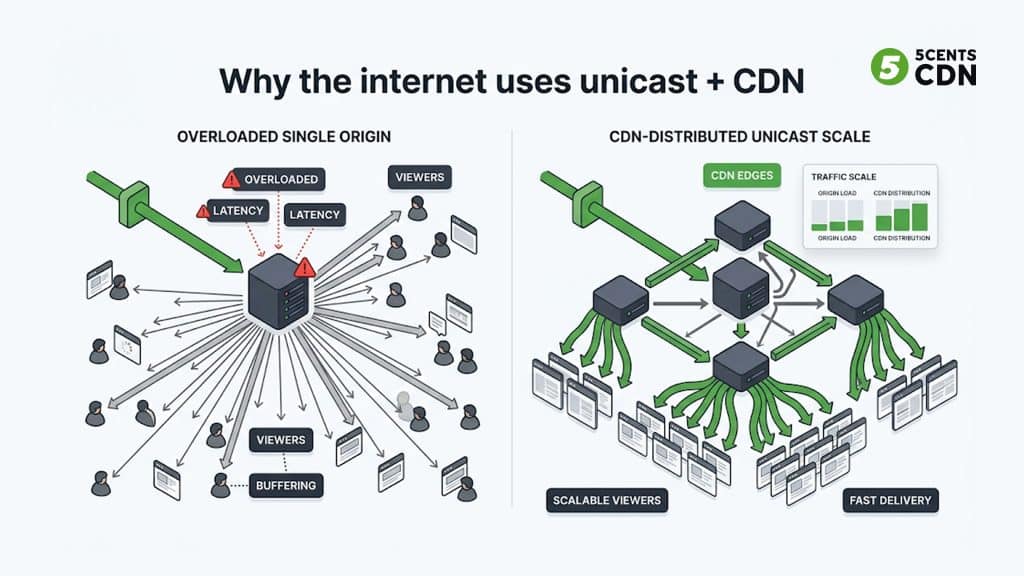
The reason is that multicast needs a network you control end to end, and nobody controls the public internet. Your viewers sit behind thousands of different ISPs and routers you have no authority over, and most of them do not forward multicast traffic between networks. Unicast, by contrast, works over any standard internet connection with no special network support. So for reaching a general internet audience, unicast is not just the better choice — it is effectively the only choice.
That leaves unicast’s scaling problem: one origin cannot send a million individual streams. This is precisely what a content delivery network (CDN) solves. Instead of every viewer pulling from one origin, the CDN places copies of the content on edge servers around the world, and each viewer receives their unicast stream from a nearby edge. The origin sends the content to the edges once; the edges handle the millions of individual connections. In effect, the CDN gives you unicast’s universal reach and personalization while removing the single-origin bottleneck — which is why CDNs are the backbone of OTT delivery.
A helpful way to picture it: unicast without a CDN is one pizzeria trying to deliver to an entire country from a single kitchen — impossible. A CDN opens local kitchens everywhere, so each order still arrives hot and made-to-order (personalized), just from nearby. You keep the benefits of one-to-one delivery and lose the bottleneck.
Where Multicast Fits: IPTV and Managed Networks
Multicast is far from obsolete — it is simply used where the network is controlled. The biggest example is IPTV: when a telecom or cable operator delivers live TV over its own managed network, it typically uses multicast, since it controls every router and can replicate one stream efficiently to millions of set-top boxes. This is the technical distinction often summarized as “multicast is IPTV; unicast is OTT.”
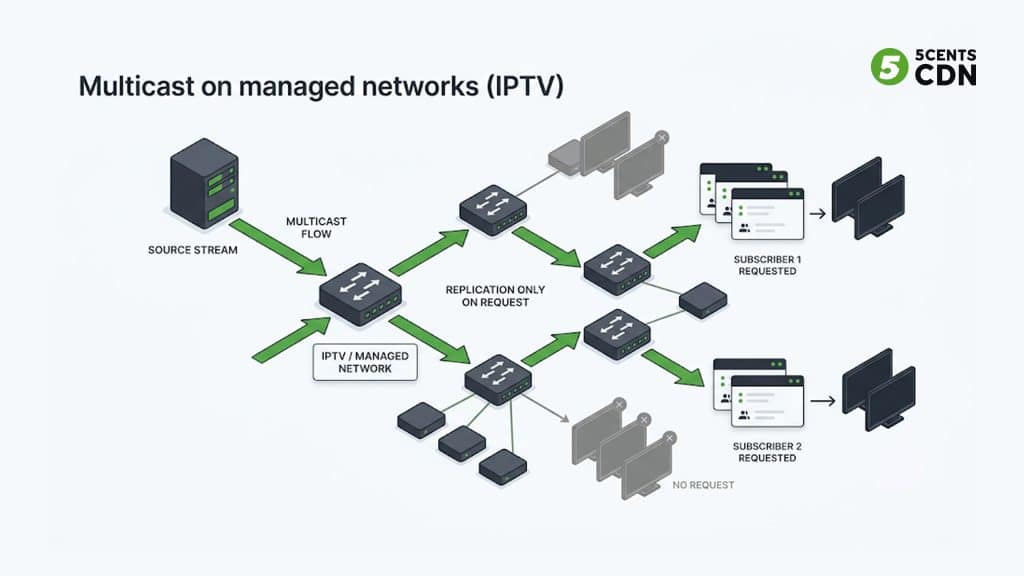
Multicast also appears inside broadcast facilities and live production networks — for instance carrying uncompressed video, audio, and metadata under standards like SMPTE ST 2110 — and on corporate LANs for large internal events. The common thread is a controlled, multicast-enabled network. The moment content has to cross the open internet to a general audience, delivery shifts to unicast plus a CDN.
Hybrid Approaches
The two models are not mutually exclusive. Operators often combine them: multicast within a managed network for efficiency, then a conversion to unicast at the edge where content leaves that network for internet viewers. A common pattern is multicast for the live linear feed on the operator network and unicast for on-demand replays and out-of-network viewers. The goal is to capture multicast’s efficiency where the network allows it and unicast’s universal reach everywhere else.
A concrete example makes the hybrid model clear. A cable or telecom operator might carry its live channels as multicast across its own backbone all the way to regional edge points — sending each channel just once no matter how many subscribers are watching. At the edge, where the content crosses into the open internet to reach a mobile app or an out-of-network viewer, a gateway converts that multicast feed into unicast streams delivered through a CDN. The subscriber on the managed network gets the efficiency of multicast; the viewer on the public internet gets the reach of unicast. Neither model has to win outright — the architecture uses each where it is strongest, which is increasingly how large operators run converged TV-plus-streaming services.
Reliability, Latency, and Quality Trade-offs
Beyond reach and efficiency, the models differ in how they handle reliability and quality. Unicast typically runs over TCP, which guarantees every packet arrives in order by re-requesting anything lost — excellent for quality, at the cost of some latency when the network is congested. Because each unicast session is independent, one viewer’s poor connection never degrades anyone else’s, and adaptive bitrate can quietly drop that one viewer to a lower rung without affecting the rest.
Multicast runs over UDP, which does not retransmit lost packets by default. On a well-managed network that is fine — loss is rare and controlled — but it means a single stream’s quality is shared: everyone in the group gets the same feed at the same bitrate, with no per-viewer adaptation. That is perfectly suited to linear live TV, where every subscriber watching a channel genuinely wants the identical stream, and poorly suited to on-demand libraries where each person is watching something different at their own pace. In short: unicast trades efficiency for per-viewer control and resilience; multicast trades per-viewer flexibility for network efficiency. The right pick follows directly from whether your audience wants the same thing at the same moment or different things on their own schedule.
- Reaching a general internet audience? Unicast, delivered through a CDN. This covers virtually all OTT and public streaming.
- Delivering live TV over your own managed network? Multicast, for its efficiency at scale on infrastructure you control.
- Need per-viewer quality, personalization, or on-demand? Unicast, since each viewer has an independent stream.
- Distributing within a broadcast facility or LAN? Multicast is well suited to controlled local networks.
Frequently Asked Questions
What is the difference between unicast, multicast, and broadcast?
Unicast is one-to-one (a separate stream to each receiver), multicast is one-to-many (one stream the network replicates only to devices that requested it), and broadcast is one-to-all (one stream sent to every device on a segment regardless of need).
Why does internet streaming use unicast instead of multicast?
Because multicast requires a network you control end to end, and no one controls the public internet — most ISPs do not forward multicast between networks. Unicast works over any standard connection, and a CDN solves its scaling problem by delivering streams from nearby edge servers.
Is multicast better than unicast?
Neither is universally better. Multicast is far more bandwidth-efficient on a managed network, but it cannot traverse the open internet. Unicast reaches any viewer and allows personalization and adaptive bitrate, which is why OTT relies on it — with a CDN to scale.
Is IPTV unicast or multicast?
IPTV over an operator’s own managed network is typically multicast, because the operator controls the routers and can replicate one stream efficiently. OTT streaming over the public internet is unicast.
Does a CDN use unicast or multicast?
A CDN delivers unicast streams to viewers. Its role is to distribute content to edge servers worldwide so each viewer gets a one-to-one stream from a nearby edge, letting one origin effectively reach millions.
Where is broadcast used in streaming?
Pure IP network broadcast is limited to a local segment and is not used for internet video delivery. Traditional over-the-air, cable, and satellite TV are broadcast in the general sense, but modern streaming platforms use unicast (with a CDN) or multicast on managed networks.
Scaling Unicast Delivery with 5centsCDN
For any platform reaching viewers over the internet, unicast delivery through a CDN is what turns a single origin into global reach without losing per-viewer quality. 5centsCDN provides global CDN delivery built for exactly this — distributing your streams from edge servers close to every viewer. If you are planning how to scale your streaming delivery, get in touch with our team to talk through the right setup for your audience.