

A streaming URL feels private until you look at the page source. Without protection, the segments behind an HLS stream can be pulled down and replayed by anyone who finds their address — which is a problem the moment your content has any value. HLS encryption is the first and most widely supported line of defense against that, and it is simpler to reason about than full DRM once you see how the pieces fit.
This guide explains what HLS encryption is, how AES-128 actually protects each segment, where the encryption key comes from and why key delivery is the part that really matters, the difference between AES-128 and SAMPLE-AES, and how encryption relates to — but is not the same as — DRM. It is written for operators and developers who need to secure a stream, not for a cryptography exam.
What Is HLS Encryption?
HLS encryption is a method of protecting video delivered over HTTP Live Streaming (HLS) by encrypting each media segment so that only authorized players holding the correct key can decrypt and play it. The stream is still delivered as ordinary HTTP files, but those files are scrambled: intercept them without the key and you get unusable ciphertext.
The encryption almost always uses AES, the Advanced Encryption Standard — specifically the 128-bit variant, AES-128, which is the method HLS defines natively. It works for both live and video-on-demand, and because it rides on standard HTTPS delivery it needs no special streaming server. That combination of strong, standardized cryptography and broad device support is why AES-128 is the default way to secure HLS.
Why Encrypt HLS Streams?
It is worth being precise about what problem encryption solves, because HLS on its own is surprisingly open. A standard HLS stream is just a text playlist listing plain segment files served over HTTP. Anyone who views the page source or inspects network traffic can read the manifest, collect the segment URLs, and download every chunk with ordinary tools. HTTPS on the delivery URLs helps in transit, and expiring or signed URLs raise the bar, but once someone has the segment files they can reassemble and replay them.
Encryption changes the economics. When each segment is scrambled with AES-128, downloading every file gets you nothing but ciphertext — useless without the key. The security question shifts from “can someone find the segment URLs?” (often yes) to “can someone get the key?” (only if your key endpoint lets them). For monetized libraries, paid courses, premium live events, and confidential internal video, that shift is the difference between casual copying being trivial and being genuinely hard.
How HLS Encryption Works
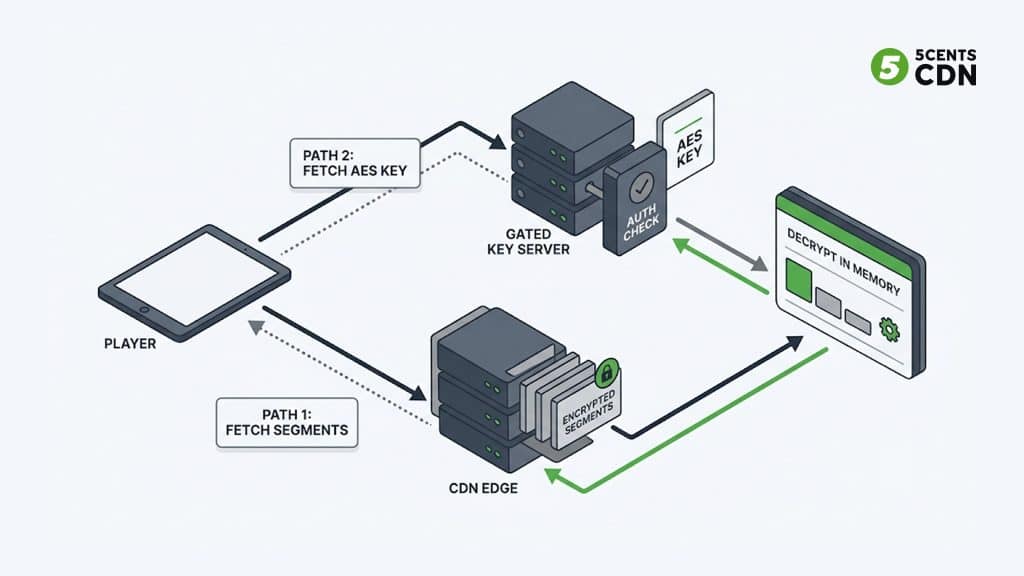
The mechanism has three moving parts: the encrypted segments, the manifest that points to the key, and the key server that actually hands out the key. Understanding the split between them is the whole game.
1. Each Segment Is Encrypted with AES-128
HLS splits a stream into short segments, typically two to ten seconds each. During packaging — the same stage where your encoding and packaging pipeline produces the renditions — each segment is encrypted with a 128-bit content encryption key using AES in cipher block chaining (CBC) mode. In CBC, each block of data is combined with the previous encrypted block before being encrypted itself, so the ciphertext of every block depends on all the blocks before it.
Because AES (the Advanced Encryption Standard) is a symmetric algorithm, the same key both encrypts the segment on the server and decrypts it in the player. An initialization vector (IV) — a 16-byte random value — seeds the first block so that identical inputs do not produce identical ciphertext, which prevents attackers from spotting patterns across segments.
2. The Manifest Points to the Key
The HLS manifest (the .m3u8 playlist) does not contain the key. Instead it carries an EXT-X-KEY tag that tells the player which encryption method is used and the URL where the key can be fetched. A minimal encrypted playlist looks like this:
#EXTM3U
#EXT-X-VERSION:3
#EXT-X-KEY:METHOD=AES-128,URI=”https://keys.example.com/key/123″,IV=0x3746…
#EXTINF:6,
segment1.ts
#EXTINF:6,
segment2.ts
#EXT-X-ENDLIST
The key itself is never in the playlist — only a reference to where the player must go to get it. That separation is what makes the next part the real security boundary.
3. The Key Server Gates Access
When the player reaches the EXT-X-KEY line, it makes a separate request to the key URL to retrieve the 16-byte key before it can decrypt anything. That endpoint is where real protection lives: it should be served over HTTPS and gated so it only returns the key to an authorized session — commonly enforced with token-based authentication or signed URLs. If the request is not authorized, the server refuses the key, and the segments stay useless ciphertext no matter how many the viewer downloaded.
This is the point most explanations underplay. AES-128 is not really “broken” by attacking the cipher — it is broken by leaving the key endpoint ungated. Get the key delivery right and the encryption does its job; get it wrong and the strongest cipher in the world does not help you.
HLS Encryption and CDN Delivery
A useful property of segment encryption is that it does not fight your CDN. The encrypted segments are still ordinary static files, so they cache at the edge and are delivered exactly like unencrypted ones — you keep your cache hit ratio and your performance. Encryption happens once at packaging time; the CDN just serves the ciphertext.
The gated part — the key request — is tiny and infrequent compared with segment traffic (one key fetch versus hundreds of segment fetches), so routing it through an authenticated endpoint adds negligible overhead. In other words, you get strong per-segment protection without giving up the scale and speed of edge delivery. The design cleanly separates the high-volume, cacheable path (segments) from the low-volume, gated path (the key).
How HLS Encryption Is Set Up (Overview)
You do not need to hand-roll cryptography to encrypt HLS — the packaging tools do the heavy lifting. At a high level the flow is:
Generate a key and IV. Create a random 16-byte AES key and a 16-byte initialization vector. These are the secrets the whole scheme depends on.
Tell the packager where the key will live. A small key-info file points the packager at the public key URL (the address the player will call), the local key file, and the optional IV.
Encrypt during segmentation. When the packager segments the stream, it encrypts each segment with the key and writes an .m3u8 that includes the EXT-X-KEY line automatically.
Serve segments via CDN, key via a gated endpoint. Publish the encrypted segments and manifest to your CDN, and host the key behind an authenticated, HTTPS-only endpoint.
On the playback side, any HLS-compliant video player that supports encrypted HLS will read the EXT-X-KEY line, request the key, and decrypt segments in memory during playback — invisibly to the viewer. The encryption is transparent when the viewer is authorized and an impassable wall when they are not.
AES-128 vs SAMPLE-AES
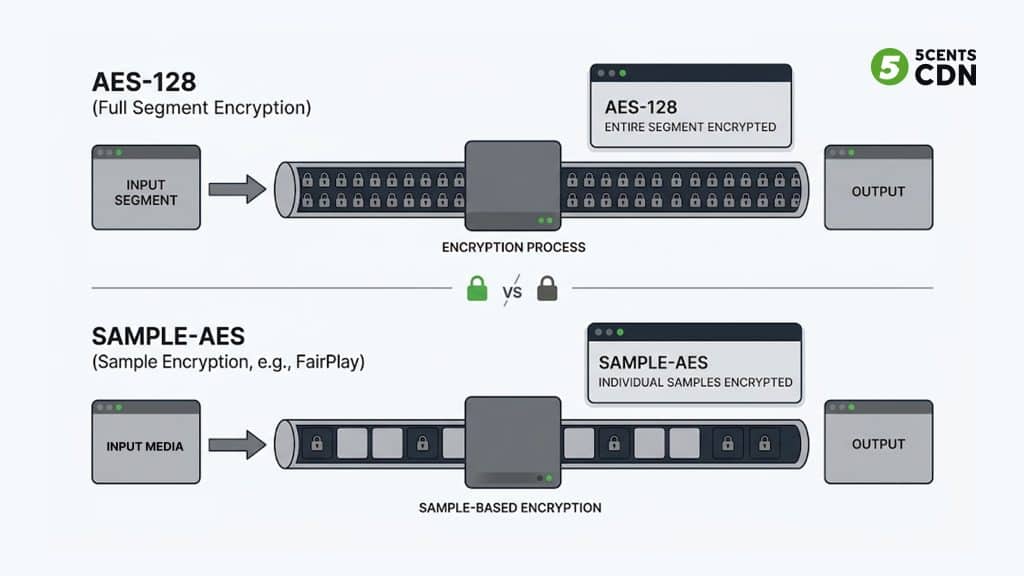
HLS supports two encryption methods, and they are often confused. The difference is what gets encrypted.
| AES-128 | SAMPLE-AES | |
|---|---|---|
| What it encrypts | The entire media segment | Individual media samples within the segment |
| Granularity | Whole-segment | Sample-level (can encrypt only certain samples) |
| Common use | General-purpose HLS protection | Apple FairPlay DRM path |
| Manifest tag | METHOD=AES-128 | METHOD=SAMPLE-AES |
AES-128 encrypts the whole segment and is the general-purpose choice. SAMPLE-AES encrypts media samples individually, which allows finer control and is the format Apple’s FairPlay DRM builds on. If you are adding basic protection, AES-128 is usually what you want; if you are heading toward FairPlay DRM, SAMPLE-AES is the relevant path.
There is a practical performance angle too. Because SAMPLE-AES can encrypt only the media samples (and even a subset of them) rather than every byte of the segment, it can be lighter on decryption — useful on constrained mobile devices — while still protecting the parts that matter. AES-128, by encrypting the entire segment, is the simpler mental model and the most broadly interoperable across players. Neither is “more secure” in cipher terms; they differ in granularity and in which downstream systems (plain HLS vs FairPlay) expect them. A common pattern is to standardize on AES-128 for general protection and switch to SAMPLE-AES specifically where FairPlay is in play.
HLS Encryption vs DRM: Not the Same Thing
This is the distinction that trips people up. AES-128 encryption scrambles the content and controls who can fetch the key. Full DRM (Digital Rights Management) — Widevine, PlayReady, FairPlay — is a larger framework built on top of encryption that adds hardware-backed secure key exchange, license and usage rules (such as expiry, output protection, and device limits), and a robust licensing server.
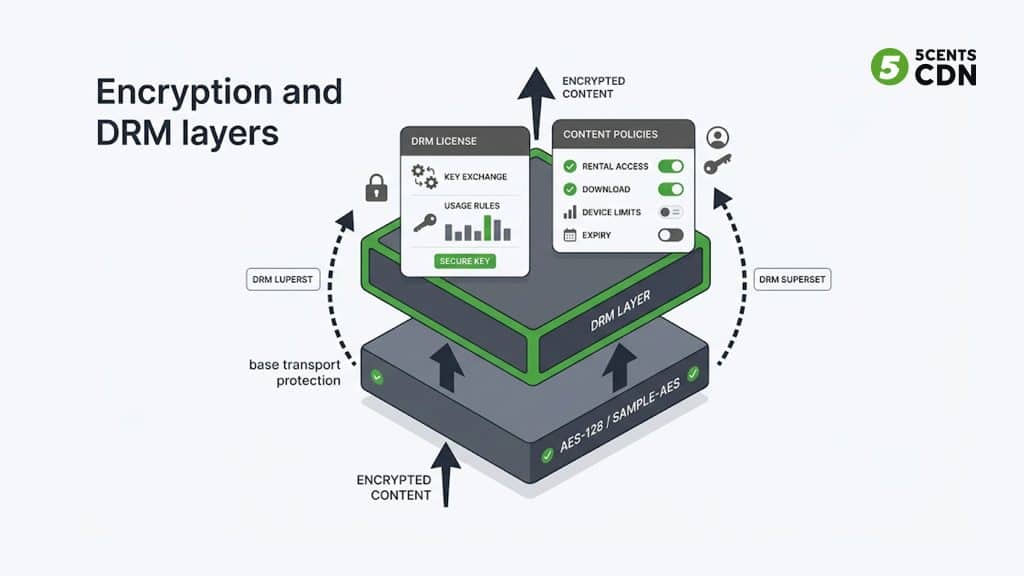
Put simply: encryption is a component; DRM is the system that manages encryption plus rights. AES-128 HLS encryption is lighter to implement and universally compatible, and it is often enough for course content, internal video, and many monetized libraries. DRM is what you reach for when studio or premium licensing contractually requires hardware-level protection. Many platforms use AES-128 as a baseline and layer DRM on high-value titles — the two are complementary, not competing.
A helpful way to decide: start from what your content contract and threat model actually require. If the risk is casual downloading and URL sharing, AES-128 with a properly gated key endpoint handles the large majority of cases at low complexity and full device reach. If a rights holder mandates output protection, device revocation, or hardware-backed key storage — typical for first-run studio films or major live sports — only DRM satisfies that, and AES-128 alone will not meet the contract no matter how well it is implemented. The cost of DRM (licensing servers, per-stream fees, integration work) is why most catalogs reserve it for their highest-value tier rather than applying it everywhere.
Key Rotation for Live Streams
For long-running live streams, a single static key is a larger risk: if it leaks mid-event, everything from that point is exposed. Key rotation addresses this by periodically changing the encryption key during the stream — the packager issues new keys at intervals and updates the manifest with fresh EXT-X-KEY lines, so any single captured key unlocks only a short window of content rather than the whole broadcast. It adds operational complexity (more key requests, tighter coordination between packager and key server), so it is typically reserved for high-value live events like pay-per-view or premium sports where the payoff justifies it.
HLS Encryption Best Practices
- Always deliver keys over HTTPS. A key sent over plain HTTP can be intercepted, defeating the whole scheme.
- Gate the key endpoint. Require token authentication or signed URLs so only authorized sessions receive the key; expire tokens quickly.
- Use unique keys per asset. Avoid reusing one key across many videos so a single leaked key does not expose your whole library.
- Rotate keys on live streams. Changing keys periodically during a long live event limits how much content one captured key can unlock.
- Layer other protections. Combine encryption with geo rules, referrer/domain restrictions, watermarking, and — for premium content — DRM.
- Keep segments on the CDN, keys on a gated endpoint. Preserve edge cacheability for segments while keeping the key path authenticated.
Common Use Cases
- Subscription and monetized VOD: stop non-subscribers from downloading and redistributing content.
- Online courses and e-learning: protect paid course videos from casual copying.
- Corporate and internal video: keep training, all-hands, and confidential material restricted.
- Live events and PPV: protect a paid live stream, often with key rotation.
Limitations to Keep in Mind
AES-128 HLS encryption is strong and practical, but it is not a complete rights-management system on its own. Because playback ultimately happens in software, it does not provide the hardware-backed guarantees that studio licensing sometimes demands — that is DRM territory. Its security depends entirely on protecting the key: an ungated key endpoint undoes everything. And like any protection, it deters and raises the cost of piracy rather than making it mathematically impossible. Used correctly — keys over HTTPS, endpoint gated, unique keys, DRM added where required — it is the right baseline for the large majority of streaming content.
Frequently Asked Questions
What is HLS encryption?
HLS encryption protects video delivered over HTTP Live Streaming by encrypting each media segment — usually with AES-128 — so only players that can fetch the correct key from an authorized endpoint can decrypt and play the content.
Is AES-128 secure enough for video?
Yes for most content. AES-128 is a widely trusted standard, and in practice HLS security depends less on the cipher and more on protecting the key: delivering it over HTTPS through a gated, authenticated endpoint.
What is the difference between AES-128 and SAMPLE-AES?
AES-128 encrypts the entire media segment. SAMPLE-AES encrypts individual media samples within a segment, allowing finer control, and is the encryption format Apple FairPlay DRM is built on.
Is HLS encryption the same as DRM?
No. AES-128 encryption is one component; DRM (Widevine, PlayReady, FairPlay) is a larger framework that adds secure hardware-backed key exchange, license and usage rules, and a licensing server on top of encryption.
Does encrypting HLS break CDN caching?
No. Encrypted segments are still ordinary static files, so they cache and deliver at the CDN edge just like unencrypted ones. Only the small, infrequent key request is routed through a gated endpoint.
How is the encryption key kept safe?
The key is never placed in the manifest — the playlist only references a key URL. The player fetches the key over HTTPS from a server that should be gated with token authentication or signed URLs so unauthorized viewers cannot retrieve it.
Securing Your HLS Streams with 5centsCDN
Getting HLS encryption right comes down to encrypting every segment and, above all, gating key delivery while keeping segments fast at the edge. 5centsCDN supports HLS AES encryption as part of its secure video delivery workflow. If you want to protect a monetized library, course catalog, or live event, get in touch with our team to set up the protection that fits your content.