

Free Ad-Supported Streaming Television (FAST) channels have moved from an emerging format to a core distribution strategy for media companies in 2026. FAST channel infrastructure now sit on every major connected TV platform — Roku, Samsung TV Plus, LG Channels, Amazon Freevee, Pluto TV — and they are increasingly the primary way audiences discover and consume free content on television screens.
But launching a FAST channel is not just a content and business decision. It requires an always-on technical infrastructure that runs continuously, delivers a scheduled programme lineup with precise timing, inserts advertisements at defined break points, and maintains broadcast-quality uptime — 24 hours a day, every day.
This guide covers the FAST channel infrastructure stack for operators: cloud playout architecture, EPG-driven HLS delivery, SCTE-35 ad marker insertion, CDN configuration for linear delivery, SSAI integration, and redundancy design for 24/7 uptime. For a business and strategy overview of FAST channels, see our complete FAST channel guide.
What Makes FAST Channel Infrastructure Different from Standard Streaming
Most streaming infrastructure is designed for one of two models: live events (short-duration, high-concurrency bursts) or VOD (asynchronous viewer delivery from a pre-encoded library). FAST channels require a third model — linear streaming — which combines elements of both but operates under different constraints than either.
A FAST channel runs continuously, delivering a scheduled programme lineup in real time. Unlike a live event, there is no fixed start and end — the channel runs 24/7, every day of the year. Unlike VOD, content is not served on-demand — viewers join the stream at whatever point the schedule has reached. The infrastructure must handle:
- Continuous uninterrupted output: any gap in the playout stream causes a black screen for all current viewers — there is no pause-and-resume buffer like VOD
- Schedule-driven content switching: content transitions must happen on precise schedule boundaries — a few seconds early or late disrupts the EPG data all FAST platforms publish to viewers
- Ad break enforcement: SCTE-35 markers must fire at exact schedule positions for FAST platform ad insertion to work correctly — misaligned markers mean lost ad revenue
- Always-on uptime: a live event downtime affects one event window; a FAST channel downtime is immediately visible to any viewer who happens to be watching at that moment
The Full FAST Channel Technical Stack
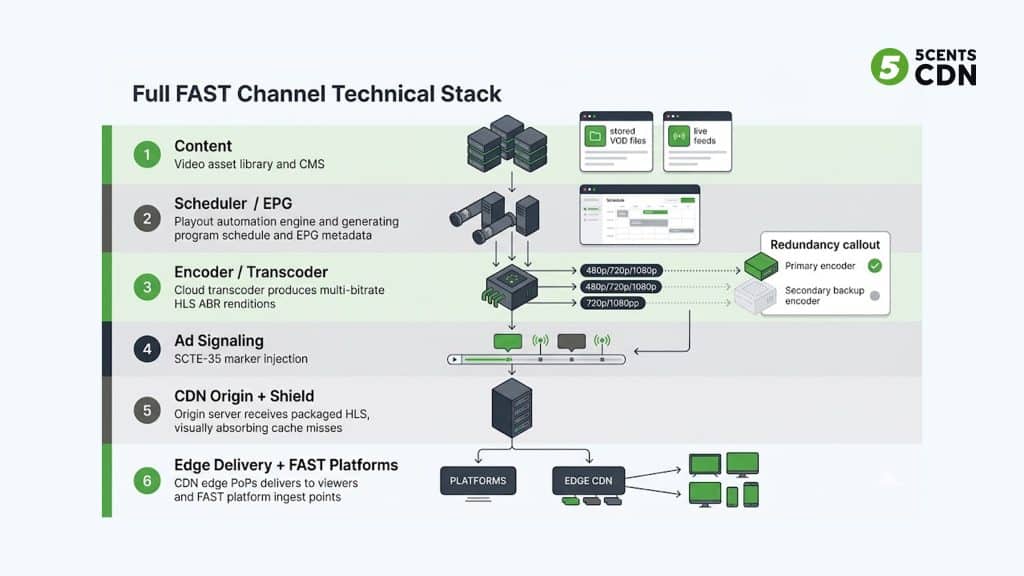
A production-ready FAST channel infrastructure has six functional layers, each with specific technical requirements:
| Layer | Component | Function | Key Requirement |
| 1 — Content | Asset library / CMS | Stores all VOD assets and live feed inputs for playout | Metadata tagging, duration accuracy, format consistency |
| 2 — Schedule | Playout scheduler / EPG engine | Generates continuous programme schedule + EPG XML | Precise timing, gap-fill logic, schedule export |
| 3 — Encode | Cloud or on-premise encoder/transcoder | Produces multi-bitrate HLS ABR output in real time | CBR output, short keyframe interval, hardware acceleration |
| 4 — Ad Signal | SCTE-35 marker injection | Signals ad break positions in the stream | Encoder-side or CDN-side insertion at schedule break points |
| 5 — Deliver | CDN origin + edge network | Distributes HLS stream to viewers and FAST platform endpoints | Origin shield, linear TTL config, 24/7 uptime SLA |
| 6 — Monetize | SSAI / ad decision server | Stitches ads into stream at SCTE-35 break points | VAST/VMAP integration, low-latency ad decisioning |
Content Ingest and Asset Management
The foundation of a FAST channel is its content library. Unlike a live event where the source is a single encoder feed, a FAST channel typically draws from a VOD asset library — feature films, TV episodes, documentaries, sports archives, or original programming — combined in a scheduled playout sequence.
Asset ingest requirements:
- Format normalisation: all assets should be transcoded to a consistent format before entering the playout system. Mixing source formats (ProRes, H.264, MXF) in a live playout queue risks encoder instability
- Duration metadata accuracy: the scheduler uses asset duration to build the EPG timeline. Duration errors of even a few seconds compound across a day’s schedule and produce EPG misalignment on FAST platforms
- Closed caption files: most FAST platforms require closed captions for accessibility compliance. SRT or WebVTT caption files must be linked to each asset at ingest
- Content rights validation: FAST platforms audit content rights. Assets without confirmed licensing will result in distribution rejection
Playout Scheduler and EPG Generation
The playout scheduler is the control plane of a FAST channel. It determines what content plays at what time, when ad breaks occur, and generates the Electronic Programme Guide (EPG) metadata that FAST platforms display to viewers as the channel programme listing.
Most cloud playout systems generate EPG data in XMLTV format and publish it to an endpoint that FAST distribution platforms poll on a schedule (typically every 15–60 minutes). The EPG must stay aligned with the actual stream timing — if the stream runs ahead of or behind the schedule due to encoder instability or asset duration errors, the EPG becomes inaccurate and viewer experience degrades.
Key scheduler requirements:
- Gap-fill logic — automatic insertion of filler content when the schedule has gaps (typically channel branding or bumpers) to prevent black screens
- Ad break placement — SCTE-35 marker timing defined at the schedule level and executed at the encoding layer
- Live feed integration — ability to insert live sources (breaking news, live sports) into the schedule alongside VOD assets
- Repeat scheduling — automated repeat programming (e.g., 6-hour block repeated 4 times daily) for low-overhead channel management
Cloud Playout vs On-Premise: Which Is Right for You?
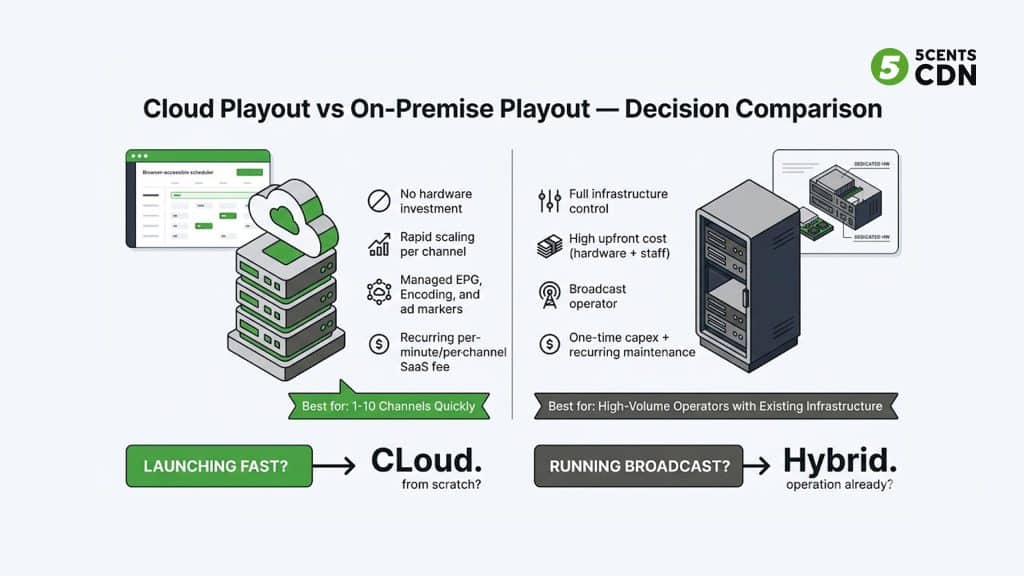
The choice between cloud and on-premise playout is the first major infrastructure decision for a new FAST channel operator:
| Factor | Cloud Playout | On-Premise Playout |
| Setup time | Hours to days | Weeks to months (hardware procurement) |
| Upfront cost | Zero capex — SaaS subscription | Significant hardware investment |
| Monthly cost | Per-channel or per-minute SaaS fee | Amortised hardware + maintenance |
| Scaling | Add channels instantly | Hardware procurement required |
| Control | Platform-defined configuration | Full custom configuration |
| Redundancy | Typically built in to platform SLA | Must be engineered and maintained |
| Best for | New FAST operators, 1–20 channels | Large broadcast operators, 20+ channels at scale |
For most FAST channel operators in 2026 — particularly those launching their first channel or scaling a small portfolio — cloud playout is the correct starting point. The operational overhead of on-premise hardware is rarely justified below 20+ channels, and the time-to-launch advantage of cloud is significant in a competitive market.
Encoding and Transcoding for Linear FAST Delivery
FAST channel encoding shares characteristics of both live transcoding (real-time output required) and VOD transcoding (content quality matters for long-running library assets). The key encoder configuration requirements for linear FAST delivery:
- CBR output: constant bitrate is required for stable CDN delivery and predictable ad break timing. VBR produces bitrate spikes that can disrupt SCTE-35 marker positioning
- Keyframe interval: 2 seconds for standard FAST delivery (not as aggressive as live news, but precise enough for reliable ad break entry and exit points)
- ABR ladder: minimum 3 renditions (1080p / 720p / 480p) to serve all connected TV and mobile viewer types across FAST platforms
- HLS output format: all major FAST platforms (Roku, Samsung TV Plus, LG Channels, Pluto TV, Amazon Freevee) ingest HLS. DASH support varies by platform
- Seamless content transitions: the encoder must handle content handoffs between assets without producing visible glitches, black frames, or audio pops at the schedule boundary
Use 5centsCDN’s live transcoding infrastructure for cloud-based FAST channel encoding — built for continuous real-time output with CBR stability and multi-rendition HLS delivery.
SCTE-35 Ad Markers: Encoder-Side vs CDN-Side Insertion
SCTE-35 is the broadcast standard for signaling ad break opportunities in a video stream. FAST platforms use SCTE-35 cue markers to identify where ads should be inserted — either by the platform’s own ad system or by your SSAI workflow. Without SCTE-35 markers, FAST platforms either cannot monetize your channel or use unreliable time-based insertion that misses schedule boundaries.
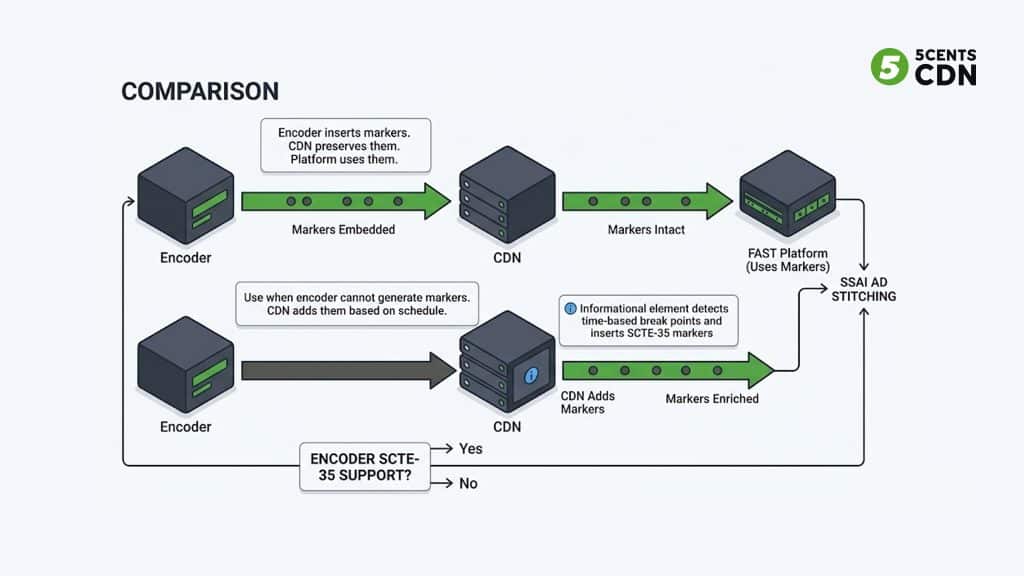
Encoder-Side Insertion
When the playout encoder supports SCTE-35 output (most professional cloud playout systems do), markers are embedded directly in the HLS stream at the correct schedule positions. The CDN transports the markers intact through to delivery. This is the preferred approach — markers are precise, time-aligned with the schedule, and portable across all downstream systems.
CDN-Side Insertion
When the encoder cannot generate SCTE-35 markers — common with simpler playout systems or software encoders — the CDN can insert markers at the delivery layer based on a schedule or time cue. 5centsCDN supports SCTE-35 marker insertion via edge rules. See our dedicated guide on SCTE-35 and SSAI workflows for full configuration details.
SSAI: How Server-Side Ad Insertion Connects to the FAST Pipeline
Server-Side Ad Insertion (SSAI) stitches advertisements directly into the video stream at SCTE-35 break points, producing a seamless output stream that viewers cannot distinguish from regular content. This eliminates ad blockers, prevents buffering at ad transitions, and enables more accurate ad delivery reporting.
The SSAI workflow in a FAST pipeline:
- Playout stream contains SCTE-35 markers at ad break positions
- SSAI system detects an approaching SCTE-35 cue
- Ad Decision Server (ADS) is queried with viewer context (device, geography, content metadata) via VAST or VMAP ad request
- ADS returns an ad creative URL
- SSAI transcodes the ad to match stream specifications (bitrate, codec, resolution) and stitches it into the HLS output at the break point
- Viewer receives a continuous stream with no visible transition between content and ad
For FAST channels distributing through platforms like Roku or Samsung TV Plus, the platform itself often handles ad insertion and revenue share — your job is to deliver a clean HLS stream with accurate SCTE-35 markers. For FAST channels you distribute directly (your own app, website, or white-label player), SSAI gives you full control over ad inventory and revenue.
CDN Configuration for Linear FAST Delivery
A CDN for a FAST channel must handle a continuous stream of time-aligned HLS segments reliably, 24 hours a day. The configuration requirements differ from both live event delivery and standard VOD:
Segment TTL Strategy
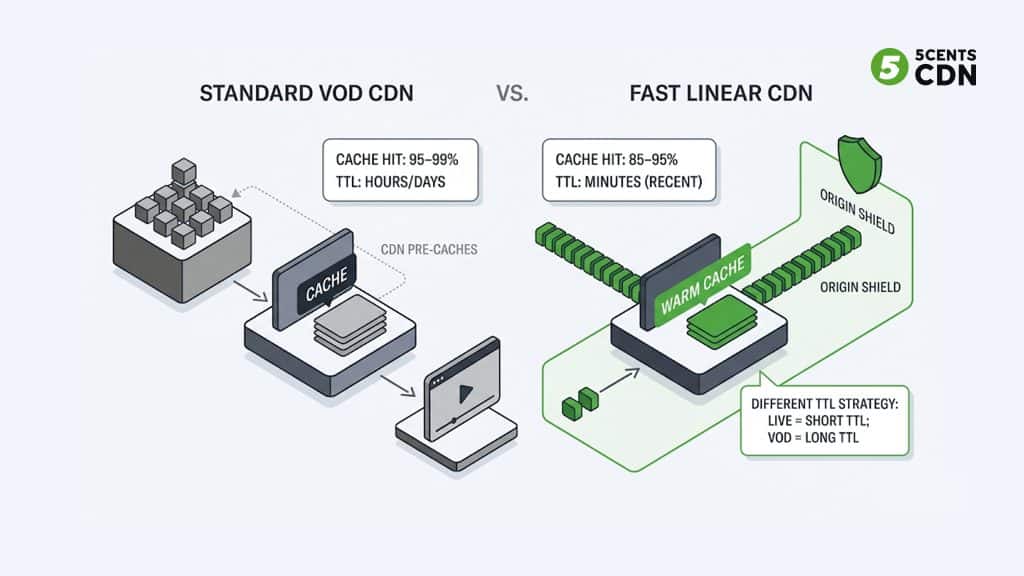
FAST channels mix two types of content in the same HLS stream — recent live-linear segments (generated in the last few minutes) and scheduled VOD segments (content from the asset library). These require different cache TTL strategies:
- Recent live-linear segments (last 30–60 minutes): short TTL (1–5 minutes) — content is time-sensitive and catch-up viewers should receive the current programme position
- Scheduled VOD segments within the playout: longer TTL (30–120 minutes) — same asset may repeat in the schedule; edge caching reduces origin load significantly
Origin Shield for 24/7 Continuity
A 24/7 channel cannot afford origin overload. Origin shield places a regional cache layer between edge nodes and the origin — when edge nodes miss, they request from the shield, not directly from origin. For a FAST channel with distributed global viewers, this means the origin handles a predictable low request volume regardless of peak viewership.
Manifest Caching
The HLS master manifest and media playlists must be configured with appropriate cache headers. The master manifest (which lists all ABR renditions) is relatively static — cache with a moderate TTL (5–15 minutes). The media playlist (which lists current segments) updates continuously — cache with a very short TTL (2–10 seconds) or use cache-control: no-store to ensure viewers always receive the latest segment list.
Redundancy: Designing for 24/7 Uptime
A FAST channel with no redundancy is a channel that will eventually go dark — and when it does, every viewer currently watching sees a black screen or error. Unlike a live event where downtime affects a defined time window, FAST channel downtime is ongoing until the fault is resolved.
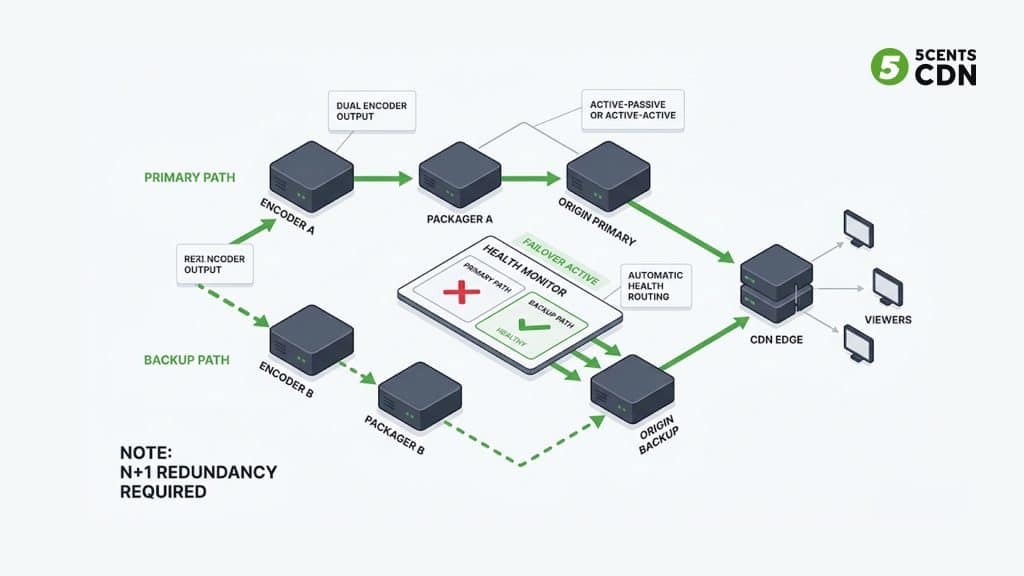
N+1 redundancy at three critical layers:
Encoder Redundancy
Run a primary and backup encoder simultaneously from the same source. If the primary encoder fails, an automatic health check switches the CDN to the backup encoder feed within seconds. Most cloud playout systems include this as a feature; for on-premise setups, it requires explicit dual-encoder configuration.
Origin Redundancy
Configure an active-passive or active-active origin pair. The CDN health-checks both origins continuously. If the primary origin becomes unreachable, the CDN fails over to the secondary automatically. Combined with origin shield, most failover events are invisible to viewers because edge nodes continue serving cached segments during the failover window.
CDN Redundancy
For highest-uptime requirements, a multi-CDN configuration routes viewer traffic across two CDN providers. If one CDN experiences a regional outage, traffic is automatically shifted to the secondary. This is infrastructure-level insurance for channels that cannot afford any viewer-facing downtime. See live event streaming solutions for enterprise redundancy configurations.
Monitoring and Analytics for FAST Channels
A running FAST channel requires both infrastructure monitoring (is the stream healthy?) and viewer analytics (is the audience engaged?).
Infrastructure Monitoring — Key Metrics
- Encoder output bitrate stability — should stay within ±5% of target CBR
- Stream availability — continuous uptime check against the HLS endpoint
- CDN cache hit ratio — target >85% for FAST linear segments
- Origin request rate — spike detection indicating cache miss cascade or encoder issues
- SCTE-35 marker delivery accuracy — markers firing at correct schedule positions
Viewer Analytics — Key Metrics
- Concurrent viewers per hour: identifies peak viewing windows for schedule optimization
- Average view duration: measures lean-back engagement — FAST should drive longer sessions than VOD
- Ad completion rate: percentage of ad breaks watched to completion — directly affects eCPM and platform revenue share
- Rebuffer ratio: target <0.5% — buffering on a lean-back channel is more damaging than on VOD because viewers cannot skip ahead
Use the video analytics SDK for real-time player-side metrics across all viewer devices and FAST platforms.
Pre-Launch Infrastructure Checklist
| Layer | Check | Pass Condition |
| Content | All assets ingested with correct duration metadata | Duration accuracy within ±1 second |
| Content | Closed caption files linked to all assets | SRT/WebVTT file per asset |
| Content | Content rights confirmed for FAST distribution | Rights documentation on file |
| Scheduler | 48-hour EPG schedule generated and validated | EPG XML exports without errors |
| Scheduler | Gap-fill filler content configured | No gaps in 48-hour schedule |
| Encoder | CBR mode confirmed, keyframe interval = 2s | Test output verified stable |
| Encoder | All 3 ABR renditions active (1080p / 720p / 480p) | All renditions present in HLS manifest |
| Encoder | Backup encoder configured and tested | Failover switch tested successfully |
| SCTE-35 | Ad break markers verified at scheduled positions | Markers verified in stream analyser tool |
| SSAI / Ads | VAST/VMAP ad tag tested and returning fill | Ad fill rate >80% in test environment |
| CDN | Origin shield active | Origin request rate <15% under test load |
| CDN | Segment TTL configured correctly by segment type | Recent segments: short TTL. VOD segments: longer TTL |
| CDN | Manifest cache headers set correctly | Media playlist: short TTL or no-store |
| CDN | Edge PoPs verified for target distribution regions | Latency <100ms to primary viewer geographies |
| Monitoring | Stream availability monitor active | Alerting configured for any stream interruption |
| Monitoring | Video analytics SDK active | QoE metrics reporting in real time |
| Distribution | FAST platform technical onboarding complete | HLS feed accepted by target platforms |
| Distribution | EPG feed registered with FAST platforms | Programme guide displaying correctly |
Frequently Asked Questions
What infrastructure do I need to run a FAST channel?
A production-ready FAST channel requires six infrastructure components: a content asset library with accurate metadata, a playout scheduler generating EPG data, a cloud or on-premise encoder producing continuous multi-bitrate HLS output, SCTE-35 ad marker injection, a CDN configured for 24/7 linear delivery, and optionally an SSAI system for direct ad monetization. Cloud playout platforms bundle most of these into a single managed service, reducing the infrastructure complexity significantly for new operators.
What is SCTE-35 and why does a FAST channel need it?
SCTE-35 is a broadcast signaling standard that embeds ad break cue markers in a video stream. FAST platforms use these markers to identify where advertisements should be inserted. Without SCTE-35 markers, platforms like Roku and Samsung TV Plus either cannot monetize your channel or use unreliable time-based insertion that frequently misses schedule boundaries. Accurate SCTE-35 markers are a technical requirement for revenue generation on FAST platforms.
What is EPG and how does it work for a FAST channel?
An Electronic Programme Guide (EPG) is the programme listing that FAST platforms display to viewers — showing what is playing now and what is coming up. The playout scheduler generates EPG data (typically in XMLTV format) from the programme schedule. FAST distribution platforms poll the EPG endpoint periodically and update their viewer-facing guide accordingly. EPG accuracy depends on the scheduler’s schedule timing matching the actual encoder output timing — any drift between them creates programme listing errors.
How is CDN configuration for FAST channels different from VOD or live streaming?
FAST channels require a mixed CDN caching strategy because they contain both live-linear segments (generated in real time, time-sensitive) and scheduled VOD segments (from the asset library, cacheable for longer). Recent live-linear segments need short TTLs to ensure viewer catch-up accuracy. VOD segments within the playout schedule can use longer TTLs to reduce origin load. The HLS media playlist (which lists current segments) needs very short TTL or no-cache to ensure viewers receive the current schedule position.
Do I need redundancy for a FAST channel?
Yes — more so than for a standard VOD platform. A FAST channel runs continuously, which means any single point of failure immediately affects all current viewers with no automatic recovery path. N+1 redundancy at the encoder, origin, and ideally CDN layers is the standard for production FAST channels. Cloud playout platforms typically include encoder and origin redundancy in their service SLA; CDN redundancy requires explicit configuration.
Can I run a FAST channel on the same infrastructure as my live streaming or VOD platform?
Yes — and this is the recommended architecture for OTT operators running multiple delivery models. A shared CDN handles live event streaming, VOD delivery, and FAST linear output simultaneously from the same edge infrastructure. The transcoding pipeline runs separate real-time encoder paths for live events and FAST playout, with shared VOD transcoding for the asset library. Unified analytics across all three models gives a complete view of audience engagement.
FAST Channel Infrastructure at 5centsCDN
Building a production-ready FAST channel pipeline requires aligned infrastructure across encoding, ad signaling, CDN delivery, and monitoring. Getting any one layer wrong — misconfigured SCTE-35 markers, incorrect segment TTLs, no origin redundancy — creates problems that are difficult to diagnose once the channel is live.
5centsCDN provides custom infrastructure for FAST channel operators — covering live transcoding, SCTE-35 marker support, origin shield, delivery acceleration, and 24/7 stream monitoring for always-on linear channels. Solutions are scoped per project based on your channel count, content volume, and distribution targets.
| Building a FAST Channel Streaming Infrastructure? 5centsCDN provides CDN delivery, live transcoding, SCTE-35 support, and origin shield for FAST channel operators. Get in touch to discuss your pipeline requirements. → Contact us |