

Every time an ad appears inside a streaming video, some system had to answer a question in a fraction of a second: out of all the ads that could run in this slot, which one should play right now? The system that answers that question is the ad decision server. It is one of the least visible pieces of the streaming ad stack, and one of the most important — because it is where the actual choice of ad gets made.
This guide explains what an ad decision server (ADS) is, how it differs from the ad server and the demand sources around it, how it fits into the request-and-response flow that ends with an ad inside your stream, and why it matters for anyone monetizing live or on-demand video.
What is an ad decision server, in one sentence
An ad decision server (ADS), sometimes called an ad decision service, is the back-end system that evaluates an ad opportunity in real time and selects which ad to serve, then returns that decision — usually as a VAST response — to the platform that will play or insert the ad.
The key word is decision. An ADS is a logic engine. When an ad break opens, it looks at everything known about that specific opportunity — the device, the content, the viewer’s rough context, the ad slot’s length, which campaigns are eligible, frequency limits, and business rules — and it chooses the single best ad to run. It is the referee that turns “an ad could play here” into “this exact ad plays here.”
The distinction that causes the most confusion: ADS vs ad server
The terms “ad server” and “ad decision server” are often used loosely, and the overlap trips people up. They are related but not the same, and separating them makes the whole stack clearer.
An ad server is primarily about storage and delivery. It is where ad creatives live and from where they are served. Think of it as the warehouse and the delivery truck: it holds the actual ad files and hands them out when told to.
An ad decision server is about the choice. It is the logic engine that evaluates the request and decides which ad should win the slot, based on targeting data and rules. It does not necessarily store the creative; it makes the call about which creative to use.
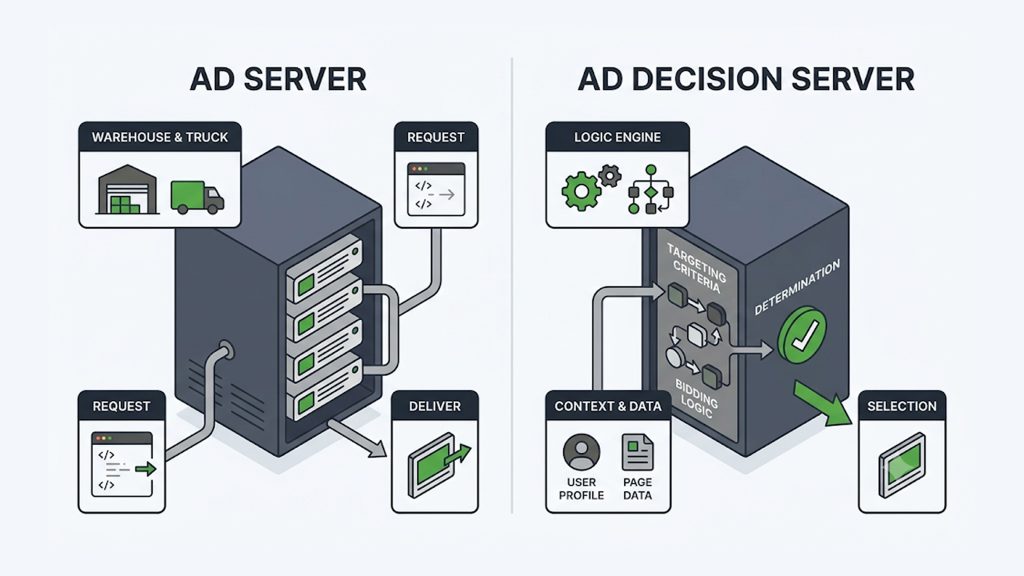
In many real systems these two functions live inside the same platform — a full ad server usually contains a decision engine — which is why the names get blurred. But the functions remain distinct: one stores and delivers, the other evaluates and chooses. When you separate “which ad” (decisioning) from “where the file lives and how it ships” (serving), the rest of the ecosystem falls into place. To picture it simply: the ad server is the kitchen that holds the ingredients and plates the dish, while the ad decision server is the head chef deciding which dish to make for this particular guest.
Where the ADS sits relative to demand
An ad decision server is not the same thing as a source of demand, though it works closely with demand. Demand sources — direct-sold campaigns, an ad server’s booked deals, a demand partner or SSP, or a programmatic marketplace — are where the ads and the money come from. The ADS is the layer that decides, at the moment of the request, which of the available demand should fill this specific slot.
Put another way: demand sources supply the candidates; the ad decision server picks the winner. If you want the full picture of where ads come from, our guide to ad demand sources for streaming covers the supply side, and explains how DSPs, SSPs, and ad exchanges work covers the marketplace players. The ADS is the decisioning point those inputs feed into.
How an ad decision server works, step by step
The flow is easiest to follow as a sequence. It begins the instant an ad opportunity appears and ends with a chosen ad on its way to the viewer.
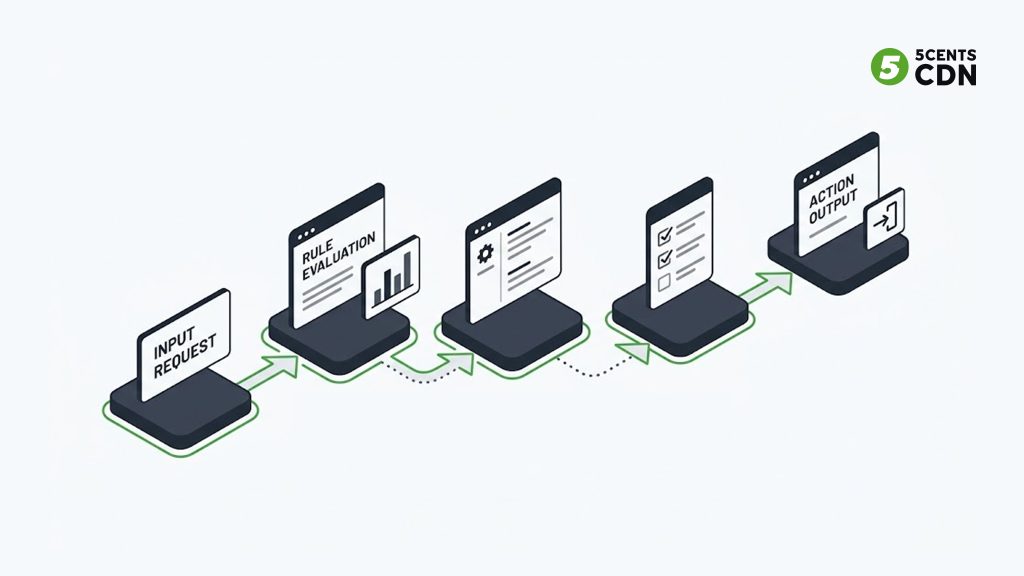
First, an ad opportunity is created. In live streaming, the stream itself signals that a commercial break is starting, commonly through SCTE-35 markers. In on-demand video, the opportunity is defined by the ad slots configured for that content.
Second, an ad request is sent to the ad decision server. That request carries context about the opportunity: the type of device, the content or channel, a rough location, the length of the ad slot, the ad position, and a unique identifier for the request. The richer and more accurate that context, the better the decision the ADS can make.
Third, the ADS evaluates the request. This is the core job. It checks which campaigns and demand sources are eligible for this opportunity, applies targeting criteria and business rules, honors frequency caps so a viewer is not shown the same ad too often, and weighs which eligible ad is most valuable or most relevant. In programmatic setups, this evaluation can include a real-time auction among competing buyers.
Fourth, the ADS returns a decision. It selects the winning ad and responds — typically with a VAST response, the standard format that describes the chosen ad: which video file to play, how long it runs, and how to track it. The decision is the output; VAST is the envelope it travels in.
Fifth, the ad is inserted and delivered. The platform that receives the VAST response fetches the ad and places it into the stream, in streaming most often through server-side ad insertion, so the viewer sees it as a seamless part of the broadcast.
The whole cycle happens in a fraction of a second, every time a slot needs to be filled.
What an ad decision server weighs when it chooses
The “decision” is not a coin flip. A capable ADS balances several inputs at once, and understanding them explains why the same slot can yield different ads for different viewers.
Targeting and eligibility come first: which campaigns are even allowed to run against this opportunity, given the audience, content, and geography. Then business rules and priority: a direct-sold campaign a publisher committed to may be given priority over open-market demand. Frequency capping limits how often a given viewer sees the same ad, protecting the experience. Value comes into play too: among eligible ads, the ADS generally favors the one that earns the most or performs best, whether by a fixed priority, a price, or a live auction. And technical eligibility matters: an ad whose format the stream cannot handle is not a valid choice, no matter how well it targets.
Balancing these is exactly why a dedicated decisioning layer exists. Without it, filling a slot would be guesswork; with it, every opportunity is matched to the best allowable ad automatically.
Two ways the decision gets made: priority and auction
Not every ad decision is made the same way, and it helps to know the two broad models a decision server uses to pick a winner.
The first is priority-based decisioning. Here the publisher sets a ranked order of who gets first chance at a slot. A direct-sold campaign that was booked in advance sits at the top, because the publisher has committed to delivering it; if it has an eligible ad for this opportunity, it wins. If it does not, the decision passes down the ranking to the next tier — a preferred partner, then broader demand — until something fills. This model gives publishers firm control and is ideal for honoring guaranteed deals.
The second is auction-based decisioning. Here eligible demand competes on value, and the highest bid for the impression wins. This is the logic behind programmatic and real-time bidding, and it tends to maximize the price of open-market inventory because buyers compete against each other in the moment.
Most mature setups blend the two: guaranteed direct deals are honored first by priority, and whatever they do not take is opened to an auction so the remaining inventory earns as much as possible. A capable ad decision server can run both models together, which is what lets a publisher protect committed deals and still squeeze the best price from everything else.
Why the ad decision server matters for streaming publishers
For a publisher, the ad decision server is where monetization strategy becomes real. Every rule about who gets priority, how often ads repeat, which demand competes, and what fills a slot when nothing else does — all of that is enforced at the decisioning layer. A weak or absent decisioning setup leaves revenue on the table: slots go unfilled, the wrong ad wins, or a valuable direct deal loses out to cheaper demand.
This is also why decisioning is closely tied to fill rate — the share of ad opportunities that actually get filled with a paying ad. A good ADS increases fill by drawing on multiple eligible demand sources and applying sensible fallback logic, so that if the first choice has nothing to serve, a second or third option, or a house ad, still fills the break rather than leaving dead air.
The decisioning layer, in short, is where a pile of demand connections turns into a coherent, revenue-maximizing strategy — the difference between simply having ads available and actually showing the right one every time.
Where 5centsCDN fits
At 5centsCDN, decisioning and insertion live together in the streaming path. Our ad manager provides the decisioning and routing layer — where you set demand priority, fallback order, frequency rules, and reporting across multiple sources — and our ad insertion technology carries out the result, reading the VAST response and stitching the chosen ad into your live or on-demand stream before delivering it worldwide. Because we operate inside the media path, the decision about which ad to serve and the mechanics of getting it cleanly into the video are handled in one connected workflow rather than bolted together after the fact.
In practice, you bring your demand — your own advertisers, an ad server, a demand partner, or a programmatic source — and our platform handles the decisioning and the insertion, so the right ad is chosen and delivered for every eligible opportunity. If you want to see how the decisioning and insertion layers can work together for your streams, get in touch with our team.
The bottom line: an ad decision server is the logic engine that chooses which ad plays in each slot, returns that choice as a VAST response, and hands it to the insertion layer to place into the stream. It is distinct from the ad server that stores and delivers creatives, and from the demand sources that supply the candidates. Get the decisioning layer right, and every ad opportunity is matched to the best allowable ad — which is where streaming revenue is won or lost.
Frequently asked questions
What is the difference between an ad server and an ad decision server?
An ad server primarily stores ad creatives and delivers them, while an ad decision server is the logic engine that evaluates each ad opportunity and chooses which ad to serve. In many platforms both functions are combined, but they are distinct roles: one stores and ships the ad, the other decides which ad wins the slot.
Does an ad decision server insert the ad into my stream?
No. The ad decision server chooses which ad to serve and returns that choice, usually as a VAST response. Placing the ad into the video is done by an ad insertion layer, most often server-side ad insertion (SSAI) in streaming, which is a separate function that reads the VAST response and stitches the ad into the stream.
Is an ad decision server the same as a demand source?
No. Demand sources — direct advertisers, an ad server’s booked deals, an SSP, or a programmatic marketplace — supply the candidate ads and the money. The ad decision server is the layer that decides, at request time, which of that available demand fills a specific slot.
What information does an ad decision server use to choose an ad?
It weighs targeting and eligibility, business rules and campaign priority, frequency caps, the value or bid of each eligible ad, and technical compatibility with the stream. It uses the context in the ad request — device, content, location, slot length, and position — to match the opportunity to the best allowable ad.
Why does the ad decision server matter for monetization?
Because it is where your rules about priority, frequency, competing demand, and fallback are enforced, the decisioning layer directly affects fill rate and revenue. A strong setup ensures the most valuable eligible ad wins each slot and that breaks are filled rather than left empty.