

You have a stream, an audience, and ad slots waiting to be filled — but where do the actual ads come from? If you have been told to “bring your own demand” and you are not sure what that means or where to find it, this guide explains ad demand sources and how they fit into the process. Not for advertisers buying ad space, but for the publisher who owns the content and needs ads to fill it.
Most guides on this topic are written backwards, for brands trying to buy their way onto streaming platforms. This one takes the publisher’s side of the table: what “demand” actually is, the real sources you can tap, how they connect to your stream, and why filling every slot is harder — and more important — than simply having an ad tag.
First, get the direction of the market right
Before hunting for ad sources, it helps to be clear about which side of the market you are on, because getting this backwards is the single most common and expensive mistake in streaming monetization.
You own the audience and the ad slots. That makes you the supply side — a publisher. Your goal is to earn money by showing ads to your viewers. What you are looking for is demand: advertisers willing to pay to reach that audience. Money flows from advertisers, through the ad-tech chain, to you.
This matters because many ad companies serve both advertisers and publishers from the same product, and if you approach them as though you want to buy ad space, you will be set up as the opposite of what you are. If the players and platforms in this space are unfamiliar, our guide to how DSPs, SSPs, and ad exchanges work explains who does what. For now, hold one idea: you are the seller, and you are shopping for demand.
What “demand” actually means
Demand is simply advertisers who are willing to pay to show ads to your viewers. A demand source is anything that can respond to a request for an ad with an actual ad to play.
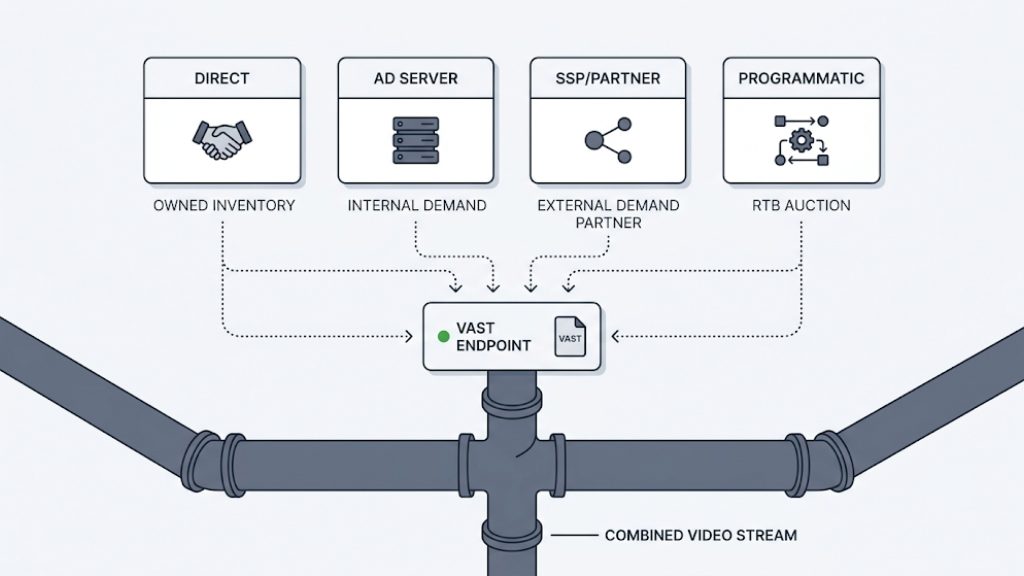
In technical terms, almost every demand source hands you the same thing: a VAST endpoint — a single link that, when your streaming platform calls it during an ad break, returns an ad. VAST (Video Ad Serving Template) is the industry-standard format for describing that ad. You do not need to master its internals to source demand; you just need to know that “getting demand” almost always means “getting a VAST endpoint from a source.” If you want the full picture of what that response contains, our explanation on what VAST is walks through it.
So the practical question “where do streaming ads come from?” becomes “where do I get a source that returns ads?” There are four main answers.
Source 1: Your own direct advertisers
The most valuable demand is often demand you already have. If you can sell ad space directly — to a local business, a sponsor, an endemic brand that wants your specific audience — that is direct-sold demand, and it usually pays the best because there is no chain of intermediaries each taking a margin.
Direct deals give you guaranteed placements and predictable revenue. A regional streaming service might sell a month-long campaign to a car dealership; a niche sports channel might land a betting sponsor for a season. The trade-off is effort: you have to find the advertisers, negotiate, and manage the relationships yourself. Most publishers cannot fill every slot this way, which is why direct demand is usually the first layer rather than the whole solution. Ad-management tools can take these direct deals and produce a VAST endpoint that plugs into your stream like any other source.
Source 2: An ad server
An ad server is the system publishers use to store ad creatives, decide which ad to show in a given slot, and track impressions and clicks. Google Ad Manager is the best-known example. An ad server lets you manage direct-sold campaigns and connect programmatic demand in one place, and it returns a VAST endpoint you hand to your streaming platform.
For a publisher who wants a single control point — rules about which advertiser gets priority, frequency caps, fallback behavior — an ad server is the natural home. It is the layer where “which ad plays here” gets decided before the ad is ever inserted into the video.
Source 3: A demand partner or SSP
If you do not have enough direct advertisers to fill your inventory — and most publishers do not — you connect to demand that someone else aggregates. A supply-side platform (SSP) or demand partner exposes your ad slots to a marketplace of advertisers and returns ads to fill them, again as a VAST endpoint.
This is the route that fills the gap between the slots you can sell yourself and the slots you cannot. An SSP runs automated auctions so multiple buyers compete for each impression, which tends to raise the price you earn. The trade-off is that you share revenue with the platform, and you have less direct say over each advertiser.
One critical warning, because it is exactly where publishers get burned: when you sign up with an SSP or demand partner, make sure you enroll as a publisher looking to monetize your inventory — the supply side. Some companies offer both a buy-side and a sell-side product in the same login, and it is easy to end up in the wrong one. If a conversation starts sounding like you would be paying to run ads, or asks how much inventory you want to buy, stop and clarify that you are a publisher seeking demand for your stream.
Source 4: Programmatic marketplaces
Beyond a single SSP, broader programmatic marketplaces connect your inventory to many demand sources at once through automated, real-time auctions. Programmatic advertising is the automated buying and selling of ad space, and real-time bidding is the auction that prices each individual impression in the moment it becomes available.
The appeal is scale and fill: instead of relying on one source, your ad opportunity is offered to many potential buyers, raising the odds that a slot gets filled at a competitive price. The mechanics are more involved, and quality control matters — but conceptually, programmatic is still just another way to get eligible ads returned to your stream as VAST responses.
Not all of your inventory is worth the same
One idea that helps you choose sources wisely: your ad slots are not all equal in value, and matching the right demand to the right inventory is part of the job.
Publishers usually think in terms of premium and remnant inventory. Premium inventory is your most valuable ad space — the slots most likely to be seen and completed, such as a pre-roll before a popular live event, or ad breaks in a show with a loyal, engaged audience. This space tends to command higher prices and is the best candidate for direct-sold deals, where you can negotiate a strong rate. Remnant inventory is the space you cannot sell directly — leftover slots that would otherwise go empty. Rather than show nothing, you route remnant inventory to a demand partner or programmatic marketplace to earn whatever it can, which is usually less than a direct deal but far better than an unfilled break.
Seeing your inventory in these tiers explains why publishers use more than one demand source: you sell your best slots directly for the highest price, and you use aggregated demand to monetize everything you could not sell yourself. The goal is not one perfect source; it is the right source for each slot.
Combining sources: the demand waterfall
In practice, publishers rarely rely on a single source. The strongest setups layer them, so that the highest-value demand gets first chance at each slot and lower-value demand fills whatever is left.
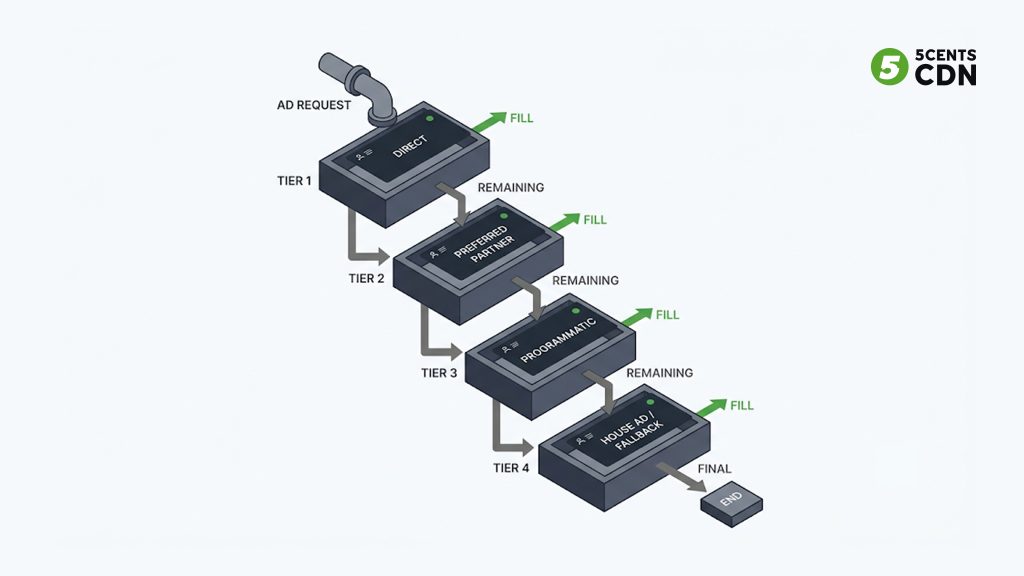
A typical priority order runs like this: your direct-sold campaigns get first look, because they pay best. If there is no direct ad for that slot, the opportunity passes to a preferred demand partner. If that partner has nothing eligible, it flows to the broader programmatic marketplace. And if nothing fills at all, a house ad or a fallback keeps the break from showing dead air. This layered approach is often called a waterfall, and its whole purpose is to maximize how many slots earn revenue without leaving money on the table.
An ad-management layer is what lets you define this order, set price floors, and route between sources — turning a pile of demand connections into a coherent monetization strategy.
Why fill rate matters more than having an ad tag
Here is the part newcomers underestimate. Connecting a demand source does not guarantee revenue. What matters is fill rate — the share of your ad opportunities that actually get filled with a paying ad.
Suppose your channel generates a million ad opportunities in a month, but your demand sources only return ads for six hundred thousand of them. Your fill rate is sixty percent, and the other four hundred thousand opportunities earn nothing. That gap is why publishers connect multiple demand sources, add fallback logic, and pay attention to targeting and formats: every unfilled slot is revenue that silently disappears.
Several practical factors move fill rate up or down. The number of demand sources competing for each slot is the biggest lever — more eligible buyers means a higher chance any given break is filled, which is the whole logic behind connecting multiple sources rather than one. Targeting data matters too: a demand source can only return an ad if it has enough information about the opportunity to match a campaign, which is why passing accurate signals about device, content, and audience raises fill.
Format and technical compatibility play a role as well — if the returned ad does not match what your player or stream can handle, the slot goes unfilled even though demand existed. And the way you let sources compete affects the outcome: some publishers move from a strict waterfall, where sources are tried one after another, toward setups where multiple sources bid at the same time so the highest price wins. On the web, that simultaneous-competition approach is known as header bidding; the underlying principle — letting demand compete rather than queue — applies to streaming too.
Having a demand source is the starting line, not the finish; the real work is filling as much inventory as possible at the best price.
The step every demand source depends on: insertion
There is one thing none of these demand sources do, and it is the step that turns a returned ad into revenue: putting the ad inside your video.
A demand source answers “which ad, and what is it worth.” It hands back a VAST response. But that response is just instructions — it does not place anything into your stream. Something still has to detect the ad break, call the demand source, read the VAST response, and stitch the selected ad into the video so your viewer sees it as a seamless part of the broadcast. In live streaming, the ad break is typically announced inside the stream by SCTE-35 markers, and the insertion is handled by server-side ad insertion (SSAI), which places the ad into the stream before it reaches the viewer.
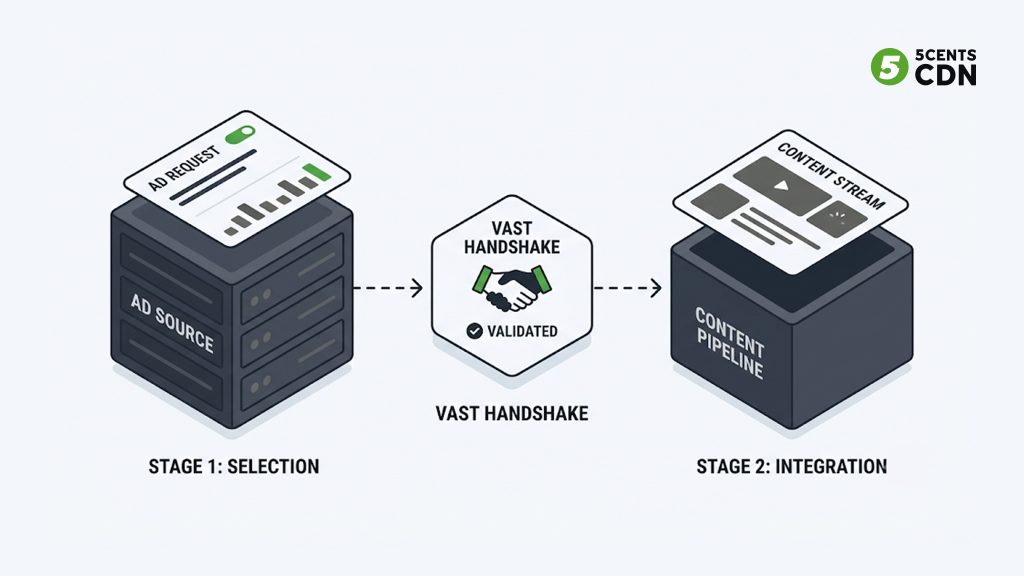
This is why sourcing demand and inserting ads are two separate jobs. Your demand source provides the ads; your streaming and insertion platform gets them into the video. They connect through VAST as a common handshake — which is exactly what lets you bring whatever demand pays best and still rely on one platform to deliver it cleanly.
Where 5centsCDN fits
5centsCDN is the streaming delivery and insertion layer — the part that turns the ads your demand sources return into ads your viewers actually see. You bring the demand (your direct advertisers, an ad server, a demand partner, or a programmatic source, in any combination), and our ad insertion technology detects the break, calls your VAST endpoint, and stitches the selected ad into your live or on-demand stream before delivering it worldwide.
For publishers juggling several demand sources, our ad manager provides the decisioning and waterfall layer — priority order, fallback rules, and reporting — so you can maximize fill without wiring each source together by hand. And if you are building free ad-supported channels, our FAST channel builder ties the programming and ad breaks together. If you are still deciding which business model fits, our guide to OTT monetization models covers AVOD, FAST, and the alternatives.
The bottom line: streaming ads come from advertisers, reached through four main routes — your own direct deals, an ad server, a demand partner or SSP, and programmatic marketplaces — and every one of them hands you the same thing, a VAST endpoint. Getting demand is step one. Filling as many slots as possible, and inserting those ads cleanly into your stream, is where the revenue actually happens. If you want help connecting your demand and turning it into inserted, delivered ads, get in touch with our team.
Frequently asked questions
What does “bring your own demand” mean for a streaming publisher?
It means you supply the source of ads — usually a VAST endpoint from your own advertisers, an ad server, a demand partner, or a programmatic marketplace — and your streaming platform handles inserting those ads into your stream. You are not expected to build ad technology; you just connect a source that returns ads.
Where do streaming publishers actually get their ads?
From four main sources: direct-sold advertisers you sell to yourself, an ad server such as Google Ad Manager, a demand partner or SSP that aggregates advertisers, and programmatic marketplaces that auction each impression. Most publishers combine several of these to fill more of their inventory.
Do I have to choose just one demand source?
No. Most publishers layer sources in a priority order, or waterfall — direct deals first because they pay best, then a demand partner, then programmatic, with a house ad as a final fallback. Combining sources raises your fill rate and your revenue.
What is fill rate, and why does it matter?
Fill rate is the percentage of your ad opportunities that get filled with a paying ad. If only part of your inventory is filled, the rest earns nothing, so a higher fill rate means more revenue from the same audience. It is usually more important than simply having a single ad source connected.
Does my demand source insert the ads into my stream?
No. A demand source returns which ad to show, as a VAST response, but it does not place the ad into your video. Inserting the ad — detecting the break, reading the VAST response, and stitching the ad into the stream — is done by a streaming and ad-insertion platform, which is a separate function connected to your demand source through the VAST standard.