

A live sports stream piracy attack does not always begin with a cracked encryption key. Increasingly, it begins with your own infrastructure delivering the game to people who never paid for it. The pirate does not need to break your DRM if they can simply borrow a legitimate viewer’s access and let your content delivery network do the rest, serving a stolen stream at your expense while degrading quality for the subscribers who actually paid.
This is the part of the piracy problem that encryption alone does not solve. Digital rights management protects the content itself, and it remains essential, but a growing share of live sports piracy happens at the delivery layer, where streams are hijacked, re-shared, and rebroadcast in ways that a license server never sees. For a live match, where the entire commercial value is compressed into ninety minutes, that gap is expensive. This guide focuses on the defenses that live at the edge of your delivery network, the controls a CDN is uniquely positioned to enforce, and how they combine into a layered defense that closes the doors DRM leaves open.
Why Live Sports Is the Hardest Content to Protect
Three characteristics make live sports uniquely attractive to pirates, and understanding them explains why edge-layer defense matters so much.
The first is concentrated value. Broadcasters pay enormous sums for exclusive rights, so every viewer watching a free illegal feed is directly lost revenue, and the rights holder is watching those numbers closely. The second is the compressed window. A pirate does not need to host a film library indefinitely; they only need to relay a signal for roughly two hours. That short window means takedown speed matters more than almost anything else, because by the time a slow process catches up, the match is over and the damage is done. The third is simultaneous scale. Tens of millions of people want the same moment at the same instant, so a single illegal stream can attract a massive audience the moment it appears, and demand-driven piracy spikes exactly when your legitimate infrastructure is already under peak load.
Put together, these three forces mean live sports piracy is not a slow, background leak you can address at leisure. It is a fast, high-value, high-volume attack that unfolds in real time, and the defenses that work are the ones that operate automatically at the point of delivery rather than after the fact.
The Two Piracy Methods That Target Your Delivery Layer
Most live sports piracy that involves your delivery network takes one of two forms. They work differently, and they call for different defenses.
Restreaming
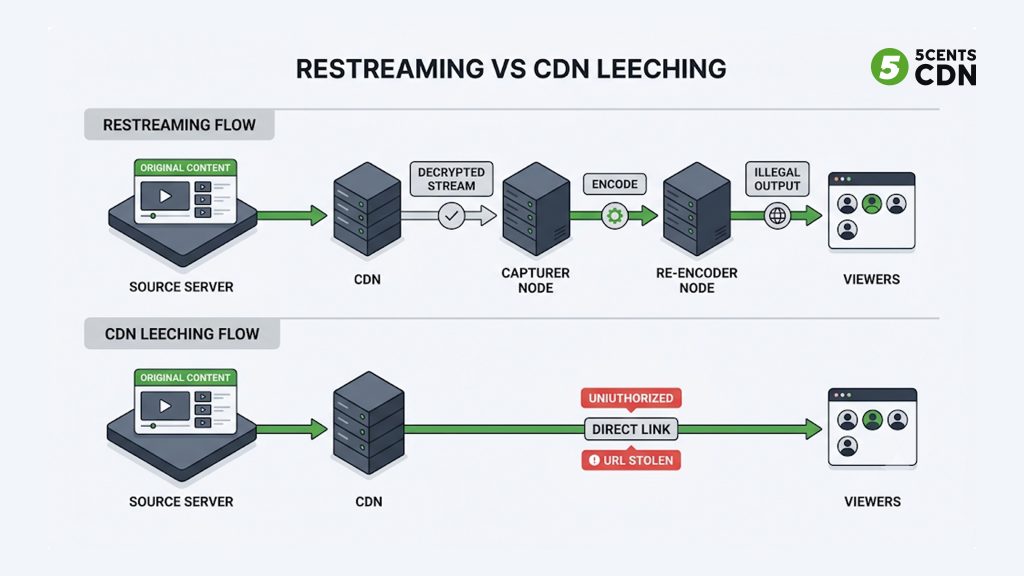
Restreaming is the traditional method. A pirate subscribes legitimately, captures the decoded video signal, often by tapping the output after it has already been decrypted on a device they control, then re-encodes it and pushes it out through a social platform or a private distribution network. Because the capture happens after decryption, restreaming sidesteps content encryption entirely; the pirate is copying pictures off a screen they were authorized to see, not breaking the lock on the file. This is precisely why encryption alone cannot stop it, and why restreaming is the vector that forensic watermarking, discussed below, is designed to address.
CDN Leeching
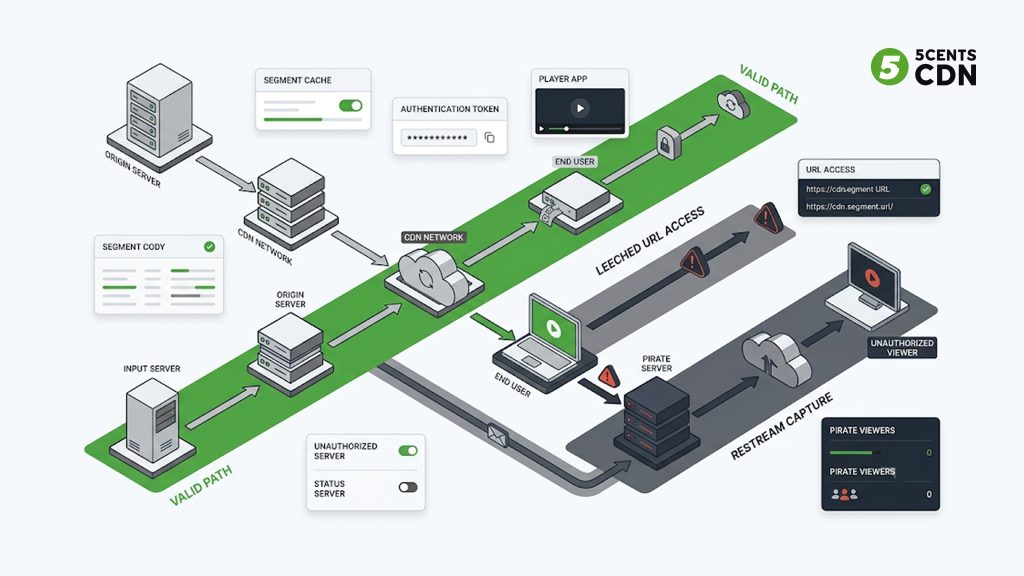
CDN leeching is newer and, for a delivery network, more insidious. Instead of re-encoding anything, the pirate reverse-engineers a legitimate app to extract the live stream URL and the associated access credentials, then shares those broadly. Unauthorized viewers then pull the stream directly from your real CDN. The consequences are doubly damaging: you lose the subscription revenue, and you also pay the delivery cost of serving every stolen view, since the traffic is real traffic from your own edge. Worse, that unplanned load can spike unpredictably during a big match and degrade quality for paying subscribers. Because the requests look like genuine CDN traffic, leeching is genuinely hard to detect without the right controls in place, which is exactly why it has become one of the dominant piracy methods for high-demand live content.
Where Leeching Gets In: The Weak Points at the Edge
CDN leeching succeeds by exploiting gaps that most streaming setups leave open without realizing it. Recognizing these weak points is the first step to closing them.
The most common gap is missing or weak stream authentication, where the CDN will serve a valid stream URL to anyone who presents it, with no check on whether the requester is entitled to it. Close behind is insufficient geographic and network filtering, where streams remain accessible from regions or networks that should be blocked outright under the rights agreement. A third is the absence of delivery-layer analytics and monitoring, which leaves operators blind to the traffic anomalies that signal theft in progress. And a fourth is weak application protection, where an app that can be trivially reverse-engineered hands attackers the URLs and credentials they need to leech in the first place. Each of these is addressable, and the following layers map directly onto them.
What makes leeching especially stubborn is that, unlike a brute-force attack or an obvious credential-stuffing run, the stolen traffic is indistinguishable from legitimate traffic at the byte level. The pirate is not sending malformed requests or hammering a login endpoint; they are replaying a genuine, valid stream URL that your CDN was built to serve. Without controls that inspect entitlement and behavior rather than just request validity, there is no signal to trip. That is why effective defense does not try to spot “bad bytes” but instead layers checks that ask harder questions: is this request carrying a live, unexpired entitlement, is it coming from where it should, and does its pattern match a real subscriber or a shared backdoor. The rest of this guide is organized around exactly those questions.
Layer One: Token Authentication at the Edge
The single most important delivery-layer defense is signed token authentication enforced at the CDN edge. Rather than treating a stream URL as a public address that anyone can request, token authentication requires each request to carry a cryptographically signed token that the edge validates before it serves a single byte. A request that arrives without a valid token, or with an expired or tampered one, is rejected at the edge even if it originates from inside the licensed region.
This directly attacks CDN leeching. A shared URL becomes useless once the token attached to it expires, so a credential that leaks mid-match stops working within the short lifetime you assign to it rather than remaining a permanent backdoor. Tokens can be scoped tightly, bound to short validity windows, to specific content, and to conditions you define, so that even a captured token grants only a narrow slice of access before it dies. Because the check happens at the edge, it adds negligible latency while shutting off the most cost-damaging piracy vector at the door. Implementing this well is a matter of configuring the right rules at the delivery layer; 5centsCDN handles token validation through edge rules so that entitlement is checked on every request. For a deeper explanation of how signed tokens work as an access-control mechanism, our guide to token-based authentication covers the fundamentals.
There is also an industry effort worth watching here: work toward a common access-token standard across CDNs aims to unify how tokens are issued and validated, which simplifies protection for operators running more than one delivery network. For teams already thinking about resilience through a multi-CDN posture, consistent token enforcement across networks is an important part of keeping the same protection everywhere.
Layer Two: Geo-Blocking and Network Filtering
Live sports rights are sold by territory, so geographic enforcement is both a licensing obligation and a genuine anti-piracy control. Geo-blocking identifies the requester’s location from their IP address and allows or denies access according to the rules for that specific event or competition. Done at the delivery layer, it lets you apply granular, per-event and per-region rules rather than a blunt all-or-nothing policy, which matters when a broadcaster holds rights to one league across several countries and another league in just one.
Geographic rules alone are not the whole story, because determined viewers reach for tools that mask their true location. Effective network filtering therefore pairs location rules with detection of the anonymizing networks commonly used to bypass them, so that access from clearly evasive sources can be challenged or denied. The goal is not to punish legitimate travelers but to make casual circumvention meaningfully harder. 5centsCDN provides geo-blocking at the edge so operators can enforce territorial rights precisely where delivery happens. Combined with token authentication, geo-blocking ensures that a request must be both entitled and in-territory before it is served.
Layer Three: Bot Defense and Traffic Anomaly Detection
Automated abuse sits underneath both leeching and large-scale unauthorized access. Scripts harvest stream URLs, credential-stuffing tools test stolen logins, and bot fleets pull streams at scale. Defending the edge therefore means distinguishing automated abuse from genuine viewers and acting on it in real time.
Two capabilities matter most here. The first is active bot management that identifies and challenges automated clients before they can harvest URLs or drive leeched traffic, which addresses the reconnaissance stage of an attack rather than waiting for the theft itself. The second is anomaly detection built on delivery analytics: a single stream URL suddenly serving an implausible number of sessions, a spike of requests from unexpected networks, or concurrency patterns that do not match a legitimate subscriber base are all signatures of piracy in progress. Watching these signals lets you respond within the live window rather than discovering the theft after the match. 5centsCDN pairs bot protection and management with a real-time video analytics SDK so that the same data which measures audience also surfaces the anomalies that reveal theft. Underpinning all of this, DDoS protection keeps the delivery layer stable when a viral illegal stream drives unexpected load.
Layer Four: Encryption and DRM, the Adjacent Layer
Everything above governs who can reach your stream. Encryption governs what they can do with it if they get a copy of the bytes, and it remains a non-negotiable foundation. Content protected with digital rights management is encrypted so that even a captured segment is useless without a valid, time-limited license, and for live content the encryption key is rotated periodically through the broadcast so that a single compromised license exposes only a short window rather than the whole match.
DRM and edge access control are complementary, not alternatives. Token authentication stops an unauthorized request from reaching the content; DRM ensures that content obtained anyway cannot be decrypted and replayed. A serious live sports defense uses both, and the two are frequently confused precisely because they are so often deployed together. Because DRM is a deep topic in its own right, covering the three major systems, multi-DRM packaging, hardware security levels, and license-server scaling for live peaks, we treat it fully in a dedicated guide rather than repeating it here; see our explainer on DRM for OTT streaming for how encryption and licensing fit alongside the edge defenses in this article. The encrypted segments themselves are delivered by the CDN like any other content, which is why encryption and edge enforcement combine so cleanly at the delivery layer.
The One Layer 5centsCDN Does Not Provide: Forensic Watermarking
Restreaming, where a pirate captures the decoded picture and rebroadcasts it, cannot be stopped by access control or encryption, because the pirate was an authorized viewer at the moment of capture. The technique the industry uses against it is forensic watermarking: embedding an invisible, session-specific identifier into each viewer’s stream so that if a pirated feed surfaces, the mark can be extracted from it and traced back to the account or device that leaked it, enabling that session to be shut off.
In the interest of an honest account, 5centsCDN does not provide forensic or per-viewer watermarking. It is a genuine and important layer in a complete anti-piracy posture, and operators protecting the highest-value live rights typically source it from a specialist watermarking provider and run it alongside their delivery stack. What 5centsCDN does provide is the delivery-layer foundation that everything else builds on: token authentication, geo-blocking, bot and anomaly defense, and secure delivery of encrypted content. We would rather be clear about the boundary than imply a capability we do not offer, so that you can plan a complete defense with accurate expectations of which pieces come from where.
Putting the Layers Together
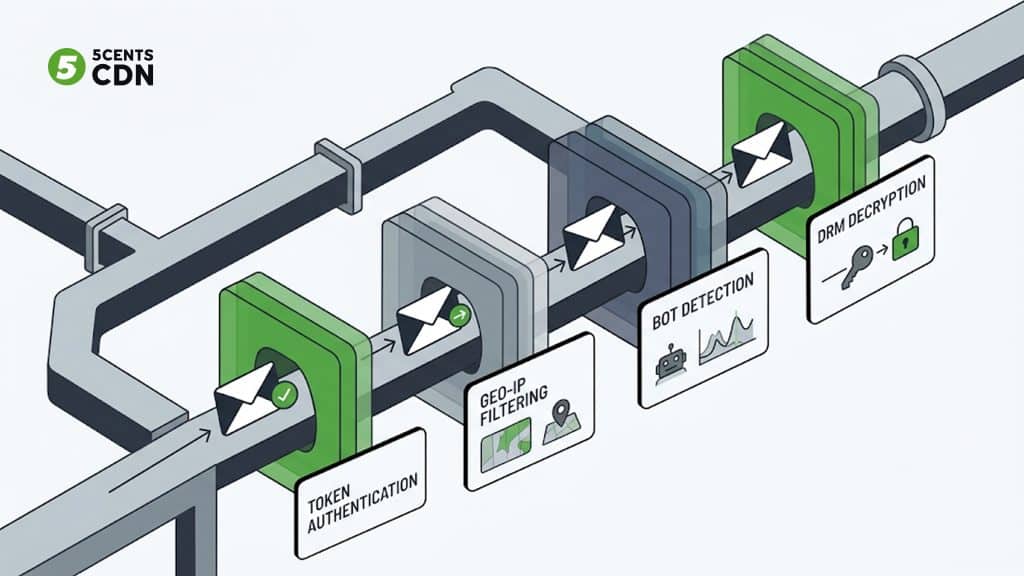
No single control stops live sports piracy, and the mistake most often made is treating any one of them as sufficient. Encryption without edge access control leaves your CDN willing to serve stolen URLs. Token authentication without geo-blocking leaves territorial rights unenforced. Geo-blocking without anomaly detection leaves you blind to the theft that slips through. The defenses work because they overlap: a request must survive token validation, then territorial and network filtering, then bot and anomaly screening, all before it is served, and any content that escapes anyway is still encrypted. Each layer covers a different attacker, and each covers the gaps the others leave.
The practical sequence for an operator is to start where the cost bleeds fastest. Turn on token authentication first, because it directly stops CDN leeching, the vector that makes you pay to deliver stolen streams. Layer geo-blocking and network filtering next to enforce your rights map and cut off out-of-territory access. Add bot defense and anomaly monitoring so you can see and stop theft within the live window rather than after it. Keep DRM encryption as the constant foundation beneath all of it. And if your rights are valuable enough to justify tracing individual leakers, add forensic watermarking from a specialist as the final layer. Built in that order, each step delivers a concrete reduction in piracy exposure on its own, and together they form a defense calibrated to the way live sports is actually stolen.
Protecting Your Next Live Event
Live sports piracy at the delivery layer is a solvable problem, but only with controls that operate automatically, at the edge, in real time, because that is the speed at which the theft happens. Token authentication, geo-blocking, bot and anomaly defense, and the secure delivery of encrypted content are the layers a CDN is uniquely placed to enforce, and they are the difference between a stream that serves only the audience you intended and one that quietly funds its own piracy.
5centsCDN gives broadcasters and OTT operators the delivery-layer defenses that close the doors leeching and unauthorized access rely on: edge token validation, precise geo-blocking, bot protection, DDoS resilience, and real-time analytics, delivered over a purpose-built CDN for live streaming. If you are protecting a live sports rights package and want to pressure-test where your current setup leaks, talk to our team about hardening delivery before your next event goes live.
Frequently Asked Questions
What is CDN leeching in live sports streaming?
When pirates extract a legitimate stream URL and credentials, then let unauthorized viewers pull the stream directly from the real CDN, so the operator loses revenue and pays to deliver stolen views.
How is restreaming different from CDN leeching?
Restreaming captures the decoded picture after decryption and re-encodes it for redistribution; leeching steals the URL and serves the original stream from your CDN. Encryption stops neither on its own.
How does token authentication stop stream piracy?
The CDN edge validates a signed, short-lived token on every request and rejects any request without a valid one, so a leaked URL stops working when its token expires.
Does DRM alone stop live sports piracy?
No. DRM protects the content if bytes are captured, but it does not stop URL hijacking or post-decryption restreaming. Edge access control and DRM are complementary layers.