

If you have ever seen “this content is not available in your region,” you have met geo-blocking. For a viewer it is a minor annoyance; for a streaming business it is a contractual necessity. Content is licensed territory by territory, and a platform that serves a title where it has no rights is not just breaking a rule — it is exposing itself to real legal and financial risk.
This guide explains what geo-blocking is, why streaming platforms rely on it, and — the part most explanations skip — how it is actually enforced across the delivery stack, from the CDN edge to the DRM license server. It is written for operators who need to implement regional restrictions, not for viewers looking to get around them.
We will cover the definitions and the terminology people mix up, the business and legal reasons geo-blocking exists, the detection methods behind it, the three layers where it is actually enforced, how it differs from geo-routing, the legal picture including the EU rules, the main use cases, the practical challenges, and a short set of best practices for getting it right.
What Is Geo-Blocking?
Geo-blocking (also called geo-restriction) is the practice of allowing or denying access to online content based on the user’s geographic location. In streaming, it means a given video, live channel, or entire catalog is made available only in the regions where the provider has the right to distribute it — and blocked everywhere else.
A closely related term is geo-fencing, which usually refers to drawing a virtual boundary around a specific area (sometimes much smaller than a country) and controlling access within it. In practice, streaming operators use the terms loosely, but the underlying idea is the same: location decides access.
Why Streaming Platforms Use Geo-Blocking
Geo-blocking is rarely optional for a serious streaming operation. It exists to satisfy several distinct business and legal needs at once.
Content Licensing and Territorial Rights
This is the dominant reason. Studios, leagues, and distributors sell rights region by region. A film licensed to one platform in the United States may belong to a different broadcaster in the United Kingdom, and may not be licensed at all somewhere else. Geo-blocking is how a platform honors those territorial agreements and avoids serving content where it has no rights.
Live Sports and Blackouts
Sports rights are among the strictest. Leagues sell exclusive regional broadcast rights and often enforce local “blackouts” — a game may be unavailable in the home team’s market to protect ticket sales or a local broadcaster’s deal. Geo-blocking is what makes it possible to show a live event in the correct territories while blocking it in blacked-out ones.
Regulatory and Compliance Requirements
Some content is legal in one country and restricted in another due to censorship rules, age regulations, or cultural sensitivities. Online gambling and betting streams are a common example, since gambling law varies sharply by jurisdiction. Geo-blocking helps operators stay compliant with the local rules of each market they serve.
Market Segmentation and Pricing
Operators also use geo-blocking to run different catalogs, languages, or price points per region, tailoring both the offering and the economics to local markets.
How Geo-Blocking Works
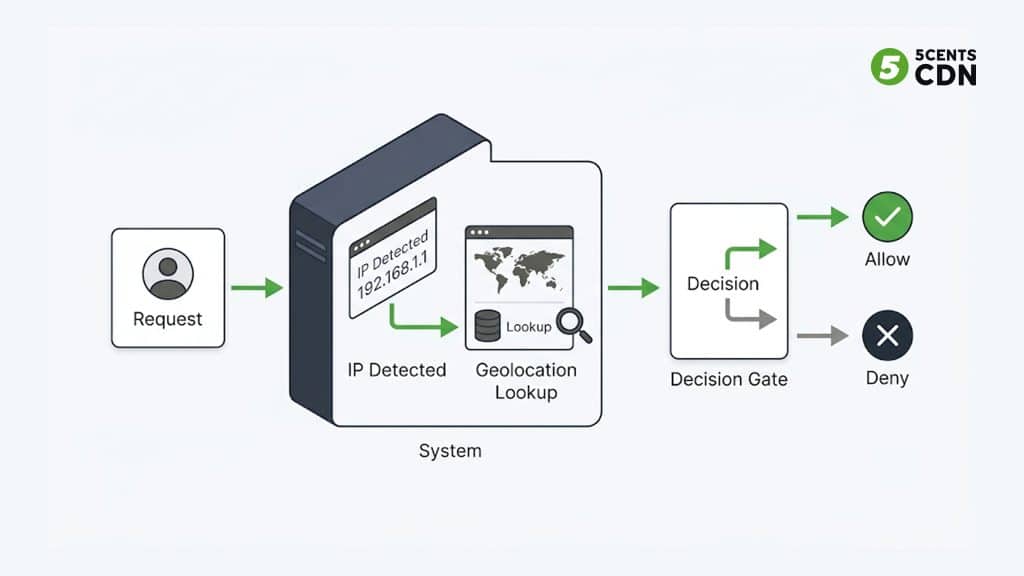
At its core, geo-blocking answers one question on every request: where is this viewer, and are they allowed to watch this? The mechanics come down to detecting location and then applying a rule.
IP Geolocation
The most common method is IP-based geolocation. Every device on the internet has an IP address, and providers maintain databases that map IP ranges to countries and regions. When a viewer requests a stream, the platform looks up their IP, infers their location, and decides whether to serve or refuse the content.
The important nuance is accuracy. Country-level geolocation is highly reliable when VPN traffic is excluded, which is why country-based rules are the workhorse of streaming geo-blocking. Sub-country accuracy — state, region, or city — is much shakier, often materially less reliable, which is exactly why fine-grained rules like a single-market sports blackout are harder to enforce cleanly than a simple “this country only” rule. Operators designing blackout logic need to account for that margin of error rather than assuming pinpoint precision.
Device Location and Other Signals
On native mobile and TV apps, an operator can optionally use the device’s own location services (GPS) for cases where the rule is smaller than a country or where extra certainty is needed. Some setups also factor in account and billing signals — for example, the registered home country of a subscriber — to distinguish a traveler from someone trying to spoof their location. In practice, robust systems combine several signals rather than trusting IP alone.
VPN and Proxy Detection
Because viewers can use VPNs or proxies to disguise their location, operators layer in anonymizer detection — flagging IP ranges known to belong to VPN and proxy services. Without it, an IP check alone is a fence with an obvious gap. Detection typically relies on reputation databases of known VPN/proxy endpoints, and because those endpoints change constantly, it is an ongoing effort rather than a one-time setting. Some operators respond to a suspected VPN with a hard block; others use a softer challenge where the deal terms allow it.
Allowlist vs Blocklist
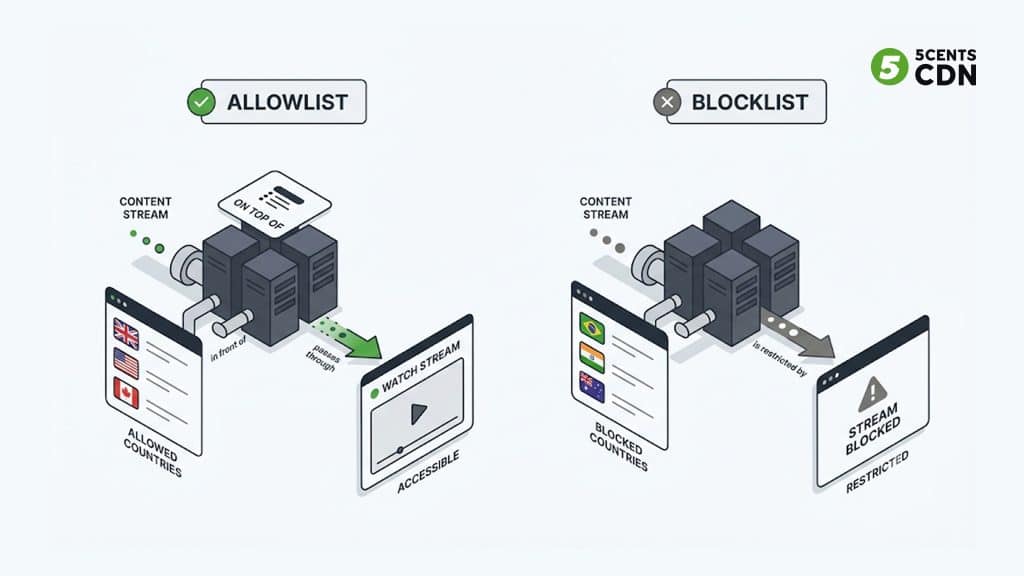
Rules are usually expressed one of two ways. An allowlist (allow only these countries; block everyone else) is the safest default when you hold rights for a defined set of territories. A blocklist (allow everyone except these countries) suits cases like blackouts where you serve broadly but must exclude a few regions. Choosing the right model per asset prevents both accidental leaks and accidental lockouts.
Where Geo-Blocking Is Enforced: The Three Layers
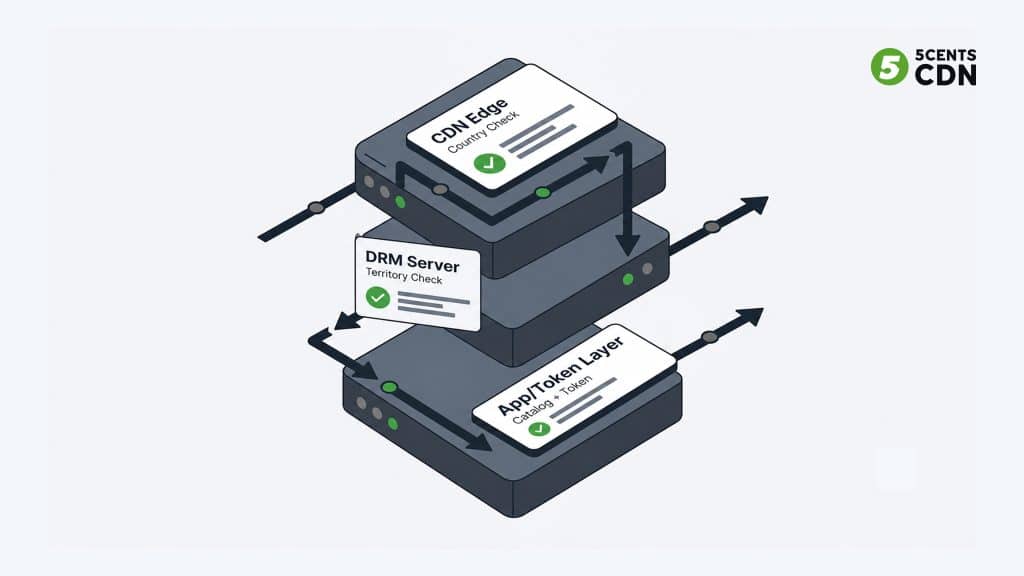
Here is the part most explanations gloss over. In a real streaming platform, geo-blocking is not a single switch — it is enforced at several layers at once, and understanding them is the difference between a rule that looks right and one that actually holds.
1. The CDN Edge
The first and highest-volume line of enforcement is the CDN edge. Because the edge is where viewer requests actually land, a country lookup can happen there — before the request ever reaches your origin. If the viewer is out of territory, the edge refuses the manifest or the individual video segments outright. Enforcing at the edge is cheap, fast, and scales to millions of requests, which is exactly why it is the front door for geo-blocking. It also protects origin resources, since blocked requests never travel back through your infrastructure.
2. The DRM License Server
For protected content, the same geographic check is repeated as a separate gate at the DRM license server. Even if a request somehow reaches the point of playback, the license server can refuse to issue the decryption key when the viewer is outside the licensed territory. This matters because it ties the geographic rule directly to the rights decision: no valid location, no key, no playback. Keeping geo rules aligned with DRM policy avoids having two separate “sources of truth” that can drift apart.
3. The Application and Token Layer
Finally, the application layer filters what a viewer can even see — catalogs and metadata are tailored so out-of-region titles do not appear in search or browse. This is often combined with token-based authentication, where a short-lived, signed token encodes who may watch and from where, and the edge validates it before delivering content. Token auth and geo rules work hand in hand: the token proves the session is authorized, and the geo check confirms the location is allowed.
Used together, these layers give both breadth and depth: the edge does cheap high-volume denial, the DRM server enforces the policy-rich rule on protected paths, and the app layer shapes the visible experience. A platform that relies on only one layer usually has a hole somewhere.
A concrete example ties it together. Imagine a league match that is licensed nationwide except for a blackout in the home team’s local market. When a viewer opens the app, the application layer decides whether the event even appears in their catalog. When they press play, the CDN edge checks their country (and flags VPN use) before serving the manifest — and if they are inside the blacked-out region, the edge refuses. For a DRM-protected stream, the license server independently confirms the territory before issuing a key. A request has to pass every applicable layer; failing any one of them stops playback. That redundancy is what makes the rule hold up under a rights-holder audit, not just in a demo.
Geo-Blocking vs Geo-Routing: Not the Same Thing
It is worth clearing up a common confusion. Geo-blocking restricts access by location. Geo-routing — the kind of location awareness a CDN uses with technologies like Anycast and DNS load balancing — does almost the opposite: it directs each viewer to the nearest or best-performing edge to speed delivery up. One decides whether a viewer may watch; the other decides where from they are served. A modern platform uses both: geo-routing for performance, geo-blocking for rights.
Is Geo-Blocking Legal?
Geo-blocking is legal in most of the world and is standard practice for licensed content. The most-cited nuance is the European Union’s Geo-Blocking Regulation (in force since 2018), which bans unjustified geo-blocking for many goods and online services within the EU. Crucially for streaming, the regulation explicitly exempts audiovisual and copyrighted works — so territorial licensing of films, shows, and sports remains lawful inside the EU.
A separate EU rule requires paid streaming services to offer “portability,” meaning a subscriber traveling within the EU must still be able to access their home-country service. The practical takeaway: geo-blocking for licensing reasons is generally fine, but the exact rules vary by market, so operators should confirm the framework for each region they serve. (This is general information, not legal advice.)
Common Use Cases
- OTT and VOD catalogs: different libraries per country under regional licensing deals.
- Live sports: enforcing exclusive regional rights and local blackouts.
- Pay-per-view events: restricting an auction, match, or concert to specific territories.
- Betting and gambling streams: serving only where the operator is licensed.
- Enterprise and internal video: limiting town halls or training to approved regions.
Challenges and Limitations
Geo-blocking is essential but imperfect, and it helps to be clear-eyed about where it strains. IP geolocation is highly accurate at the country level but weaker at state or city granularity, which complicates fine-grained blackouts and regional windows. VPNs and proxies let determined users spoof their location, so enforcement requires ongoing anonymizer detection that never fully “finishes.” False positives are their own problem: a legitimate viewer flagged as a VPN user, or mislocated by an out-of-date IP database, becomes a support ticket and a churn risk.
There is also an operational dimension. Because rules differ per asset, per licensing window, and per territory, the logic can become hard to maintain unless it is centralized and kept consistent across the edge, DRM, and application layers. When those layers hold different versions of the truth, viewers hit confusing, seemingly random region errors. The goal is a location check that is fast, auditable, and wrong as rarely as possible — because every error is either a rights breach on one side or a frustrated paying viewer on the other.
Geo-Blocking Best Practices
A few principles separate a geo-blocking setup that merely looks correct from one that holds up in production:
- Enforce at the edge first. Do the high-volume country denial at the CDN edge so blocked requests never reach origin, then back it with DRM and application checks.
- Keep one source of truth. Drive the edge, DRM, and app rules from the same territory policy so they cannot drift out of sync.
- Pair geo rules with token authentication. Location confirms where; a signed token confirms who and that the session is authorized.
- Layer in VPN/proxy detection. An IP check without anonymizer detection is easy to bypass; treat detection as an ongoing process.
- Design for accuracy limits. Assume sub-country geolocation is imperfect and build blackout logic with that margin in mind.
- Keep auditable logs. Record who was blocked, where, and why, so you can satisfy rights-holder audits and resolve viewer complaints.
Frequently Asked Questions
What is the difference between geo-blocking and geo-fencing?
Geo-blocking restricts access to content by broad region, usually by country. Geo-fencing typically draws a smaller virtual boundary around a specific area and controls access within it. In streaming the terms overlap, but both use location to decide access.
How does geo-blocking know where I am?
Most commonly through IP-based geolocation — the platform looks up the viewer’s IP address against a database that maps IP ranges to countries and regions, then applies the access rule. Some setups add VPN/proxy detection and, on native apps, device location.
Is geo-blocking legal?
In most regions, yes — it is standard for licensed content. The EU bans unjustified geo-blocking for many goods and services but explicitly exempts audiovisual and copyrighted works, so territorial streaming licenses remain lawful there. Rules vary by market.
Where is geo-blocking enforced in a streaming platform?
Typically at three layers: the CDN edge (a country check before the manifest or segments are served), the DRM license server (a territory check before the decryption key is issued), and the application layer (catalog filtering plus token-based access control).
Can viewers bypass geo-blocking?
Some try, using VPNs or proxies to disguise their location. Operators counter this with anonymizer detection that flags known VPN and proxy IP ranges, though it is an ongoing effort rather than a permanent fix.
Does geo-blocking slow down streaming?
When enforced at the CDN edge, the location check adds negligible overhead and can actually protect performance by refusing out-of-region requests before they reach origin. It is separate from geo-routing, which speeds delivery by sending viewers to the nearest edge.
Enforcing Regional Access with 5centsCDN
Enforcing regional rights reliably depends on doing the location check where it is cheapest and hardest to bypass — at the delivery edge, alongside your access-control and content-protection setup. 5centsCDN supports geo-based access control as part of its secure delivery workflow. If you need to enforce territorial licensing, blackouts, or region-specific access for your streams, get in touch with our team to talk through the setup that fits your requirements.