

It is tempting to assume that delivering audio is a simpler, smaller version of delivering video — same pipeline, fewer bytes, less to worry about. That assumption quietly costs audio platforms money and performance, because podcast CDN delivery is not just video delivery scaled down. The economics work differently, the access patterns are different, and the dominant format — the podcast — behaves unlike anything in video. An audio platform run on video-delivery instincts will overpay, underperform, or both, in ways that are invisible until you understand what actually makes audio different.
Audio is also a large and growing business in its own right. Podcasting has become a mainstream medium with hundreds of millions of listeners, music streaming is ubiquitous, and audio-first apps, radio, and audiobooks all run on the same delivery challenge. Listening sessions are long — often the better part of an hour a day per active user — and the aggregate bandwidth keeps climbing. This guide explains how audio and podcast delivery actually works, why it differs from video in ways that matter for cost and performance, and what a delivery setup built for audio needs to get right.
The Two Ways Audio Reaches a Listener: Download vs Stream
The first thing that separates audio from video is that audio has two fundamentally different delivery models in common use, and podcasts primarily use the one video almost never does.
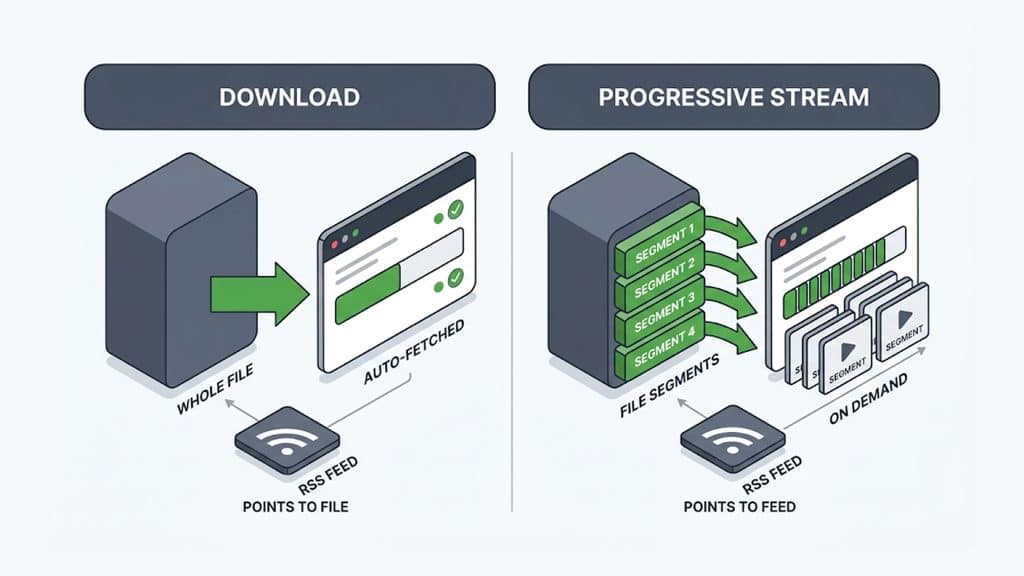
Progressive streaming is the model most like video: the audio is delivered as it plays, often as small segments that the player fetches in sequence, so playback can start quickly and the listener can seek around. This is how most music services and live audio work. Downloading is the other model, and it is the historical and still-dominant model for podcasts: the entire episode file is transferred to the listener’s device — by a podcast app, in the background, often over wifi ahead of time — and played from local storage. A listener who subscribes to a show may have the app automatically download every new episode the moment it publishes, whether or not they ever listen. This distinction is not academic. A download delivers the whole file in one large transfer; a stream delivers many small pieces on demand. They put completely different loads on your delivery infrastructure, and a podcast platform that thinks in streaming terms will misjudge both its bandwidth and its caching.
Podcasts add a second peculiarity: distribution is decentralized through RSS. Rather than living on one platform, a podcast publishes an RSS feed — a standardized file listing its episodes and, crucially, the direct URL to each episode’s audio file. Podcast apps, directories, and aggregators all read that feed and fetch the audio from wherever it is hosted. This means your audio files are requested by a huge, unpredictable variety of clients you don’t control, pulling directly from your hosting, which makes reliable, fast, globally distributed delivery of those raw files the entire game. The feed points everyone at your files; the CDN is what makes serving them to everyone, everywhere, actually work.
Why the Economics Are Different: It’s About Requests, Not Bytes
Here is the insight that most surprises teams moving from video to audio, and the one that most affects the bill: in audio delivery, the number of requests often matters more than the number of bytes.
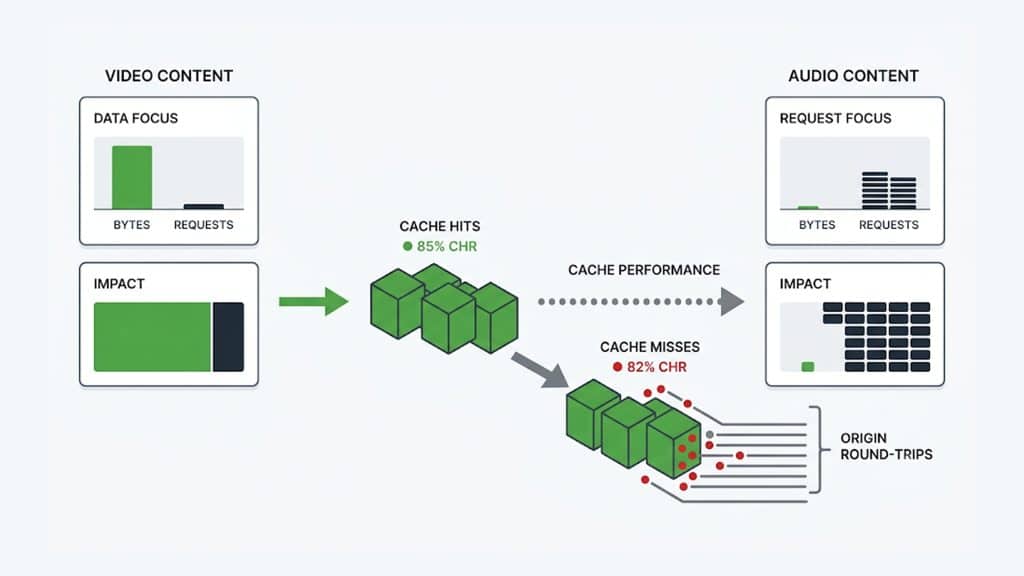
The reason is segment size. A video stream is made of relatively large segments — several seconds of high-bitrate video, often measured in megabytes. Audio is tiny by comparison: a segment of compressed audio might be a few tens or low hundreds of kilobytes, because audio bitrates are a fraction of video bitrates. When your content is made of many small objects, the per-request overhead — the cost and latency of each individual fetch, cache lookup, and possible origin trip — becomes proportionally huge relative to the bytes being moved. In video, a cache miss is expensive because it moves a lot of data; in audio, a cache miss is expensive because there are so many tiny requests that even a small percentage going to origin adds up to an enormous number of origin round-trips per second at scale. This flips the optimization priority. For video, you obsess over bytes and bitrate; for audio, cache efficiency measured per request becomes the dominant lever, because a small drop in cache-hit ratio translates into a flood of unnecessary origin fetches, each adding latency and load out of all proportion to its size. Keeping a very high cache-hit ratio is therefore even more critical for audio than for video — it is the difference between a delivery layer that hums and one that hammers your origin thousands of times a second for kilobytes at a time.
The Long-Tail Catalog Problem
Audio catalogs have a shape that makes caching both more important and more difficult, and understanding that shape is central to delivering audio efficiently.
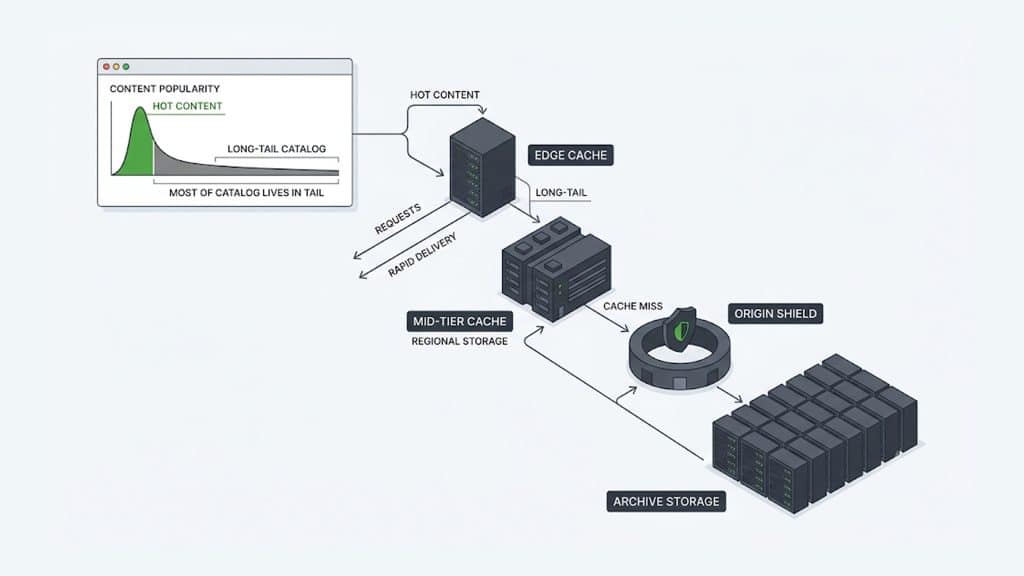
A music library or a podcast back-catalog is enormous and grows constantly, and its access pattern is extremely lopsided: a small fraction of the content — the new releases, the popular shows, the viral episodes — accounts for the overwhelming majority of plays, while the vast remainder of the catalog is requested rarely but still requested. This is the classic long tail, and it creates a genuine tension for caching. The hot content is easy: it stays in cache near listeners and serves fast. The long tail is the problem — millions of tracks or episodes that get occasional requests, too infrequent to stay resident in edge caches, so each request risks an expensive trip back toward origin. A naive single-tier cache handles the hot content well and the long tail badly, and because the long tail is where most of the catalog lives, that is a lot of slow, origin-hitting requests. The answer is a tiered caching architecture — edge caches for the hot content, backed by larger mid-tier caches that hold much more of the catalog and shield the origin from the long tail. A well-designed tiered setup with a strong origin shield can push origin offload very high even across a huge, sparsely-accessed catalog, which for audio is not a nice-to-have but the core of making the economics work.
The Viral Spike: Audio Has Flash Crowds Too
Audio may lack video’s live-event scale, but it has its own version of the sudden-surge problem, and it catches podcast and audio platforms off guard precisely because they assume audio is low-drama.
When a podcast episode features a major guest, gets a viral moment, or a show is suddenly recommended by a large platform, downloads can multiply overnight — and because podcast apps often download new episodes automatically for every subscriber, the publication of a hot episode can trigger a synchronized wave of large file transfers the moment it goes live. A music track that breaks out, or an album drop from a major artist, produces the same effect at greater scale. The delivery layer has to absorb these surges without slowing down for everyone else or falling over, which is the same fundamental challenge any content platform faces at peak but with audio’s twist that the “event” is often a file-download flood rather than a live stream. A CDN with strong edge caching absorbs this by serving the surge from cache near listeners rather than funneling it all to origin, and the platforms that handle viral moments gracefully are the ones whose delivery was built to scale elastically rather than provisioned for the average. This is also why the “unlimited bandwidth” promise common in audio hosting is only as good as the delivery network behind it — unlimited is meaningless if the delivery buckles when everyone shows up at once.
Format and Encoding Choices That Shape Delivery
What you encode your audio as directly affects how much you deliver and how well it plays, and audio has its own codec considerations distinct from video’s.
The dominant choice is between broad compatibility and maximum efficiency. AAC is the widely-supported default that plays essentially everywhere, which matters enormously for podcasts given the uncontrolled variety of apps reading your feed. Opus is the modern, open, royalty-free codec that delivers better quality at lower bitrates, especially for speech — which describes most podcast content — making it increasingly attractive where the playback chain supports it. Lossless formats have their place for source and archive material but are far too large for efficient delivery to listeners. The practical point for delivery is that codec and bitrate choices set the size of every object you serve, so they compound with everything above: a more efficient codec means smaller files, which means less bandwidth and better cache density, across an entire catalog and every request. Choosing deliberately, rather than defaulting, is worth doing — our guide to audio codecs covers the AAC-versus-Opus-versus-lossless decision in depth. For podcasts specifically, offering a couple of bitrate options — a standard-quality file and a low-bandwidth version — serves listeners on constrained connections without forcing everyone to the smallest size.
Storage, Origin, and the Growing Archive
Audio content accumulates relentlessly, and where and how you store the growing archive is part of the delivery equation in a way that is easy to underestimate.
Every podcast adds episodes forever; every music catalog only grows. That back-catalog has to live somewhere durable and be servable on demand whenever some listener, anywhere, requests an old episode through an RSS feed or digs a deep cut out of a music library. This makes reliable, scalable origin storage a real requirement rather than an afterthought — the long tail means any part of the archive can be requested at any time, so nothing can be truly “cold” in the sense of being unavailable. Pairing cost-effective cloud storage for the archive with a CDN that caches the frequently-requested slice in front of it gives you the economics that work for audio: cheap, durable storage for the vast catalog, and fast edge delivery for the fraction being actively played. The origin holds everything; the edge serves what’s hot; the tiered cache in between handles the long tail. Getting that division right is what keeps a growing audio archive affordable to keep online indefinitely.
Measuring Audio Is Its Own Puzzle
One more way audio differs from video is in how you count consumption, and podcasts in particular make measurement genuinely tricky in ways that affect both business decisions and delivery understanding.
Because podcasts are distributed as downloads pulled by countless apps you don’t control, you cannot directly observe whether a downloaded episode was actually listened to, for how long, or at all. A download is a request for a file, not proof of a human hearing it — and automatic background downloads mean many files are fetched by apps for subscribers who never press play. This is the opposite of video streaming, where the player reports second-by-second engagement back to you. The industry has responded with standardized measurement conventions that filter and de-duplicate raw requests to produce a more honest “download” figure, but the fundamental limitation remains: for downloaded audio, your server logs are your primary window into consumption, and interpreting them well matters. The practical implication for delivery is that your CDN and origin request logs are not just an operational tool but a core analytics source — the accuracy of your audience numbers depends partly on how cleanly your delivery layer records and reports requests, filtering out bots, partial fetches, and duplicate range requests. Progressive-streaming audio and in-app playback give you richer engagement data closer to video’s, but the download model that still dominates podcasting means measurement and delivery are unusually intertwined. Understanding this keeps you from either overcounting a viral spike that was mostly automated downloads or undercounting genuine reach.
Controlling the Cost of Audio at Scale
Because audio sessions are long and catalogs are large, bandwidth is the dominant variable cost for any serious audio platform, and controlling it follows the same principles as video delivery cost but with audio’s particular emphases.
The levers are familiar but weighted differently for audio: maximize cache-hit ratio, because for audio that directly attacks the per-request cost that dominates; encode efficiently, because smaller files compound across enormous request volumes; use tiered caching to keep the long tail off origin; and model your real delivery volume rather than trusting an “unlimited” promise that may throttle or surprise-bill you under load. The same disciplined approach that controls CDN bandwidth costs for video applies to audio, with the emphasis shifted toward request efficiency and cache density rather than raw bitrate reduction. Audio platforms that treat delivery cost as an engineering problem — measuring effective cost per gigabyte, watching cache-hit ratio as a first-class metric, and choosing codecs and cache tiers deliberately — run far leaner than those that accept whatever their hosting bundles, and at audio’s scale of long sessions and growing catalogs, that difference compounds into real money.
What Audio Delivery Actually Needs
Pulling it together, delivering audio and podcasts well rests on getting a specific set of things right, most of which differ in emphasis from video: serve both download and progressive-streaming models reliably, since podcasts lean on downloads while music and live audio stream; deliver the raw files an RSS feed points to fast and globally, to every uncontrolled client that reads the feed; treat cache-hit ratio as the primary economic lever, because audio’s tiny objects make per-request efficiency dominate; use tiered caching with a strong origin shield to keep an enormous long-tail catalog off origin; scale elastically to absorb the viral-episode and album-drop surges that audio very much does experience; choose codecs and bitrates deliberately, since object size compounds across every request; pair durable, cost-effective archive storage with fast edge delivery for the hot slice; and control cost by measuring and optimizing rather than trusting an “unlimited” label. Each of these maps to a way audio genuinely differs from video, and getting them right is what separates an audio platform that scales affordably from one that fights its own delivery.
Deliver Audio Like It’s Audio
The mistake that costs audio platforms most is treating delivery as an afterthought or as a smaller copy of video. Audio’s economics run on requests more than bytes, its catalogs hide a demanding long tail, its dominant format distributes through RSS and downloads rather than a controlled player, and its surges arrive as file-download floods. A delivery setup that respects those differences — high cache efficiency, tiered caching, deliberate encoding, durable archive storage, and elastic scale — makes audio cheap to deliver well and reliable at any scale, while one built on video instincts quietly leaks money and buckles at the worst moments.
5centsCDN delivers audio and podcasts on the same purpose-built foundation it uses for video, with the emphasis audio needs: a global CDN with high cache-hit ratios and origin shielding to keep tiny-object, long-tail catalogs efficient, durable cloud storage for archives that only grow, elastic scale to absorb viral-episode surges, and transparent pricing you can model with a bandwidth calculator rather than an “unlimited” promise. If you are running a podcast, a music service, or any audio-first platform and want delivery built for how audio actually behaves, talk to our team.
Frequently Asked Questions
Is delivering audio the same as delivering video?
No. Audio delivery runs on requests more than bytes (its segments are tiny), its catalogs have a demanding long tail, its dominant format (the podcast) distributes via RSS and downloads rather than a controlled player, and its surges arrive as file-download floods. Video instincts overpay and underperform.
Do podcasts stream or download?
Podcasts primarily download: a subscriber’s app fetches the whole episode file, often automatically for every new episode, and plays it from local storage. Music and live audio more often progressively stream. The two models load your delivery very differently.
Why does cache-hit ratio matter more for audio?
Because audio segments are tiny, the per-request overhead dominates. A small drop in cache-hit ratio means a flood of unnecessary origin round-trips — each expensive relative to the few kilobytes it moves — so per-request cache efficiency is audio’s primary cost lever.
What is the long-tail catalog problem in audio?
A small fraction of tracks or episodes drives most plays, while a huge remainder is requested rarely but still requested. Those infrequent requests fall out of edge caches and hit origin. Tiered caching with an origin shield holds the long tail off origin.
Do podcasts have traffic spikes?
Yes. A viral episode, big guest, or platform recommendation can trigger a synchronized flood of large file downloads — amplified because apps auto-download new episodes for every subscriber. Album drops do the same at greater scale. Elastic, edge-cached delivery absorbs it.
Why can’t I fully trust ‘unlimited bandwidth’ podcast hosting?
‘Unlimited’ is only as good as the delivery network behind it. It’s meaningless if delivery throttles or buckles when a viral episode brings everyone at once. Model your real volume and look at the actual delivery architecture.