


In most live video, a few seconds of delay is harmless — nobody is hurt if a sports replay or a concert reaches one viewer slightly before another. Live auction streaming is the rare case where that delay is not harmless at all. When an auctioneer calls “going once, going twice,” and the hammer falls, the exact timing of every bid decides who wins, what they pay, and whether the sale holds up. If one bidder’s screen lags behind another’s, they can lose a lot they would have won, bid on an item that has already sold, or dispute a result they believe was unfair. In an auction, latency and synchronization are not quality-of-experience niceties; they are questions of fairness, and fairness is the entire product.
This makes live auctions one of the most demanding streaming use cases there is, and one where the naive approach — just point a camera at the room and stream it — fails in ways that have legal and financial consequences, because a bid is a binding commitment, not a casual tap. This guide is about delivering live auctions properly: why fairness is fundamentally a synchronization problem, how to keep every bidder seeing the same moment, how to merge in-room and online bidders onto equal footing, and what the delivery setup behind a trustworthy live auction actually needs. It focuses on the infrastructure and delivery layer, not the auction software itself, because that layer is where auctions most often quietly become unfair.
Why Fairness Is a Synchronization Problem
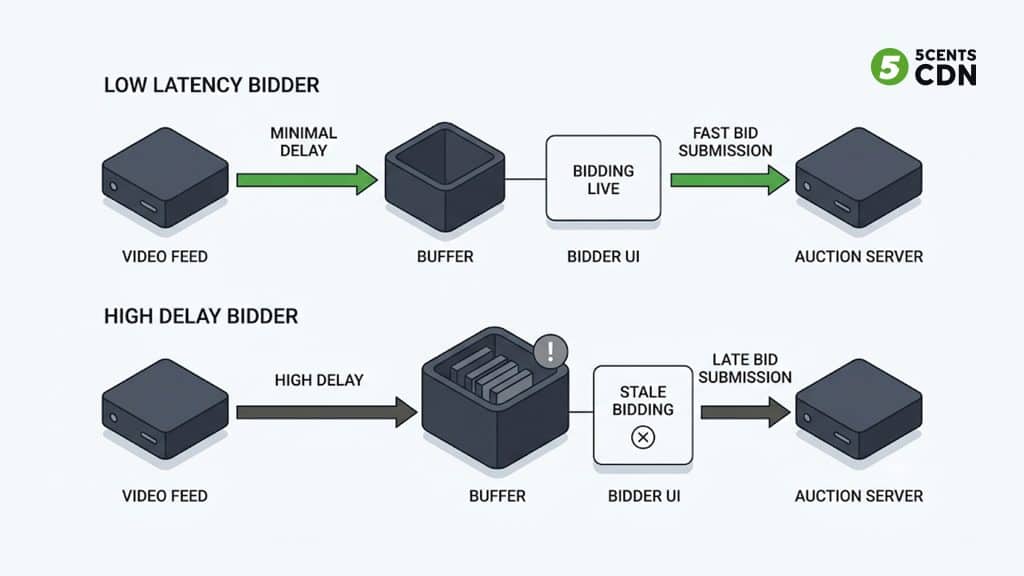
An auction works only if every participant is competing on the same information at the same time. The entire mechanism — bidders reacting to each other’s bids, the price climbing in increments, the auctioneer closing the lot — assumes everyone sees the current state simultaneously. The moment that assumption breaks, the auction stops being fair, and streaming is exactly where it tends to break.
Consider what happens when video is delayed. A live video stream, delivered the ordinary way, is buffered — the picture a viewer sees is some seconds behind real time, and worse, different viewers can be behind by different amounts depending on their connection and device. In most contexts that is invisible. In an auction it is corrosive: if bidder A sees the auctioneer call the current price two seconds before bidder B does, bidder A gets two seconds of advantage on every single bid. If the auctioneer closes the lot based on the room while an online bidder’s feed hasn’t yet shown the final call, that online bidder is shut out of a lot they were willing to win — the “sold too fast” dispute that plagues naive auction streams. And if the lot on screen hasn’t updated in sync with the lot the auctioneer is actually selling, a bidder can place real money on the wrong item. These are not edge cases; they are the predictable result of treating an auction like ordinary one-way video. Fairness requires that the gap between participants be small and, crucially, that the thing they’re bidding against — the current bid state — be identical for everyone, instantly.
The Core Principle: Decouple the Bid State from the Video
Here is the insight that separates auction platforms that are fair from those that generate disputes, and it is the same architectural principle that underpins any serious real-time commerce experience: the bid state must travel on its own real-time data channel, independent of the video stream.
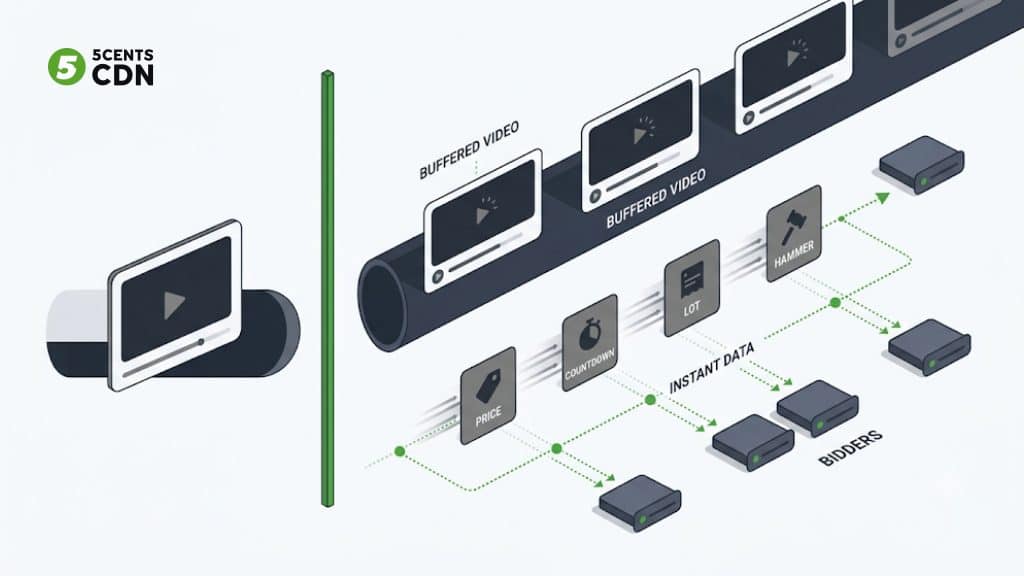
The reasoning follows directly from the latency problem. Video is buffered and will always carry some delay; trying to make video itself perfectly real-time for a mass audience is expensive and fragile. But the *bid state* — the current high bid, the asking price, the countdown, which lot is live, whether the hammer has fallen — is tiny data, and tiny data can be pushed to every participant in milliseconds over a persistent connection such as a WebSocket, far faster than video can ever travel. So the fair design is to let the video carry the *experience* — the auctioneer’s voice, the energy of the room, the look of the lot — while a separate, instant data channel carries the *authoritative state* that actually governs the sale. Every bidder’s current price, countdown, and “lot closed” signal arrives at essentially the same instant regardless of where their video buffer happens to be, so the competition is conducted on synchronized state even though the video is not frame-synchronized. This is the same principle we cover for retail in our guide to live shopping infrastructure — commerce events ride a data channel, not the video — but in auctions it is not merely an optimization; it is the foundation of a defensible, fair result. A platform that ties the bid state to the video buffer will produce unfair outcomes and disputes; one that decouples them can be fair even over imperfect video.
How Low Does the Video Latency Really Need to Be?
Given all this, it is tempting to conclude that auctions demand the absolute lowest possible video latency, and the market is full of real-time-streaming solutions promising sub-second, interactive video for exactly this reason. But the honest answer is more nuanced, and getting it right saves both money and complexity.
The strictest live-auction formats — fast-moving auto, livestock, or asset auctions where lots sell every few seconds and in-room and online bidders are in direct head-to-head competition — genuinely benefit from the lowest achievable video latency, because here the video itself is part of the bidding loop and any gap between the floor and remote bidders is a fairness problem. These scenarios are the domain of true real-time streaming technologies built on approaches like WebRTC, which push video latency toward a fraction of a second at the cost of more specialized, harder-to-scale infrastructure. For many other auctions, though, low-latency streaming over standard protocols — bringing the video within a handful of seconds of real time — is entirely sufficient *when the bid state is decoupled as described above*, because the authoritative state everyone competes on is already synchronized through the data channel and the video is there to inform and engage rather than to be the bidding mechanism itself. The practical guidance is to match the video latency tier to the auction’s tempo and fairness model rather than reflexively chasing the lowest number: the faster and more head-to-head the format, the tighter the video latency needs to be, while a well-decoupled design lets many auctions run fairly on robust low-latency delivery. The expensive mistake is assuming you must make the video itself real-time when the fairness problem is actually solved at the data layer; the complementary mistake is ignoring video latency entirely in a format where the video truly is part of the bidding loop.
The Hybrid Challenge: In-Room and Online on Equal Footing
The hardest fairness problem in modern auctions is the hybrid or simulcast auction, where bidders in the physical room compete simultaneously with bidders online — and getting this right is where delivery infrastructure earns its place.
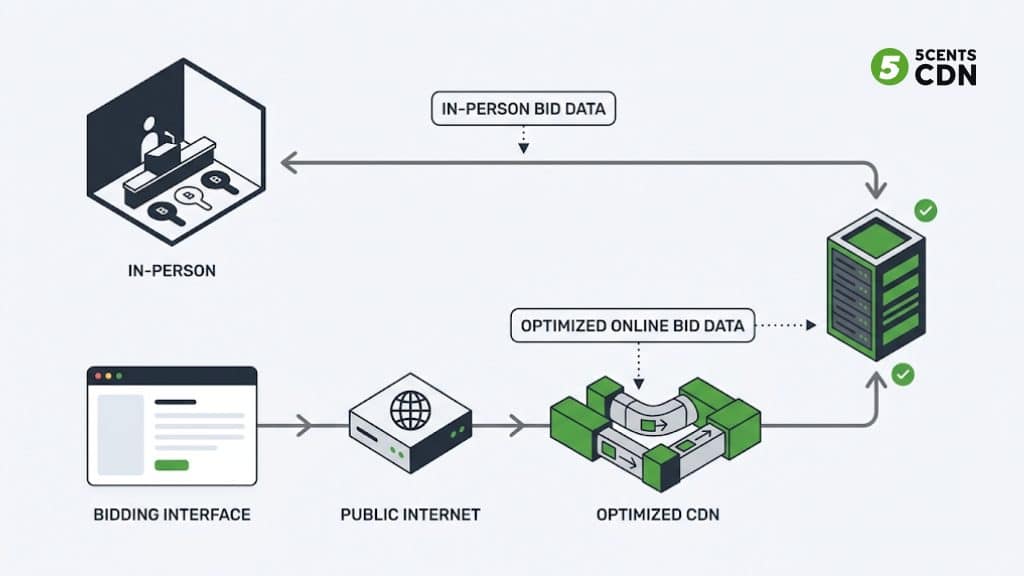
In a purely in-room auction, everyone shares the same reality by being in the same place. The instant you add online bidders, you introduce a structural asymmetry: the room sees and hears the auctioneer with zero delay, while online bidders receive a streamed version that is inherently behind. If nothing compensates for this, online bidders are permanently disadvantaged — they are always reacting to a slightly older reality than the floor, which is both unfair and, for an auction house, a liability that erodes trust and suppresses online participation. Solving it requires the delivery design to actively close that gap: keeping the video latency as low as the format demands, synchronizing the authoritative bid state to the floor and online participants together so the auctioneer’s “fair warning” and hammer reach everyone’s bid interface at the same moment, and giving the auctioneer tools to account for online bidders rather than closing purely on the room. The goal is a single, unified auction in which a remote bidder has a genuinely fair chance against someone standing in the room — and whether a platform achieves that is almost entirely a function of how well its delivery and synchronization are engineered. An auction house that streams online bidding without solving this is not running one fair auction; it is running a privileged in-room auction with disadvantaged spectators who are allowed to bid.
Seeing the Lot: Multi-Angle and Quality
Fairness is not only about timing; it is also about information, and in an auction the item itself is the information that matters most. A bidder deciding whether to commit real money to a lot needs to see it clearly, which raises delivery considerations specific to auctions.
High-value lots — art, jewelry, collectibles, vehicles — often warrant more than a single camera angle, so that remote bidders can inspect an item the way an in-room bidder would walk around it. Delivering multiple synchronized camera feeds, or letting a bidder switch angles, puts more demand on the delivery layer but materially improves a remote bidder’s confidence and willingness to bid. Image quality matters for the same reason: adaptive bitrate delivery ensures each bidder gets the clearest feed their connection allows, which is not a cosmetic concern when someone is deciding whether a piece has a flaw or a vehicle shows wear. And the clarity has to survive the pressure of the moment — the delivery must hold up its quality precisely when attention and stakes peak at the close of a hot lot. Treating the visual presentation of the lot as a first-class delivery requirement, rather than an afterthought behind the bid mechanics, is part of what makes remote bidders participate as confidently as the room.
The Last Second: Timing Integrity and Soft Closes
Nowhere does auction fairness get tested harder than in the final seconds of a lot, and this is a delivery concern as much as a rules concern. The close is when bids cluster, latency differences bite hardest, and disputes are born — so how the platform handles the last second matters disproportionately.
The classic problem is the last-moment bid: a bidder places a winning bid a heartbeat before close, but because of latency, other bidders never saw it in time to respond, or the system itself registers it ambiguously against the clock. In purely online timed auctions this is often addressed at the rules layer with a soft close or anti-sniping extension — any bid in the final seconds pushes the closing time out slightly, giving everyone a fair chance to respond — but that mechanism only works if the bid state and the countdown are synchronized to every participant through the real-time data channel, so that “the final seconds” means the same moment for all of them. If the countdown each bidder sees is driven by their own video buffer rather than by a shared authoritative clock, a soft close cannot be fair because participants disagree on when the window even is. This is the clearest illustration of why the decoupled data channel matters: the authoritative clock and bid state governing the close must be the same for everyone to the millisecond, while the video can lag harmlessly behind. A platform that gets the last second right — synchronized clock, unambiguous bid ordering, and a close rule that accounts for latency — is one whose results hold up; one that gets it wrong will spend its time adjudicating disputes.
Scaling, Reliability, and the Auction Record
An auction’s delivery has to be reliable in a way that tolerates no excuses, because the event is live, scheduled, often legally significant, and completely unforgiving of downtime at the wrong moment. A few considerations round out a trustworthy setup.
Reliability is paramount: an auction that drops its stream mid-sale, or whose bid channel stalls as a lot closes, is not a degraded experience but a failed and potentially disputed sale. This argues for delivery with strong redundancy and the capacity to stay stable through the surges a popular lot or a well-promoted sale can bring, so the infrastructure must be ready for the peak, not the average. Scale varies enormously — from a single boutique auction to platforms running thousands of simultaneous sales — and the delivery needs to flex to the event without the operator over-provisioning for a rare peak or under-provisioning for a real one; a CDN that absorbs audience surges by serving from the edge is what makes this elastic. Underpinning the whole event, low-latency streaming keeps the video close enough to real time for the format, while the data channel keeps the bid state exact. Finally, because auctions carry legal and financial weight, recording the complete event — the video and the synchronized record of bids and timings — is often a genuine requirement rather than a convenience, both for dispute resolution and compliance; reliable recording of the sale into a durable archive is part of what makes the result defensible after the fact. Real-time analytics on the stream during the event also lets the operator catch a delivery problem — a region where bidders are lagging, a quality drop as the audience surges — while the sale is still live and something can be done about it.
What a Live Auction Delivery Setup Needs
Pulling it together, delivering a fair, trustworthy live auction rests on a specific set of requirements, most of which differ from ordinary live streaming in ways driven by fairness: decouple the authoritative bid state onto a real-time data channel so every bidder competes on identical, instant state regardless of video buffer; match the video latency tier to the auction’s tempo — sub-second real-time video for fast head-to-head formats, robust low-latency delivery for the rest when the bid state is properly decoupled; actively close the in-room-versus-online gap so hybrid auctions are genuinely fair rather than privileging the floor; synchronize lot and catalog state with the video so no one bids on the wrong item; deliver the lot clearly, with multi-angle options for high-value items and adaptive quality for every connection; engineer for reliability and surge capacity, because a dropped stream at the close is a failed sale; and record the complete event, video and bid timeline together, for dispute resolution and compliance. Each of these maps to a way an auction is less forgiving than normal video, and getting them right is the difference between a platform bidders trust and one that generates disputes.
Deliver Auctions That Bidders Can Trust
A live auction is a promise: that everyone had a fair chance, that the highest genuine bid won, and that the result will stand. Streaming can keep that promise or quietly break it, and which one happens comes down to the delivery and synchronization behind the scenes far more than the camera in front of them. Decouple the bid state from the video so fairness doesn’t depend on the buffer, match video latency to the format instead of over- or under-engineering it, bring in-room and online bidders onto truly equal footing, show the lot clearly, and build for reliability and the record — do that, and a remote bidder on the other side of the world competes as fairly as someone in the front row, which is the entire point of putting an auction online.
5centsCDN provides the delivery foundation a trustworthy live auction is built on: low-latency streaming that keeps the video close to real time for the format, adaptive live transcoding and a capable video player for clear multi-device lot viewing, elastic CDN delivery that stays stable through the surge of a hot sale, real-time analytics to watch the experience as it happens, and reliable recording for the auction record — the video and delivery layer you pair with your bidding engine to run auctions that are fast, clear, and fair. If you are building or running live auctions and want delivery that bidders can trust, talk to our team.
Frequently Asked Questions
Why is latency such a problem for live auction streaming?
Because a bid’s exact timing decides who wins and what they pay. If one bidder’s video lags behind another’s, they get an unfair advantage, miss bids, or bid on an already-sold lot — the ‘sold too fast’ dispute. In auctions, latency is a fairness issue, not a quality nicety.
How do you keep a live auction fair across online bidders?
Decouple the authoritative bid state (current price, countdown, lot, hammer) onto a real-time data channel so it reaches every bidder in milliseconds, identically, regardless of their video buffer. The video carries the experience; the data channel governs the sale.
How low does video latency need to be for auctions?
It depends on tempo. Fast head-to-head formats (auto, livestock) benefit from sub-second real-time video (via approaches like WebRTC); many auctions run fairly on robust low-latency delivery when the bid state is properly decoupled. Match the tier to the format.
What is a hybrid or simulcast auction’s main challenge?
The room sees the auctioneer with zero delay while online bidders get a streamed, delayed version. Without compensation, online bidders are permanently disadvantaged. Fair hybrid auctions close that gap with low latency plus bid state synchronized to floor and online together.
How do soft closes and last-second bids work with streaming?
A soft close extends the clock when a bid lands in the final seconds, but it’s only fair if the countdown and bid state are synchronized to everyone via the data channel. If each bidder’s clock is driven by their own video buffer, they disagree on when the window is.
Do live auctions need to be recorded?
Usually yes. Because a bid is a binding commitment with legal and financial weight, recording the complete event — the video plus the synchronized bid-and-timing record — is often a genuine requirement for dispute resolution and compliance, not just a convenience.