


Release day for an AI product rarely fails because of the model. It fails because of the download. The new checkpoint is ready, the announcement goes out, thousands of users and hundreds of GPU nodes all reach for the same enormous files at the same moment, and the origin that served last month’s release quietly buckles. Downloads crawl, connections drop at 80 percent, the egress bill arrives a few weeks later, and the engineering team spends launch week debugging file transfers instead of the product. AI model distribution is the delivery challenge behind that failure.
This is a distribution problem, and it has become a genuine bottleneck as AI artifacts have grown. Model weights now run from tens of gigabytes to over a terabyte. Desktop apps bundle models alongside installers. Datasets ship as multi-part packages. Every one of those transfers is billed as data leaving somebody’s network, and success makes it worse, because the more people want the release, the harder the surge. This guide explains what makes AI artifact delivery different from web or video delivery, where the costs and failures actually come from, how a CDN changes the equation, the large-file mechanics that matter (range requests, resumable downloads, versioning, integrity), how to control access to gated models, and where a CDN stops and in-cluster caching begins. It is a practical guide for the teams shipping model checkpoints, SDK bundles, installers, and dataset packages.
Why AI Artifacts Are Different From Web Content
Most CDN thinking was built for two shapes of content: many small objects, like a web page’s images and scripts, and continuous streams, like video segments. AI artifacts are a third shape, and the differences drive every decision that follows.
They are few and huge. Instead of hundreds of small files per visit, a user fetches a handful of very large ones, often a checkpoint split into several multi-gigabyte shards. Demand is synchronized: a release announcement or an autoscaling event makes everyone want the same bytes at the same time, which is the classic thundering herd pattern. Reliability dominates the experience: a ninety-percent-complete download of an eighty-gigabyte file is worth nothing, so interrupted transfers must resume rather than restart. Integrity matters more than usual, because a corrupted weight file does not always fail loudly; it can load and quietly misbehave. Access is often controlled, since gated, licensed, or paid models must not be freely downloadable. And artifacts are versioned: every release is a new file, and an old version must remain consistent for anyone still pulling it.
Taken together, that profile rewards a delivery layer built around caching big objects once, serving them from nearby, and handling interruption and access control gracefully, which is a description of a CDN used for large-file distribution rather than for web pages.
Two Distribution Problems, Not One
It helps to separate two situations that are easy to conflate, because they call for different tools.
The first is external distribution: getting artifacts to people and systems outside your own infrastructure. That means customers downloading a desktop app or open-weight model, developers pulling an SDK, partners fetching a dataset, and your own clusters in other regions pulling from a central store. Here the challenge is global reach, origin load, and egress cost.
The second is fan-out inside a cluster: a single deployment where dozens or hundreds of nodes all need the same model at startup or during a scale event. The challenge here is not the public internet; it is the cluster’s own link to the outside world being asked to carry the same file once per node.
A CDN is the right answer to the first problem, and a major help for the second when the nodes are spread across regions. It is not, by itself, the answer to the fan-out inside one cluster, and being honest about that boundary is what makes the architecture later in this guide hold together.
The Thundering Herd and the Egress Bill
The economics of naive distribution are easy to underestimate until you do the arithmetic.
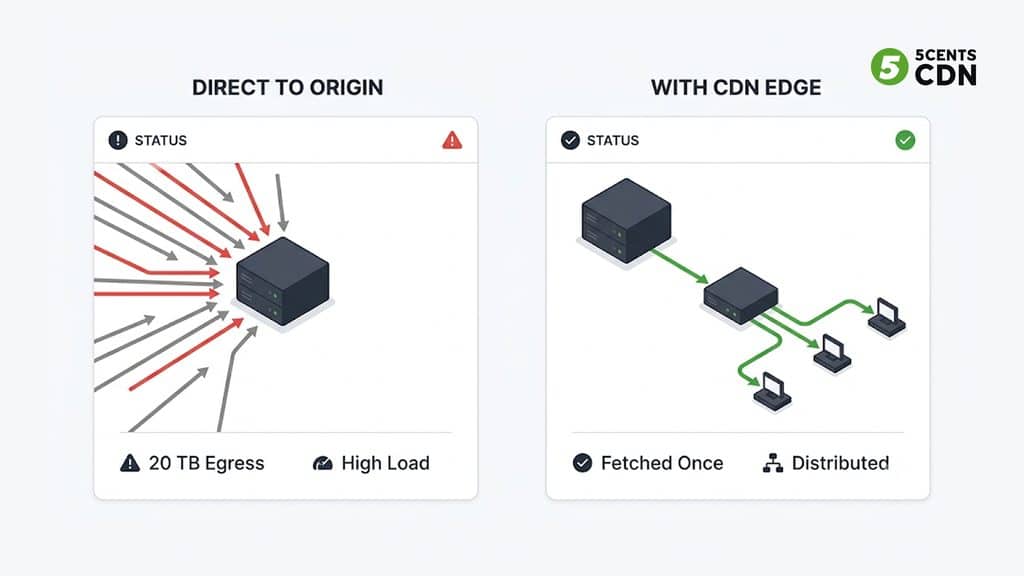
Suppose a checkpoint is 100 gigabytes and a deployment scales out to 200 nodes, each pulling its own copy from the origin. That is 20,000 gigabytes, or 20 terabytes, leaving your storage for a single rollout. At an illustrative cloud egress rate of around nine cents per gigabyte, that one rollout costs roughly $1,800 in data transfer alone, before compute. Do it several times a week across regions and it becomes a budget line of its own. Our guide to cloud repatriation for streaming explains why per-gigabyte egress is such a poor fit for high-volume, repetitive delivery, and the same logic applies to model files. Use your own file sizes, node counts, and rate in the same calculation; our bandwidth calculator is a quick way to model it.
Cost is only half the problem. The same synchronized demand hits throughput limits. Public model hubs and object stores throttle or rate-limit heavy parallel pulls, and operators of large inference clusters have described cold starts stretching from minutes to the better part of an hour when many nodes download the same large model at once. Slow starts mean idle GPUs, which are the most expensive thing in the building. And because an origin sized for steady traffic is suddenly asked to serve a spike, release day is exactly when it is least able to cope.
How a CDN Changes the Equation
A CDN attacks the herd directly: the file is fetched from your origin once, cached at the edge, and served from there to everyone else.
Instead of 200 requests all reaching your origin, the first request fills the cache and the rest are served from it. A mid-tier layer such as an origin shield goes further by letting many edge locations draw from one intermediate cache rather than each going back to origin, so the origin sees roughly one fetch per object rather than one per location. Serving from nearby points of presence also cuts transfer time for users and regional clusters far from your storage, and delivery is priced per gigabyte at flat, predictable rates rather than at cloud egress rates. The origin’s job shrinks from serving every download to serving each file about once, which is what makes release day survivable.
Two caveats are worth knowing. The first request for a cold file still has to come from origin, so release-day performance depends on how quickly the cache fills; a simple, effective tactic is to request the new files from the regions where you expect the most demand before you announce. That warms the edge locations serving those regions, so the first wave of users is not the one that pays for the cache fill. And simultaneous requests for an uncached object can all pass through to the origin unless the CDN coalesces them into a single fetch, so it is worth asking any provider whether it collapses simultaneous misses. Both are the large-file version of the surge dynamics we cover in why streaming platforms crash during live events.
Where each distribution layer fits
| Approach | Best at | Limits |
| Pull directly from object storage or a model hub | Simplest; no extra infrastructure | Per-gigabyte egress on every download; rate limits and throttling; a single origin; slow for distant regions |
| CDN in front of your origin | External and cross-region distribution; origin offload; flat delivery pricing; signed-link access control | Does not remove fan-out inside one cluster: every node still pulls its own copy over the cluster’s external link |
| In-cluster cache or peer-to-peer layer | Removes last-hop fan-out: download once per cluster, share among nodes | Needs running and maintaining; helps only inside that cluster, not external users |
| CDN plus in-cluster layer | Cheap, reliable global hop plus fast node startup | Most moving parts; worthwhile mainly for large multi-region GPU deployments |
General architecture guidance. The right mix depends on your file sizes, node counts, regions, and who is downloading.
Large-File Mechanics That Matter
Delivering big objects well depends on a few HTTP behaviors that barely matter for small files.
Range requests. HTTP lets a client ask for part of a file, and a server advertises support with the Accept-Ranges header, answering partial requests with a 206 Partial Content status. This is the foundation of resumable downloads and of downloading one file in parallel pieces. MDN’s guide to HTTP range requests covers the mechanism. For you it means a dropped connection at 90 percent should cost the last ten percent, not the whole file, and that download tools can pull several chunks at once to use more of the available bandwidth.
Slice-style caching. Without it, a CDN may fetch an entire huge file from origin before serving a single byte, or forward every range request to origin. With it, the file is broken into chunks that are cached independently, so a client asking for the middle of a file is served without pulling the whole object, and later requests for any slice are hits. It is exactly the range-caching setting we describe in our guide to CDN Edge Rules, and it matters most for artifacts of this size.
Provider limits. Large objects test limits that small ones never reach, such as maximum object size, how range requests are handled for very large files, and how long the first uncached request can take. These are worth asking about directly, with your real file sizes, before you depend on a provider for release day.
No on-the-fly compression. Model weights are dense numerical data that usually compress poorly, so spending CPU compressing them in transit adds latency for little saving. Serve them as-is.
Version Files Like Releases, Not Like Websites
How you name and cache files decides whether a release is clean or chaotic, and the best pattern borrows directly from streaming.
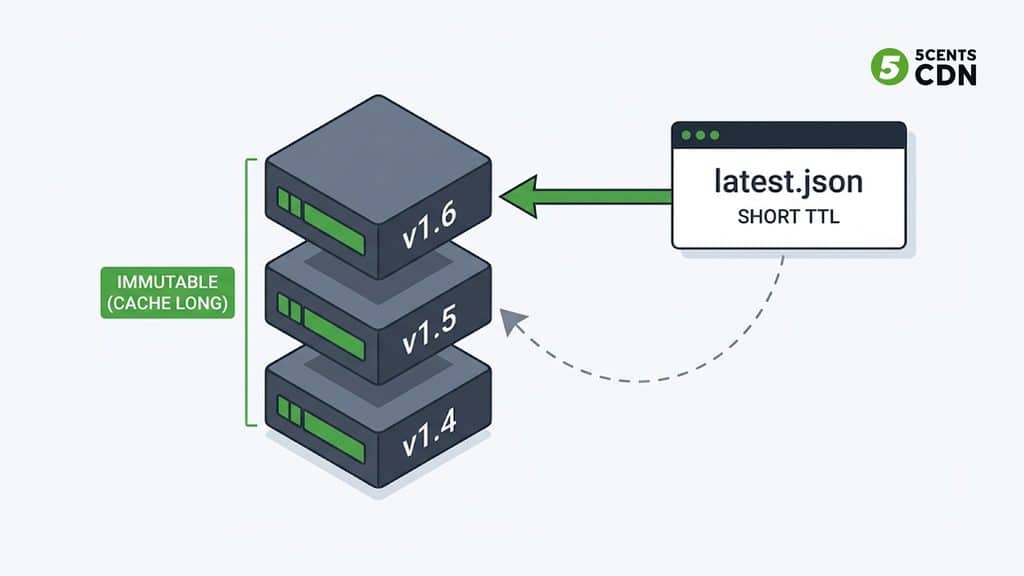
In video delivery, segments never change once published and can be cached for a very long time, while the manifest that points to them changes constantly and must stay fresh. Model distribution works the same way. Treat each released file as immutable: give every version its own name, with the version or a content hash in the filename, and never overwrite it. An immutable file can be cached for a very long time and never needs purging, because it never changes. Then keep a tiny pointer, such as a manifest or a “latest” file that names the current version, with a short cache lifetime, so that clients always learn about new releases within moments.
There are three reasons this matters. It makes caching trivial, since the big objects are immutable and the only thing that changes is a small file. It makes rollbacks safe, because the previous version is still there, intact, at its own address. And it protects resumed downloads: if a file is replaced under the same name between a download attempt and its resume, the two halves come from different versions and the result is silently corrupt, which is precisely why HTTP has conditional range headers to guard against it. With versioned names the problem cannot occur.
Integrity: Trust, but Verify
Because corrupt weights may not announce themselves, integrity checking belongs in the pipeline rather than being left to hope. Publish a cryptographic checksum, such as SHA-256, alongside every artifact, and have your download tooling verify it after every transfer, including resumed and parallel ones. A CDN delivers the bytes it was given and should not alter them, so any mismatch points to a transfer problem or a bad upload at the origin, either of which you want to catch before a model is loaded onto a GPU. Verifying costs seconds and can save hours of debugging a model that behaves strangely for no visible reason.
Controlling Access to Gated Models
Many AI artifacts should not be freely downloadable. A licensed model, a paid dataset, a customer-specific build, or a pre-release checkpoint all need an access check, and a CDN gives you a cheap place to enforce it.
The common pattern is signed, expiring links: your application decides who is entitled to download, then issues a link that carries a signature and an expiry, and the CDN validates that link on each request without involving your origin. We explain the mechanism in detail in our guide to CDN secure tokens. On 5centsCDN, Secure Token authentication is part of the AI software distribution offering for protecting model files and installers.
Large files add one wrinkle that streaming only hints at: expiry has to account for how long a download can take. A link that expires in minutes will cut off a slow connection partway through an eighty-gigabyte transfer, and because validation happens per request, a resumed download after expiry typically needs a freshly issued link. Size expiry to the slowest realistic download, and make your tooling able to request a new link when it resumes. Remember too that a link controls who can request the file, not what they do with it afterward; for genuinely sensitive weights, access control is one layer, not the whole answer.
Where the CDN Stops: Pairing It With In-Cluster Caching
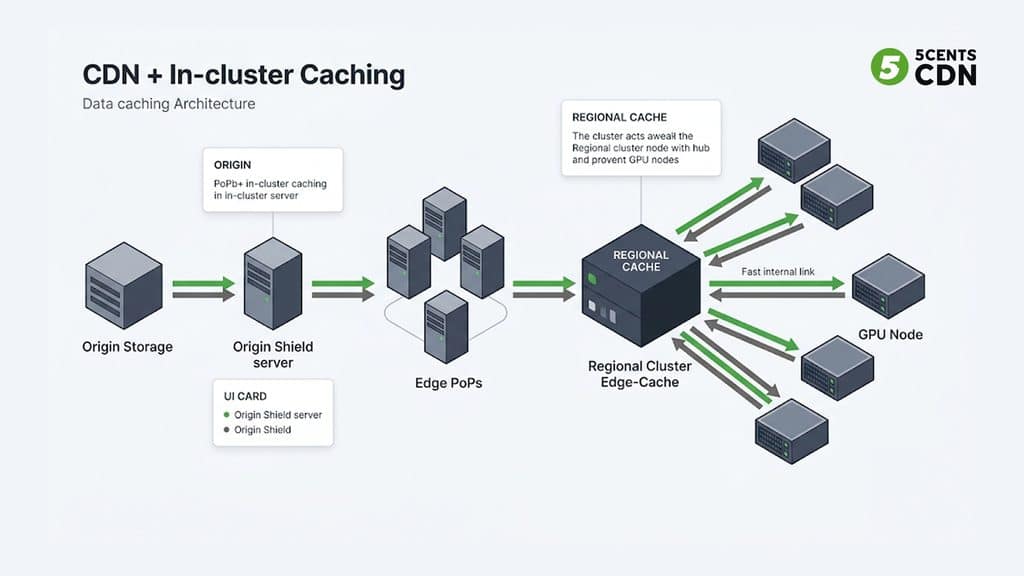
Return to the two problems from earlier. A CDN solves external and cross-region distribution, but if 200 nodes in one cluster each download a 100-gigabyte checkpoint from the CDN, the cluster’s own connection to the outside world is still asked to carry 20 terabytes. The CDN protected your origin and your egress bill; it did not remove the fan-out inside the cluster.
The complementary pattern is to download once per cluster and share inside it: a local cache or a peer-to-peer layer fetches the artifact from the CDN a single time, and the nodes then pull from each other or from that local copy over fast internal links. Open-source and commercial tools exist for exactly this, and for large GPU deployments the combination is the strongest design: the CDN handles the global, external hop cheaply and reliably, and the in-cluster layer handles the last-hop fan-out. The right split depends on your scale. A team distributing an app and model to end users needs the CDN and nothing more; a team running large inference clusters across several regions benefits from both.
Measure What Matters
You cannot tune distribution you cannot see, and a few metrics tell you most of what you need. Track download completion rate and failure rate, because abandoned or interrupted transfers are the clearest sign of trouble. Track time to complete by region, which exposes slow geographies before users complain. Watch cache-hit ratio on your large objects; our guide to improving cache-hit ratio covers the tactics. Track origin load and egress during releases, so you can see the herd being absorbed, and watch resume rates, since a high number points to unreliable connections or expiry set too short. Real-time delivery metrics by region turn release day from a guess into something you can watch and react to.
A Release-Day Checklist
Pulling it together, a team shipping large AI artifacts should be able to answer yes to each of these: every released file is immutable and versioned by name or hash, with a short-lived pointer naming the current version; checksums are published and verified after every download, including resumed ones; the CDN supports range requests and slice-style caching for your largest files, and you have confirmed its limits against your real file sizes; you have asked whether simultaneous cache misses are coalesced; the new files have been requested from the regions where you expect the most demand before announcement, to warm the nearest edge locations; gated artifacts use signed, expiring links sized to the slowest realistic download, with a way to reissue on resume; compression is off for weight files; you have modeled egress for a full rollout across all your nodes, with and without a CDN; large clusters have an in-cluster caching plan for the last hop; and you are watching completion rate, regional time to complete, cache-hit ratio, and origin load while the release goes out.
Make Release Day Boring
The best release day is a boring one: the files are fetched from your origin once, served from the edge to everyone else, resumed cleanly when connections drop, verified on arrival, and gated where they should be. None of that depends on exotic technology. It depends on treating large AI artifacts as what they are, big immutable objects with synchronized demand, and putting a delivery layer in front of them that was built to cache them once and serve them many times. Add in-cluster caching where your own fan-out demands it, and the download stops being the part of the launch you worry about.
5centsCDN’s solution for AI and software distribution is built for this: edge caching designed for heavy payloads, delivery through nearby points of presence, origin offloading during heavy releases, secure token authentication for model files and installers, real-time metrics on download trends and regional performance, and API workflows to update files, purge cache, and manage versions. It runs on a global CDN with AI smart routing and pairs with durable cloud storage as your origin. If you’re planning a model or software release and want to talk through the delivery side, talk to our team.
Frequently Asked Questions
How do you distribute large AI model files globally?
Put a CDN in front of your origin so each file is fetched from origin once, cached at the edge, and served from nearby locations. Pair it with range-request support for resumable downloads, immutable versioned filenames, published checksums, and signed links for gated models.
Why do AI model downloads cost so much?
Cloud providers bill per gigabyte for data leaving their network, and large models multiply the volume: a 100 GB checkpoint pulled by 200 nodes is 20 TB from origin per rollout. Synchronized demand also triggers throttling and slow cold starts.
How do range requests help with large downloads?
A server that advertises Accept-Ranges answers partial requests with 206 Partial Content, so an interrupted download resumes from where it stopped and tools can fetch several chunks of one file in parallel. Slice-style caching lets the CDN cache those chunks independently.
How should I version model files for caching?
Treat each released file as immutable with the version or a content hash in its name, cached for a long time and never purged. Keep a tiny pointer file naming the current version with a short cache lifetime. This makes rollbacks safe and prevents resumed downloads from mixing two versions.
How do I restrict access to gated or licensed models?
Issue signed, expiring links after your application checks entitlement, and let the CDN validate them on each request. Size the expiry to the slowest realistic download and let tooling request a fresh link when a download resumes. A link controls who can request the file, not what they do afterward.
Do I still need in-cluster caching if I use a CDN?
For large GPU clusters, often yes. The CDN protects your origin and egress bill, but if 200 nodes each download the artifact over the cluster’s external link, that fan-out remains. A local cache or peer-to-peer layer downloads once per cluster and shares internally.
