

For years, making video accessible was treated as a courtesy — a nice thing to do when there was time and budget. That era is over. A wave of regulation now makes video accessibility compliance a legal requirement for a growing list of organizations, with hard deadlines attached, and the penalties for missing them range from lawsuits to lost funding to reputational damage. If your organization publishes video — internal training, public-service content, course lectures, healthcare information, or media programming — the question is no longer whether to make it accessible, but which rules apply to you and by when.
The problem is that “video accessibility compliance” is not one rule but several overlapping ones, each administered by a different authority, each covering a different kind of organization, and each demanding a slightly different set of things. It is genuinely confusing, and the confusion is where organizations get caught out — assuming a rule doesn’t apply to them, or that clearing one requirement means they’re done. This guide untangles it: what the major regulations actually require for video, which one covers your organization, the deadlines as they stand in 2026, and how to build a delivery workflow that meets them. It is an overview to help you understand the landscape, not legal advice — your specific obligations should be confirmed with counsel — but it will tell you where to look and what accessible video actually involves.
What “Accessible Video” Actually Requires
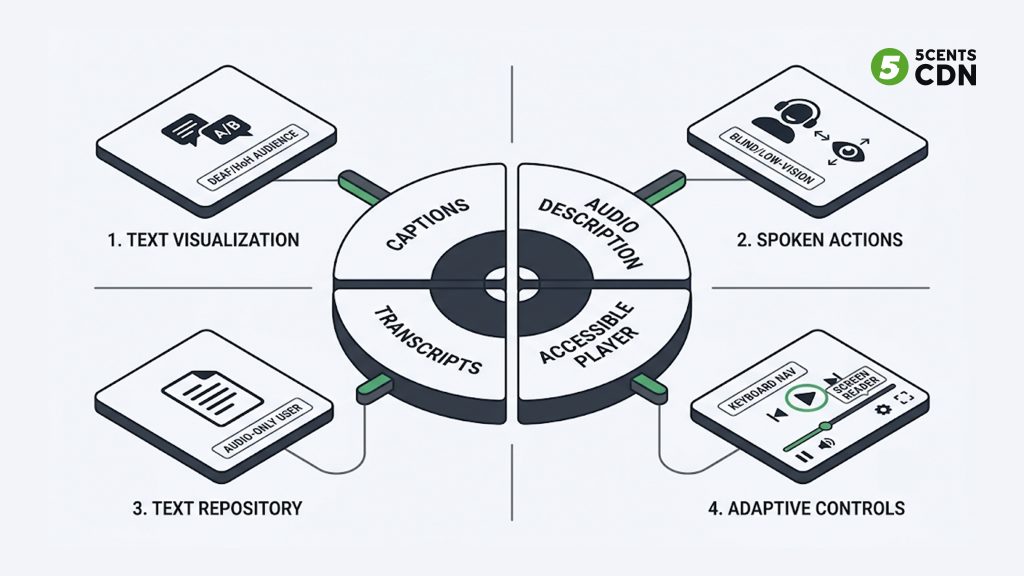
Before the rules, it helps to know what they are asking for, because “accessible video” is a bundle of distinct components serving different disabilities, and the regulations reference them by name. There are four that matter most.
Captions are the best-known: the synchronized on-screen text of a video’s audio — dialogue, speaker identification, and important non-speech sounds — that serves deaf and hard-of-hearing viewers. The critical distinction the rules draw is between pre-recorded captions and live captions: both are required in most frameworks, but live captioning of real-time content is a harder technical task, and automatic machine captions are generally not considered sufficient on their own for compliance because their accuracy falls short.
Audio description is the component most often overlooked and the one tripping up the most organizations right now: a separate narration track that describes the important visual information a blind or low-vision viewer cannot see — on-screen text, actions, settings, charts, demonstrations — spoken during the natural pauses in the audio. If your video conveys meaning visually that the soundtrack alone does not explain, audio description is what makes it accessible, and it is required for pre-recorded video under the main web standard. Transcripts, a full text version of the content, are the baseline requirement for audio-only material and a useful supplement elsewhere. And accessible player controls round it out: the video player itself must be operable by keyboard and screen reader, with controls to turn captions and audio description on and off.
Understanding these four as separate obligations is the first step, because a common and costly mistake is adding captions, declaring victory, and remaining non-compliant because audio description was never addressed.
The Standard Everything Points To: WCAG 2.1 Level AA
Almost every digital accessibility rule in force today converges on a single technical standard, which is what makes the landscape more navigable than it first appears. That standard is the Web Content Accessibility Guidelines, or WCAG, published by the World Wide Web Consortium — and specifically WCAG version 2.1, Level AA, which US regulators have adopted as the required conformance level.
For video, the WCAG 2.1 AA success criteria translate directly into the components above: captions for pre-recorded video, captions for live audio content, and audio description for pre-recorded video are all explicit requirements at Level AA. The reason this matters strategically is that because the different laws all point to the same WCAG 2.1 AA target, an organization covered by more than one rule does not have to build to multiple conflicting standards — it builds to WCAG 2.1 AA once and satisfies them all, working to whichever deadline hits first.
WCAG itself is a guideline document rather than a law, but when a regulation adopts it by reference, conforming to it becomes the legal requirement. It is worth noting that WCAG has newer versions — 2.2 is current and 3.0 is in development — but the version written into US rules today is 2.1 AA, so that is the target that matters for compliance right now.
Which Rule Covers You? The Three Regimes
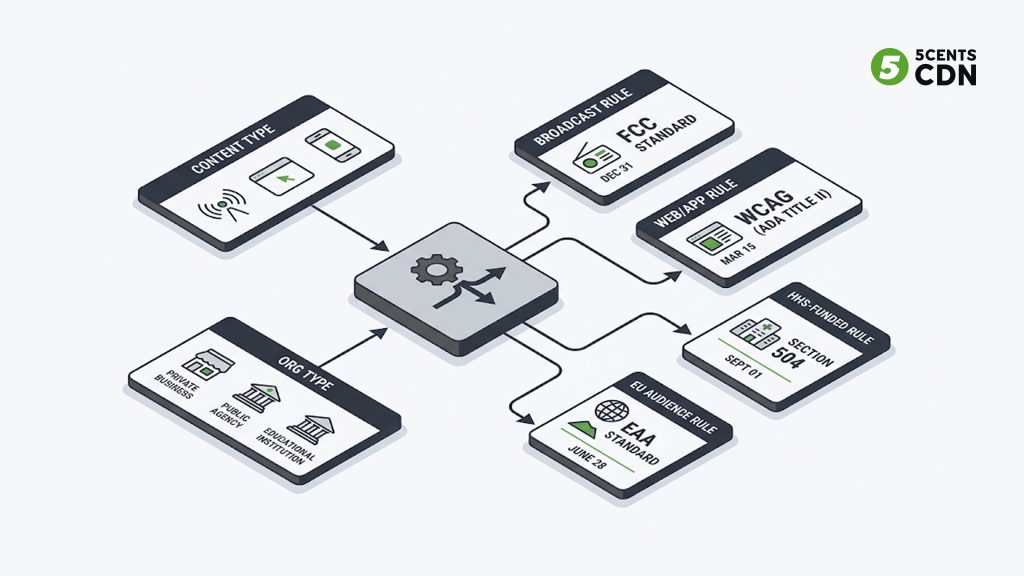
Here is the part that causes the most confusion and the part worth reading carefully: video accessibility in the US is governed by different authorities depending on what kind of organization you are and where your video lives. The first question is not “how much accessibility do I need” but “which rulebook covers my content.” There are three main regimes.
ADA Title II — state and local government and public education
The most significant recent development is the Department of Justice’s rule under Title II of the Americans with Disabilities Act, which for the first time set a specific technical standard for the digital content of state and local governments — including public colleges, universities, and school districts, courts, and special districts. The rule adopts WCAG 2.1 Level AA, and its scope is expansive, covering not just content an entity produces itself but content provided or made available through third parties and vendors.
The deadlines shifted in 2026, and getting them right matters. The DOJ’s original 2024 rule set compliance for April 2026, but on April 20, 2026 — days before that deadline — the DOJ issued an interim final rule extending the dates by one year. As it stands, public entities serving populations of 50,000 or more must comply by April 26, 2027, and smaller entities and special districts by April 26, 2028.
Critically, the extension moved only the dates: the WCAG 2.1 AA standard and all underlying obligations are unchanged, the DOJ has stated it fully anticipates enforcing at the new deadline, and — importantly — private lawsuits under the ADA can and do continue during the extension, because the ADA’s private right of action is independent of the federal compliance timeline. The official ADA web rule guidance from ada.gov is the authoritative reference, and it stresses that because accessible content takes time to produce, organizations should be working now rather than waiting for the deadline.
Section 504 (HHS) — recipients of federal health and human services funding
Running on a separate and, importantly, earlier track is the Department of Health and Human Services rule under Section 504 of the Rehabilitation Act, which imposes parallel WCAG 2.1 AA requirements on organizations that receive HHS funding — a category that reaches many healthcare providers and educational institutions. The crucial catch is that HHS did not match the DOJ’s one-year extension; its compliance timeline has run on its own schedule, with first deadlines arriving earlier than the extended ADA Title II dates. An organization that is both a public entity and an HHS-funded recipient must therefore work to the earlier of the two deadlines, and assuming the ADA extension covers you when you are also HHS-funded is exactly the trap that catches dual-covered organizations.
FCC / CVAA — broadcast and traditional television programming
The third regime is entirely separate and predates the web rules: the Federal Communications Commission regulates captioning and audio description for television programming under the Twenty-First Century Communications and Video Accessibility Act. This is a different rulebook with a different structure — rather than a blanket “make everything accessible” mandate, it sets quarterly quotas, such as a specific number of audio-described programming hours per quarter for stations affiliated with the major broadcast networks, and requires that consumer equipment make the secondary audio track carrying description available to viewers. If your content airs on US television, this is your starting point rather than WCAG; if it lives on a website, an app, or a streaming platform, WCAG is. Many media companies have to satisfy both, for different parts of their output.
The practical takeaway from all three: identify which regime — or regimes — covers your organization and your content before anything else, because it determines your standard, your deadline, and your exact obligations. When in doubt, this is the point at which to involve legal counsel who can map your specific situation.
Beyond the US: the European Accessibility Act
If your organization serves audiences in the European Union, a fourth regime applies regardless of where you are based, and it is already in force. The European Accessibility Act came into effect on June 28, 2025 across all 27 EU member states, and it reaches businesses outside the EU that provide products or services to EU residents — which brings many global streaming platforms, media companies, and enterprises into scope. For audiovisual media, the EAA mandates accessibility features including captions and audio description (and, for certain content, sign-language interpretation), broadly aligned with WCAG 2.1 AA and the European standard EN 301 549.
Two features of the EAA are worth flagging specifically. First, it carries a language dimension US rules do not: captions and audio description generally must be provided in the language of each market you serve, so English-only coverage does not satisfy the requirement for non-English EU markets. Second, audiovisual media services benefit from a multi-year transitional period for pre-existing content, but content published after the June 2025 effective date is subject to the requirements without that grace. For any organization with EU reach, the EAA means accessibility is not a US-only concern and is, in fact, already enforceable today rather than on a future deadline.
Why This Is Suddenly Urgent
It would be easy to read the DOJ’s one-year extension as breathing room and slow down. That would be a mistake, for several concrete reasons that are worth being clear-eyed about.
First, the extension moved the deadline but not the obligation — the underlying duty to provide accessible content remains fully in force, and the standard did not change. Second, private litigation never paused: digital accessibility lawsuits have been climbing year over year, and plaintiffs do not need to wait for a federal deadline to sue, so an organization with inaccessible video is exposed today regardless of the compliance date.
Third, and most practically, accessibility is not a switch you flip at the deadline — captioning and especially audio-describing a back catalog of video takes time, budget, and workflow changes, and organizations that wait until the deadline approaches will find the work cannot be compressed into the final months. The realistic reading is that the extra year is time to do the work properly, not permission to defer it. And beyond compliance, there is a genuine audience case: a large majority of viewers now use captions at least some of the time, many by preference rather than necessity, so accessible video measurably widens reach and engagement rather than merely satisfying a regulation.
Building an Accessible Video Workflow
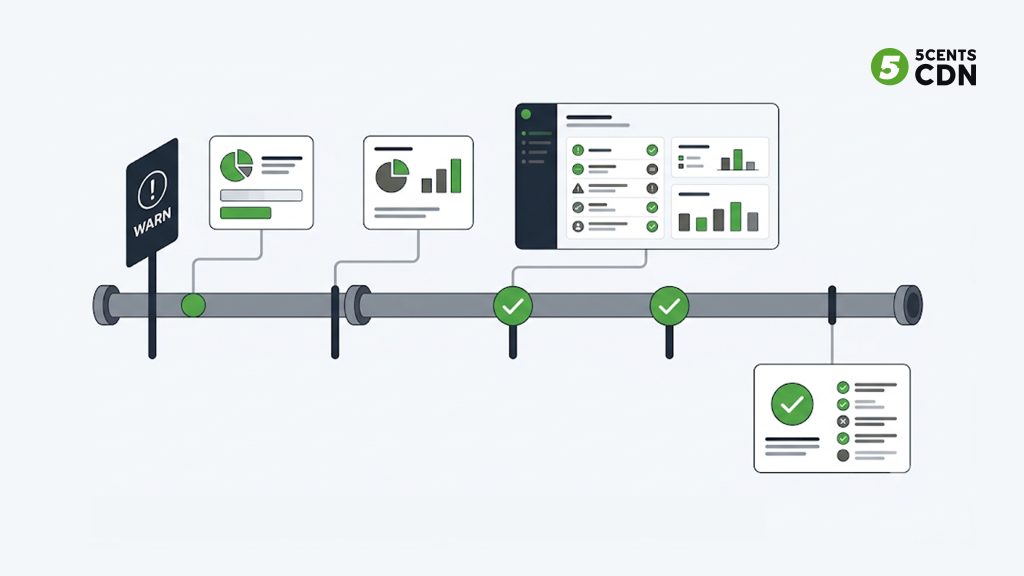
Meeting these requirements is less about a one-time remediation project and more about building accessibility into how video is produced and delivered from now on. The workflow breaks into a few practical stages.
It starts with an audit and prioritization. Inventory the video your organization actually publishes and uses — lecture recordings, training modules, public-information content, media programming — and prioritize by use and exposure: high-traffic, student-facing, or public-service content first, then work back through the archive. Note that content genuinely archived and never updated may fall outside some rules, but anything in active use generally does not. Public-sector organizations in particular, whose obligations under Title II are among the most explicit, will find this audit overlaps with the broader delivery planning covered in our guide to government live streaming.
Next comes producing the accessible components: accurate captions for pre-recorded content (with human review rather than raw machine output, since automatic captions generally fall short of the accuracy the rules expect), live captioning for real-time events, audio description tracks for video with essential visual information, and transcripts where required. This authoring is often where specialist captioning and description services come in, and it is worth building it into the standard production process for all new video so the backlog stops growing while you work through the existing one.
Then the accessible components have to actually reach the viewer, and this is where delivery matters as much as authoring. Captions authored perfectly are worthless if they are stripped out in processing or the player cannot display them — the delivery pipeline has to carry the caption data intact through transcoding and packaging and present it in a player the viewer can control. For live content specifically, getting embedded captions to survive the encoding-to-delivery chain is its own technical discipline, which our guide on how to add closed captions to a live stream covers in depth.
The player must expose accessible controls — keyboard-operable, screen-reader-compatible, with caption and audio-description toggles — and the whole thing has to work across the devices your audience actually uses. Finally, because much accessible content is consumed on demand after a live event, a reliable way to record and archive accessible video, with its captions and controls intact, into a searchable library completes the workflow.
A Video Accessibility Compliance Checklist
Pulling the landscape into an actionable sequence: identify which regime covers you — ADA Title II, Section 504/HHS, FCC/CVAA, or a combination — and confirm your specific obligations with counsel; determine your exact deadline, remembering that the DOJ extension pushed ADA Title II to April 2027/2028 but HHS runs earlier and private lawsuits continue now; adopt WCAG 2.1 Level AA as your technical target, since every web-facing regime points to it; audit and prioritize your video library by use and exposure.
Produce the required components — human-reviewed captions, live captions, audio description for essential visuals, and transcripts — and build them into all new production; ensure your delivery pipeline carries captions intact through transcoding and packaging into an accessible, controllable player; confirm the player supports keyboard and screen-reader operation with caption and audio-description toggles; and record accessible content into an on-demand archive so it stays compliant after the live event. Each item maps to a real requirement, and each is far cheaper to address in a planned workflow than in a deadline scramble or after a complaint.
Accessibility Is Now Table Stakes
The regulatory picture for video accessibility in 2026 is clearer than its tangle of authorities suggests: nearly everything points to WCAG 2.1 Level AA, the deadlines are real even after the DOJ’s extension, and the obligation to provide captions, audio description, and accessible playback is now a legal requirement for a wide range of organizations rather than an optional courtesy. The organizations that come through this well are the ones treating it as a standing capability — building accessible captioning, description, and delivery into how they produce and publish video from now on — rather than a last-minute project. Done that way, compliance stops being a threat and becomes what it was always meant to be: content that reaches everyone in your audience, not just some of them.
5centsCDN supports the delivery side of accessible video: live transcoding that carries embedded captions intact through the processing chain, a video player that displays captions and gives viewers the controls accessibility requires, recording and DVR that turns live events into an accessible on-demand archive, and reliable global live streaming and CDN delivery underneath it all. Whether you are a public university, a healthcare provider, an enterprise, or a media company working toward a compliance deadline, talk to our team about building a delivery pipeline that keeps your accessible content accessible all the way to the viewer.
Frequently Asked Questions
Is video accessibility legally required?
Yes, for a growing range of organizations. US state/local government and public education fall under ADA Title II (WCAG 2.1 AA); HHS-funded entities under Section 504; broadcast TV under the FCC/CVAA; and businesses serving EU audiences under the European Accessibility Act. Each mandates captions and, for most, audio description.
What is the WCAG 2.1 AA requirement for video?
At Level AA, WCAG requires captions for pre-recorded video, captions for live audio content, and audio description for pre-recorded video, plus accessible player controls. It’s the technical standard nearly every web-facing accessibility law adopts.
When is the ADA video accessibility deadline?
The DOJ’s April 2026 interim final rule extended ADA Title II to April 26, 2027 for entities serving 50,000+ people and April 26, 2028 for smaller ones. The standard and obligations are unchanged, and private lawsuits continue during the extension.
What is audio description and is it required?
Audio description is a narration track describing important visual information (on-screen text, actions, charts) for blind and low-vision viewers. It’s required for pre-recorded video under WCAG 2.1 AA and is the most commonly overlooked requirement.
Do captions and audio description have to be human-made?
Automatic machine captions are generally not considered sufficient for compliance on their own because their accuracy falls short. Most organizations use human-reviewed captions and professionally produced audio description.
Does accessibility apply if I only serve the EU?
Yes. The European Accessibility Act has been in force since June 28, 2025 and applies to businesses serving EU residents, including non-EU companies, requiring captions and audio description for audiovisual media, generally in the language of each market served.