

Your stream looks flawless from your desk. It starts instantly, holds full quality, never stutters. So when reports trickle in that viewers in another country are getting constant buffering and grainy video, it is tempting to assume the problem is on their end — their internet, their devices, their habits. Sometimes it is. But very often the uncomfortable truth is that your Regional CDN Performance is genuinely worse in that region, and the reason has nothing to do with your viewers and everything to do with how and where your content is being served.
Regional performance disparity is one of the most under-diagnosed problems in streaming, partly because it is invisible from wherever the operator happens to sit. A platform that performs beautifully in its home market can be quietly failing a whole continent, and because the dashboards near headquarters look green, nobody goes looking. This guide explains why the same stream can be excellent in one place and poor in another, how to tell a real delivery problem apart from viewer-side noise, and the concrete steps that close the gap so quality is consistent everywhere your audience is.
The Symptom You Might Be Misreading
Before the causes, it is worth naming how this problem usually shows up, because it is frequently mistaken for something else entirely.
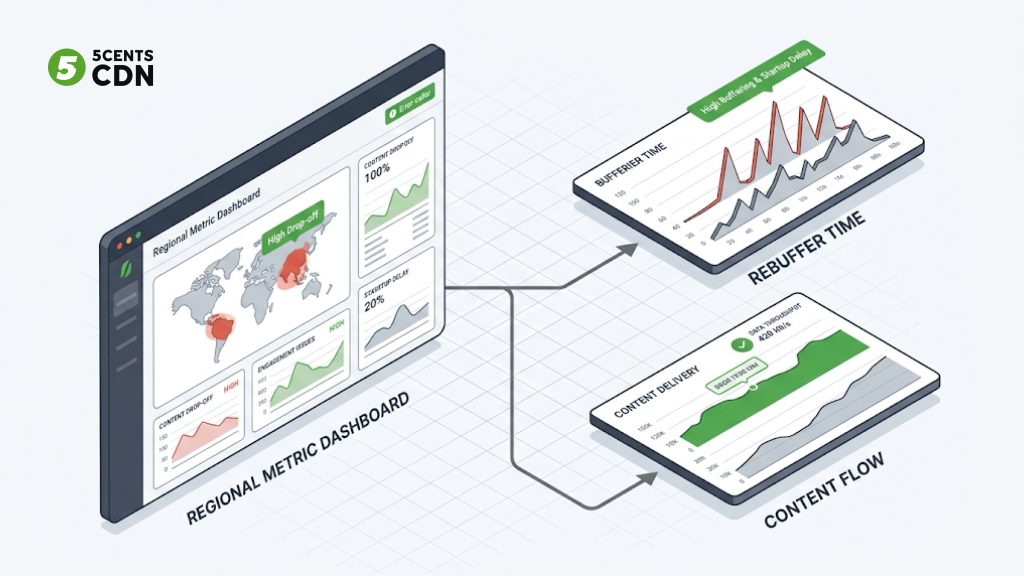
In your analytics, a region with poor delivery does not announce itself as “bad CDN performance.” It appears as clustered early drop-off: viewers in a particular country or area who leave far faster than viewers elsewhere, lower average watch time, and a concentration of low-bitrate sessions in one geography. Teams routinely misread this pattern as a content or marketing problem — the wrong titles for that market, weak localization, poor product-market fit — and respond by changing the catalog or the campaign when the real issue is that the stream simply performs badly there.
The tell is in the quality metrics rather than the engagement metrics: if a region shows systematically higher startup times, higher rebuffer ratios, and a rendition mix skewed toward the bottom of your ladder, that is a delivery problem wearing an engagement problem’s clothing. Learning to read regional quality metrics separately from regional engagement is the first step, because it points you at the real cause instead of an expensive false one.
Why the Same Stream Performs Differently by Region
Regional disparity comes from a handful of distinct causes, and they stack. Understanding each one tells you which fix actually applies rather than guessing.
Distance to the nearest edge
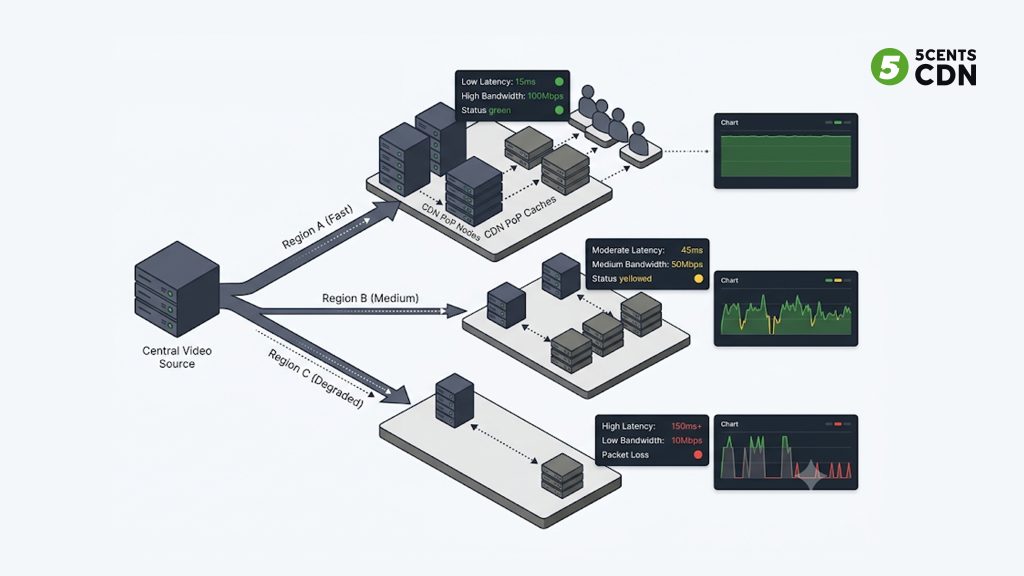
The most fundamental cause is simple physics. A content delivery network works by serving video from edge locations close to viewers, so the segment travels a short distance instead of crossing the planet. When there is a well-placed edge near your viewers, delivery is fast; when the nearest edge is thousands of kilometres away, every request makes a long round trip, and latency, startup time, and the fragility of the connection all get worse. A viewer served from a data center on another continent is fighting the speed of light on every segment, and no amount of encoding cleverness fully compensates for that distance.
Coverage density, not raw point-of-presence count
Here is the part that surprises people: the headline number of points of presence a network advertises tells you almost nothing about how it will perform for *your* audience. What matters is coverage density where your viewers actually are. A network with hundreds of points of presence spread thin, none of them in your primary market, will serve that market worse than a smaller network with a handful of edges sitting right where your audience lives. When you evaluate delivery for a region, the only question that matters is how well-served *that specific region* is, not how impressive the global map looks. Coverage gaps in the delivery network create predictable, repeatable degradation in exactly the regions they leave uncovered.
Routing and peering quality
Even when an edge exists near your viewers, how their traffic reaches it matters enormously. The internet is a mesh of independent networks that hand traffic to one another at internet exchange points, and the quality of those interconnections varies dramatically by region. A CDN that peers well with the local internet providers in a market — exchanging traffic directly and efficiently — delivers a noticeably better experience than one whose traffic has to take a circuitous path through distant exchanges before it reaches the viewer
Two networks with an edge in the same city can perform very differently depending on how directly each one connects to the ISPs that actually serve the audience. Routing decides which edge a viewer reaches in the first place: the Anycast routing that CDNs rely on sends each request to the topologically nearest node, but “nearest” is a function of network paths and peering relationships, not just geography. This is why poor regional peering can send viewers to a suboptimal edge even when a closer one exists.
Regional cache behavior
A cause that hides in plain sight is regional cache efficiency. A CDN edge only accelerates content it actually has in cache; on a miss, it has to fetch from origin, which for a distant region means a long, slow retrieval. If your cache-hit ratio is high in your home market but low in a remote one — because that region gets less traffic, so content is evicted before it is re-requested, or because cache-key fragmentation is splitting requests — then viewers there routinely wait for origin fetches that home-market viewers never experience. The same content can have a 95% hit ratio in one region and a far worse one in another, and that gap alone produces a visibly worse stream.
Regional last-mile and device conditions
Finally, some regional variance genuinely does originate closer to the viewer: markets differ in typical connection speeds, in how much of the audience is on mobile and cellular rather than fixed broadband, and in the stability of the local last mile. This is real, and it is not something a CDN can eliminate — but it is something a well-designed delivery setup can adapt to, by serving those markets an encoding profile suited to their conditions rather than pretending every viewer has fiber. The mistake is treating last-mile variance as the whole story and using it to excuse delivery problems that are actually fixable.
How to Diagnose Whether It’s Really Your Delivery
Because the causes stack and the symptom mimics other problems, disciplined diagnosis matters before you spend money on a fix. The goal is to separate “our delivery is worse here” from “this market’s networks are genuinely harder.”
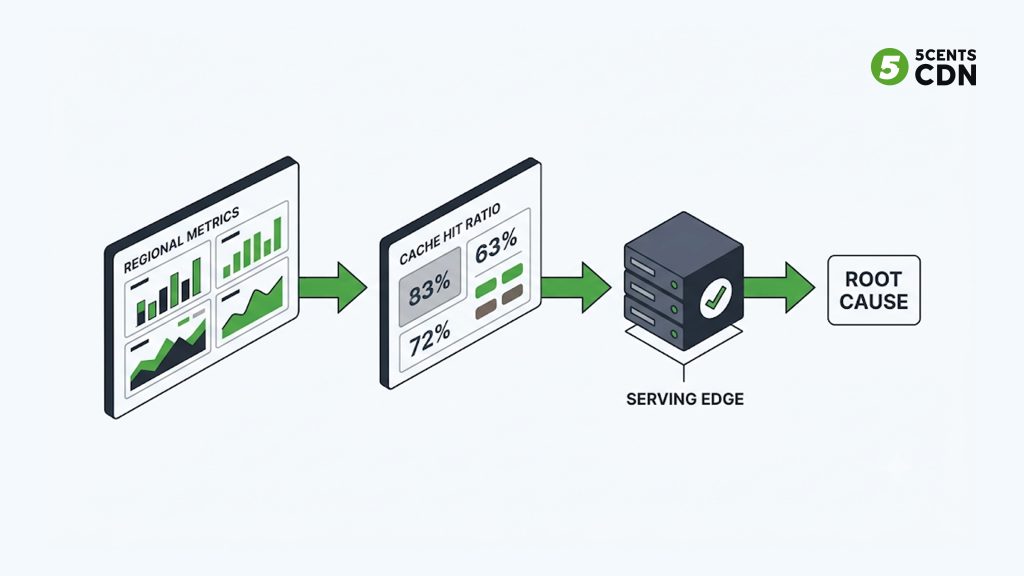
Start with per-region quality metrics, not engagement metrics. Break out startup time, rebuffer ratio, and the distribution of rendition bitrates by region, and compare the struggling region against a healthy one. If the struggling region shows much higher startup times and rebuffering, that points at delivery — distance, routing, or cache — rather than at your content. Next, look at cache-hit ratio by region specifically; a hit ratio that collapses in one geography localizes the problem to caching there.
Then examine where that region’s viewers are actually being served from: if they are being routed to an edge on another continent, you have a coverage or routing problem, not a viewer problem. Real-time analytics with a geographic breakdown is what makes this possible — without per-region visibility, regional problems stay invisible until they show up as unexplained churn. The principle is simple: measure the regions separately, because a global average is precisely the thing that hides a regional disaster.
How to Fix Regional Performance
Once you have localized the cause, the fixes are concrete and map directly onto the problems above. Most services need a combination rather than a single change.
Put delivery capacity where your audience actually is
The foundational fix is ensuring there is well-provisioned edge capacity close to the regions that matter to you, with strong local peering. This is less about the size of a global map and more about density and interconnection quality in your specific markets. A delivery network with genuine presence and good local peering in a region collapses the distance and routing problems at once, because viewers are served from nearby over efficient paths. When you assess a CDN for a region, weigh its actual footprint and peering there far more heavily than its worldwide totals.
Route each viewer to the genuinely best path
Beyond having edges in the right places, intelligent routing ensures each viewer actually reaches the best-performing one. Rather than relying on geography alone, performance-aware routing considers real network conditions and steers each request down the path that will serve it best in that moment. AI smart routing makes this decision per request, which matters most precisely in the regions where the naive “nearest by map” choice is not the fastest in practice because of peering or congestion.
Add a second network to cover the gaps
No single CDN is the best performer in every region on earth; each has strengths and weak spots geographically. Where one network is thin, another may be strong, so distributing delivery across more than one network and routing each region to whichever performs best there is one of the most direct cures for regional outliers. This is a core benefit of a multi-CDN posture, which we cover in depth separately — for the regional-performance problem specifically, the point is that a second network lets you close a coverage gap in one market without disrupting the markets that are already working.
Improve cache efficiency in the weak regions
Where the diagnosis points at regional cache behavior, the fix is raising the hit ratio in that geography: normalizing cache keys so tracking parameters and session tokens do not fragment identical segments into many cache entries, and ensuring sufficient regional cache capacity so hot content stays resident even in lower-traffic markets. A healthy cache-hit ratio in every region, not just the busy ones, means viewers everywhere are served from the edge rather than waiting on distant origin fetches.
Tune the encoding ladder for regional conditions
Where a market genuinely has lower typical bandwidth or a mobile-heavy audience, the answer is not to give up but to adapt: provide an adaptive bitrate ladder with rungs suited to those conditions, so the player has good lower-bitrate options to fall back to instead of collapsing to an unwatchable floor. Well-designed video encoding with a ladder that serves constrained connections gracefully turns a harsh last mile into a merely lower-resolution but smooth experience, rather than a buffering one. This is the honest part of the fix: you cannot change a region’s networks, but you can meet them where they are.
What Regional Disparity Actually Costs You
It is worth being explicit about why this problem deserves real investment, because its cost is easy to underestimate precisely because it is hidden.
The Business Cost of Regional Disparity
The damage from regional disparity is silent in a way that a total outage never is. When your whole service goes down, everyone notices immediately and you fix it fast. When one region quietly underperforms, there is no alarm — just a market that never grows the way it should, viewers who sign up and drift away, and expansion campaigns that mysteriously underdeliver. You are paying full price to acquire audiences in that region and then losing them to a delivery problem you cannot see from home, which is close to the worst return on marketing spend imaginable. A region that could have been a growth market instead becomes a leaky bucket, and because the cause is invisible, the usual response is to spend more on acquisition rather than fix the delivery, which pours more water into the same bucket.
There is also a compounding effect over time. Viewers who have a poor first experience in an underperforming region do not just leave; they form a lasting impression that your service is unreliable, and word of that spreads within a market. By the time regional performance is finally diagnosed and fixed, you may have burned through a chunk of the addressable audience in that geography, and winning back people who already decided your product does not work is far harder than keeping them would have been.
This is why regional performance quietly sits behind a large share of CDN switching decisions: an operator expanding into new markets discovers that their current provider simply does not deliver well there, and rather than accept a permanent ceiling on international growth, they go looking for delivery that treats every region as a first-class market. Diagnosing the problem early, before it has cost you a market, is dramatically cheaper than rescuing one after the fact.
How to Fix Regional Performance Gaps
Pulling it together, a service that wants consistent quality everywhere should be able to work through this sequence: break out startup time, rebuffer ratio, and rendition mix by region so quality is measured per market, not as a global average; check cache-hit ratio region by region to catch geographies where it collapses; verify where each region’s viewers are actually served from, flagging any routed to a distant edge; and confirm edge coverage and local peering density in priority markets rather than trusting a global point-of-presence count.
Then, enable performance-aware routing so each viewer reaches the genuinely best path; add a second delivery network wherever a single provider leaves a regional gap; normalize cache keys and size regional cache so hot content stays resident in lower-traffic markets; and tune the encoding ladder to serve constrained or mobile-heavy regions gracefully. Each step maps to one of the causes above, and together they turn a patchwork of regional experiences into a consistent one.
Give Every Region the Same Stream
A viewer in a distant market does not care why their stream is worse than someone else’s — they only know it is, and they leave. Regional performance disparity is one of the quietest ways a streaming service loses audiences it already won, precisely because it is invisible from wherever the operator sits and easy to misattribute to content or to the viewers themselves. But it is a delivery problem, and delivery problems have delivery solutions: put capacity where your audience actually is, route each viewer to the best real path, cover the gaps with a second network, keep caches efficient in every region, and adapt the encode to local conditions. Do that, and the stream that looks perfect from your desk looks just as good from the other side of the world.
If your analytics show a region quietly underperforming and you want delivery built for consistent global quality, 5centsCDN pairs a well-peered global CDN with AI smart routing, multi-CDN setup, and real-time regional analytics so you can find and close the gap. For the buffering mechanics behind these symptoms, our guide to reducing buffering in live streaming is a useful companion. When you want to see where your delivery is underperforming by region, talk to our team.
Frequently Asked Questions
Why is my stream worse in some regions than others?
Usually a delivery problem: no nearby edge, thin coverage in that market, poor local peering/routing, or low regional cache-hit ratio — not your viewers. Some variance is genuine last-mile difference, but much of it is fixable.
Does a CDN with more points of presence perform better?
Not necessarily. Coverage density where your audience actually is matters far more than the global count. A network with edges in your market beats one with a bigger map but nothing nearby.
How do I tell if it’s my delivery or the viewer’s internet?
Break out startup time, rebuffer ratio, and rendition mix by region. If a region shows systematically worse quality metrics and a collapsing cache-hit ratio, it’s delivery, not content or the viewer.
How do I fix poor performance in a specific region?
Ensure edge capacity and peering in that market, route each viewer to the best real path, add a second CDN to cover gaps, raise regional cache-hit ratio, and tune the ABR ladder for local conditions.
Why do coverage gaps cause regional problems?
When there’s no nearby edge, requests make long round trips to distant servers, raising latency and startup time and making the connection more fragile — so viewers in uncovered regions get a systematically worse stream.