

There is a particular kind of helplessness in watching your service go dark for a reason that is entirely outside your control. Your code is fine. The origin is healthy. Your team did nothing wrong. But CDN outages can bring your delivery layer down, and because everything you serve flows through it, your outage is now their outage. Viewers see errors, support tickets flood in, and all you can do is refresh a status page that has not updated yet.
If that scenario feels familiar, or if you are trying to make sure it never happens to you, the uncomfortable truth is that you cannot prevent your CDN provider from ever failing. Even the largest, most sophisticated networks go down, and they do so more often than their marketing suggests. What you can do — and what separates services that survive a provider outage from those that go dark with it — is architect so that a single provider’s bad day does not become your bad day. This guide explains why CDNs fail, what actually happens to your service when one does, and the concrete resilience strategies that keep you streaming through it.
Why Even the Best CDNs Go Down
The first step to resilience is abandoning the assumption that a big enough provider will simply never fail. They do, and understanding why reframes the whole problem.
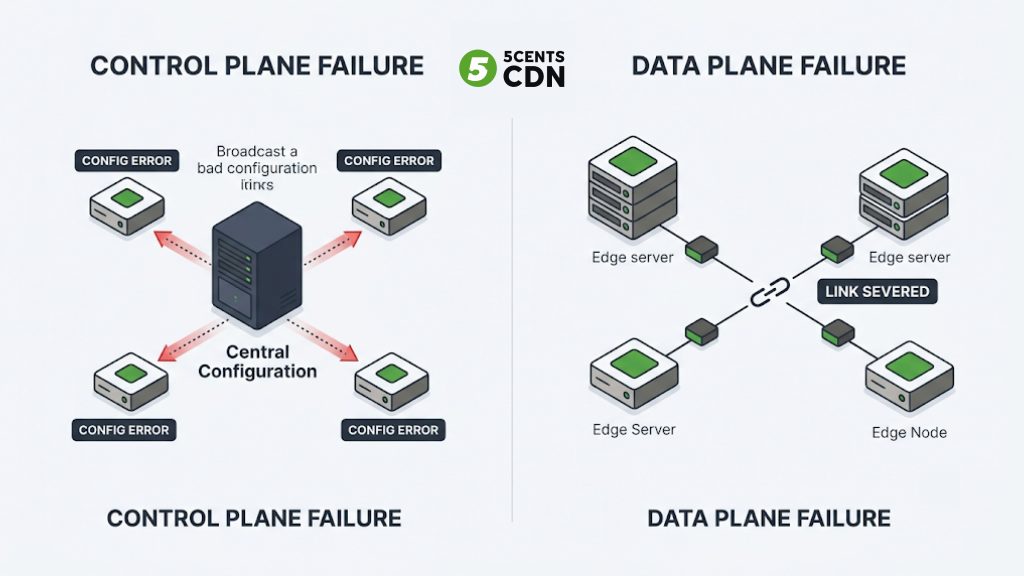
The popular image of a CDN outage is something physical and dramatic: a severed fiber line, a data center fire, a massive attack overwhelming the network. Those happen, but they are rarely the cause of the large, headline-making disruptions. The modern reality is that most impactful CDN outages come from the control plane, not the physical network. Providers push configuration and software updates out to thousands of edge locations at once, and if one of those updates contains a subtle error, otherwise-healthy hardware everywhere starts rejecting valid requests or routing them wrong. The machines are fine; the logic telling them what to do is broken, and it is broken everywhere simultaneously.
Recent history makes the point. Across late 2025, several of the largest providers of internet infrastructure suffered major outages traced not to physical damage but to configuration errors, automation faults, and tangled dependency chains — a bad config file that grew too large, an automation process that removed the DNS records a service needed to be reachable, a control-plane change that propagated a fault globally before anyone could stop it. The lesson for anyone who depends on a CDN is not that these particular providers are unreliable; it is that a class of failure exists that no amount of provider scale prevents, and that you must design for provider failure rather than assume provider perfection.
There is a second, crueler wrinkle. Control-plane failures often disable the very tools you would use to escape them. During some recent incidents, providers deliberately froze customer configuration changes to stabilize their networks during recovery, which meant customers could not purge caches or change routing even when they knew exactly what they wanted to do. If your entire disaster-recovery plan is “log into the CDN dashboard and change a setting,” you may find that door locked at the precise moment you need it.
What Actually Happens to Your Service When the CDN Fails
When your CDN goes down, the failure reaches your viewers in several distinct ways, and knowing them tells you what you are defending against.
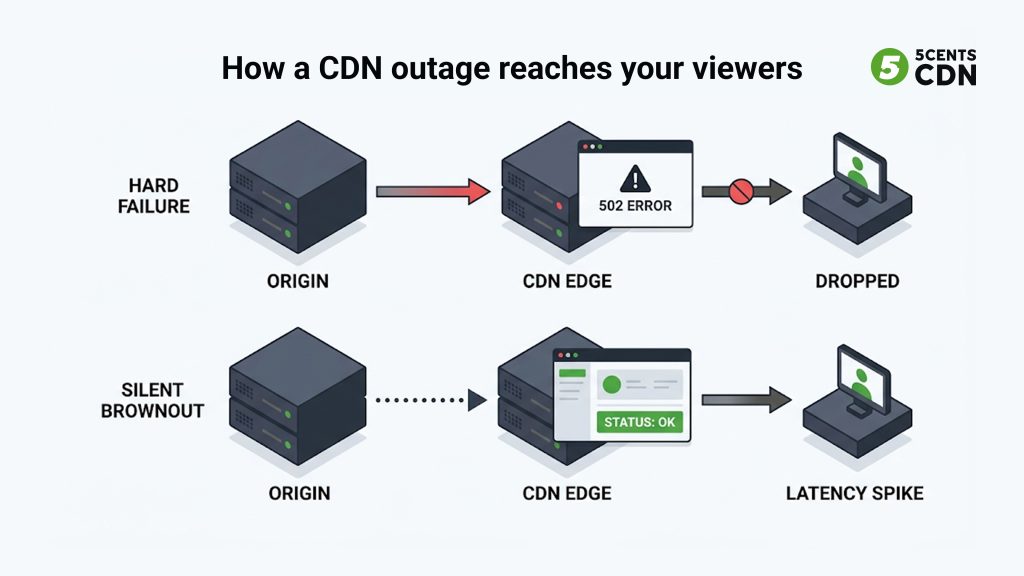
The most obvious is the hard error: the edge returns 5xx errors or simply times out, and viewers get broken players, spinning loaders, or blank pages instead of video. But the more insidious failures are partial and regional. A CDN rarely fails everywhere at once; far more often a specific region, edge location, or network path degrades while a global status page still cheerfully reports that all systems are operational. Your viewers in one country are locked out mid-stream while your dashboards look fine, because the failure is localized below the resolution of the provider’s public reporting. For a live event, a regional brownout at the wrong moment can cost you a huge slice of your audience with no global alarm ever sounding.
The business consequences follow immediately and outlast the outage. For a subscription service it is churn, as viewers who could not watch question why they pay. For an ad-supported service it is revenue evaporating in real time. When a live or pay-per-view event fails, refund demands are layered on top of lost trust.. And underneath all of it is the reputational damage, because an outage during a high-profile moment is exactly the kind of failure that trends publicly and becomes the story. This is why a provider outage is one of the most common reasons operators start shopping for a new CDN — the search usually begins the morning after a dark night.
The Resilience Stack: Staying Up When Your Provider Goes Down
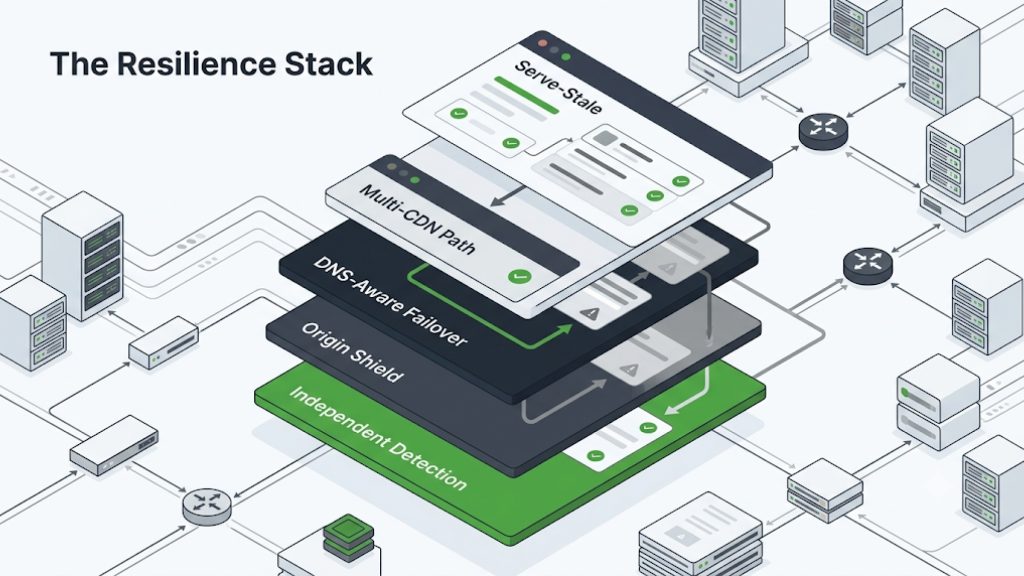
The good news is that surviving a CDN outage is a solved problem, provided you build for it before you need it. Resilience is not a single feature but a stack of complementary defenses, each covering a different failure mode. Here is what that stack looks like, roughly in order of return on effort.
Serve stale content when the origin or provider errors
The single highest-return resilience tactic requires no second vendor and no complex engineering — just better use of standard HTTP caching. By default, most setups fail hard: if the origin returns an error or cannot be reached, the CDN passes that error straight to the viewer. You can change that behavior with the cache directives standardized in RFC 5861, specifically stale-if-error. This tells the cache that if it cannot reach the origin or the origin returns a server error, it should serve slightly expired content from cache rather than a hard failure. Its companion, stale-while-revalidate, serves the cached copy instantly while refreshing it in the background, hiding transient hiccups from viewers entirely.
For streaming, serving a manifest or segment that is a little stale is almost always better than serving an error, and for catalog pages, thumbnails, and metadata it decouples your availability from your origin’s immediate health. This one change turns a whole category of “hard down” moments into invisible non-events, which is why it belongs at the top of any resilience plan.
Remove the single point of failure with multiple delivery paths
Serving stale content buys you time during a brief failure, but for a sustained provider outage you need somewhere else to send traffic. Relying on one CDN means that provider is a single point of failure for your entire service — when it goes down, so do you, completely. Distributing delivery across more than one network removes that structural risk: when one path degrades, traffic shifts to another, and a total provider outage becomes a partial, survivable event instead of a blackout.
This is the core case for a multi-CDN posture, which we cover in depth separately — here the point is narrower and specific to outages: a second delivery path is the difference between “one provider is down” and “we are down.” It adds operational complexity, because configurations and security rules must stay synchronized across providers so the backup behaves like the primary, but for services where uptime is the business, that complexity is the price of never going fully dark.
Understand the DNS failover trap before you rely on it
Most multi-provider failover is orchestrated at the DNS level: when the primary is detected as unhealthy, DNS steers viewers to the backup. This works, but it has sharp edges that catch teams by surprise mid-outage, so it is worth understanding before you depend on it. DNS changes do not propagate instantly. Recursive resolvers at internet providers frequently ignore the short time-to-live values you set, caching the old records — and therefore pointing at the failing network — for anywhere from minutes to hours after you flip the switch.
A portion of your audience will keep hitting the broken path long after you have “failed over.” Reliable failover therefore means designing for a gradual traffic migration rather than an instant switch, keeping TTLs sensibly low in advance, and accepting that some users stay stranded until their resolver catches up. Fast, resilient DNS management is part of the toolkit here, but no DNS setup makes failover truly instantaneous, and planning as though it does is a common and painful mistake.
Protect the origin so a failover does not cascade
There is a hidden danger in failover: when traffic suddenly shifts to a backup path, or when a CDN recovers and cold caches all miss at once, the flood of requests can fall through to your origin and overwhelm it — turning a delivery outage into an origin outage. Keeping a healthy origin shield and a high cache-hit ratio in front of your origin means the backup path is not starting from cold and your origin is never exposed to the full weight of a synchronized failover. Resilience at the edge only helps if the core behind it survives the moment everyone reconnects.
Detect the failure faster than the status page
Every defense above is useless if you do not know the outage is happening. The most common and costly mistake during an incident is waiting for the provider’s status page to confirm what your viewers are already experiencing. Status pages are manually updated communication tools, not real-time monitors, and they routinely lag the actual incident by many minutes to an hour while the provider’s engineers verify scope — and in at least one recent case the status page itself was caught up in the outage it was meant to report.
To react in time, you need observability you control: independent monitoring of your own error rates, latency, and traffic by region, so that when errors spike in one region you know within seconds rather than waiting for external confirmation. Real-time analytics on your actual delivery is what lets you make the call to shift traffic before the provider has even admitted there is a problem. You cannot mitigate what you cannot see, and you cannot afford to see it late.
What Your SLA Actually Promises (and What It Doesn’t)
Before trusting any single provider’s reliability, it is worth understanding what uptime guarantees really mean, because the numbers are less reassuring than they sound. Availability is usually expressed in “nines”: three nines is 99.9% uptime, four nines is 99.99%, and so on, a shorthand for high availability that hides how much downtime each level actually permits. The gap between those figures is larger than intuition suggests. A service at 99.9% uptime can be down for roughly nine hours across a year; at 99.99% it is still down for nearly an hour. Nine hours of blackout, or even one, can all land in a single catastrophic window during your most important event.
Two things about SLAs catch operators off guard. First, the guarantee is typically measured monthly and compensated with service credits — a partial refund of what you paid the provider — which comes nowhere close to covering the revenue, churn, and reputational damage a real outage inflicts. The SLA pays you back cents while the outage costs you dollars.
Second, and more fundamentally, an SLA is a commercial promise, not a technical guarantee that the outage cannot happen; it defines what the provider owes you when they fail, not a force field that stops them failing. Reading an SLA as an assurance of uptime rather than as a compensation schedule for downtime is a common and costly misreading. The practical conclusion is the throughline of this whole guide: do not outsource your availability to a single provider’s promise. Architect so that your uptime is a property of your own design, not a number in someone else’s contract.
The best-designed resilience stack will still fail you if it only exists on paper. This is the quiet truth behind many public outages: the affected company had a failover plan, but it had never been exercised under real conditions, and when the moment came the backup origin lacked capacity, the SSL certificates on the secondary path had expired, or the frantic failover API calls hit rate limits. A failover path that is never tested is not a failover path; it is a hope.
Treating reliability as an active practice means deliberately exercising failure before it happens. Schedule controlled drills where you sever the primary CDN on purpose and watch what the system actually does: does the secondary path pick up the load, do certificates work on the backup route, does the origin hold, does the monitoring fire, can the team execute the switch quickly and correctly. Untested failover paths rot silently — configurations drift, certificates lapse, and the institutional knowledge of how to trigger the switch leaves with the people who set it up. The only way to know your resilience works is to prove it during calm conditions, on your schedule, rather than discovering its gaps live during a real provider outage in front of your largest audience.
A CDN Outage Readiness Checklist
Pulling the stack together, a service that wants to survive provider outages should be able to check off each of these: stale-if-error and stale-while-revalidate configured so cached content is served during origin or provider errors; a second delivery path available and kept in configuration parity with the primary; DNS TTLs set low in advance with failover modeled as a gradual migration, not an instant switch; origin shield and a healthy cache-hit ratio in place so a failover or recovery does not stampede the origin.
Independent, real-time monitoring of error rates and latency by region should be in place so you detect incidents before the status page updates; a documented, current incident-response runbook naming who can trigger failover and how; and a tested failover, exercised in a controlled drill within recent memory rather than assumed to work. Each item maps directly to one of the failure modes above, and each is far cheaper to arrange in advance than to improvise during an incident.
Don’t Let Your Provider’s Outage Become Yours
CDN outages are inevitable in the sense that no provider, however large, is immune to a bad configuration push or a tangled dependency. But your outage is not inevitable. The services that stay online through a provider failure are the ones that treated single-provider dependence as the risk it is: they serve stale content instead of errors, keep a second delivery path ready, understand the real behavior of DNS failover, shield their origin against the reconnect surge, detect problems independently and fast, and prove their failover works before they need it. Do that, and a provider’s worst day becomes, for your viewers, a few seconds of slightly stale content they never even notice.
If reliability is central to your service and you want delivery infrastructure built for it, 5centsCDN combines a resilient CDN with multi-CDN setup, origin shielding, fast DNS, real-time analytics, and DDoS protection, backed by a transparent SLA. For the architecture behind redundant delivery, our multi-CDN guide is the companion to this one, and for surviving demand-driven failures specifically, see why streaming platforms crash during live event spikes. When you want to pressure-test your resilience before the next outage, talk to our team.
Frequently Asked Questions
Can I prevent a CDN outage?
No. Even the largest providers fail, usually from control-plane configuration errors, not physical damage. You can’t prevent the provider failing, but you can stop its outage from taking your service down.
What is the easiest way to survive a CDN outage?
Configure stale-if-error (RFC 5861) so the cache serves slightly expired content instead of a hard error when the origin or provider fails. It’s the highest-return resilience tactic and needs no second vendor.
Does multi-CDN prevent outages?
It doesn’t prevent a provider failing, but it removes the single point of failure: a second delivery path turns a total provider outage into a partial, survivable event. Configs must stay in parity across providers.
Why shouldn’t I rely on my provider’s status page?
Status pages are manually updated and often lag the real incident by many minutes to an hour. Independent, real-time monitoring of your own error rates by region detects problems far faster.
Is DNS failover instant?
No. Recursive resolvers often ignore low TTLs and cache old records for minutes to hours, so some users stay on the failing path after you switch. Plan failover as a gradual migration, not an instant cutover.