

Everything is fine right up until the moment it isn’t. Your platform has run smoothly for months, handling your normal audience without a complaint. Then you stream the big one — the final, the premiere, the product launch — and at the exact moment the most people are watching, it falls over, streaming platform crashes during live events. Streams won’t load, logins fail, the player spins, and social media fills with your own customers asking if it’s just them. The event you spent months promoting becomes the event everyone remembers for the wrong reason.
This failure is common, it is specific, and it is preventable. It is also not the same problem as everyday slowness. A platform can be perfectly well-built for steady traffic and still collapse under a live event, because a synchronized audience arriving all at once is a fundamentally different engineering challenge than the same number of people arriving gradually. This guide explains why live-event spikes break streaming platforms, walks through the specific failure points that cause the crash, and lays out the delivery architecture and pre-event discipline that keep you online when it matters most.
Why a Live Spike Is a Different Problem Entirely
The core misunderstanding behind most live-event crashes is treating peak traffic as simply “more traffic.” It isn’t. The shape of the demand is what breaks things, not just the size.
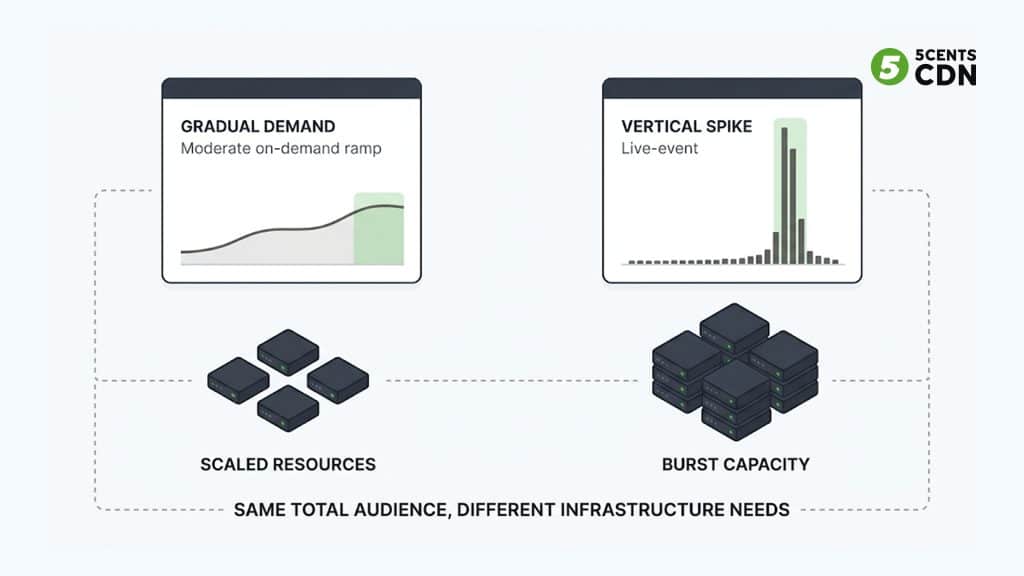
Most platforms are engineered, consciously or not, for gradual demand. A popular on-demand title releases and its audience trickles in over hours and days; auto-scaling has time to add capacity, caches fill naturally, and every system in the chain absorbs the growth at a manageable pace. A scheduled live event does the opposite. When a match kicks off or a premiere goes live at an announced time, the audience does not trickle — it arrives vertically, hundreds of thousands or millions of people hitting play inside the same sixty seconds. Demand goes straight up rather than ramping, and systems that scale in minutes cannot react in seconds.
This is exactly what was on display in the widely reported August 2026 incident when a major game reveal was routed through a large streaming service and its edge network could not absorb the simultaneous, instantaneous demand a fixed-time global event produces. An architecture that works at extraordinary efficiency for gradual on-demand viewing met a vertical demand curve it was never shaped for. The lesson is not that the platform was badly built; it is that synchronized live demand is a distinct problem requiring distinct engineering.
Worse, live events compound the difficulty in ways on-demand never does. The audience is watching the same few seconds of footage at the same instant, so you cannot spread the load across a catalog. A single dramatic moment — a goal, a knockout, a reveal — can spike traffic several times higher again within seconds. And every viewer is intolerant of delay, so the usual graceful-degradation tricks that work for web pages feel broken on a live stream. Understanding this is the difference between provisioning for the average and surviving the peak.
To make the contrast concrete, picture the same one hundred thousand viewers arriving two different ways. Spread across an afternoon of on-demand viewing, that is a gentle curve any modern auto-scaler handles without noticing; new capacity comes online faster than the audience grows, and caches warm as they go. Now compress those same hundred thousand into the ninety seconds after a scheduled kickoff. The request rate per second is now orders of magnitude higher, it arrives before any reactive scaling can respond, and it all targets the identical fresh content. Same total audience, same total bandwidth over the session — but one shape is routine and the other is a stress test that finds every weak point simultaneously. The number of viewers never told you whether you would survive; the shape of their arrival did.
The Anatomy of a Live-Event Crash
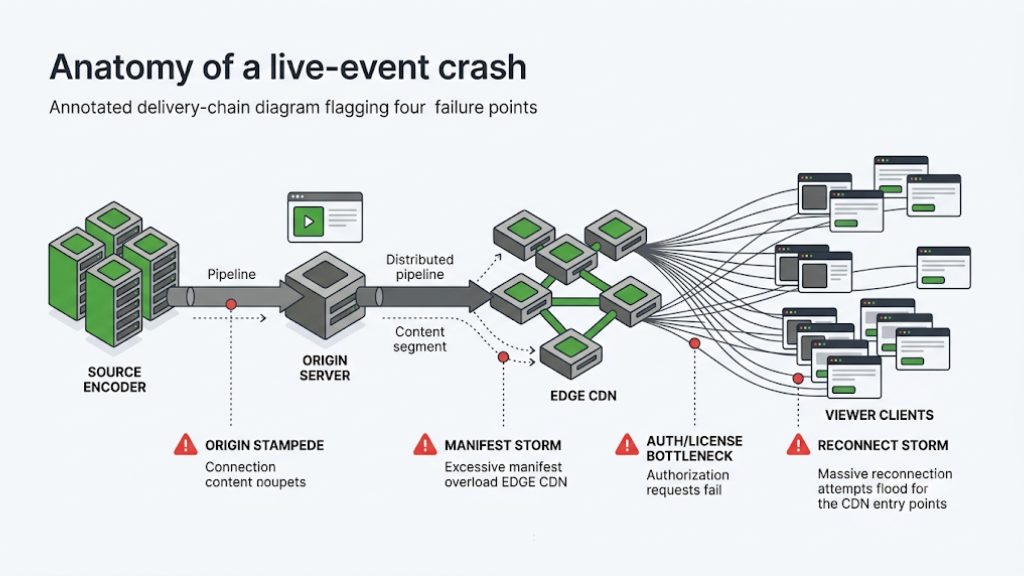
When a platform goes down under live load, it is rarely the thing operators were watching. The failure hides in whichever part of the delivery chain saturates first, and there are a handful of usual suspects. A streaming platform is a chain of systems — authentication, playback session management, origin, CDN edge, and the networks in between — and the whole experience fails the moment any single link saturates, even briefly.
The origin gets stampeded
The most common hard failure is origin overload. If the CDN edge cannot serve a request from cache — because the content is fresh, the cache has expired, or the request is for a constantly-updating live manifest — it falls through to your origin. Under synchronized peak, a vast number of these fall-through requests hit the origin in the same instant, all asking for the same object. This is the classic thundering herd problem: a cache built to shield your origin instead delivers a load spike straight to it, at the exact moment it is least able to cope. The origin slows, then times out, then falls over, and because every edge is now missing, the failure cascades outward to the whole audience.
The manifest path collapses before the video does
A subtler and very common failure is the manifest storm. Live streaming, especially at low latency, means every player refreshes the manifest — the playlist that tells it which segments to fetch — on a tight, constant cadence. As concurrency jumps, the manifest request rate can climb faster than the segment request rate, because manifests are requested more often than the segments they point to. The origin starts serving manifests slowly or staler than it should, and viewers see stalling that the dashboards cannot explain, because the video segments themselves are fine. The manifests are simply arriving late. The mechanics of these constant playlist refreshes are defined in the HLS specification, and they are precisely why the manifest path needs testing separately from the segment path.
Authentication and licensing become the bottleneck
The crash is not always in the video path at all. During a big event, thousands of viewers log in and start playback in the same few seconds, and the authentication service, entitlement check, or DRM license server can become the choke point. If your license system is sized for average concurrent playback rather than the synchronized rush at kickoff, it will authenticate viewers slowly or fail them outright — and a viewer who cannot get a license cannot watch, no matter how healthy your delivery is. These supporting systems are easy to forget precisely because they are invisible at normal load.
A minor blip triggers a recovery storm
Finally, a small interruption can cause a disproportionate crash. If a brief network hiccup causes a large population of players or devices to disconnect and reconnect at the same instant, they all request the same segments at the same moment — a synchronized recovery spike that can be larger than your steady-state peak. The original blip was trivial; the coordinated recovery is what takes the service down. This is the thundering herd again, arriving through the back door.
The Delivery Architecture That Survives the Spike
The good news is that every one of these failure modes has a well-understood defense, and they work together as a layered system rather than as a single magic setting. The goal is to design so that the vast, synchronized demand of a live event is absorbed smoothly at the edge and never reaches the fragile core as a spike.
Shield the origin with tiered caching and request collapsing
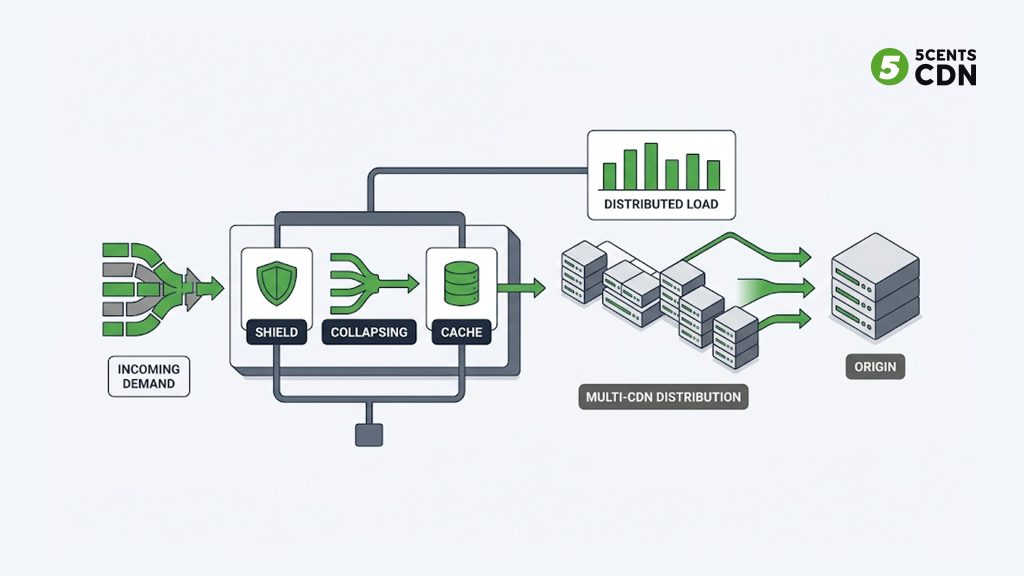
The single most important defense against the stampede is to make sure synchronized requests never hit the origin as a flood. An origin shield inserts a mid-tier caching layer between the edge and your origin, so the origin sees a small fraction of total requests even under extreme concurrency. Paired with request collapsing — where the CDN coalesces many simultaneous requests for the same object into a single origin fetch — this directly neutralizes the thundering herd. When a hundred thousand viewers ask for the same fresh segment at once, the origin is asked for it exactly once, and the shield fans the answer back out. This is the mechanism that turns a vertical demand curve into a manageable trickle at the origin.
Push your cache-hit ratio as high as it will go
Origin shielding works best when as little as possible needs to reach the origin in the first place. A high cache-hit ratio means the overwhelming majority of requests are served from the edge, close to viewers, and never trouble your core. For live events, this includes caching the constantly-refreshing manifest at the edge with a short but correct time-to-live, so the manifest storm is absorbed by the edge rather than passed through. A few percentage points of cache efficiency, trivial at average load, becomes the difference between staying up and browning out at peak.
Distribute load and remove the single point of failure
Relying on one delivery network for a marquee event is a structural risk: if that network degrades in a region, a whole slice of your audience is lost at the worst possible moment. A multi-CDN posture distributes delivery across more than one network and routes viewers to the best-performing path in real time, adding both raw capacity and redundancy. If one path weakens under the spike, traffic shifts to another rather than failing. For the highest-stakes events, this is the difference between a degraded region and a dark one.
Pre-warm caches before the doors open
Because the danger is the first synchronized wave, much of it can be defused before the event even starts. Pre-warming pushes the manifest and opening segments out to edge caches in advance, so the first flood of viewers is served from a primed edge rather than all falling through to a cold origin simultaneously. For a scheduled event — and live events are almost always scheduled — there is no excuse for the first wave to hit an empty cache. Capacity for anticipated demand can be arranged ahead of time rather than scrambled for on the day.
Keep the supporting systems and the edge in sync
The defenses cannot stop at the video path. Authentication, entitlement, and license systems must be load-tested and sized for the synchronized kickoff rush, not average concurrency. Enforcing token authentication and access control at the edge rather than round-tripping to the origin keeps those checks from becoming the bottleneck. And because a high-profile event reliably attracts attacks alongside real viewers, DDoS protection at the edge keeps malicious traffic from consuming the capacity you provisioned for your audience.
You Cannot Fix at Kickoff What You Did Not Test Before It
Architecture is only half the answer. The failures that take down a live stream are invisible at normal load and only appear at peak — which means they ship into production unnoticed and get discovered live, in front of your largest-ever audience. The operators who get through a major event cleanly are the ones who deliberately tested the peak-specific failure modes beforehand, while there was still time to fix them.
Effective pre-event testing means load-testing at projected peak concurrency, not at a comfortable multiple of normal traffic, and doing it against the failure modes above specifically. Test the manifest request path separately from the segment path, because the manifest usually breaks first and most synthetic tests under-exercise it. Model cache fill for the specific regions you expect to peak, using realistic geographic clustering rather than evenly spread synthetic load, because a global average hides a regional brownout.
Simulate a synchronized reconnect across a representative device population to measure the recovery spike, since the danger is often in the recovery rather than the original interruption. And rehearse the human side too: who has authority to shift traffic, block an abusive source, or adjust a configuration mid-event, and how fast can they act. One honest caveat: no test rig reproduces a real audience perfectly, so the realistic goal is to eliminate every failure that is findable in advance, leaving only the genuinely unforeseeable ones for match day — a far smaller and more survivable set.
A Pre-Event Readiness Checklist
Pulling the prevention stack together, here is the shape of a live-event readiness pass. Treat it as the minimum before any high-stakes broadcast: confirm origin shield and request collapsing are active and verified, not just enabled; confirm the manifest is cached at the edge with a correct short TTL; confirm cache-hit ratio is measured and healthy for live content specifically; confirm multi-CDN or failover routing is in place for marquee events; pre-warm manifests and opening segments to the regions you expect to peak.
Load-test authentication and license systems at synchronized-kickoff concurrency, not average; run a peak-concurrency load test that exercises the manifest path and a synchronized-reconnect scenario; verify DDoS protection is active at the edge; and confirm real-time monitoring of startup time, rebuffer ratio, and concurrency so problems surface during the event, not in the post-mortem. Every item on that list maps to one of the failure modes above, and every one is far cheaper to check the week before than to diagnose during the event.
The Real Cost of a Crash (and Why It Drives CDN Switching)
It is worth being clear-eyed about why this matters enough to engineer against so deliberately, because the cost of a live-event failure lands in several places at once, and most of them are larger than the delivery bill you were trying to manage.
The immediate loss is the audience in the moment: viewers who cannot watch the event they showed up for, many of whom will not come back for the next one. For a subscription service that is churn; for an ad-supported one it is impressions and revenue evaporating at the peak-value moment; for a ticketed or pay-per-view event it is refund demands on top of lost trust. Then there is the reputational cost, which outlasts the outage by far — a crash during a marquee event is precisely the kind of failure that trends publicly, gets screenshotted, and becomes the story instead of the content. The event you paid to promote ends up promoting your unreliability.
This is exactly why a live-event crash is one of the most common reasons operators start looking for a new delivery partner. A platform that runs fine day to day but falls over on the one night that mattered has failed at the only test that counts, and the search for a CDN that can absorb synchronized demand usually begins the morning after. If you are reading this because that already happened, the reassuring part is that the fix is architectural and well understood — the failure was not inevitable, and the next event does not have to repeat it.
Don’t Let the Big Moment Be the Breaking Point
A live-event crash is one of the most damaging things that can happen to a streaming platform, because it fails publicly, at scale, at the exact moment you have the most viewers and the most attention. But it is not bad luck and it is not unavoidable. It is the predictable result of meeting a vertical, synchronized demand curve with an architecture and a plan built for gradual growth. Fix the shape of the problem — shield the origin, collapse duplicate requests, cache aggressively at the edge, distribute across networks, pre-warm before the doors open, and test the peak-specific failures before kickoff — and the goal-moment spike becomes a normal Tuesday rather than a catastrophe.
If you are preparing for a high-stakes broadcast and want delivery infrastructure built to absorb synchronized demand, 5centsCDN pairs origin shielding, high cache efficiency, multi-CDN delivery, and DDoS protection in a platform designed for exactly this, backed by live event streaming support over a purpose-built CDN. For the full technical picture of how a live event is delivered end to end, our live sports streaming infrastructure guide is the companion build guide to this one. When you’re ready to pressure-test your setup before the big day, talk to our team.
Frequently Asked Questions
Why does my streaming platform crash during live events but not normally?
A live audience arrives all at once (vertical demand), which is a different problem than gradual growth. Systems that scale in minutes can’t react in seconds, so weak points that are invisible at average load fail at peak.
What is the thundering herd problem in streaming?
When the CDN edge can’t serve a request from cache, it falls through to origin. Under synchronized peak, a flood of identical requests hits origin at once — a cache built to protect the origin instead delivers a load spike to it.
What is a manifest storm?
At low latency, every player refreshes the manifest constantly. As concurrency jumps, the manifest request rate can outpace the segment rate and overwhelm the origin, causing stalls the CDN dashboards don’t explain.
How do I stop my stream from crashing at peak?
Shield the origin with tiered caching and request collapsing, raise cache-hit ratio, use multi-CDN failover, pre-warm caches before the event, size auth/license systems for the kickoff rush, and load-test the peak-specific failure modes beforehand.
Why did a big platform crash during a scheduled premiere?
An edge network tuned for gradual on-demand demand met a vertical, synchronized spike from a fixed-time global event — a fundamentally different engineering challenge that edge caching alone can’t absorb.