

If you already run HTTP/2, you have probably wondered about HTTP/2 vs HTTP/3 and whether HTTP/3 is worth the switch. HTTP/2 was a genuine leap over HTTP/1.1, and it still powers a huge share of the web perfectly well. HTTP/3 is newer, faster in the situations that matter most, and increasingly the default on modern delivery networks, but the gap between the two is more subtle than the jump from HTTP/1.1 to HTTP/2 was.
The honest answer is that HTTP/3 is not a rewrite of HTTP/2. It provides the same features and the same request-and-response semantics; what changes is the transport layer underneath, and that single change quietly fixes some of HTTP/2’s most stubborn weaknesses. Whether that matters for you depends almost entirely on who your audience is and how they connect. This guide lays the two protocols side by side, explains where they genuinely differ, and gives you a clear way to decide whether enabling HTTP/3 is worth it.
The Same Semantics, a Different Foundation
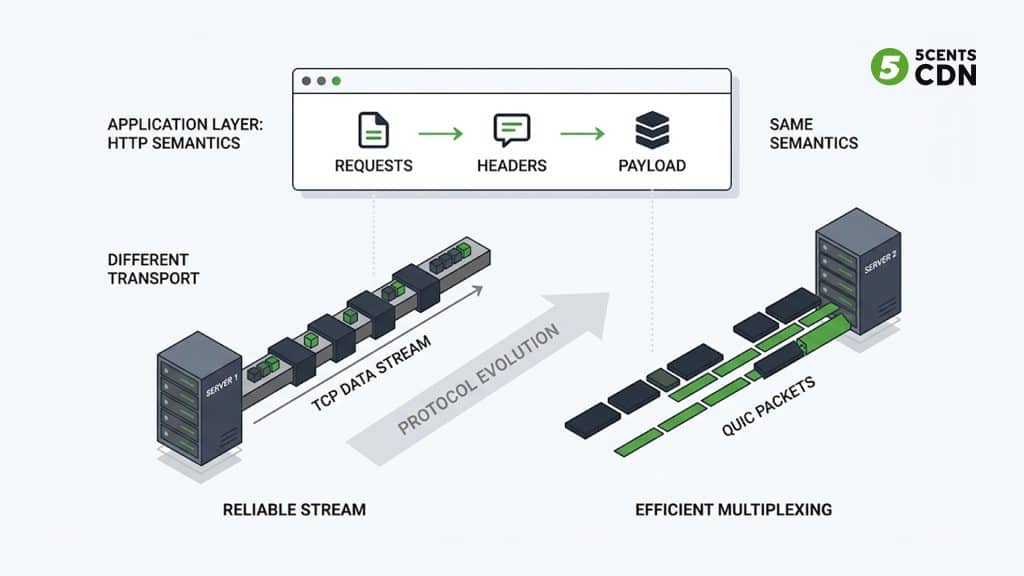
The most important thing to understand up front is that HTTP/2 and HTTP/3 do not differ in *what* they do, only in *how* they move data. Both use the same core HTTP concepts: methods like GET and POST, status codes, headers, URLs, and request-and-response message exchanges. An application built for HTTP/2 works over HTTP/3 without changes to that logic, because the semantics are identical.
The difference is the transport layer beneath those semantics. HTTP/2 runs on TCP, the reliable, ordered transport protocol that has carried the internet for decades. HTTP/3 runs on QUIC, a newer transport built on UDP, with encryption and modern connection handling built directly into the protocol. Because so much of a protocol’s real-world performance is determined by how its transport behaves under imperfect network conditions, moving from TCP to QUIC is where every meaningful HTTP/3 advantage comes from. Everything that follows is a downstream consequence of that one architectural choice.
It helps to think of it like upgrading the engine and drivetrain of a car while keeping the same steering wheel, pedals, and dashboard. The driver interacts with the vehicle exactly as before; the controls are unchanged. But the machinery that actually turns intent into motion is different, and that is where the smoother ride comes from.
Where HTTP/2 Came From
To judge HTTP/3 fairly, it helps to remember what HTTP/2 fixed. Standardized in 2015 and defined in RFC 9113, HTTP/2 addressed the biggest pain point of HTTP/1.1: the need to open many parallel connections to load a page, because HTTP/1.1 could effectively handle only one outstanding request per connection at a time.
HTTP/2 introduced multiplexing, which lets many requests and responses share a single connection at once, along with header compression to cut the overhead of repetitive headers, and stream prioritization so more important resources can be delivered first. These were substantial gains, and they eliminated the awkward workarounds developers had relied on for years, such as combining images into sprite sheets or splitting assets across multiple domains. For most sites, moving from HTTP/1.1 to HTTP/2 produced an immediate, visible speed improvement.
But HTTP/2 carried one inherited limitation it could not solve on its own, because the limitation lived in TCP rather than in HTTP/2 itself. That limitation is the reason HTTP/3 exists.
The Core Difference: Head-of-Line Blocking
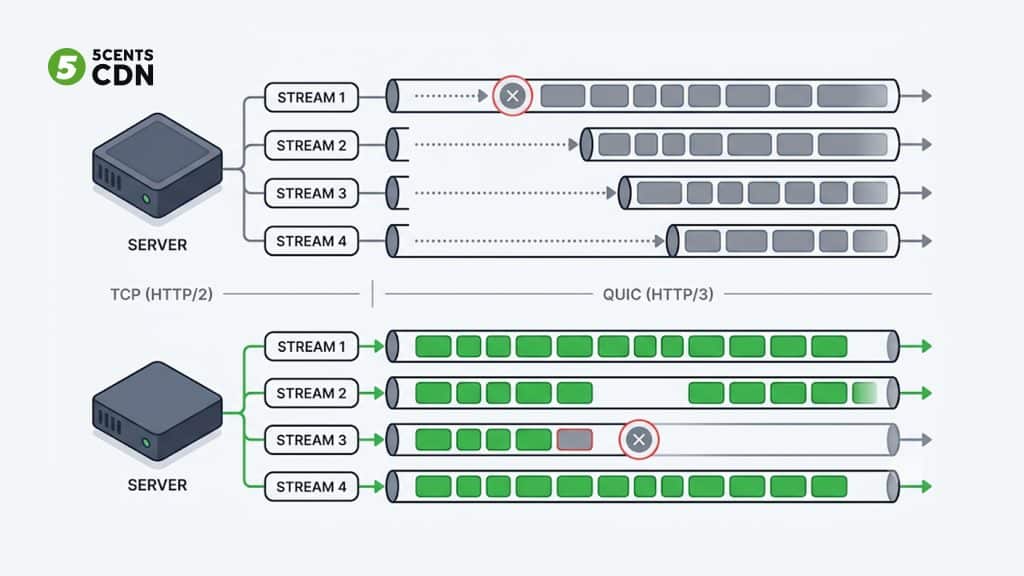
HTTP/2 multiplexes many streams over a single TCP connection, which is efficient until a packet goes missing. TCP guarantees in-order delivery, so when one packet is lost, TCP holds back everything that arrives after it until the missing packet is retransmitted and received, even data belonging to completely unrelated streams. Because all of HTTP/2’s multiplexed streams share one TCP connection, a single lost packet stalls every stream at once. This is called head-of-line blocking, and it is HTTP/2’s central weakness on imperfect networks.
The irony is that HTTP/2 solved head-of-line blocking at the application layer, only to have it reappear at the transport layer. HTTP/2 made sure one slow request would not block others in the way it did under HTTP/1.1, but because TCP still delivers the whole connection as one ordered stream, a lost packet reintroduces the exact problem one level down.
HTTP/3 eliminates this at the source. QUIC treats each stream as genuinely independent, so a lost packet affecting one stream does not block the others. If a packet carrying part of an image is lost, the stylesheets, scripts, and other resources on their own streams keep flowing uninterrupted; only the affected stream waits for its retransmission. On a clean network the difference is small, but on a lossy mobile or congested connection it is the single biggest reason HTTP/3 feels faster.
Comparing the Two Protocols Point by Point
Head-of-line blocking is the headline difference, but several others follow from the TCP-versus-QUIC split. Here is how the two protocols line up across the dimensions that actually affect performance.
Transport protocol. HTTP/2 uses TCP; HTTP/3 uses QUIC over UDP. This is the root difference from which the others follow.
Connection setup. HTTP/2 over TCP needs a TCP handshake followed by a separate TLS handshake to secure the connection, which typically means multiple round trips before any data flows. QUIC integrates the transport and TLS 1.3 handshakes into a single exchange, cutting the round trips needed to start a secure connection. For returning visitors, QUIC can resume a session with essentially no handshake delay at all. Fewer round trips before the first byte means a faster start, which matters most on high-latency connections.
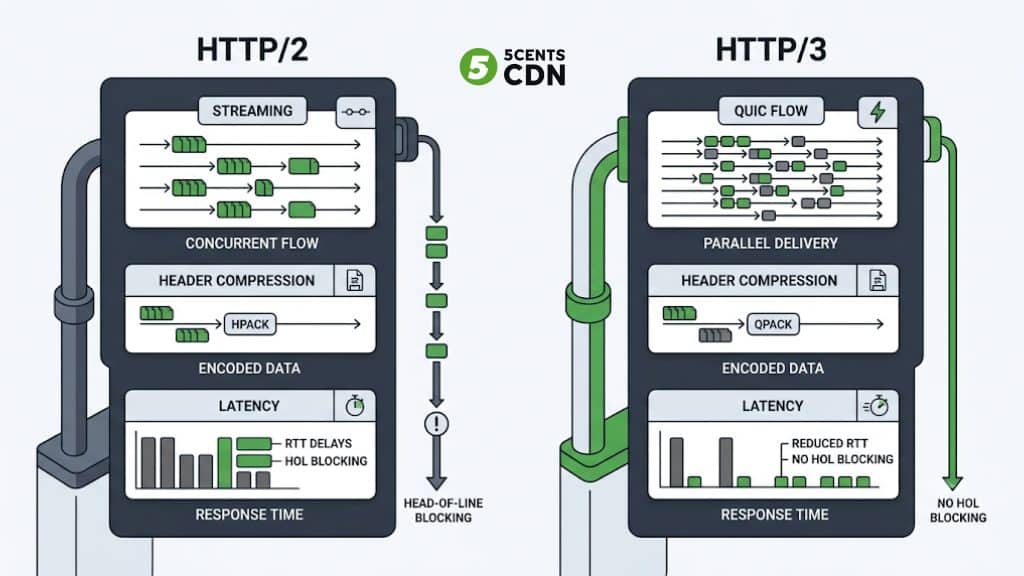
Head-of-line blocking. Present in HTTP/2 at the transport layer because of TCP’s in-order delivery; eliminated in HTTP/3 because QUIC streams are independent.
Header compression. Both compress headers to reduce overhead, but they use different mechanisms suited to their transports. HTTP/2 uses HPACK, which depends on in-order delivery and can itself become a source of head-of-line blocking. HTTP/3 uses QPACK, redesigned to work with QUIC’s out-of-order streams without reintroducing the stall.
Network switching. A TCP connection is bound to the specific IP addresses and ports at each end, so when a device changes networks, such as a phone moving from Wi-Fi to cellular, the connection breaks and must be rebuilt. QUIC identifies a connection by an ID independent of the network path, so it can survive that switch and keep going. This connection migration is a genuine HTTP/3-only capability with no HTTP/2 equivalent.
Encryption. HTTP/2 is almost always deployed with TLS but does not strictly require it by specification. QUIC builds TLS 1.3 encryption directly into the transport, so HTTP/3 is encrypted by design rather than by convention.
Maturity and reach. HTTP/2 is universally supported and battle-tested across more than a decade of deployment. HTTP/3 is now supported by every major browser and most modern delivery networks, but as the newer protocol it is still catching up in some server software.
Where the Two Protocols Are Actually the Same
It would be misleading to present HTTP/3 as a wholesale replacement, because in several respects the two protocols are deliberately identical, and that continuity is a feature rather than a shortcoming.
Both offer full multiplexing of concurrent requests. The compressed headers differ only in their mechanism. Both support stream prioritization so important resources arrive first, and both support server push, though it has fallen out of favor in practice on both. Most importantly, both expose the exact same HTTP semantics to your application, which is precisely why you can enable HTTP/3 without touching your application code. HTTP/3 was designed to port HTTP/2’s feature set onto a better transport, not to reinvent the feature set. Recognizing this is what keeps the comparison honest: HTTP/3 is an evolution of the same ideas, not a competing design.
Is HTTP/3 Actually Faster?
The accurate answer is: sometimes significantly, sometimes barely, and it depends on the network. Because HTTP/3’s advantages come from handling adverse conditions better, its benefit is largest exactly where those conditions are worst, and smallest where the network is already ideal.
HTTP/3 tends to deliver its clearest gains on mobile and cellular networks, where packet loss and network switching are common; on high-latency and long-distance connections, where saving handshake round trips matters most; for returning visitors who benefit from faster session resumption; and for pages with many resources, where independent streams keep more of them flowing during packet loss. Conversely, on a fast, stable, low-latency wired connection loading a simple page, the difference between HTTP/2 and HTTP/3 can be small enough to be hard to measure, because TCP was already performing close to ideally in that environment.
This is the crucial nuance that many comparisons miss. HTTP/3 is not universally and dramatically faster than HTTP/2 in every scenario; it is meaningfully faster in the difficult conditions that make up a large and growing share of real-world traffic, especially mobile. Because the web has shifted decisively toward mobile viewing on variable networks, the population of sessions that benefit from HTTP/3 keeps growing, which is what makes the upgrade increasingly worthwhile even though any single lab test on a perfect connection might show only a modest gain.
Practical Realities of Running HTTP/3
Beyond raw performance, a few operational differences shape what adopting HTTP/3 actually looks like, and they are worth knowing before you flip the switch.
The first is protocol negotiation. A browser does not know a site supports HTTP/3 until the server tells it, which usually happens after an initial connection over HTTP/2. In practice this means the very first visit to a domain often happens over HTTP/2, and the browser only upgrades to HTTP/3 on subsequent requests once it has learned the server supports it. This is normal and invisible to users, but it means HTTP/3’s benefits accrue most to returning visitors and later requests in a session rather than the very first connection, and it is why testing HTTP/3 requires a warm cache rather than a single cold load.
The second is the reliance on UDP. Because QUIC runs over UDP rather than TCP, it depends on UDP traffic being allowed end to end. Most networks pass it without issue, but some restrictive corporate firewalls or unusual network configurations block or throttle UDP, in which case HTTP/3 simply cannot be used. This is not a risk to worry about, precisely because of the fallback: any client that cannot establish an HTTP/3 connection quietly drops back to HTTP/2 over TCP, so the visitor still gets your site, just over the older protocol. The graceful fallback turns what could have been a compatibility problem into a non-event.
The third is server and tooling maturity. HTTP/2 support is universal and deeply mature across every web server. HTTP/3 support is now broad but not yet total: several major servers support it well, while some widely used server software still lacks native support. This is one of the strongest reasons the CDN path to HTTP/3 is so popular, because it lets you offer HTTP/3 to clients regardless of whether your origin server software supports it yet.
When Should You Upgrade to HTTP/3?
For most sites and services, the practical answer is to enable HTTP/3 while keeping HTTP/2, because the two are not mutually exclusive. A server advertises HTTP/3 support, capable clients use it, and everyone else automatically falls back to HTTP/2 or HTTP/1.1. You are not choosing one protocol over the other; you are adding HTTP/3 as an option that the best-equipped clients will take.
The case for enabling HTTP/3 is strongest if a large share of your audience is on mobile, if you serve an international or geographically dispersed audience over long network paths, if you have many returning visitors, or if your pages carry many resources. It is weaker, though rarely harmful, if your audience is small, local, and entirely on fast wired connections. Because HTTP/3 falls back gracefully and requires no change to your application, the downside of enabling it is minimal, which tilts the decision toward yes for most operators. The real question is usually not whether HTTP/3 is worth a major project, because it is not a major project, but simply whether your delivery platform supports it well.
The simplest path to HTTP/3 for most teams is through a content delivery network. Rather than wrestling with server modules and configuration, you enable HTTP/3 at the edge and let the network negotiate the best protocol with each visitor automatically. This is also the easiest way to add HTTP/3 in front of server software that does not yet support it natively, since the CDN handles the modern protocol on the client side regardless of what your origin speaks. Pairing that with a broader delivery acceleration posture means each request can be served over the best available protocol and path together.
HTTP/3, HTTP/2, and Your Delivery Stack
Choosing between HTTP/2 and HTTP/3 is ultimately the wrong framing, because the right answer for nearly everyone is to support both and let each visitor get the best protocol their client can handle. HTTP/2 remains a strong, universally supported baseline; HTTP/3 layers on top of it to serve the mobile, high-latency, and lossy-network sessions that make up an increasing share of real traffic. Standardized in RFC 9114 and now widely deployed, HTTP/3 has moved well past the experimental stage and into mainstream, low-risk adoption.
If your audience skews toward video, it is worth understanding how these same transport advantages play out specifically for streaming, where startup time and resilience directly shape the viewer experience; our companion guide on HTTP/3 and QUIC for video streaming covers that in depth. And for a plain-language primer on the protocol itself, our overview of HTTP/3 explains how it evolved from earlier versions.
5centsCDN delivers your content over HTTP/3 as part of a purpose-built CDN, with automatic protocol negotiation so every visitor gets the fastest, most resilient connection their device supports, with a clean fallback for those that do not. If you want to talk through whether enabling HTTP/3 would benefit your specific audience, get in touch with our team.
Frequently Asked Questions
What is the main difference between HTTP/2 and HTTP/3?
Same HTTP semantics, different transport: HTTP/2 runs on TCP, HTTP/3 runs on QUIC over UDP. Every performance difference follows from that change.
Is HTTP/3 faster than HTTP/2?
Often, but it depends on the network. HTTP/3’s gains are largest on mobile, high-latency, lossy, and long-distance connections, and smallest on fast stable wired ones.
What is head-of-line blocking?
On TCP, one lost packet stalls every multiplexed HTTP/2 stream until it is retransmitted. QUIC’s independent streams eliminate this, so HTTP/3 avoids it.
Should I upgrade from HTTP/2 to HTTP/3?
For most sites, enable HTTP/3 while keeping HTTP/2. Clients that support HTTP/3 use it; others fall back automatically. The easiest path is via a CDN.
Do I have to choose between HTTP/2 and HTTP/3?
No. They coexist. A server advertises HTTP/3; capable clients use it and everyone else falls back to HTTP/2 or HTTP/1.1.