

Live shopping looks effortless when it works. A host holds up a product, viewers tap to buy without leaving the video, a countdown ticks down on a flash deal, and the “sold out” badge appears the instant the last unit goes. That seamlessness is the whole point — the entire premise of live commerce is collapsing the distance between wanting something and buying it to nearly zero. But that effortless feel rests on a delivery stack that is genuinely harder to get right than ordinary video streaming, and when any part of it is wrong, the magic breaks in ways that cost real sales: a viewer bids on an item that already closed, asks a question the host answers thirty seconds too late, or taps “buy” on stock that no longer exists.
Most writing about live shopping is about platforms and tactics — which tool to pick, how to promote a show, how to pick a host. This guide is about the layer underneath all of that: the video delivery and real-time infrastructure that makes live commerce actually convert. If you are a retailer, a DTC brand, or a team building a live-shopping experience, understanding this layer is what separates a stream that sells from one that frustrates. We will cover why live shopping is technically demanding, the single most important architectural decision in the whole stack, how latency shapes what is possible, and how to turn one live show into content that keeps selling long after it ends.
Why Live Shopping Is Harder Than It Looks
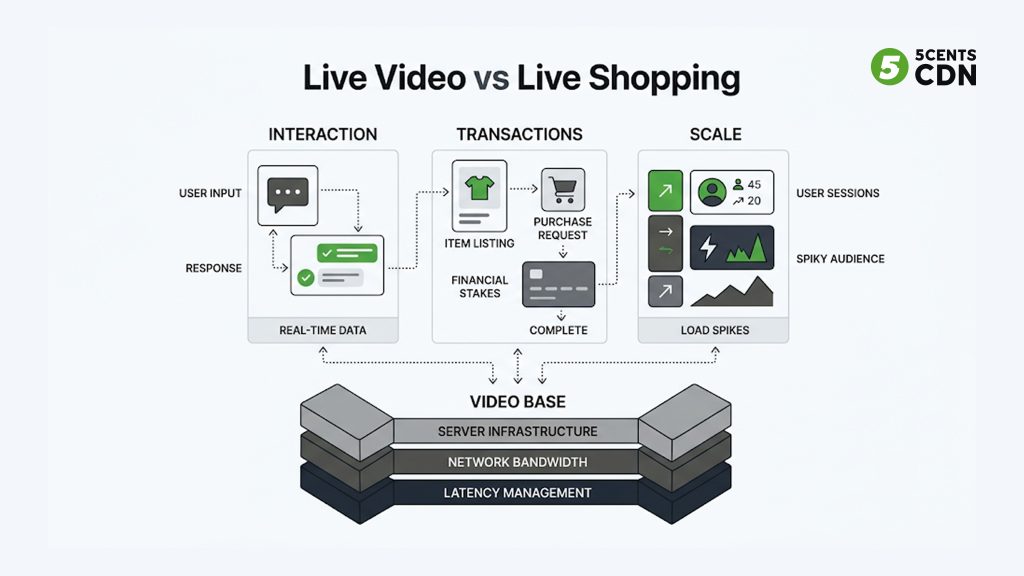
On the surface, a live shopping broadcast is just a live video stream, and live video is a solved problem. But live commerce layers three demands on top of ordinary streaming that, together, make it one of the more exacting video use cases there is.
The first is that interaction is the product. In most live streaming, the video is the whole experience and any interactivity is a bonus. In live shopping, the transaction is the point, and it depends on a tight loop between what the host says and what the viewer does — a question answered, a limited drop claimed, a flash price beaten before it expires. That loop only works if the delay between host and viewer is small; a stream that lags badly turns a live conversation into a series of missed connections.
The second is that the stakes are immediate and financial. A buffering sermon or a laggy webinar is annoying; a live shopping stream that stalls during a product reveal, or shows a viewer a price that has already changed, loses a sale in that moment and erodes the trust that makes the next one possible. The third is that the audience is unpredictable and spiky. A flash sale, a celebrity appearance, or a viral moment can multiply the concurrent audience in seconds, and every one of those viewers arrives on mobile, on a variable connection, expecting the stream and the store to both hold up. Meeting all three at once is the real work of live-commerce delivery.
The Most Important Decision: Separate the Commerce from the Video
Here is the single architectural insight that most distinguishes a live-shopping stack that works from one that fails, and it is the opposite of what intuition suggests. The commerce events — the bids, the countdown timers, the stock and price updates, the “add to cart” and purchase confirmations — must travel on a separate real-time data channel, not inside the video stream.
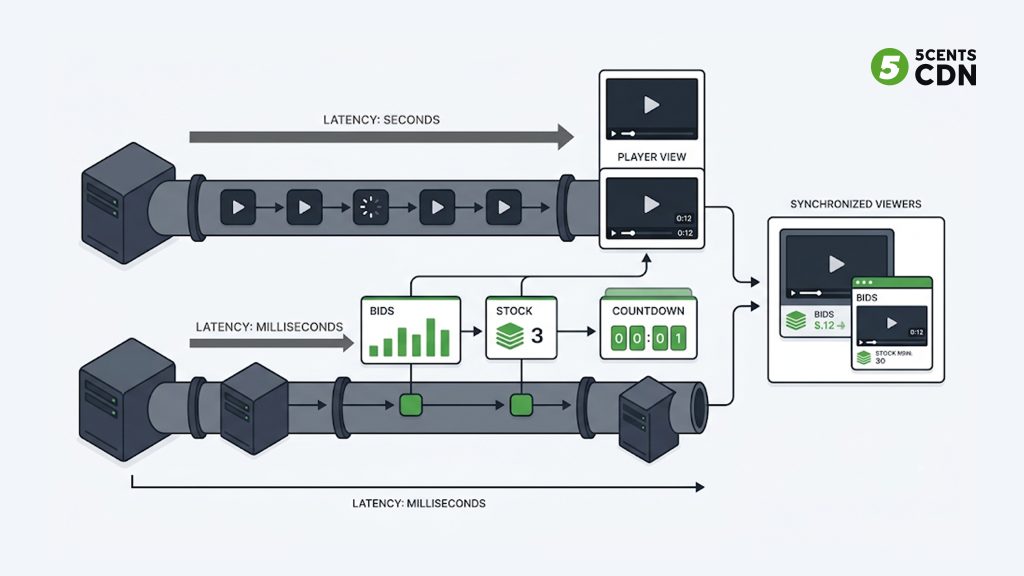
The reason is a fundamental property of how streaming video works. Video delivered over standard protocols like HLS is broken into segments and buffered, which means the picture a viewer sees is always some seconds behind real time — that delay is what keeps playback smooth, and it is largely unavoidable for mass-scale video. If you tied your commerce events to the video — revealing a price change or closing an auction only as fast as the video reaches each viewer — then every viewer would experience the store at a different moment, dictated by their individual video buffer. One viewer’s countdown would hit zero while another’s still showed ten seconds; someone would win an auction that, on another screen, appeared still open. That is a recipe for overselling, disputes, and lost trust.
The solution is to run the commerce layer over a fast, bidirectional data channel — in practice a technology like WebSocket, which keeps a persistent connection open between server and viewer and pushes updates in milliseconds, independent of the video. The stock counter, the current bid, the countdown, and the buy confirmation all arrive nearly instantly and in sync across every viewer, even while the video itself is a few seconds behind. The video carries the *experience* — the host, the product, the atmosphere — while the data channel carries the *transaction*, and keeping them separate is what lets the store stay accurate and fair even though the video is buffered. Any team building live shopping that gets this separation wrong will sell inventory it no longer has; any team that gets it right has solved the hardest correctness problem in the category.
How Much Latency Can Live Shopping Tolerate?
Latency — the glass-to-glass delay between the host’s camera and the viewer’s screen — is the spec that rules a live-shopping approach in or out, because it determines whether the interaction feels honest. But the honest answer is that the right latency target depends on the format, and understanding the tiers keeps you from over-engineering.
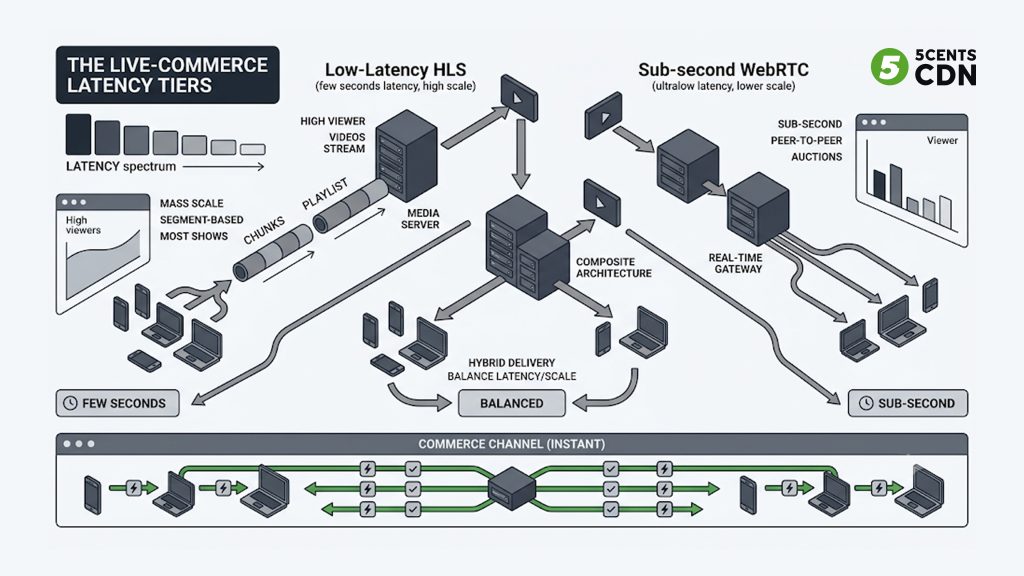
For a straightforward live product showcase — a host demonstrating items, taking questions with a little breathing room — the low-latency delivery achievable with modern streaming protocols is entirely adequate. Low-latency HLS and DASH bring the glass-to-glass delay down to a handful of seconds, tight enough that a host reading and answering chat feels responsive and natural. This is the workhorse tier for most live commerce, and it has a decisive advantage: it runs over standard HTTP infrastructure and content delivery networks, so it scales cleanly to very large audiences without exotic architecture. The faster and more resilient that delivery path is, the tighter the interaction loop feels, which is why low-latency streaming is the foundation most live-shopping experiences should build on.
At the other end, genuinely real-time formats — live auctions where a hammer price closes in an instant, or one-to-one shopping consultations — need sub-second latency, and that is a different technical regime, typically built on approaches like WebRTC that trade some of the effortless scale of HTTP streaming for minimal delay. The important nuance, and the reason not to reach for the most aggressive latency by default, is that these ultra-low-latency approaches are more complex and more expensive to scale to a mass audience.
The mature pattern in the industry is therefore hybrid: use the sub-second path only where the format truly demands it, while low-latency HLS carries the broad audience — the same tiering logic that governs interactive live events generally. Crucially, remember the previous section: because the commerce events ride their own data channel, even a broadcast on a few-seconds video delay can still have a perfectly real-time store, so you often need far less video latency than you think. The buy button is instant regardless of the video buffer.
The Engagement Layer That Drives Urgency
Beyond the core buy mechanics, live shopping leans on a set of real-time engagement features that create the urgency and community driving conversion — and every one of them rides the same data-channel logic rather than the video stream. Understanding them as infrastructure, not just marketing garnish, is part of building the experience well.
Live chat is the baseline: viewers talking to the host and each other in real time is what makes the format feel alive rather than a pre-recorded ad, and it depends on the same low-latency bidirectional channel that carries the commerce events, so messages appear near-instantly across the audience. Layered on top are the mechanics that manufacture urgency — countdown timers on limited drops, live-updating stock counters that show scarcity as it happens, flash-price reveals, and polls or reactions that pull viewers into participation.
In auction formats, live bidding is the entire experience, and it is the most latency-sensitive commerce event of all, since a bid arriving late is worse than useless. What these share is that they are all state that must stay synchronized across every viewer in real time, independent of each viewer’s video buffer — a countdown that hits zero at a different second for each person, or a stock counter that disagrees between screens, breaks the urgency it was meant to create. This is the practical payoff of separating commerce from video: the engagement layer can be genuinely real-time and consistent for everyone, which is exactly what turns passive watching into active, urgent buying. Designing these features to run on the fast data channel, kept in sync from a single source of truth, is what makes the urgency feel real rather than glitchy.
Scaling for the Flash-Sale Surge
Live shopping has a traffic signature that mirrors the hardest moments in live events: a sudden, synchronized surge. When a sale opens, a limited drop goes live, or a promoted host appears, the audience does not build gradually — it arrives in a rush, and the store behind it gets hit just as hard as the video. Both have to hold up at once, because a stream that plays perfectly while the checkout falls over converts no better than one that buffers.
On the video side, the surge is the same problem any large live broadcast faces: a large number of viewers requesting the same stream in the same moment, which a content delivery network with strong edge caching and origin protection is built to absorb by serving most viewers from the edge rather than overwhelming the origin. Pre-warming the delivery for a scheduled drop, so the first wave of shoppers hits a primed edge rather than a cold origin, is as valuable here as for any scheduled event — the same surge dynamics that make streaming platforms crash during live event spikes apply directly to a flash sale.
On the commerce side, the real-time data channel and the inventory system behind it have to handle the same spike in bids, cart actions, and stock checks — which is a distinct scaling challenge from the video, and another reason the two layers are engineered separately. The practical discipline is to load-test both paths against a realistic flash-sale peak before a major show, because the failure that hurts most is the one that strikes at the exact moment the most people are trying to buy. A brand that has rehearsed its biggest expected surge goes into a headline event confident; one that provisioned for the average discovers its limits live, in front of its largest-ever audience, at the worst possible time.
Mobile-First, Vertical, and Variable
Almost all live shopping happens on phones, and a large share of it in vertical format, over cellular connections that fluctuate as viewers move through their day. That reality shapes the delivery in concrete ways that a desktop-first mindset would miss.
Because the audience is mobile and their bandwidth varies constantly, adaptive bitrate streaming is not optional — the stream has to be prepared at multiple quality levels so each viewer’s player can drop to a lower rendition when their connection weakens and climb back when it recovers, all without the stall that would break the shopping moment. And the adaptive ladder has to be built with genuinely usable lower rungs, because a meaningful fraction of the audience will spend part of the show on them; a ladder optimized only for strong connections fails exactly the mobile viewers who make up the majority. Producing that ladder efficiently, tuned for a mobile and vertical audience rather than a living-room one, is the job of well-configured live transcoding.
The player matters too: a lightweight, fast-starting video player that begins playback quickly and embeds cleanly into the shopping experience — on the brand’s own site or app, not just a third-party platform — keeps the viewer inside the environment where the transaction happens. Every extra second of startup and every avoidable stall on a mobile connection is a shopper who might drift away before they buy.
The Show Doesn’t End When the Stream Stops
One of the biggest mistakes in live commerce is treating a live show as a one-time event. The live broadcast is only the first act; the recording is an asset that can keep selling for months, and capturing it well is part of the delivery design, not an afterthought.
The moment a live show ends, it should become on-demand video — and, better still, be broken into short, shoppable clips, each highlighting a single product or moment, that can be embedded across product pages, social channels, and email. A forty-five-minute live sale becomes a dozen evergreen shoppable segments that continue converting long after the live audience has moved on, often driving more cumulative revenue than the live event itself. Making this seamless means recording every show automatically as it streams, so the recording and DVR workflow turns the live broadcast into an on-demand library with no manual re-uploading, and keeping that video-on-demand catalog on the same reliable delivery as the live stream.
The same product tags and clickable overlays that made the live show shoppable should carry into the replay, so the archived video is not just a recording but a standing storefront. A live-commerce program that captures and repurposes its shows compounds the value of every broadcast; one that lets the stream vanish when it ends is leaving most of its return on the table.
Measuring What Actually Converts
Because live shopping exists to sell, the measurement that matters goes beyond the view counts and watch time that define ordinary streaming analytics. The questions a live-commerce team needs answered are commercial: how many viewers converted during the live window, how much revenue the show influenced in the hours and days after, where in the broadcast viewers dropped off, and which products drove the most engagement. Tying real-time analytics on the stream — concurrent viewers, where they are, how the playback quality is holding up — together with the commerce data from the transaction layer is what turns a live show from a performance into a measurable sales channel.
Watching stream quality in real time during the show also lets the team catch a delivery problem — a region where viewers are buffering, a quality drop as the audience surges — while the broadcast is still live and the sale is still on, rather than discovering it in the post-mortem after the revenue is already lost.
Building Live Shopping That Sells
Live commerce rewards teams that treat it as the demanding real-time system it is rather than as a video with a buy button bolted on. Get the fundamentals right — separate the commerce data channel from the video so the store stays accurate, choose a latency tier that fits the format instead of over-engineering, scale both the video and the transaction layer for the flash-sale surge, deliver a mobile-first adaptive stream through a fast player, and turn every live show into evergreen shoppable video — and the effortless experience that makes live shopping convert becomes something you can deliver reliably, at scale, every time.
5centsCDN provides the video-delivery foundation live commerce is built on: low-latency live streaming delivered over a global CDN that absorbs the flash-sale surge, live transcoding that produces a mobile-first adaptive ladder for viewers on any connection, a fast, embeddable video player for your own site or app, and automatic recording that turns each show into on-demand and shoppable replay content — brought together for retail in our ecommerce solution. If you are launching or scaling live shopping and want a delivery layer that holds up when a drop goes viral, talk to our team about building it to convert.
Frequently Asked Questions
What infrastructure does live shopping need?
Low-latency video delivery over a CDN, plus a separate real-time data channel for commerce events (bids, stock, countdowns, checkout), a mobile-first adaptive stream, flash-sale surge capacity, and automatic recording into shoppable replays.
Why should commerce events be separate from the video stream?
Because video is buffered and runs seconds behind real time. If bids, countdowns, or stock updates were tied to the video, each viewer would see the store at a different moment — causing overselling and closed auctions that still look open. A separate real-time channel keeps the store synced for everyone.
How much latency can live shopping tolerate?
For most product showcases, low-latency HLS (a few seconds) is fine because the commerce channel is instant regardless. True real-time formats like live auctions need sub-second latency via approaches like WebRTC, usually in a hybrid design that reserves it for where it’s truly needed.
How do you scale live shopping for a flash sale?
Both the video and the commerce/inventory layer must absorb a synchronized surge. A CDN with edge caching and pre-warming handles the video; the real-time data and inventory systems scale separately. Load-test both against your peak before a major show.
What happens to a live shopping stream after it ends?
It should become on-demand video automatically, ideally cut into short shoppable clips that keep converting for months across product pages and social — often driving more cumulative revenue than the live event itself.
Does live shopping work on mobile?
It’s overwhelmingly mobile and often vertical, over variable cellular connections. That makes adaptive bitrate streaming with capable lower rungs and a fast-starting player essential, not optional.