


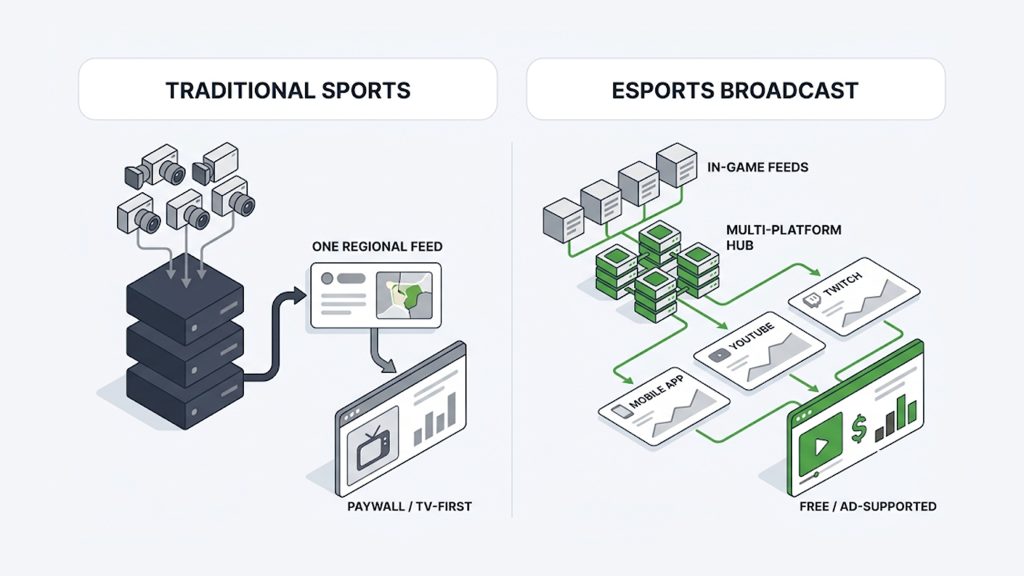
At the level of raw plumbing, streaming an esports final and streaming a football final look almost identical: both send a live video feed to a massive, synchronized audience that all arrives at once, both live or die on latency and concurrency, and both would collapse without the same core delivery techniques. If that were the whole story, there would be nothing more to say than “do what sports does.” But it isn’t the whole story. Esports is a genuinely different broadcast animal — the feed originates inside a game engine rather than a stadium, the audience watches across half a dozen platforms at once with commentators layered on top, the chat is not a side feature but the point, and the whole thing is usually free, global, and mobile-first from birth. Those differences change real infrastructure decisions.
This guide is about those differences. It assumes you already understand the shared foundation — the synchronized concurrency spikes, the low-latency protocols, the origin shielding and multi-CDN delivery that any large live event demands, all of which we cover in depth in our guide to live sports streaming infrastructure. Rather than repeat that pipeline, this article focuses on what esports does that traditional sports broadcasting does not, and the delivery choices each of those differences forces. If you are building or scaling an esports broadcast, this is where the interesting problems actually live.
The Scale Is Real — and Growing Differently
Before the differences, it is worth establishing that esports is not a niche that borrows sports infrastructure as a courtesy; it operates at genuine broadcast scale. The 2024 League of Legends World Championship peaked at roughly 6.9 million concurrent viewers according to Esports Charts — a figure that stress-tests a delivery stack as hard as many traditional sporting events, and one that excludes the enormous mainland-China audience watching on separate platforms. At that level, every technique that keeps a sports final alive is mandatory here too.
But the growth pattern differs in a way that matters for planning. Esports viewership is disproportionately young, disproportionately global rather than nationally concentrated, and disproportionately mobile — especially across Asia-Pacific, where mobile esports titles command audiences that never touch a PC or console. Traditional sports rights are usually sold and delivered territory by territory; a competitive gaming title, by contrast, tends to launch with a worldwide audience from day one, distributed across every region at once. That shapes where you need delivery capacity and how you think about latency long before you touch the shared pipeline. It also means an esports broadcaster rarely gets the luxury a national sports rights-holder has of concentrating engineering effort on a single market — the audience is everywhere at once from the first whistle, and the infrastructure has to be everywhere with it.
Difference 1: The Feed Comes from the Game, Not a Stadium
The first mile of an esports broadcast is fundamentally unlike a sports broadcast, and it changes the whole front of the pipeline.
A traditional sports stream begins with physical cameras at a venue and the hard problem of getting those high-bitrate feeds out of a stadium over unreliable connectivity — the reason contribution protocols like SRT exist. An esports broadcast has no stadium cameras capturing the action; the “cameras” are software. The primary feed is generated inside the game itself, through an observer or spectator client that moves a virtual camera around the match, switching between player points of view, overhead tactical angles, and replays — all rendered by the game engine. That observed feed, combined with commentator video, on-screen graphics, and overlays, is composited into the broadcast, often using production software the audience never sees.
This has real consequences downstream. Because the source is digital and composited rather than captured from a fixed set of physical cameras, esports broadcasts can offer things sports cannot easily match: multiple simultaneous viewing angles a viewer can choose between, per-player POV streams running in parallel, and rich real-time data overlays pulled straight from the game state. Where a live esports production spans multiple physical locations — players in an arena, casters in a studio, an audience elsewhere — reliable low-latency contribution between those sites still matters, and protocols like SRT streaming carry those feeds between production points. But the defining first-mile challenge shifts from “survive the stadium’s network” to “composite and route multiple digital sources cleanly,” which is a production and ingest problem more than a contribution-resilience one.
Difference 2: One Event, Many Platforms, Many Co-Streamers
This is the single biggest structural difference, and it maps directly onto delivery architecture. A traditional sports broadcast typically flows to one rights-holding destination per territory. An esports event does the opposite: it is deliberately broadcast to as many places as possible, simultaneously.
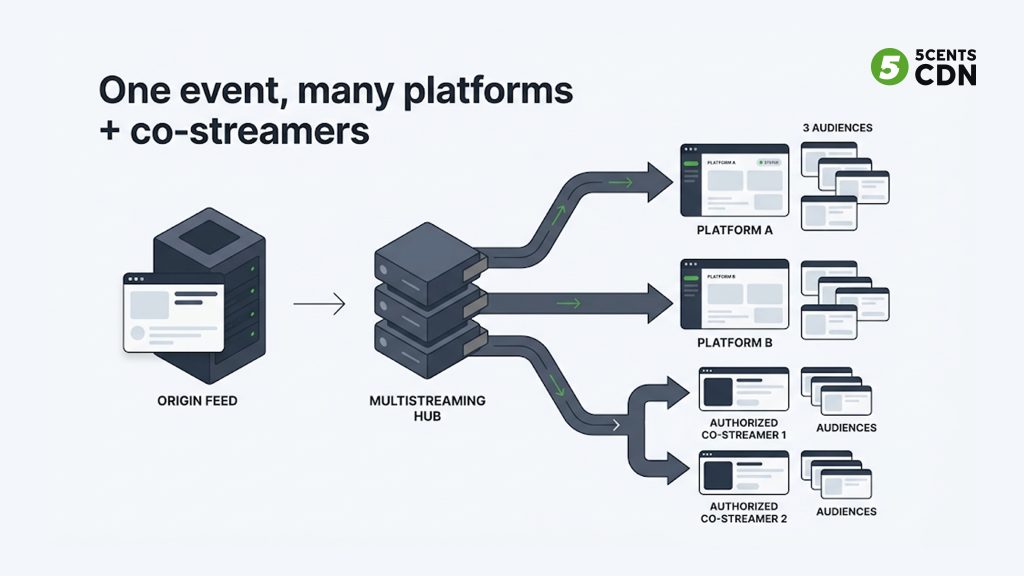
A major tournament will routinely simulcast its official feed across four or five platforms at once — different global streaming services, regional platforms, and language-specific channels — because the audience is spread across all of them and the goal is maximum reach rather than exclusivity. On top of that sits a phenomenon traditional sports has no real equivalent for: co-streaming, where independent commentators and community figures rebroadcast the event live to their own audiences with their own reactions layered on. These co-streams frequently draw more combined viewership than the official broadcast itself, effectively turning the event’s distribution into a many-to-many network rather than a one-to-many broadcast.
For infrastructure, this multiplies the delivery problem. You are not producing one output stream; you are producing a feed that must be distributed to many destinations reliably and in sync, often in multiple language variants, sometimes with different overlays per region. This is precisely where multistreaming becomes core rather than optional — the ability to take a single source and push it to many platforms simultaneously without running a separate production for each. And because official feeds and authorized co-stream partners may all pull from the same origin, the delivery layer has to serve that fan-out efficiently, which brings the shared concurrency-and-caching techniques into play but at a wider distribution surface than a single-destination sports broadcast ever faces. Handling many parallel outputs cleanly, rather than a single high-stakes feed, is the esports distribution signature.
Co-streaming also introduces a rights nuance traditional sports handles very differently. Where premium sports guards its feed and prosecutes unauthorized rebroadcast aggressively, most esports rights-holders actively *encourage* authorized co-streaming as a growth engine, providing official co-stream programs with rules about delay, branding, and monetization. That turns what would be piracy in the sports world into a sanctioned distribution channel — but it still has to be managed. The organizer typically wants official co-streamers pulling a clean, reliable feed while genuinely unauthorized restreams are discouraged, which means the delivery setup has to support broad, encouraged fan-out to approved partners without simply leaving the stream wide open. It is a middle path between the locked-down sports model and a total free-for-all, and the delivery layer has to accommodate that deliberately permissive-but-managed posture rather than defaulting to either extreme.
Difference 3: Interactivity Is the Product, Not a Feature
In traditional sports broadcasting, interactivity is a recent bolt-on — a social-media hashtag, an occasional poll. In esports, it was there from the beginning and it is central to why people watch. The culture grew up on platforms built around a live chat running beside the stream, where the audience talks to each other and to the casters in real time, and that expectation now defines the format.
The infrastructure implication is that latency carries a heavier burden in esports than the raw viewing experience alone would demand. When the audience is reacting in a chat that everyone can see, and when prediction markets, live polls, and real-time stat overlays are part of the broadcast, the video and the interaction have to stay closely aligned — a stream that lags far behind the interaction layer breaks the experience, because viewers see reactions to a play before the play reaches their screen.
This pushes esports toward the lower-latency end of the delivery spectrum for its interactive tiers, using low-latency HLS and DASH to keep the gap between the action and the conversation small. Genuinely sub-second, fully interactive scenarios use approaches like WebRTC, typically in a hybrid design that reserves the ultra-low-latency path for the most interactive contexts while low-latency HLS carries the mass audience — the same tiering logic that governs large live events generally. The point specific to esports is that the interaction layer is not optional garnish; it is a primary design constraint that makes latency discipline non-negotiable.
Difference 4: Free, Ad-Supported, and Global by Default
The business model behind an esports broadcast is usually the inverse of premium sports, and that inverts several infrastructure priorities too.
Premium sports rights are expensive, exclusive, and defended with heavy digital rights management, paywalls, geo-blocking, and blackout enforcement — the infrastructure spends real effort ensuring only authorized, paying, in-region viewers can watch. Most esports, by contrast, is free to watch, funded by advertising and sponsorship rather than subscriptions or pay-per-view, and deliberately available everywhere rather than locked by territory.
That difference redraws the priority list. The elaborate rights-enforcement layer that dominates premium sports delivery is generally lighter for esports; the emphasis shifts instead toward monetization that works at scale on a free stream, which means server-side ad insertion that stitches ads cleanly into the broadcast without giving viewers a buffering seam or something an ad-blocker can strip out. Delivering ads reliably into a free, massive, global live stream is its own discipline, and ad insertion at the server side is how esports broadcasts monetize without degrading the experience that keeps the audience there.
Being global-by-default rather than territory-locked also changes delivery geography. Instead of provisioning heavily for one national market as a rights-holder might, an esports broadcast has to deliver consistent quality across every region at once, with particular attention to the mobile-heavy, latency-variable networks of the regions where competitive gaming is largest. That is a broad, even distribution-of-capacity problem rather than a concentrated one.
Difference 5: Mobile-First Viewing Changes the Ladder
Traditional sports streaming still skews toward large screens — televisions, set-top boxes, living-room devices. A very large share of esports viewing, especially in the fastest-growing markets, happens on phones over cellular networks. That shifts how you design the delivery for quality.
A mobile-first, cellular-heavy audience means the adaptive bitrate ladder has to be built with genuinely capable lower rungs, not treated as an afterthought below the high-quality profiles, because a meaningful fraction of your audience will spend most of the broadcast on those lower renditions as their connection fluctuates. It also raises the value of efficient encoding and of getting delivery capacity close to mobile viewers in regions where the fixed-line internet is not the primary path. Thoughtful live transcoding that produces a ladder suited to a mobile, variable-network audience — rather than one optimized for living-room fiber — is what keeps the stream watchable for the viewer on a train in a dense mobile market, who may well be the median esports viewer rather than an edge case.
Difference 6: The Viewing Experience Is Multi-Stream and Second-Screen
There is one more esports-specific pattern that shapes delivery, and it follows from the game-engine source and the interaction culture together: esports viewers frequently watch more than one stream at once, and they watch differently from a lean-back sports audience.
Because a match generates many valid viewpoints — the official broadcast, individual player POV feeds, a co-streamer’s reaction channel — a committed fan may run several of these simultaneously, the main broadcast on one screen and a favorite player’s perspective or a preferred caster on another. Tournaments increasingly lean into this with official multi-view offerings that let a viewer choose or combine angles. From a delivery standpoint, this means a single viewer can represent several concurrent streams rather than one, and it means related feeds from the same event must stay closely synchronized so that switching or combining them doesn’t produce a jarring time gap. It raises the effective concurrency per human viewer and puts a premium on tight synchronization across the family of feeds a single event produces.
The second-screen and mobile reality compounds it. A large share of the audience is watching on a phone, often for long marathon sessions, where battery life and mobile-data consumption are genuine constraints the viewer feels — constraints a living-room sports viewer never thinks about. This rewards efficient encoding and a well-designed bitrate ladder not only for playback smoothness but for respecting the viewer’s data and battery, and it reinforces why the mobile-first ladder discussed above is a first-class design concern in esports rather than a fallback. The viewer deciding whether your three-hour tournament is worth the data it burns is making a retention decision traditional broadcasters rarely have to win.
Where Esports and Sports Delivery Converge
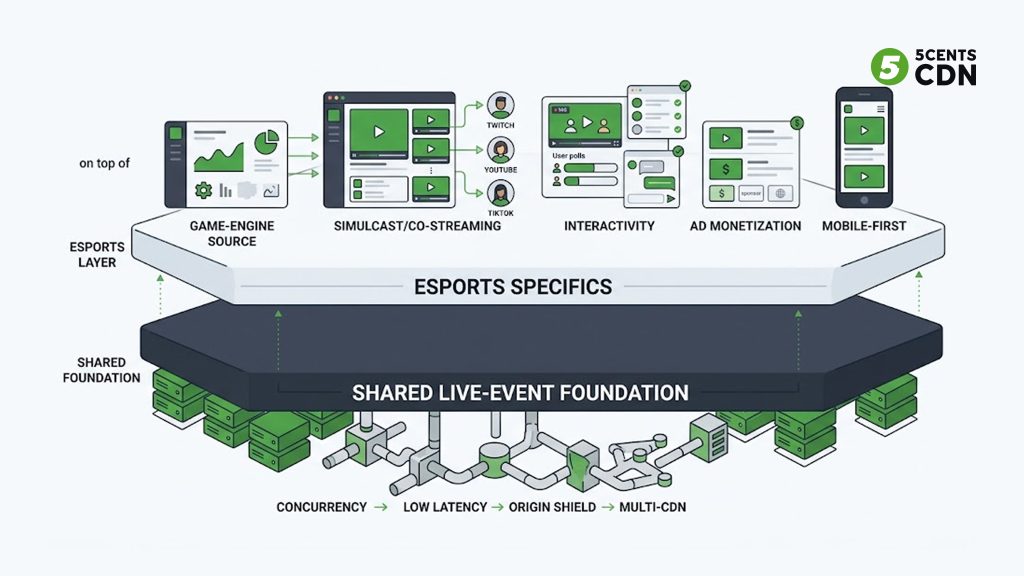
Having drawn the differences, it is worth being clear about the large shared foundation underneath them, because that is where most of the hard engineering still lives and it is the same for both. The synchronized concurrency spike when a major match starts or a decisive moment lands; the need for low-latency delivery to stay ahead of spoilers and align with the interaction layer; the tiered caching and origin shield that absorb the request storm; the multi-CDN distribution that removes the single point of failure for a marquee event; the high cache-hit ratios that keep the delivery bill sane at scale — all of this is common ground, and our live sports infrastructure guide covers it in full. An esports broadcast is, in effect, that shared live-event foundation with the esports-specific layer built on top: game-engine sourcing, multi-platform simulcast and co-streaming, interaction-driven latency discipline, free-to-air ad monetization, and mobile-first global reach.
The practical takeaway for anyone building an esports broadcast is to get the shared foundation right first — it is non-negotiable and it is where a broadcast most catastrophically fails — and then layer the esports-specific choices on top: multistreaming for the many-platform distribution, an ad-insertion path for free-to-air monetization, a latency tier tight enough for the interaction layer, and a bitrate ladder and regional footprint built for a global mobile audience.
Building an Esports Broadcast That Scales
Esports streaming rewards teams that understand it is not simply “sports streaming for games.” It shares the demanding core of any large live event — and then adds a distribution model, an interaction culture, a monetization approach, and an audience profile that each pull the infrastructure in a specific direction. Get the shared foundation of concurrency, latency, and resilient delivery right, then build the esports layer deliberately on top, and a competitive gaming broadcast can reach millions of viewers across every platform and region at once without the seams showing.
5centsCDN supports the pieces esports delivery leans on most: multistreaming to push one feed to many platforms at once, low-latency delivery and live transcoding tuned for a mobile, global audience, server-side ad insertion for free-to-air monetization, and the resilient, high-concurrency CDN foundation every large live event demands — brought together in our gaming and esports solution. If you are planning a tournament broadcast or scaling a competitive gaming platform, talk to our team about building delivery that holds up when the whole world tunes in at once.
Frequently Asked Questions
How is esports streaming different from sports streaming?
They share the same demanding live-event core (concurrency, low latency, resilient delivery), but esports adds a game-engine source, multi-platform simulcast and co-streaming, chat-driven interactivity, free ad-supported monetization, and a mobile-first global audience.
Where does an esports broadcast feed come from?
Not from stadium cameras. The primary feed is generated inside the game by an observer/spectator client that switches between player POVs and angles, composited with commentator video and overlays in production software.
What is co-streaming in esports?
Independent commentators rebroadcast an event live to their own audiences with their own reactions. Most esports rights-holders actively encourage authorized co-streaming as a growth channel, so combined co-stream viewership often exceeds the official broadcast.
Why does esports need such low latency?
Because interactivity — live chat, polls, prediction markets — is central to the experience. If the video lags behind the interaction layer, viewers see reactions before the play reaches their screen. Low-latency HLS/DASH keeps the gap small.
What infrastructure do esports broadcasts rely on most?
The shared live-event foundation (origin shield, multi-CDN, high cache-hit ratios, low latency) plus multistreaming for multi-platform distribution, server-side ad insertion for free-to-air monetization, and a mobile-first bitrate ladder for a global audience.
How many people watch major esports events?
At the top end, millions concurrently — the 2024 League of Legends World Championship peaked around 6.9 million concurrent viewers (Esports Charts), excluding the separate mainland-China audience.