

Most teams treat their CDN bill as a fixed cost of doing business — a number that arrives each month, gets approved, and disappears into the infrastructure line of the budget. That habit is expensive. A CDN contract is not a utility meter reading; it is a negotiated commercial agreement, and like any commercial agreement it can drift out of alignment with reality, accumulate charges nobody scrutinizes, and quietly renew itself into another year of overpayment. The uncomfortable truth is that a large share of CDN spend is not driven by how much content you deliver at all — it is driven by the terms you agreed to, the meters you forgot you were being billed for, and the leverage you never used at renewal.
This is a different problem from reducing how many bytes you push, and it has a different fix. You can run a perfectly efficient delivery setup and still overpay badly because your commit tier no longer matches your usage, your overage rate is punitive, you are paying for premium features you don’t touch, or an auto-renewal clause locked you in before you thought to shop around. This guide is a practical audit: how to read what you are actually being charged for, where CDN contracts hide cost, how to calculate whether you are overpaying, and how to renegotiate from a position of evidence rather than hope. It pairs naturally with the separate work of reducing the bandwidth you consume — that guide lowers the meter; this one fixes the price you pay per unit and the terms around it.
Why a CDN Bill Is No Longer Just a Bandwidth Bill
The first thing to understand is that the shape of CDN billing has changed, and most contracts have not kept pace with it. A CDN once made its money almost entirely on moving bytes, but the price of raw transit has fallen for years, turning pure delivery into a commodity. To protect their margins, providers shifted the revenue toward everything *around* delivery — the requests processed at the edge, the security features, the logging and analytics, the compute, the internal data movement. The result is that two platforms delivering the identical number of gigabytes can pay wildly different amounts depending on how many of those secondary meters are running.
This matters for an audit because it means the headline per-gigabyte rate you negotiated — the number everyone focuses on — may be a small and shrinking part of what you actually pay. Your real cost is spread across several buckets: data delivered to users, requests processed, features and security invoked, and internal transfer and operational actions like cache fills and purges. A contract that looked competitive when you signed it, focused on the bandwidth rate, can quietly become expensive as the other meters climb with your traffic. Auditing effectively means looking at all of those buckets, not just the one printed at the top of the rate card.
Step 1: Calculate Your Real Effective Rate
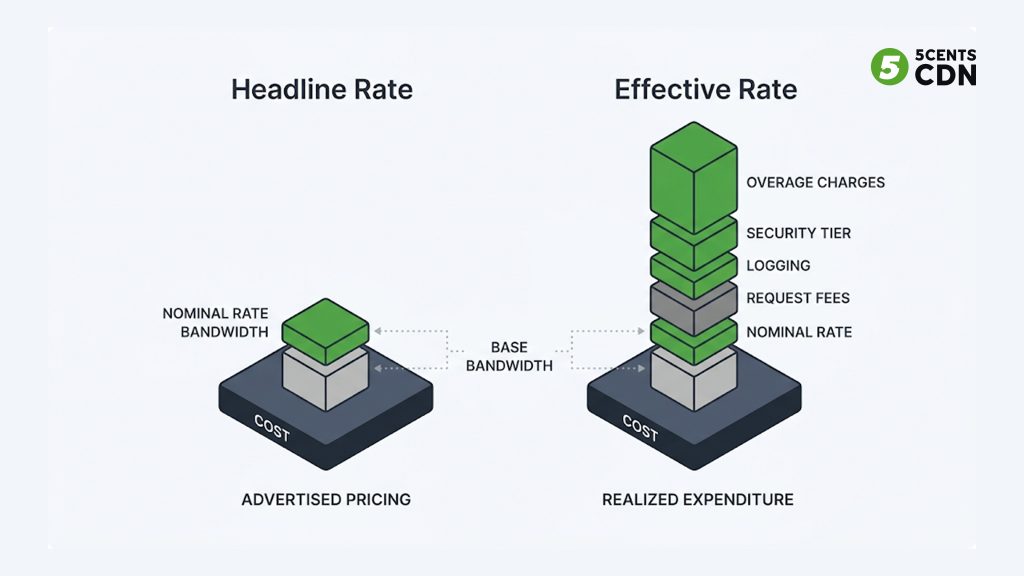
Before you can tell whether you’re overpaying, you need one number that cuts through the complexity: your effective cost per gigabyte delivered. It is simple to compute and almost nobody does it. Take your total CDN bill for a month — every line, not just the bandwidth line — and divide it by the number of gigabytes you actually delivered that month. That blended figure is what you truly pay to move a gigabyte, and it is almost always higher, often much higher, than the rate on your contract.
The gap between your headline rate and your effective rate is the first and most revealing finding of any audit. If your contract says one number and your effective rate is materially above it, the difference is being made up somewhere — in request fees, in feature charges, in overage, in regional surcharges — and that somewhere is exactly where your audit should dig.
A short illustration shows how wide that gap can quietly grow. Imagine a contract with a tidy headline bandwidth rate that looks perfectly competitive. Over the month, though, the bill also carries a request charge that turns out to be nearly as large as the bandwidth charge because the platform serves many small manifest and segment requests; a logging-and-analytics line nobody reviews; a premium security tier switched on during a past incident and never switched off; and a slice of overage billed at a steep rate after a viral week pushed traffic past the commit.
None of those individually looks alarming on the invoice, but stacked on top of the bandwidth line they can push the effective cost per gigabyte to a substantial multiple of the headline rate. The platform delivered exactly the gigabytes it planned to; it simply paid far more per gigabyte than the contract’s marquee number implied. That multiple — headline versus effective — is the single most useful figure an audit produces, because it converts a vague suspicion of overpayment into a number you can act on and negotiate against.
Modeling your expected rate against real projected volume with a cost calculator gives you a clean baseline to compare your actual bill against, and the gap between the two is your overpayment, quantified. A healthy contract keeps the effective rate close to the headline rate; a large spread is a signal that the terms have drifted away from how you actually use the service.
Step 2: Line-Item the Bill for Meters That Shouldn’t Be There
With the effective rate as your headline metric, the next step is forensic: go through the bill line by line and account for every charge, because the ones that inflate CDN spend are rarely the bandwidth line everyone expects. Several categories of charge routinely surprise teams, and each is worth hunting for specifically.
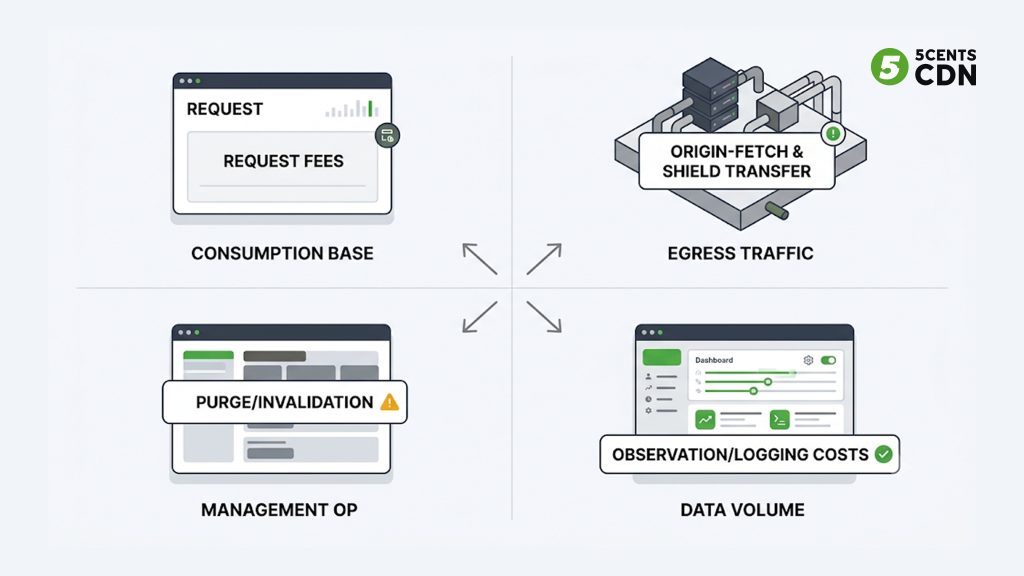
Request fees are the classic hidden driver. Many providers bill per block of requests — per ten thousand, or per million — and for a workload serving many small objects, the request meter can rival or exceed the bandwidth meter. A streaming platform is especially exposed here, because manifest files are re-requested on a tight cadence throughout every session, generating request volume out of proportion to the bytes they carry. If your request charges are a large fraction of your bill, that is a finding worth taking into a renegotiation.
Origin-fetch and shield-layer transfer charges are the next place to look. Every cache miss pulls content from your origin, which can trigger both cloud egress from your own storage and an internal transfer charge inside the CDN if a mid-tier or shield layer is involved. A single miss can become a small stack of charges, which is why a low cache-hit ratio is a financial problem and not merely a performance one. Then there are purge and invalidation fees — some providers include an allowance and bill beyond it, and an over-eager deployment pipeline that purges everything on every release can quietly rack these up. And finally, observation costs: access logs, real-time analytics, and export pipelines are frequently metered, and they scale with request volume rather than bandwidth, which means they can spike during an attack — the unwelcome experience of paying to watch someone attack you.
The discipline in this step is to ask, for each non-bandwidth line, whether the value it delivers justifies its cost and whether you even knew you were buying it. Charges for premium security tiers, advanced analytics, or edge-compute features that your team configured once and never used are pure recoverable spend. This kind of quiet, line-item overbilling — charges for things you don’t need or didn’t knowingly agree to — is exactly what a line-by-line audit is designed to surface, and it is far more common than most teams assume precisely because nobody reads the itemized bill.
Step 3: Interrogate Your Commit and Overage Terms
If your traffic is steady enough that you’ve moved onto a committed contract — promising a minimum spend or volume in exchange for a lower unit rate — then two specific terms deserve hard scrutiny, because they are where committed contracts most often turn against the customer.
The first is breakage: the money you lose when you commit to more than you use. A commit is a floor, not a cap — if you promised more volume than you actually delivered, you still pay for the full commitment, and that unused capacity is pure waste. Audits frequently find teams committed to a tier set during an optimistic growth projection that never materialized, or one that made sense before an efficiency project cut their consumption. The fix is to size your commit to your realistic baseline rather than your hoped-for peak, and to prefer quarterly or annual commitment windows over strict monthly ones if your traffic is seasonal, so unused volume in a quiet month isn’t simply forfeited.
The second is the overage rate and, more importantly, how “billable usage” is defined. Overage — what you pay above your commit — becomes dangerous when the rate jumps sharply the moment you exceed the floor, turning a modest traffic increase into a steep bill. A healthy contract keeps the overage rate close to the committed rate, a small step rather than a cliff. Just as important is the definition of what counts as billable in the first place: does it exclude documented attack traffic, or are you billed for the flood when you’re DDoSed? Are internal cache-fill bytes billed the same as real user delivery? Do overage rates change by region? These definitions, buried in the contract language, are where overage disputes are won or lost, and an audit that surfaces vague or unfavorable definitions has found real negotiating leverage.
Step 4: Find the Auto-Renewal and Notice Traps
Some of the most expensive contract terms have nothing to do with pricing at all — they govern how and when you’re allowed to leave, and they are engineered to keep you paying by default. The most common is the automatic renewal clause, the “evergreen” provision that silently rolls your contract into another full term unless you give written notice of non-renewal within a specific window before expiry. Miss that window — often by not knowing it exists — and you are locked in for another year at terms you might have improved, with no opportunity to shop the market or renegotiate.
The audit action here is to find your contract’s renewal date and, more importantly, its notice deadline, and to put both on a calendar with a reminder well ahead of the notice window rather than the renewal date itself. Over-lengthy notice periods — ninety days or more — are a recognized way these clauses work against customers, because the deadline to act arrives long before the renewal feels imminent. Knowing your notice date is what converts a renewal from something that happens *to* you into a scheduled decision point you control, and it is the single cheapest piece of leverage in the entire audit: a provider who knows you are aware of your renewal window, and able to walk, negotiates very differently from one who is counting on your inattention.
Step 5: Build Your Leverage Before You Negotiate
An audit that documents overpayment is only half the work; the other half is converting those findings into a better deal, and that requires leverage assembled before you ever open the conversation. Walking into a renegotiation with “we feel like we’re paying too much” achieves little. Walking in with “here is our effective rate, here is the breakage on our current commit, here are the three feature meters we don’t use, and here is our notice date” changes the dynamic entirely, because you are negotiating from documented evidence rather than sentiment.
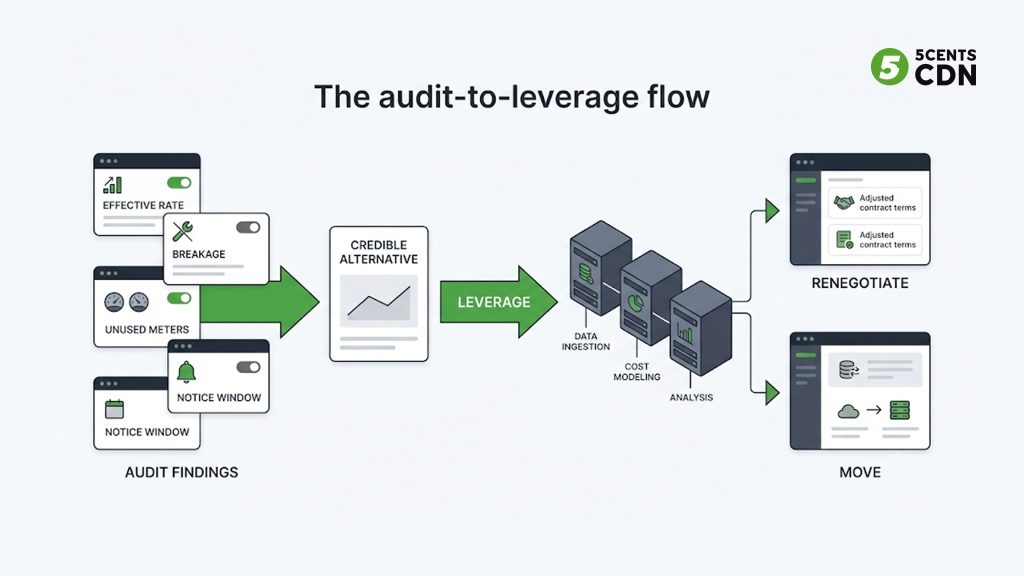
Timing is the other half of leverage. The strongest moment to renegotiate is when you hold something the provider wants to protect or something they fear losing: an approaching renewal, a documented increase in your volume (which makes you a bigger account worth keeping), or a credible competing offer. Providers rarely improve terms proactively — improvement almost always follows the customer initiating from a position of readiness. This is also where the option to move becomes valuable even if you would prefer to stay: a provider negotiates far more seriously with a customer who has genuinely evaluated alternatives and is prepared to migrate without downtime than with one who is visibly locked in. The credible ability to leave is itself the leverage, whether or not you ever exercise it.
When you do negotiate, focus the asks on the findings your audit produced: an overage rate close to your commit rate with a written example of how a month above commit is priced, a commitment tier sized to your real baseline with a ramp or seasonal buckets, billable-usage definitions that exclude attack traffic, removal of feature charges you don’t use, and a renewal cap that limits how much the price can rise. Each of these traces directly back to something the audit found, which is what makes them defensible at the table.
Step 6: Decide Whether to Renegotiate or Move
An audit produces one of two conclusions, and it’s worth being honest about which you’re in. Either your provider is fundamentally competitive and the problem is misaligned terms that a renegotiation can fix — in which case the evidence you’ve assembled should produce a materially better deal — or the provider’s underlying economics simply don’t match the market at your volume, and no amount of renegotiation closes the gap. The audit is what lets you tell these apart, because it replaces a vague sense of dissatisfaction with concrete numbers you can compare against alternatives.
If the conclusion is that the terms can be fixed, renegotiate from your documented position and lock in the improvements. If the conclusion is that the relationship is structurally overpriced, the audit has already done the hard work of preparing you to move — you know your real usage profile, your effective rate, your feature requirements, and your notice window, which is exactly the information a clean migration needs. Either way, the audit converts a passive, recurring overpayment into an active decision, and that shift is the entire point. A bill you interrogate is a bill you control.
A CDN Contract Audit Checklist
Pulling the audit into a repeatable sequence: calculate your true effective cost per gigabyte from the total bill, not the bandwidth line; compare it against a modeled baseline to quantify the gap; line-item every non-bandwidth charge and flag request fees, origin-fetch and shield transfer, purge fees, and metered logging or analytics; identify any premium features or security tiers you pay for but don’t use; check your commit tier against your real delivered volume and quantify breakage.
Scrutinize your overage rate and the written definition of billable usage, especially the treatment of attack traffic; locate your renewal date and, critically, your notice deadline, and calendar a reminder ahead of the notice window; assemble your findings and a credible alternative into negotiating leverage; and time the conversation to a renewal, a volume increase, or a competing offer. Each item turns a place contracts hide cost into a documented finding you can act on.
Stop Paying for Terms You Never Chose
A CDN contract left unexamined tends to drift in exactly one direction: toward the provider’s favor, through meters that climb unnoticed, commitments that no longer fit, and clauses that renew themselves. None of that is inevitable, and none of it requires you to change a single thing about how you deliver content. It requires only that you treat the contract as what it is — a negotiable commercial agreement — and audit it with the same rigor you’d apply to any significant line in your budget. Calculate your effective rate, hunt the hidden meters, right-size your commit, defuse the auto-renewal, and negotiate from evidence. The savings from that work are often larger, and always faster to realize, than an equivalent effort spent squeezing bytes out of your delivery.
If your audit suggests your current terms have drifted out of line with the market, 5centsCDN offers transparent, usage-based CDN pricing with no hidden meters to reverse-engineer, a bandwidth calculator so you can model your real spend before you commit rather than discover it on an invoice, and a purpose-built video CDN priced for the way streaming actually consumes delivery. When you want to see what your traffic would cost without the surprises, talk to our team.
Frequently Asked Question
How do I know if my CDN is overcharging me?
Calculate your effective cost per gigabyte (total bill divided by GB delivered) and compare it to your contract’s headline rate. A large gap means hidden meters — request fees, logging, unused features, overage — are inflating your real cost.
What are the hidden fees in a CDN contract?
Common ones are request fees (per block of requests), origin-fetch and shield-layer transfer on cache misses, cache purge/invalidation charges, and metered logging or analytics that scale with request volume — plus premium feature and security tiers you may not use.
What is breakage in a CDN commit contract?
Breakage is what you pay for committed volume you don’t actually use. A commit is a floor, not a cap, so if you committed above your real usage you still pay the full amount. Size the commit to your realistic baseline, not your hoped-for peak.
How do I avoid CDN auto-renewal lock-in?
Find your contract’s renewal date and, more importantly, its notice deadline (often 30–90 days before expiry). Calendar a reminder ahead of the notice window so renewal becomes a decision you control rather than one that happens by default.
When is the best time to renegotiate a CDN contract?
When you hold leverage: an approaching renewal, a documented volume increase, or a credible competing offer. Providers rarely improve terms proactively, so initiate from documented audit findings rather than a general sense of overpaying.
Is auditing my contract different from reducing bandwidth?
Yes. Reducing bandwidth lowers how many units you’re billed for; a contract audit fixes the price per unit and the terms around it. They’re complementary — you can be efficient on usage and still overpay on terms.