

For most of the last decade, the default answer to “where should our streaming infrastructure live?” was “the public cloud.” Spin up compute, storage, and delivery on a hyperscaler, enjoy infinite scalability, and never think about hardware again. That orthodoxy is now cracking, and streaming is at the center of the crack — because the one thing the public cloud charges most punishingly for, moving data out, is the one thing a streaming business does more than almost anyone. Every stream delivered, every file served, every byte that leaves the cloud is metered, and for a video platform at scale those egress fees quietly become one of the largest and least predictable lines on the bill. Cloud repatriation streaming is emerging as one response to that cost pressure, particularly for high-volume delivery workloads.
The industry’s response has a name: cloud repatriation — selectively moving workloads off hyperscalers and onto dedicated, colocated, or specialist infrastructure where the economics make more sense. It is one of the defining infrastructure stories of 2026, and it is widely misunderstood as “leaving the cloud,” which it mostly isn’t. This guide explains what cloud repatriation actually is for a streaming operator, why video’s egress problem makes it such a strong candidate, how to tell which workloads should move and which should stay, and why the pragmatic destination for most teams is a hybrid model rather than a wholesale exit. This is an architecture-and-economics discussion about where your delivery and storage should run; it’s the companion to the question of how to reduce what you consume, which our guide to reducing CDN bandwidth costs covers.
The Egress Trap: Why Streaming Breaks Public-Cloud Economics
To understand why repatriation hits streaming so hard, you have to understand egress — the single most important and least-budgeted cost in cloud video.
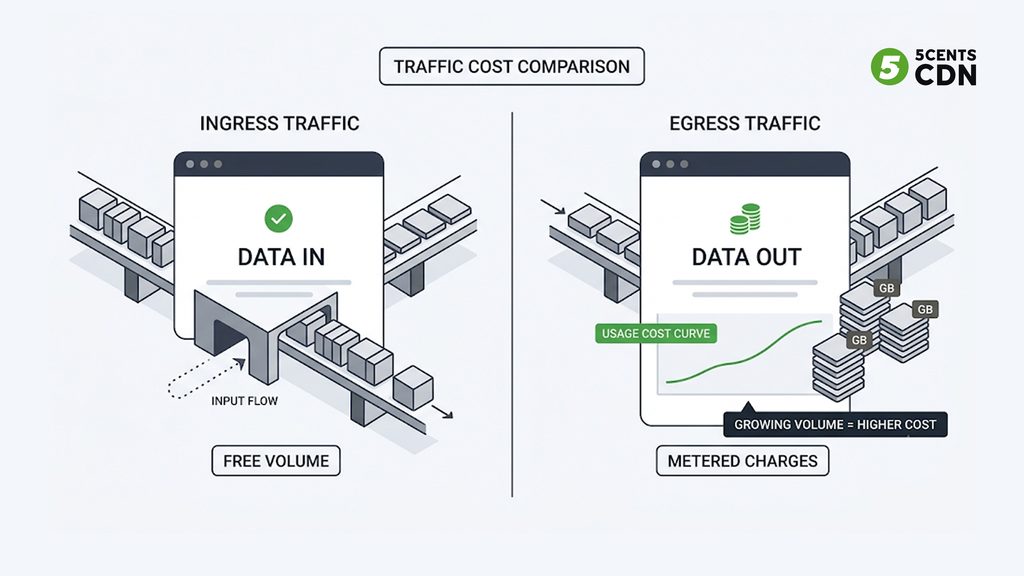
In cloud computing pricing, “egress” means data leaving the provider’s network, and it is billed per gigabyte. The asymmetry is the heart of the problem: getting data *into* the cloud is almost always free, while getting it *out* — to viewers, to another cloud, sometimes even between the provider’s own regions — is charged, and charged at rates far above what bandwidth actually costs wholesale. The headline hyperscaler rates sit around nine cents per gigabyte for the first tier of internet egress, with the major providers clustered in a similar band. Nine cents a gigabyte sounds trivial until you remember what video is: a single hour of HD streaming can move several gigabytes per viewer, so a service delivering to a large audience is pushing petabytes a month, and at per-gigabyte egress rates that becomes an enormous, recurring, usage-coupled bill.
This is why streaming breaks the cloud’s economic model in a way that a typical web application doesn’t. The public cloud’s pricing is designed for workloads that are *bursty and unpredictable* — where you pay a premium for elasticity you genuinely need. But a streaming platform’s delivery is the opposite: it’s high-volume, continuous, and relatively predictable, running at roughly the same substantial level every day. Paying elastic-premium egress rates for a steady, forecastable torrent of data is paying for flexibility you aren’t using. And because the bill scales directly with how much you deliver, success makes it worse — the more your audience grows, the more punishing the egress line becomes, turning your own growth into a cost problem. That dynamic, more than any other, is what’s driving streaming operators to ask whether all of their delivery really needs to live on a hyperscaler. The uncomfortable realization for many teams is that they adopted the cloud for its elasticity — the ability to scale instantly for unpredictable demand — but their delivery is the least elastic part of their whole operation, running at a high, steady baseline that never really benefits from the on-demand flexibility they’re paying a premium for.
A quick worked example
A rough illustration makes the scale concrete. Imagine a streaming service delivering one petabyte of video a month — a realistic figure for a mid-sized platform with a steady audience. At a representative internet-egress rate of around nine cents per gigabyte, that one petabyte of delivery is roughly ninety thousand dollars in egress fees in a single month, for the data transfer alone, before compute, storage, or anything else. The same volume delivered over infrastructure that charges a flat, predictable bandwidth rate rather than per-gigabyte egress typically costs a fraction of that — and, just as importantly, it costs the *same* fraction next month whether the audience holds steady or spikes. The exact numbers vary with provider, region, and volume tier, and tiered pricing softens the hyperscaler figure somewhat at scale, but the order-of-magnitude gap is the point: for pure, high-volume delivery, per-gigabyte egress is simply the wrong pricing model, and the difference compounds every single month. This is why delivery is almost always the first and clearest workload a streaming operator repatriates — it’s the place where the economics are most lopsided and the saving is largest and most immediate. (The same cost-predictability logic underlies a thorough review of your delivery agreements, which our guide to auditing your CDN contract walks through.)
Cloud Repatriation Is Not “Leaving the Cloud”
Before going further, it’s essential to correct the biggest misconception, because it’s the one that makes operators either dismiss repatriation as extreme or attempt it too aggressively. Cloud repatriation is not a wholesale exit from the cloud. It is a selective, workload-by-workload rebalancing.
The mature 2026 understanding is that repatriation is a portfolio decision, not a verdict on the cloud. Almost no one is deleting their cloud accounts and going fully on-premises; the small fraction attempting complete exits are the exception. What’s actually happening is that organizations are examining their workloads one at a time and moving the specific ones where owned or specialist infrastructure clearly wins — typically the steady, high-volume, predictable workloads — while keeping on the hyperscaler the things it’s genuinely good at: orchestration, identity, managed control planes, and the burst-heavy or variable workloads where elasticity earns its premium. The result is almost always a hybrid footprint rather than a clean break. Framed correctly, repatriation isn’t a rejection of cloud computing; it’s the maturing of it — a shift from “cloud at all costs” to “cloud where it makes sense, owned infrastructure where that makes sense.” For a streaming operator, that reframing matters because it means you don’t face an all-or-nothing choice: you can move the delivery and storage that are bleeding egress fees while leaving everything else exactly where it is.
Which Streaming Workloads Should Move — and Which Shouldn’t
The entire discipline of repatriation is deciding, workload by workload, what belongs where. For streaming, the sorting is clearer than in most industries because the cost driver — egress — is so concentrated. A few principles make the call.
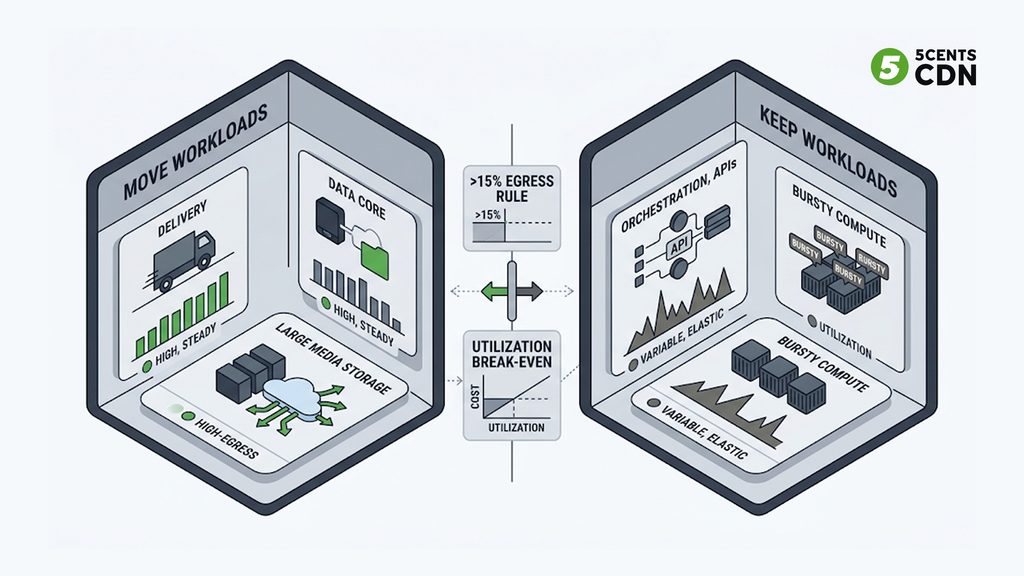
The strongest candidates to move are the high-egress, steady-state workloads: content delivery itself and the storage of large, frequently-served libraries. Delivery is the obvious one — it’s pure egress, it’s continuous, and it’s where the hyperscaler meter runs hardest, so serving it from infrastructure with predictable, flat bandwidth pricing instead of per-gigabyte egress is where the biggest, most reliable savings live. Large media storage is the next candidate, because a growing video archive accrues both storage fees and egress every time something is retrieved, and bulk storage on dedicated infrastructure is dramatically cheaper per terabyte. A useful rule of thumb that recurs across the industry: if egress is running at more than roughly 15% of a workload’s total cloud spend, that workload is a candidate for architectural review — and for streaming delivery, egress is often the *majority* of the bill, which makes it the clearest candidate there is.
What should usually stay are the burst-heavy and control-plane workloads. Genuinely spiky compute — the kind that scales from a handful of instances to many for unpredictable periods, like a sudden viral event or an irregular transcoding surge — is exactly what the hyperscaler’s elastic model prices well, and trying to own capacity for a rare peak wastes money the other way. Orchestration, APIs, identity, and managed services that you’d have to rebuild and operate yourself often aren’t worth repatriating unless they’re a significant cost. The honest framing is a break-even one: dedicated infrastructure wins decisively for high, steady utilization, while the hyperscaler wins for low or erratic utilization where you’d otherwise be paying for idle owned capacity. Streaming delivery sits firmly on the “move it” side of that line precisely because it is high and steady; much of the surrounding application may sit on the “keep it” side.
The Pragmatic Answer: Hybrid Edge
Put those principles together and you arrive at where most serious streaming operators are actually landing, which is neither pure cloud nor pure on-premises but a deliberate hybrid: keep the cloud for what it’s good at, and move the bandwidth-heavy delivery and storage to infrastructure built for it.
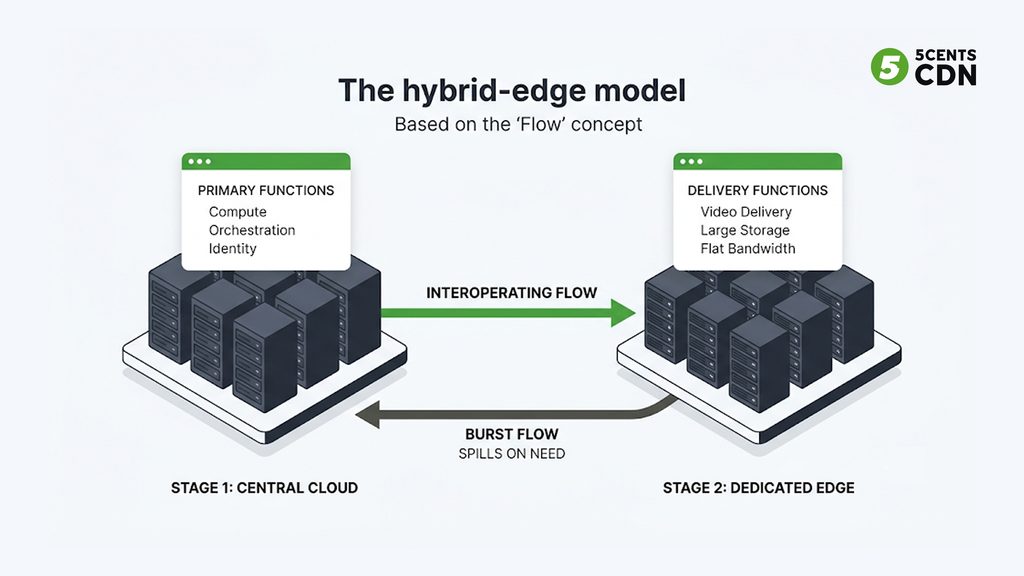
In practice this looks like keeping compute, orchestration, and control-plane services in the cloud — where their flexibility and managed convenience are worth paying for — while serving the large, high-volume assets (the video itself) from dedicated delivery infrastructure that charges predictable, flat bandwidth rates rather than per-gigabyte egress. You remove the cloud egress charge from your single largest payload while keeping the cloud for everything it does well. Burst capacity can still spill back to the hyperscaler when a genuine spike exceeds your baseline, so you pay the elastic premium only in the moments you actually need elasticity, not continuously. This is the model the industry increasingly calls hybrid edge, and its logic is simple: match each workload to the infrastructure whose pricing model fits its behavior. Steady, heavy, predictable delivery goes where bandwidth is cheap and flat; variable, bursty, convenience-driven compute stays where elasticity is cheap. A content delivery network is the natural home for the delivery half of that split — it exists precisely to serve high-volume video efficiently, at flat and predictable rates, which is the exact economic profile that hyperscaler egress fails. Pairing cloud orchestration with CDN-based delivery is, for many streaming operators, the whole repatriation move in a single step.
It’s Also About Predictability and Control — Not Only the Total
While cost is the headline driver, it’s worth being clear that the deeper appeal of repatriation is often predictability as much as the absolute number, because an unpredictable bill is its own operational problem.
Hyperscaler billing is usage-coupled across many meters — egress, requests, inter-region transfer, storage tiers, operations — so your bill moves with viewer behavior in ways that are genuinely hard to forecast, which turns capacity planning and budgeting into guesswork and makes a viral success a financial surprise rather than only a happy one. Moving steady-state delivery to flat, predictable pricing converts that variable, unforecastable OpEx into a fixed, plannable cost — and for a business trying to run healthy margins rather than chase growth at any cost, predictability has real value on its own. There’s a second, related benefit: reducing dependence on a single provider. When your delivery is wholly inside one hyperscaler, the cost of leaving — dominated by the egress fee to extract your own data — is itself a form of vendor lock-in, the uncomfortable situation where the provider’s pricing both costs you now and penalizes you for leaving. Distributing delivery onto independent infrastructure restores negotiating leverage and architectural freedom. None of this means abandoning the cloud’s genuine strengths; it means not being captive to one provider’s meter for the part of your operation that runs hardest.
Doing It Right: Repatriation Without Disruption
Repatriation delivers its savings only if it’s executed carefully, because migrating live video infrastructure carries real risk if it’s rushed, and a botched move can cost more than the fees it was meant to save.
A few disciplines keep it safe. Start by pricing the move honestly, including the one-time egress cost to extract your existing data from the cloud — for a large archive that exit fee can itself run into real money, and it has to be weighed against the ongoing savings to know the true payback period. Move selectively and incrementally rather than all at once: shift the clearest-win workload first — usually delivery — prove the savings and the stability, then decide what else follows, keeping everything else in place. Design for hybrid from the start so the cloud and the dedicated infrastructure interoperate cleanly, rather than treating it as a bridge to a full exit you may never want. And treat the transition like any critical migration, with parallel running and the ability to fall back, since this is live infrastructure serving real viewers. Done this way, repatriation is low-risk and reversible at each step; done as a rushed big-bang exit, it carries exactly the kind of risk that gives the idea a bad name. The goal is a better-matched, more predictable cost structure, not a heroic infrastructure project.
A Repatriation Decision Checklist
Pulling it together, a streaming operator weighing repatriation can work through this sequence: identify your highest-egress workloads and confirm whether egress exceeds roughly 15% of their cloud spend (for delivery, it usually far exceeds it); separate steady, high-volume, predictable workloads — candidates to move — from bursty, variable, or control-plane workloads that are better left on the hyperscaler; model the destination economics, comparing per-gigabyte egress against flat, predictable delivery pricing at your real volume; price the one-time egress exit cost of any data you’d migrate and calculate the payback period; plan a hybrid architecture that keeps cloud orchestration while moving delivery and heavy storage to dedicated or CDN infrastructure, with burst capacity still able to spill to the cloud; move the clearest win first and prove it before going further; and treat the whole thing as a careful, reversible, workload-by-workload migration rather than a wholesale exit. Each step keeps the decision grounded in economics rather than ideology.
Match the Workload to the Right Home
The cloud-first era answered “where should it run?” with “the cloud, always.” The 2026 answer is more mature and more profitable: run each workload where its economics fit. For most of a streaming operation that still means the cloud — for the orchestration, the control plane, and the genuinely bursty compute the hyperscaler prices so well. But for the one part of streaming that runs hardest and costs most, the continuous, high-volume delivery of video to viewers, the hyperscaler’s egress meter is simply the wrong pricing model, and moving that workload to flat, predictable delivery infrastructure is one of the highest-leverage cost decisions a streaming business can make. Repatriation, understood correctly, isn’t a retreat from the cloud — it’s putting your heaviest workload where it was always going to be cheapest to serve.
5centsCDN is built to be exactly that home for the delivery half of a hybrid architecture: high-volume video delivery over a purpose-built CDN at flat, predictable rates instead of per-gigabyte egress, durable cloud storage for growing media libraries at a fraction of hyperscaler retrieval economics, and transparent pricing you can model against your real volume with a bandwidth calculator rather than discover on an invoice — sitting alongside whatever cloud orchestration you keep. If your egress bill has grown faster than your revenue and you want to move delivery onto infrastructure priced for how streaming actually behaves, talk to our team about where repatriation would pay off for you.
Frequently Asked Questions
What is cloud repatriation?
Selectively moving workloads off public-cloud hyperscalers onto dedicated, colocated, or specialist infrastructure where the economics fit better. It’s a workload-by-workload rebalancing, not a wholesale exit from the cloud — most teams end up hybrid.
Why does cloud repatriation matter so much for streaming?
Because streaming’s biggest cost is egress (data leaving the cloud), billed per gigabyte, and video moves enormous, steady volumes. Hyperscaler pricing rewards bursty, unpredictable workloads; continuous high-volume delivery is the opposite, so it’s the worst fit for egress pricing.
What are cloud egress fees?
Per-gigabyte charges for data leaving a cloud provider’s network (to viewers, another cloud, or sometimes between regions). Getting data in is usually free; getting it out is billed, at rates well above wholesale bandwidth — often the majority of a streaming platform’s bill.
Which streaming workloads should be repatriated?
The high-egress, steady-state ones: content delivery first, then large media storage. A rule of thumb: if egress exceeds ~15% of a workload’s cloud spend, review it. Bursty compute and control-plane services usually stay on the hyperscaler.
Does cloud repatriation mean leaving the cloud entirely?
No. It’s selective and almost always results in a hybrid model: keep the cloud for orchestration and bursty compute, move high-volume delivery and storage to flat-rate infrastructure. Full cloud exits are rare.
What is the hybrid-edge model?
Keeping compute and orchestration in the cloud while serving large, high-volume assets (video) from dedicated or CDN infrastructure at flat, predictable rates, with burst capacity able to spill back to the cloud only when genuinely needed.