

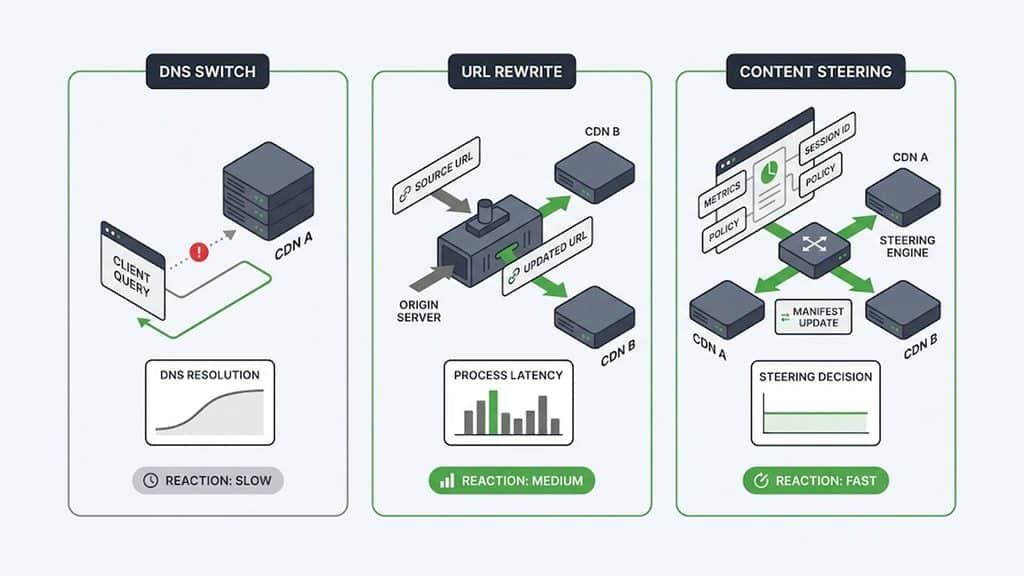
For years, switching a viewer from one CDN to another meant one of two blunt instruments: change a DNS record and wait for caches to expire, or write client-side code that catches an error and rewrites segment URLs by hand. Both work, after a fashion, and both are the reason multi-CDN earned a reputation for being fiddly and slow to react. Content steering is the standards-based approach designed to make that switching more responsive. Neither DNS nor the error-catch hack can smoothly move a whole cohort of players from a degrading CDN to a healthy one, mid-stream, before anyone buffers.
Content steering is the standards-based mechanism that replaces both. It moves the CDN-selection decision into the manifest layer where the player already lives, lets a small server hand players an ordered list of which CDN to use, and refreshes that decision on a schedule throughout playback — so you can redirect viewers in seconds, during an active session, regardless of DNS cache state. Paired with CMCD, the standard way players report their real playback experience back upstream, content steering turns multi-CDN from a static split into a live, quality-aware control loop. This guide explains exactly how both work: the tags, the steering server, the JSON manifest that drives the decision, how players implement it, and how the telemetry closes the loop. It assumes you already understand why you’d run multiple CDNs — our guide to multi-CDN covers the architecture and the case for it — and focuses on the mechanism that makes the switching actually work.
Why DNS Failover Wasn’t Enough
To see what content steering fixes, it helps to be precise about the limits of what came before, because those limits are exactly what the standard was designed around.
DNS-based steering decides which CDN a viewer uses at the moment their device resolves your streaming hostname. It’s simple and requires no player changes, which is why it’s everywhere. But its reaction speed is governed by DNS caching: you set a time-to-live on the record, and resolvers are *supposed* to re-resolve after it expires — except many resolvers and clients ignore low TTLs and hold the old answer far longer, sometimes for minutes to hours. So when a CDN starts degrading mid-event, DNS steering can’t promptly move the viewers already watching; they stay pinned to the failing network until their resolver happens to look again. DNS is a fine tool for broad geographic routing and percentage splits decided at the start of a session, and a poor one for reacting to something going wrong during it.
The other old approach — client-side URL rewriting — lives in the player’s error handler: when a segment fails, catch the error, swap the hostname from CDN A to CDN B, and reload. It reacts faster than DNS, but it’s a hack in the literal sense: every player needs custom, fragile code; it typically only triggers *after* a failure the viewer may already have felt; and moving a coordinated group of players, or adding a brand-new CDN to the mix, means shipping new client code. What the industry needed was a standard way to make the routing decision continuously, centrally, and at the manifest layer the player already understands — without custom per-player hacks and without waiting on DNS. That standard is content steering.
What Content Steering Is
Content steering is a mechanism, defined in the streaming standards themselves, that lets a server tell players which of several CDNs to fetch content from, and update that instruction throughout playback. It is specified by Apple for HLS and by DASH-IF and ETSI for DASH, with a shared IETF specification describing the common structure — which means it is not a vendor’s proprietary trick but an interoperable standard that modern players support out of the box.
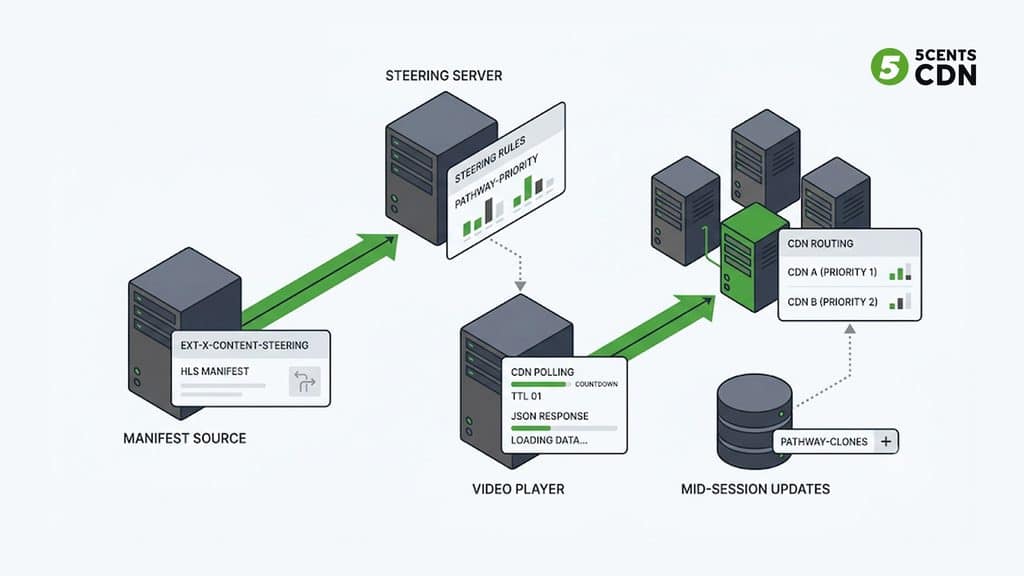
The core idea is simple. Your manifest advertises the same content available through more than one CDN, each identified by a label. The manifest also points at a small remote service called the steering server. As the player plays, it periodically asks the steering server a single question — “which CDN should I use right now?” — and the server answers with an ordered priority list. The player fetches segments from the highest-priority CDN it’s told to use, and because it re-asks on a schedule, the server can change that answer at any time and the whole population of players will follow within one refresh cycle. The decision lives on the server, centrally, where you can drive it from live performance data; the players simply obey the current instruction. That separation — players that ask, a server that decides — is the whole elegance of it.
How It Works in HLS and DASH
The two major streaming formats implement the same concept with their own syntax, and one steering server can drive both. Understanding the pieces makes the mechanism concrete.
The steering tag in the manifest
In HLS, the multi-variant playlist carries an EXT-X-CONTENT-STEERING tag that names the steering server’s address and the initial CDN to use before the first steering response arrives. Each variant stream in the playlist is tagged with a PATHWAY-ID — a label naming which CDN that variant belongs to, such as cdn-a or cdn-b. In practice you publish your variants twice, once per CDN, each set tagged with its own pathway. DASH expresses the identical idea in its XML manifest, the Media Presentation Description, using a <ContentSteering> element and identifying each CDN by a serviceLocation. The concepts map one to one: HLS’s PATHWAY-ID is DASH’s serviceLocation, and the steering tag points at the same kind of server in both. This is why a single steering strategy can cover an HLS and a DASH stack at once.
The steering manifest — the JSON that decides
When the player contacts the steering server, it gets back a small JSON document called the steering manifest. Its job is to carry two essential things: an ordered priority list of the CDN pathways — telling the player which to prefer, which to fall back to — and a TTL that tells the player how long to wait before asking again, typically on the order of 60 to 300 seconds. That’s the heartbeat of the system: every TTL interval, each player re-fetches the steering manifest and re-orders its CDN preference to match the latest instruction. To move every viewer off a degrading CDN, you change the priority order in the steering manifest, and within one TTL cycle the player population migrates — no DNS wait, no client redeployment, no per-player error handling. The steering manifest is deliberately tiny and is fetched on a cadence decoupled from the media manifest, so this control loop adds negligible overhead.
Pathway cloning: adding a CDN mid-session
One particularly useful capability is pathway cloning. Using PATHWAY-CLONES in the steering manifest, the steering server can introduce a CDN the original manifest never listed — defining a new pathway by cloning an existing one and substituting the new CDN’s host — without the player ever rebuilding its manifest. In practice this means you can bring a fresh CDN into rotation during a live event, perhaps to add emergency capacity or route around a provider having a bad day, and steer live viewers onto it on the fly. It’s the difference between a multi-CDN setup that’s fixed at stream start and one you can reconfigure while the stream is running.
Player support
None of this requires exotic clients. Content steering is supported in the major web playback libraries — hls.js implemented it from version 1.5 onward, dash.js supports the equivalent via service locations and CDN priority, and Video.js’s streaming engine reads the steering tags and polls the steering manifest the same way — as well as in modern native and smart-TV players. Because the popular frameworks handle it internally, enabling content steering is largely a matter of authoring the manifests and standing up the steering server, not rewriting your players.
Closing the Loop: CMCD Makes Steering Quality-Aware
A steering server that just rotates CDNs on a fixed schedule is useful, but the real power comes when its decisions are driven by how playback is *actually* going for real viewers. That requires the players to report their experience back upstream, and the standard way they do that is CMCD.
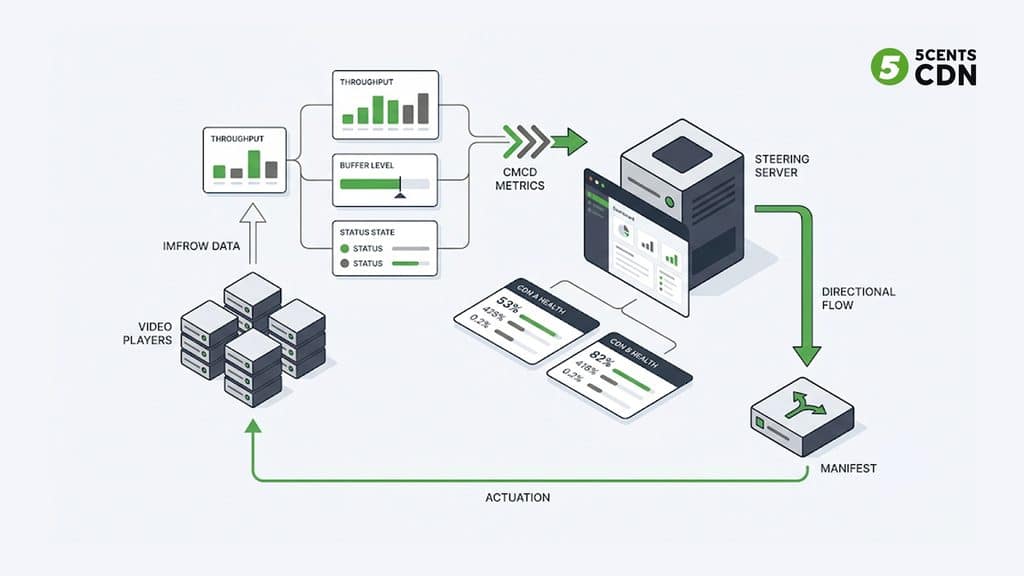
CMCD — Common Media Client Data, the CTA-5004 standard, now in its version 2 revision — defines a common vocabulary for a player to attach information about itself to each media request it makes. With CMCD enabled, every segment request a player sends can carry data such as its measured throughput, its current buffer length, the player’s state (starting, playing, rebuffering), and a session identifier — sent as an HTTP request header (the preferred method) or, with care around cache keys, as a query parameter. Before CMCD, each CDN and player reported performance in its own incompatible format; CMCD makes that telemetry standardized and interoperable across the whole delivery chain.
For content steering, CMCD is the sensing half of the control loop. A steering server receiving CMCD-style telemetry from the player population can see, in near real time, which CDNs are delivering healthy throughput and full buffers to which regions and networks — and which are starting to struggle. Instead of steering blindly on a timer or on coarse server-side health checks, it can make the decision from the viewers’ own outside-in view of each CDN’s performance, then express that decision in the next steering manifest. The players report how it’s going through CMCD; the steering server decides who goes where; the steering manifest carries the instruction back; the players move. That closed loop — measure with CMCD, decide at the steering server, actuate through the steering manifest — is what turns multi-CDN from a static redundancy arrangement into a genuinely quality-aware delivery system that routes around trouble before most viewers feel it.
What Content Steering Does and Doesn’t Solve
Being clear about the boundaries keeps expectations honest, because content steering is a precise tool, not a cure-all.
What it does well is move the CDN-selection decision to the manifest layer, make it central and continuously updatable, let you redirect a whole cohort of active players within a short refresh interval regardless of DNS cache, add or remove CDNs mid-session, and — with CMCD feeding it — base all of that on real playback performance rather than guesswork. That is a genuine step change over DNS failover and client-side URL hacks.
What it doesn’t do is eliminate the rest of a sound multi-CDN design. It doesn’t fix the cache-efficiency hit of splitting traffic across networks — that still calls for origin shielding and careful cache strategy. It doesn’t guarantee feature parity between your CDNs; each still has to be able to serve your content correctly for the pathway to be a valid fallback. It isn’t instantaneous — the TTL means there’s a refresh interval between a condition changing and the players reacting, so it’s measured in tens of seconds, not milliseconds, which is excellent for routing around a degrading CDN but is not a frame-level failover. And it only governs which CDN serves the content; it doesn’t change how well any individual CDN performs. Content steering is the control plane for multi-CDN switching; the CDNs underneath it still have to be good, and the broader architecture still has to be sound. For the full picture of that architecture and its trade-offs, the multi-CDN guide is the companion to this one.
Practical Pitfalls Worth Knowing Before You Deploy
Content steering is well-standardized, but a few real-world details catch teams out, and knowing them in advance saves a frustrating debugging session.
The first is the CMCD cache-key trap. CMCD can be sent either as an HTTP request header or as a query string appended to the media URL — and the header method is strongly preferred for exactly this reason: if you send CMCD as query parameters without configuring every CDN to exclude those parameters from its cache key, each unique CMCD string makes the URL look like a different object, fragmenting your cache and driving a flood of needless origin fetches. Sending CMCD in headers avoids the problem entirely; using query strings means every CDN in your setup must be told to ignore the CMCD parameters when caching. The second is the cold start: the steering tag names an initial CDN the player uses before the first steering response arrives, so that choice matters — pick a sensibly healthy default rather than leaving it arbitrary, because a slice of the session happens on it before steering takes over. The third is simply that the TTL is a floor on reaction time, not a target to minimize recklessly; too short a TTL hammers the steering server with refresh traffic for little benefit, while too long leaves players on a bad CDN longer than necessary — the 60-to-300-second range exists because it balances responsiveness against overhead. And the fourth, the one that underlies all the others: steering is only as smart as the data behind it, so the discipline is to validate that your telemetry genuinely reflects viewer experience before you let it drive automatic switching, rather than trusting a loop you haven’t measured.
Putting It Together: A Content-Steering Setup
Pulling the mechanism into the shape of an actual deployment: you author your HLS and DASH manifests to advertise the same content across two or more CDNs, each tagged with its pathway or service location, and point the steering tag at your steering server. You stand up that steering server to return a small JSON steering manifest with an ordered CDN priority and a sensible TTL. You enable CMCD in your players so they report real throughput, buffer, and state with each request. Your steering server ingests that telemetry — ideally joined with your own delivery analytics and per-region performance data — and continuously decides the best CDN ordering for each cohort, publishing it in the steering manifest. Modern players, using the frameworks that already support steering, poll that manifest on its TTL and follow the ordering, shifting smoothly between CDNs as conditions change. The result is a multi-CDN that reacts in seconds, from live data, with no DNS waits and no per-player hacks.
Where 5centsCDN fits in this picture is as a standards-based delivery network built to be one of the CDNs in a content-steering setup — serving HLS and DASH with the behavior a steering pathway needs, reporting the real-time performance telemetry that quality-aware steering decisions depend on, and backed by the AI smart routing and consolidated analytics that make a multi-CDN delivery layer manageable rather than fragmented. Content steering is the open standard that coordinates the networks; the value still depends on each network being a strong pathway and on the orchestration around them.
The Standard That Finally Made Multi-CDN Switching Work
Content steering is the piece multi-CDN was missing for years: a standardized, player-native way to decide which CDN serves each viewer, updated continuously throughout playback, driven by the real performance data CMCD carries back from the players themselves. It replaces the sluggishness of DNS and the fragility of client-side URL rewriting with a clean control loop — players ask, a server decides from live telemetry, the steering manifest carries the answer, and the whole audience follows within a refresh cycle. It doesn’t replace good CDNs or sound multi-CDN architecture, but it finally makes switching between CDNs fast, central, and smart enough to route around trouble before viewers feel it.
If you’re building a multi-CDN delivery layer and want a standards-based network engineered to serve as a strong content-steering pathway — with the real-time telemetry and orchestration quality-aware steering needs — 5centsCDN’s CDN and multi-CDN setup are built for exactly that. Talk to our team about designing a multi-CDN that switches the modern way.
Frequently Asked Questions
What is content steering in streaming?
A standards-based mechanism (in HLS and DASH) that lets a server tell video players which of several CDNs to fetch content from, and update that decision throughout playback. It moves CDN selection into the manifest layer the player already uses.
How is content steering better than DNS-based CDN failover?
DNS is slow to react because resolvers cache answers past the TTL, so it can’t promptly move viewers already watching. Content steering refreshes on a short TTL (typically 60–300s) and moves a whole cohort of active players within one cycle, regardless of DNS cache.
What is a steering manifest?
A small JSON document the player fetches from the steering server. It carries an ordered CDN priority list (which to prefer, which to fall back to) and a TTL telling the player how long before it asks again. Changing the priority order migrates the player population within one TTL.
What is CMCD and how does it relate to content steering?
CMCD (Common Media Client Data, CTA-5004) is a standard way for players to attach performance data — throughput, buffer, state — to each request. Feeding that telemetry to the steering server lets it make quality-aware CDN decisions based on real viewer experience rather than guesswork.
What is pathway cloning (PATHWAY-CLONES)?
A feature that lets the steering server introduce a CDN the original manifest never listed, by cloning an existing pathway and substituting the new CDN’s host — so you can add a CDN to the rotation mid-session, during a live event, without rebuilding the manifest.
Do players support content steering?
Yes. It’s supported in the major web playback libraries — hls.js (from v1.5), dash.js (via service locations and CDN priority), and Video.js’s streaming engine — plus modern native and smart-TV players, so enabling it is mostly about authoring manifests and running a steering server, not rewriting players.